
AMA Indoor Nationals
John Kagan
Record-punching pierced the tranquil atmosphere at the annual FF competition.
SEVERAL DRAMATIC thunderstorms crashed through Johnson City, Tennessee, at the beginning of June, but we didn’t care because we were safe and snug under the 116-foot ceiling of the East Tennessee State University Mini-Dome. No worries about being blown out by wind or washed out by rain—this was the ethereal slow-motion world of Indoor FF.
Welcome to the coverage of the 2008 AMA Indoor FF Nationals and the NFFS (National Free Flight Society) US Indoor Championships!
Attendance was down from last year, but the competition was as fierce as ever. From May 28 through June 1, approximately 65 competitors who visited the world-class flying site—including a healthy contingent of Juniors—battled for top honors.
Even those who weren’t in serious contention for trophies enjoyed the extensive flying time, exposure to volumes of knowledge, and days packed with model airplanes.
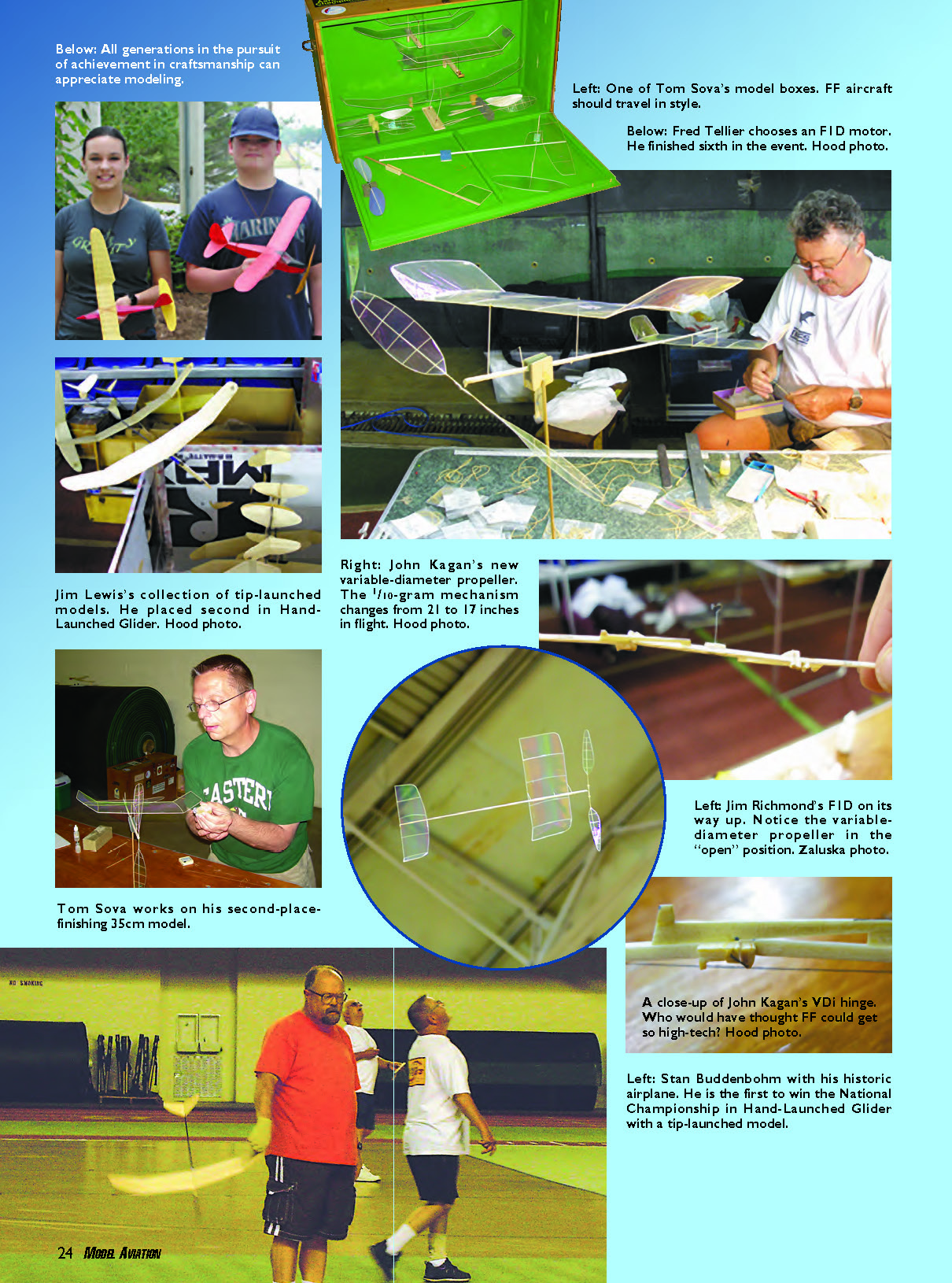
The Glider events kicked things off, with Hand Launched, Standard Catapult, and Unlimited Catapult taking center stage. The big news was Stan Buddenbohm’s historic Hand Launched Glider win with an Indoor tip-launched glider.
This lower-stress—but higher-performance—method of launching has taken the Outdoor world by storm. Indoor success has been harder to come by, though, despite the top experts’ extensive efforts. Tighter airspace and models that are more delicately balanced on the edge of a stall contribute to the increased complexity.
Indoor tip-launched gliders have long held promise, but Stan unlocked it in a convincing way. His two-flight total of 167.2 is a site record, and he came within a whisker of toppling Ron Wittman’s 34-year-old historic 90-second flight.
Glider fliers have mixed emotions about the new tip-launched gliders. They are sad to see the javelin-launch method they’ve spent their lives flying become obsolete, while the reduced trauma of the tip-launch technique opens the door for many new participants.
Either way, tip launch is here to stay. And it’s still going to take experts such as Stan to win a National Championship!
Young Brett Sanborn made waves in the premier FAI duration event: F1D. It seems like just yesterday when he was on the podium with a Silver Medal at the 2004 Junior FF World Championships and with the second-place Senior team in 2006.
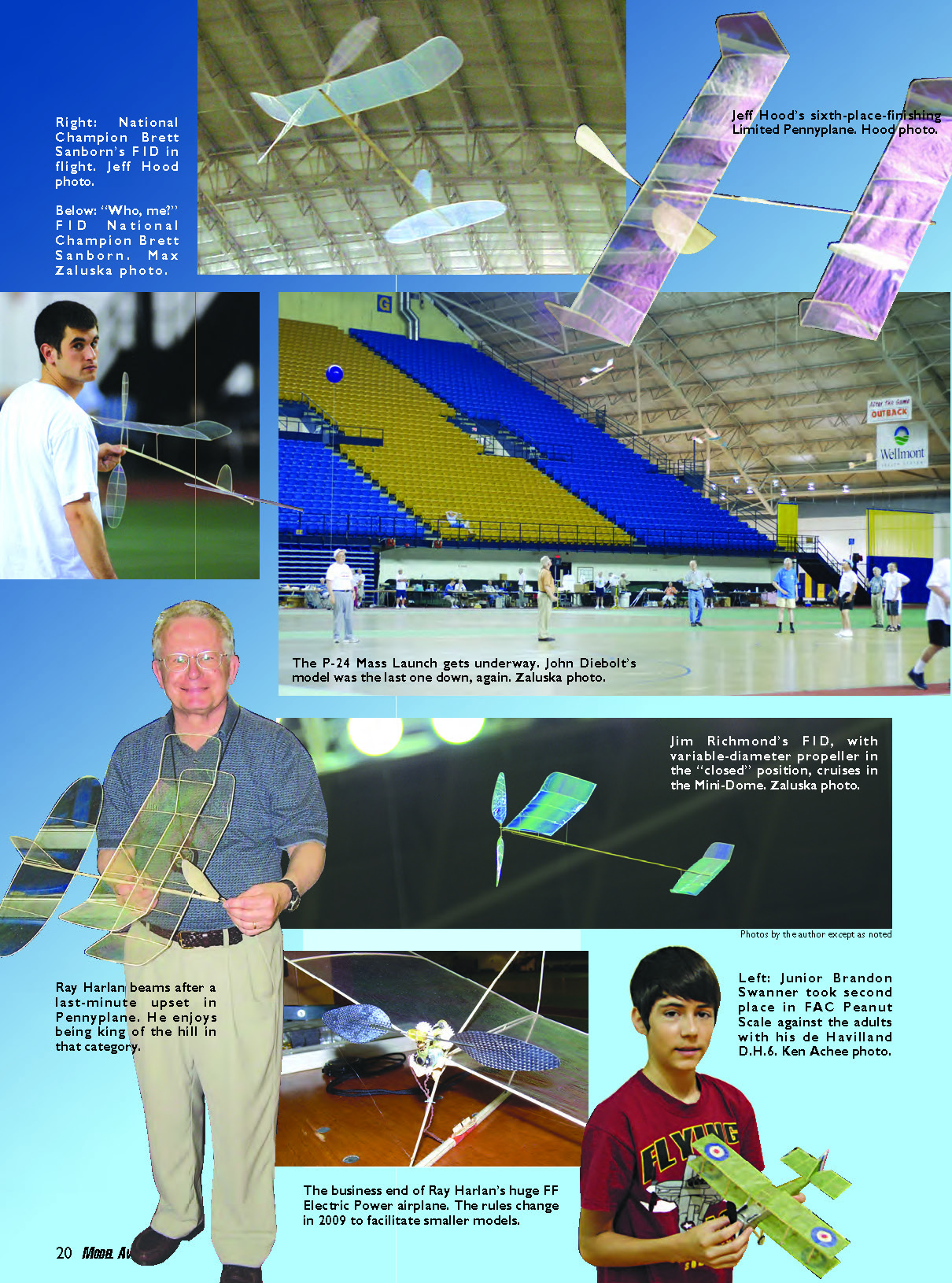
This year he has continued to establish his place in the F1D elite, scoring his first National Championship trophy. Brett posted a dominating string of 34- and 35-minute flights to take the win despite a late surge by second-place finisher, Tom Sova.
In a discipline such as Indoor FF that is traditionally characterized by more mature fliers, it is great to see the young faces who will carry the torch going forward.
Eight-time World Champion and Indoor FF living legend Jim Richmond showed that the “old guys” still have plenty of fight too. He posted the highest F1D time but had to settle for third place; he ran out of time and flights trying for a good backup. (F1D uses a two-flight total.)
However, Jim did take home National Championship awards in the hotly contested EZB and F1L events.
Ray Harlan, another big name and longtime flier, kept Jim from taking home a third champion trophy with a last-minute burner in Pennyplane. Jim had pumped up a blazing 17:16 to lead the field early in the day, and then he packed up to leave. The rest of the field struggled to overtake him and, with time running out, Ray finally did, logging a 17:58.
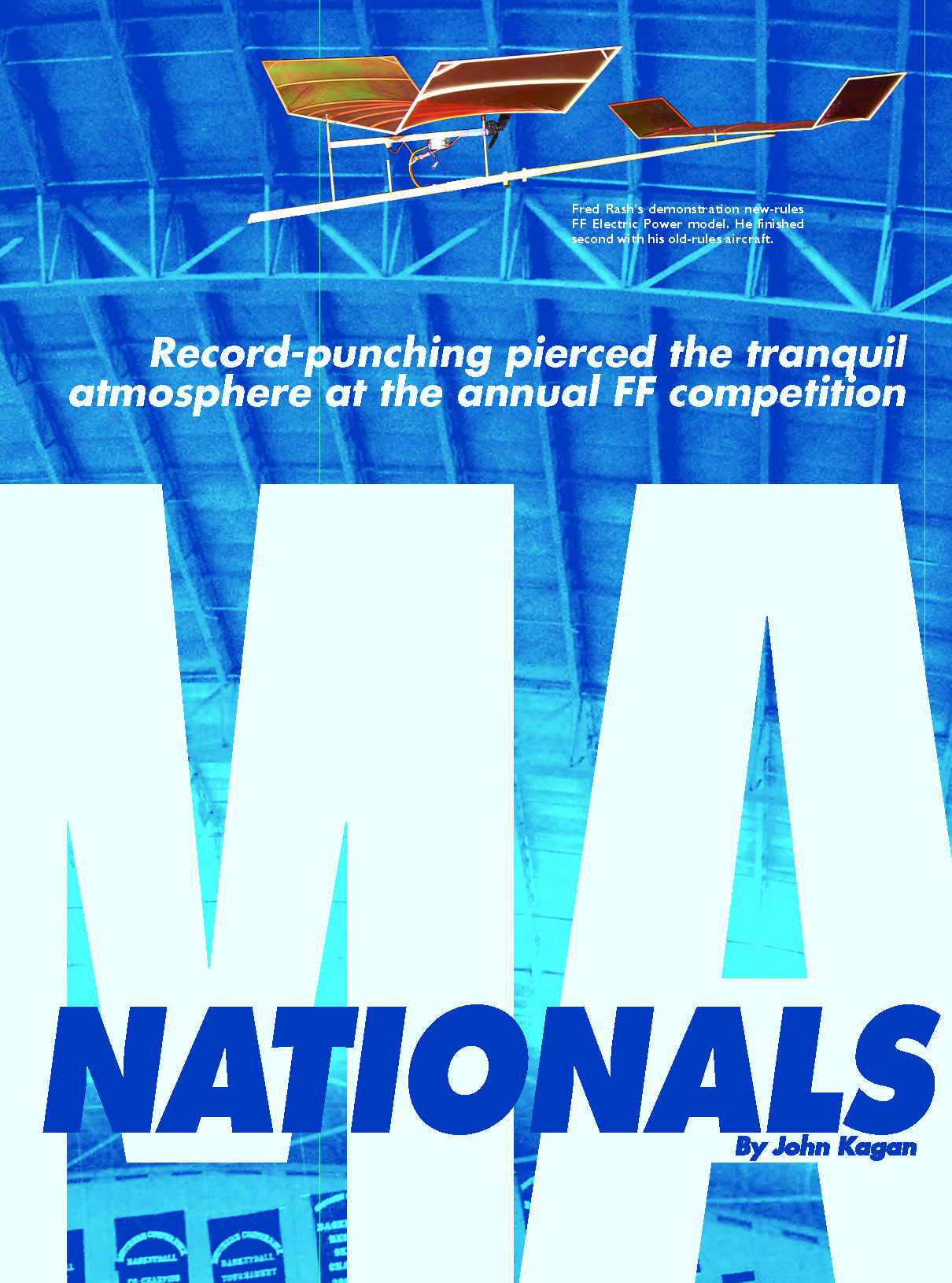
He continued to clean up with wins in Hand Launched Stick, Electric FF, 35cm, Dime Scale, Race-to-the-Roof, and Ornithopter. Now Ray can panel his workshop with National Champion trophies.
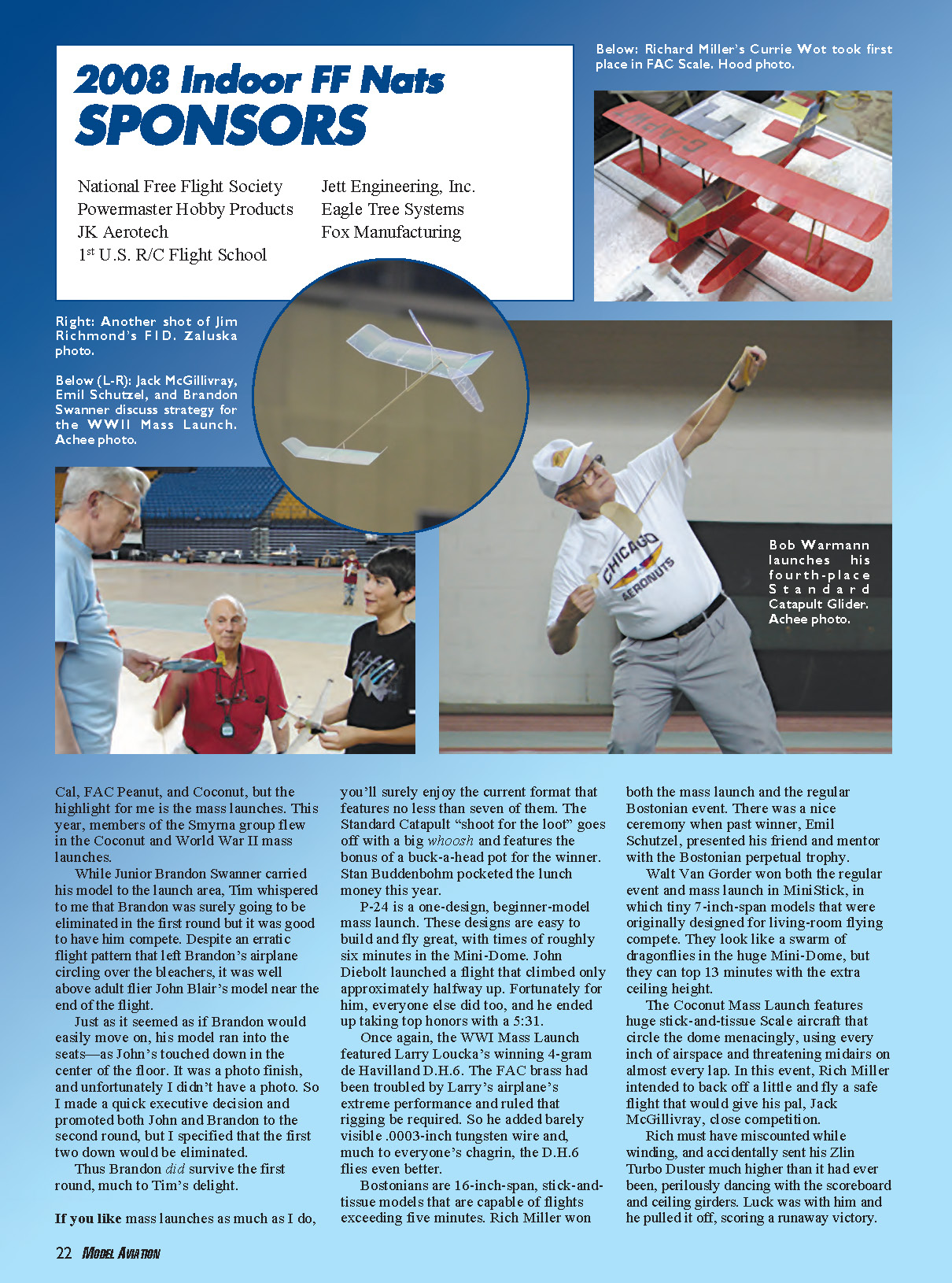
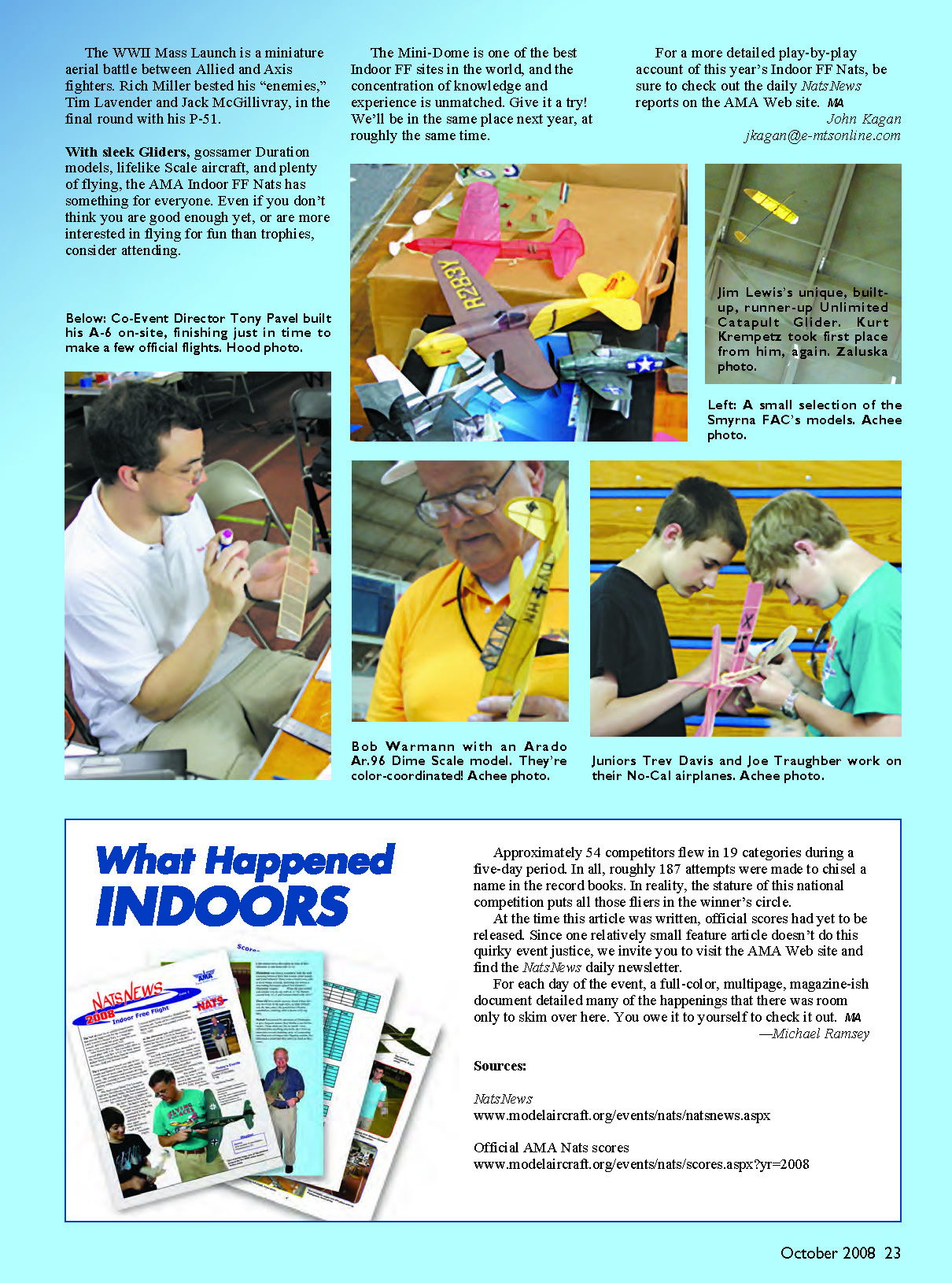
It has become a tradition for Tim Lavender and his protégés—the Smyrna Flying Aces Club (FAC)—to set up camp in their corner of the dome with a large air force of Scale models. They did not disappoint.
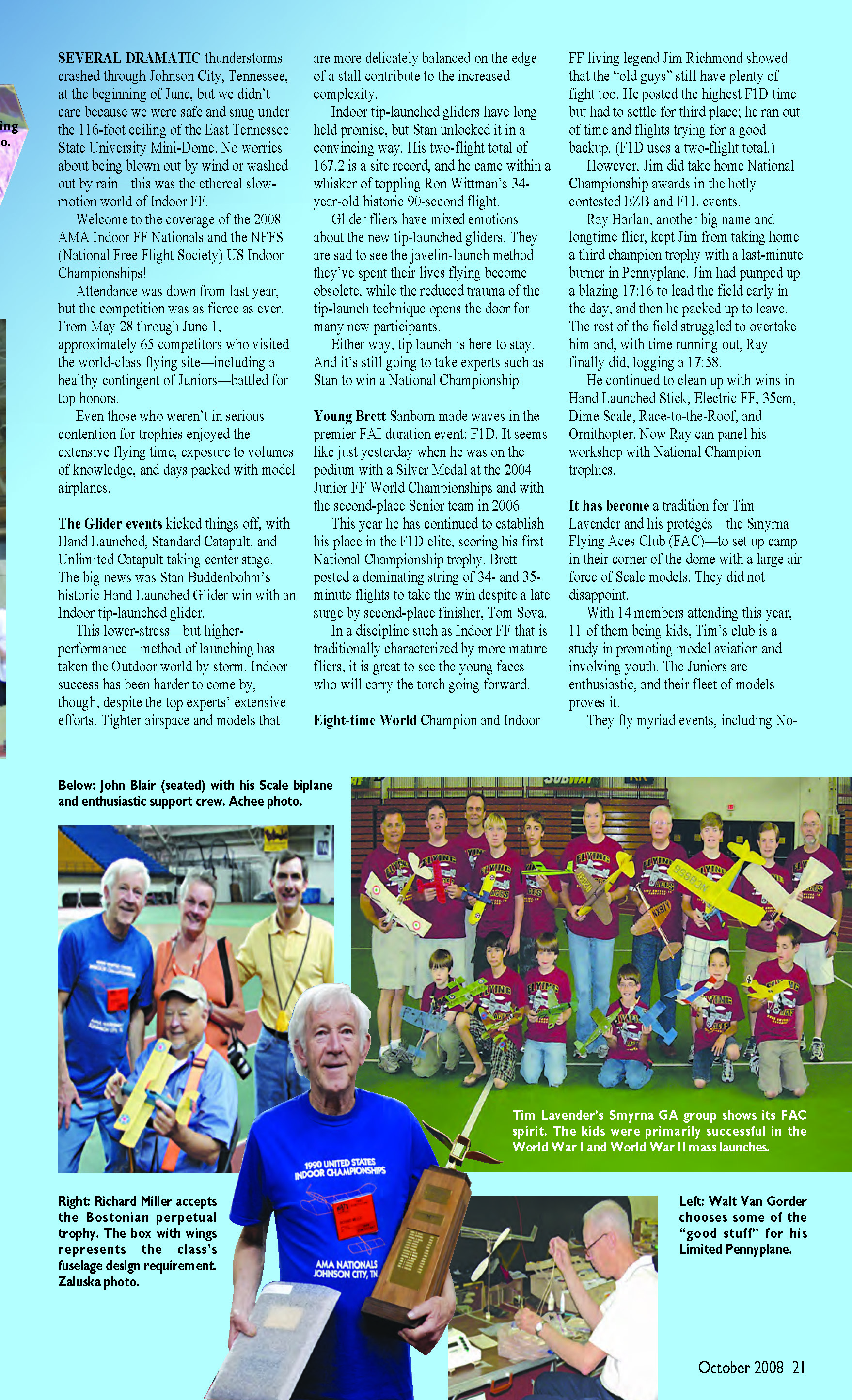
With 14 members attending this year, 11 of them being kids, Tim’s club is a study in promoting model aviation and involving youth. The Juniors are enthusiastic, and their fleet of models proves it. They fly myriad events, including No-Cal, FAC Peanut, and Coconut, but the highlight for me is the mass launches. This year, members of the Smyrna group flew in the Coconut and World War II mass launches.
While Junior Brandon Swanner carried his model to the launch area, Tim whispered to me that Brandon was surely going to be eliminated in the first round but it was good to have him compete. Despite an erratic flight pattern that left Brandon's airplane circling over the bleachers, it was well above adult flier John Blair's model near the end of the flight.
Just as it seemed as if Brandon would easily move on, his model ran into the seats—as John's touched down in the center of the floor. It was a photo finish, and unfortunately I didn't have a photo. So I made a quick executive decision and promoted both John and Brandon to the second round, but I specified that the first two down would be eliminated.
Thus Brandon did survive the first round, much to Tim's delight.
If you like mass launches as much as I do, you'll surely enjoy the current format that features no less than seven of them. The Standard Catapult "shoot for the loot" goes off with a big whoosh and features the bonus of a buck-a-head pot for the winner. Stan Buddenbohm pocketed the lunch money this year.
P-24 is a one-design, beginner-model mass launch. These designs are easy to build and fly great, with times of roughly six minutes in the Mini-Dome. John Diebolt launched a flight that climbed only approximately halfway up. Fortunately for him, everyone else did too, and he ended up taking top honors with a 5:31.
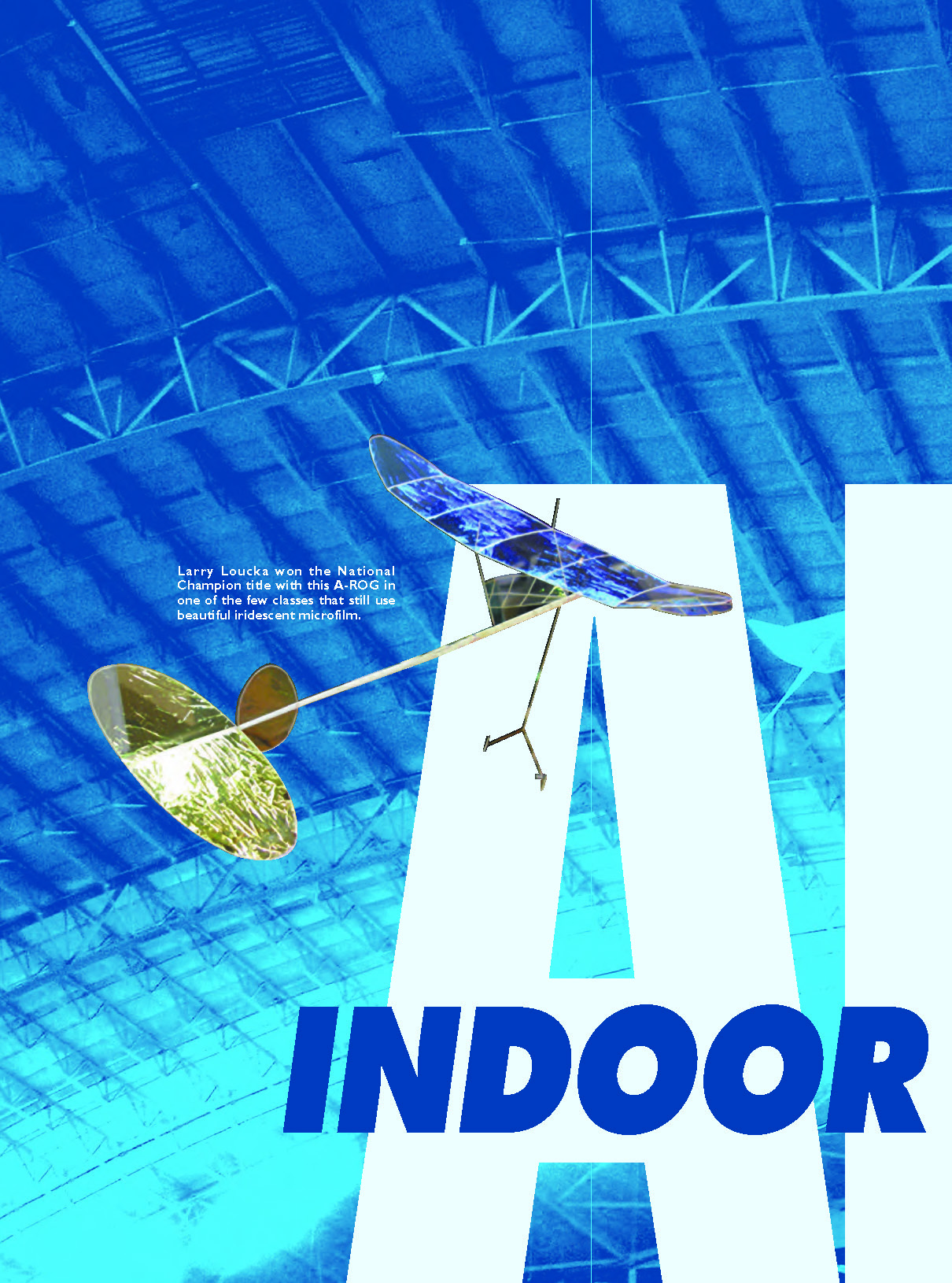
Once again, the WWII Mass Launch featured Larry Loucka's winning 4-gram de Havilland D.H.6. The FAC brass had been troubled by Larry's airplane's extreme tendency to land nose first, and the required rigging was a problem. He removed the visible .0003-inch tungsten wire and much to everyone's chagrin, the D.H.6 flew even better.
Bostonians are 16-inch-span, stick-and-tissue models that are capable of flights exceeding five minutes. Rich Miller won both the mass launch and the regular Bostonian event. There was a nice ceremony when past winner, Emil Schutzel, presented his friend and mentor with the Bostonian perpetual trophy.
Walt Van Gorder won both the regular event and mass launch in MiniStick, in which tiny 7-inch-span models that were originally designed for living-room flying compete. They look like a swarm of dragonflies in the huge Mini-Dome, but they can top 13 minutes with the extra ceiling height.
The Coconut Mass Launch features huge stick-and-tissue Scale aircraft that circle the dome menacingly, using every inch of airspace and threatening midairs on almost every lap. In this event, Rich Miller intended to back off a little and fly a safe flight that would give his pal, Jack McGillivray, close competition.
Rich must have miscounted while winding, and accidentally sent his Zlin Turbo Duster much higher than it had ever been, perilously dancing with the scoreboard and ceiling girders. Luck was with him and he pulled it off, scoring a runaway victory.
The WWII Mass Launch is a miniature aerial battle between Allied and Axis fighters. Rich Miller bested his "enemies," Tim Lavender and Jack McGillivray, in the final round with his P-51.
With sleek Gliders, gossamer Duration models, lifelike Scale aircraft, and plenty of flying, the AMA Indoor FF Nats has something for everyone. Even if you don't think you are good enough yet, or are more interested in flying for fun than trophies, consider attending.
The Mini-Dome is one of the best Indoor FF sites in the world, and the concentration of knowledge and experience is unmatched. Give it a try! We'll be in the same place next year, at roughly the same time.
For a more detailed play-by-play account of this year's Indoor FF Nats, be sure to check out the daily NatsNews reports on the AMA Web site.
John Kagan [email protected]
Transcribed from original scans by AI. Minor OCR errors may remain.

