
AMA Nationals
by MA and NN Staff
No matter what aviation interest you have, you are invited to participate in the AMA Nationals. The best in aeromodeling attend on a regular basis, but the wonderful thing about our Nats is that it welcomes fresh competitors to learn from these experts. Those who attend this event can attribute their growth in the activity, and beyond, to what they experience there.
Daily activity of the nearly six-week event is well documented in the NatsNews (NN) newsletter. We welcomed those reporters to sum up the experiences so we can showcase our 2010 heroes. Their accounts follow.
Indoor FF
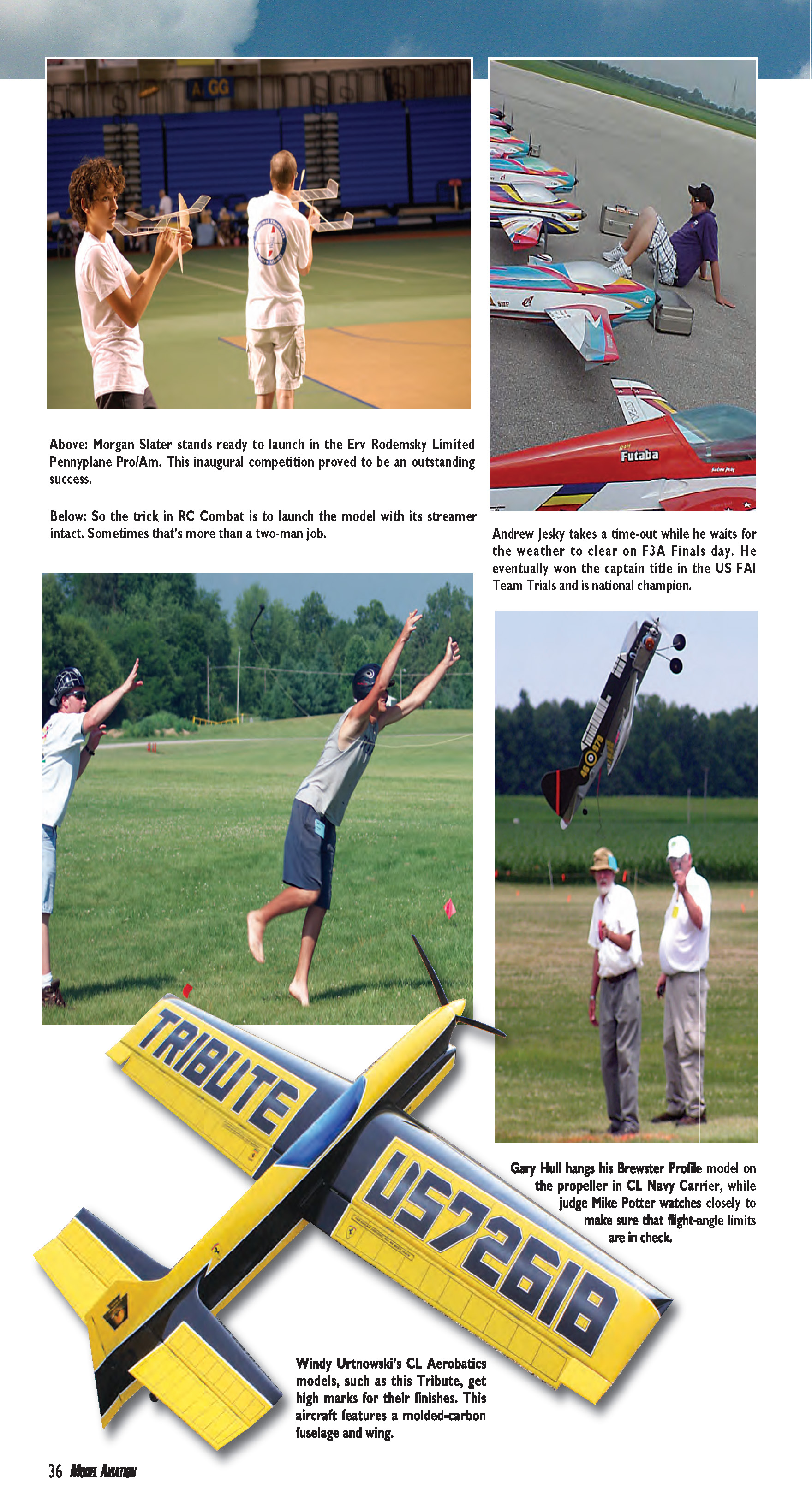
What an exhausting week. Tom Iacobellis used Saturday’s Pro/Am as good practice and reigned in Sunday’s Limited Pennyplane (LPP) class with just less than 16 minutes. Bill Gowen, Brett Sanborn, and Tom Sova had flights exceeding 15 minutes, taking the next three spots.
2010 Nats Management
Ron Morgan: Nationals director/manager Al Williamson: RC manager Wayne Yeager: RC director Brenda Schuette: CL manager Phil Sullivan: FF manager Joe Vislay: Assistant RC director
Event Directors
- Gary Freeman Jr.: RC Pylon Racing
- Craig Bradley: RC Helicopter
- Kent Porter: RC Scale Aerobatics
- Paul Walker: CL Precision Aerobatics
- Dave Mark: CL Speed
- Bob Whitney: CL Racing
- Michael Potter: CL Navy Carrier
- Wayne McDaniel: CL Combat
- Dave Guerin: RC Aerobatics
- Marc Gellart: RC Soaring
- Tom Kallevang: RC Electrics
- Charles Jones: FF Outdoor
- Carl Bakay: FF Indoor
- Rick Fraley: RC Combat
- Dale Arvin and Paul Cain: RC Scale
- Jack Sheeks: CL Scale
Nationals Sponsors
- AeroWorks
- Castle Creations
- Ritch’s Brew
- PSP Manufacturing
- Tru-Turn
General Notes
The amount of stress that a model can bear is amazing. Keep an eye out for that competition near you.
Kurt Koelling won the Bennett Cup: an award for the highest cumulative scores as a percentage of perfection. It was a great week, and I look forward to seeing everyone next year.
Curtis Cozier [email protected]
CL Scale
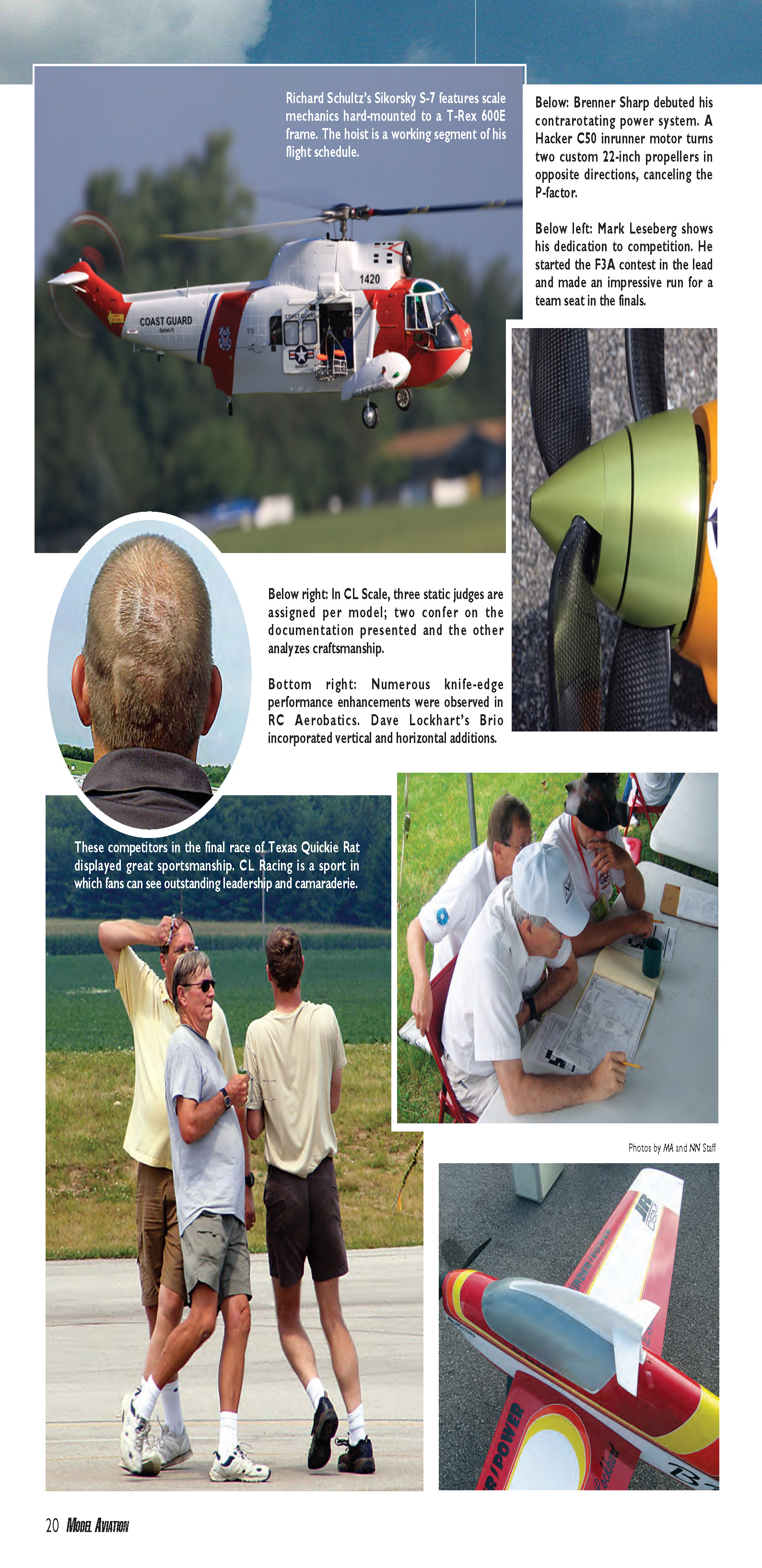
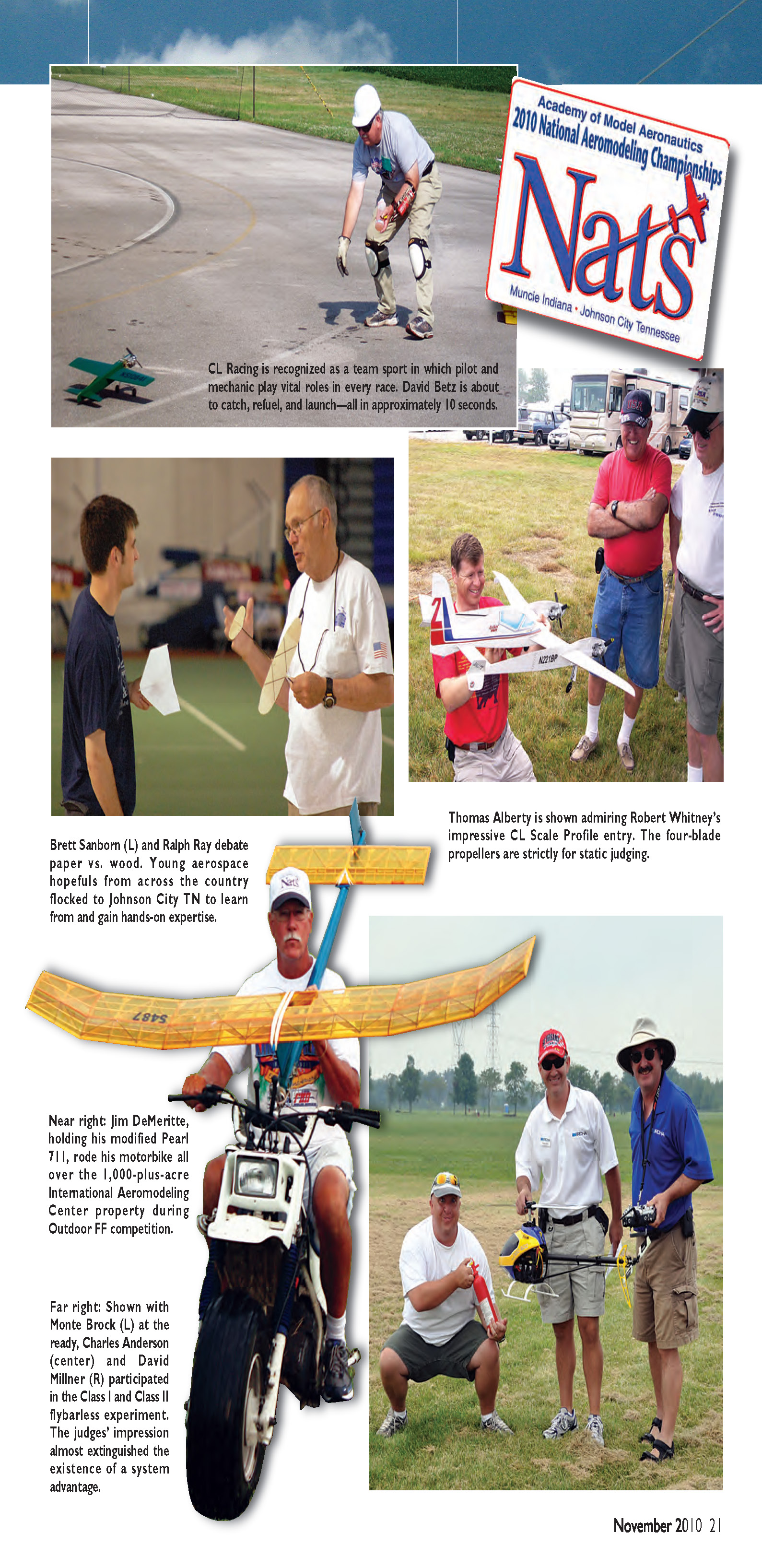
This is a fascinating event at the Nats; it is static judged and flown in conjunction with RC Scale. For the first time in many years, CL Scale was contested in sequence with the other CL classes: Speed, Combat, Aerobatics (Stunt), Racing, and Navy Carrier.
A fun part of CL Scale is the opportunity to build and fly your favorite airplane or surprise your colleagues with a unique subject that is modeled for the first time. Aircraft with two and four power plants and sweet-sounding engines are common. Motors bypass the starting issue, but you can't replace the sensation of "nitro" engine reverberation.
Informal judging and critiques were executed in contestants' hotel lobbies the night before flying began. Contestants gathered around their masterpieces to point out features and chat about practice flights.
The next day pilots gathered underneath a big tent to assemble their aircraft. Contestants held their models for three-view conformance and color and craftsmanship judging.
With AMA Scale discontinued and FAI F4B (CL Scale) going away, the new "museum class" event is Designer Scale. In that category judges inspect up close, cockpits and all, instead of from 15 feet away.
After Day One of flying, Frank Beatty and his recently completed Hawker Fury had a small lead over Charlie Bauer's J-3 Cub. Chris Brownhill and his Hampton had the highest static score and close to the best flight score in Profile Scale. John Wright with his long-in-the-tooth Corsair FG-1 was close behind.
Fun Scale was dominated by the flight score, and Allen Goff took a commanding lead with his PT-17. He was also 9 points up on John Brodak because of his Sport Scale static score. In Junior/Senior Sport Scale Mindy Alberty had a solid lead over Jason and Aaron Bauer, but the tables were reversed in Junior/Senior Profile.
Several competitors learned that an ounce of tip weight is not enough for windy-day slow and high flight. Saturday's leads held.
Mindy slipped into second place in Profile Scale. With the wind picking up, Allen Goff passed on his last Sport Scale flight with his WACO. John Brodak's persistence and wind-penetrating Shoestring allowed him to nail his fourth flight and earn the Grand National Champion award.
The first-place-finishing models were throttle-only, winning on static judging and skilled flying. The few multifunction subjects with retracts, multiple engines, bomb drops, or flaps were back in the pack.
Theodore C. Kraver [email protected]
RC Scale
This year's event was blessed with beautiful weather featuring sunny skies. By the end of Saturday the emerging Scale National Champion had put himself in first place with a high static score and two flights in the 92–95 scoring range.
David Pinegar and his Top Flite Piper Arrow II won Expert Sport Scale with a total score of 192.25. He dispelled the old belief that civil aircraft aren't competitive in Scale competition.
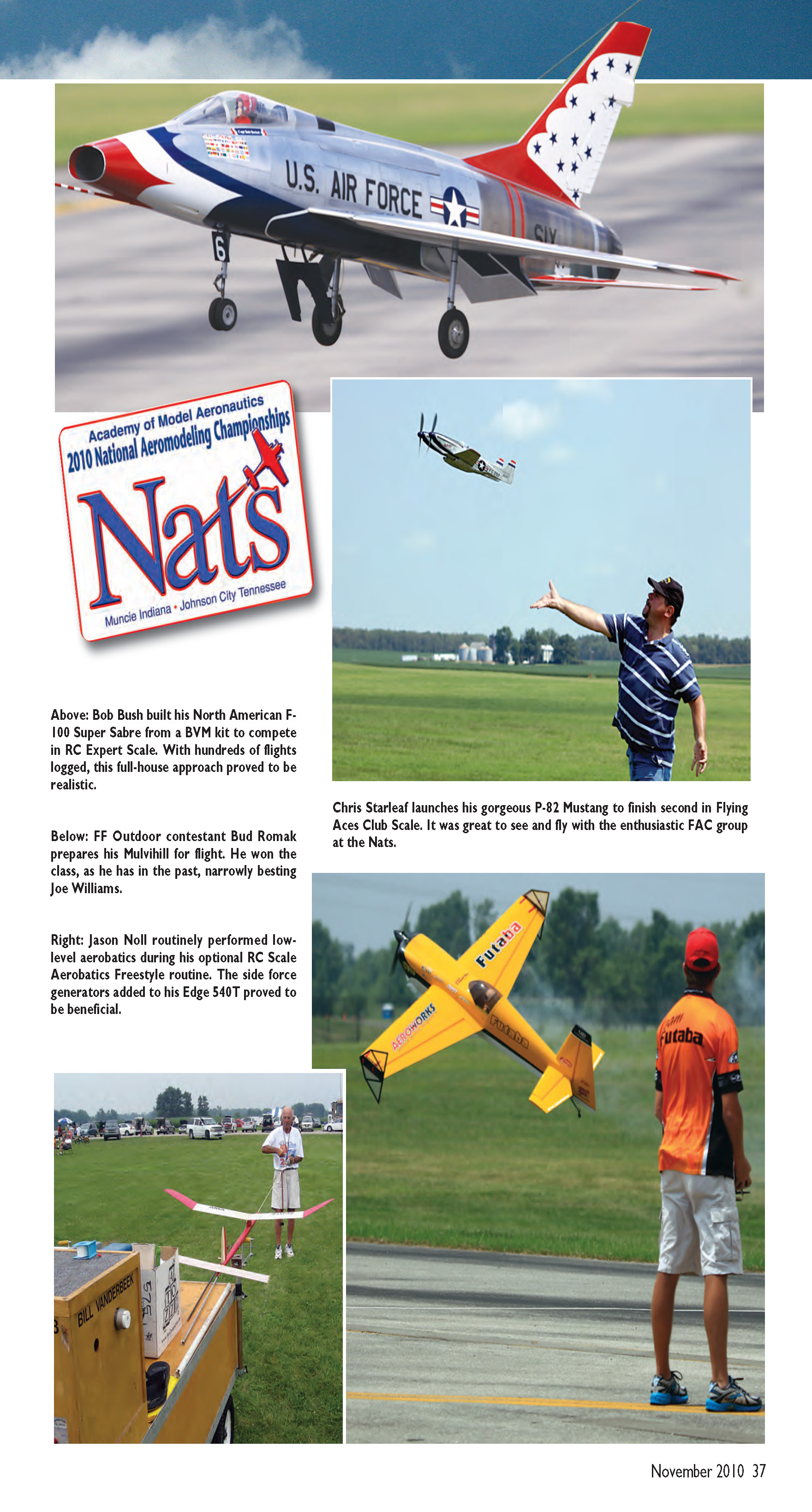
Mike Barbee flew his T-34C from a Mark Frankel kit to second place in Expert with a score of 188.625. Bob Bush finished third with a Bob Violett Models F-100 Super Sabre.
Fun Scale had the largest number of competitors, and the entry total was up from last year's Nats—an encouraging sign. Young Zach Spychalla flew an A-4E Hawk in Aggressor Squadron colors to first place. At the beginning of the event he had put 30 flights on the Tamjets kit. Peter Goldsmith piloted a BAe Hawk jet trainer to a close second place, by only 0.75 point.
John Boyko won Sportsman with his Pitts Special, and runner-up was newcomer Michael Wartman flying his Balsa USA Fokker E.IV. Steve Eagle finished third with another Balsa USA model—the 1/3-scale Nieuport 17—on its first outing.
Chuck Snyder, who has been a competitor in CL Scale, made the switch to RC this year. He flew a Jerry Bates plans Ki-61.
All in all it was a great Nationals, with good competition, fun, friends, and food. What better place is there to be than at the International Aeromodeling Center in July?
Stan Alexander [email protected]
CL Aerobatics
The skies remained calm and bright for the final flights of this event, which culminated on Saturday, July 17. This day is relegated to Junior, Senior, and Open flyoffs, and the Walker Cup competition that follows.
The Walker Cup is a non-appearance-point flying event between the best Junior, the highest-scoring Senior, and the most qualified Open contestant. Mike Paris won the Junior class. Samuel Niebel won Senior after tussling with Pat Gibson for the victory, and multitime champion Bill Werwage captured the Open class.
The best five Open fliers took to Circle 4 on the "L" pad, and Bill Werwage (1,067.50) earned the top spot to go on to the Walker Cup. His first Walker Cup win was in 1959, and he has accomplished a win for each decade following that first title.
The Advanced class finished with its champion determined on Friday afternoon; it was Eric Viglione (998.5) of Florida. Paul Winter (983.5) of London, England, finished second, and third place went to Eric Taylor (969.5) of the New Albany, Indiana, area.
Adrian Dominguez (965.5) of Winston-Salem, North Carolina, captured fourth place, and Enrique Diez (965.0) of Miami, Florida, rounded out the top five.
Jim Aron took home a plaque, which Windy Urtnowski donated, in appreciation of his 20-appearance-point model. The 65 Advanced and Open pilots also chose Jim's airplane as the Concours winner.
Bud Wieder was named Rookie of the Year. Bill Werwage was presented his AMA Model Aviation Hall of Fame plaque at the Saturday-night banquet.
Allen Brickhaus [email protected]
CL Racing
Rat Racing has been given the nickname "Hamster," because the required engine size has been reduced from .40 cu. in. to .15 cu. in. Airspeeds were approximately 160 mph with the .40-size power plant, and very few pilots could handle it.
Although the speeds have become more manageable, most teams still do not have their equipment sorted out. A Goodyear model currently holds the Rat Racing record. This year eight teams entered a wide variety of airplanes in the class.
Bill Lee used a Texas Quickie Rat with a Nelson .15, several teams used Goodyear aircraft, and there were three purpose-built Rats. For the third year Bob Whitney entered an F2C Team Race model with an extended tank.
The preliminary races were well run and times were close. The team of Les Akre/Jason Allen was first with 2:58.34, followed by Tim Stone/Bob Oge at 2:58.88, and "King Rat" Bob Whitney/Jason Allen with a 3:06.
When two 140-lap finals were contested, the Muncie heat and humidity began to take its toll on the glow engines. Bob Whitney's diesel-powered F2C model won easily with a 6:05, followed by Les Akre with 6:31 and Bill Lee/Tim Stone at 7:31.
The B Team Race was canceled because of lack of entries. Tim Stone won the high-point trophy for this Nats; Bob Oge had been his sole pitman. The NCLRA (National Control Line Racing Association) Sportsmanship Award was given to Zella Betz for her tireless help in timing and keeping things moving.
Thanks to all 2010 participants; there was a level of involvement unlike at previous Nats. Despite poor pre-entry numbers, it turned out to be a good contest.
Tim Stone [email protected]
CL Combat
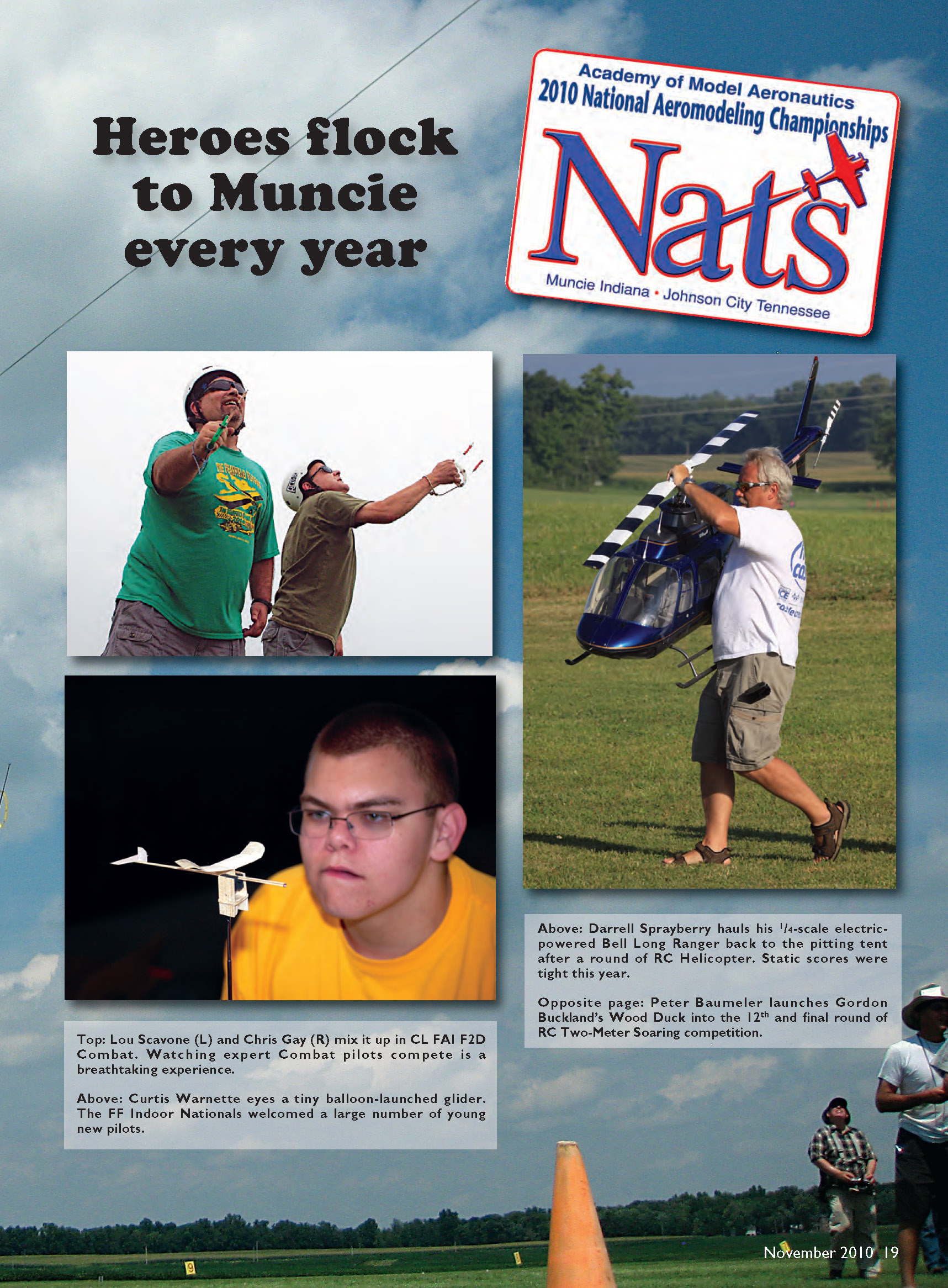
On the last day of the Nats we flew Fast Combat.
It was strange when I drove onto the site; approximately 100 Boy Scouts were sitting outside the museum. I continued driving down the road and looked over at the Combat site to see all of the tables and chairs and the blue scoring stand gone. I was wondering if they canceled something and didn't tell me.
Then I saw the scoring stand broken in half, 100 yards from where I saw it the night before. I looked around and saw all of the portable toilets resting on their sides. I wondered what the Boy Scouts did. I knew they were having a campout last night.
Then a Nats official pulled up and told me that high winds the previous night tore up several things. That ruined a good theory. The Boy Scouts had to spend the night in the new Claude McCullough education building.
I thank all of my judges: Brad La Pointe, Lou Scavone, Larry Scarinzi, Patrick Gibson, Mike Gibson, Phil Cartier, and Chris Gay. The best match was between Jeff Rein and Phil Cartier; it was a good minute-and-a-half of mayhem.
Models used were store-bought, mostly from GRS and Foamies. Engines were Foras and Nelsons. This might be the last year of the big-dog engines in Fast Combat. There is a rules-change proposal to fly F2D power plants in .328 only. I hope it does not pass.
Attendance at this Combat Nats was low, but everybody seemed to enjoy himself or herself. I don't think anyone got overly upset about anything. Make plans to attend next year!
Wayne McDaniel [email protected]
CL Navy Carrier
Contestants look forward to unofficial events at the end of the week. This year expectations were high, with new models for some and a few contestants trying different events. We had a great time, despite the fact that strong, gusty winds added challenges that tempered some of the pure enjoyment and added a risk factor to flying.
With wind making flying difficult, some contestants chose not to fly. Others found complete flights elusive as models touched the ground during low speed or missed the deck on landing; a few models were damaged by unplanned "water" landings.
Art Johnson was an exception to the trend. He entered four events and made complete flights in each. All but one of his landings were successful on the first attempts; one required a second approach when turbulence caused him to miss the first landing.
Art's consistent performance earned him first-place honors in Electric Profile and Electric Class I. He also won trophies in Skyray Carrier and in the Sportsman class of .15 Carrier.
The electric-power events were supposed to feature new models at the Nats, but time and other constraints resulted in only one: Everett Shoemaker's Fulmar. He has been developing the Fulmar for AMA classes, and this was a conversion of the basic design to electric power. It flew well and looked great in the air. Technical problems kept it from an official flight.
Nostalgia events featured new models including Dick Perry's A4P design from the early 1970s, Burt Brokaw's new Guardian and T-28 Trojan, and a Marvin Martinez C6N1 Myrt that Everett Shoemaker built. Ted Kraver entered a Marvin Martinez Curtiss F6C Hawk biplane and his Domizi Guardian.
There were a couple of nontraditional models in Profile too, making it the best-attended Nats Nostalgia event so far. Everett Shoemaker took home the Roland Baltes Award for C6N1 flights that earned him a win in Class II.
Jo Shoemaker flew a new Fieseler Fi-167, a dragonfly-like biplane, in .15 Carrier. Burt Brokaw won .15 Expert class, with Gary Hull and Melvin Schuette very close behind. The little models and their pilots handled the wind well.
Full results of unofficial Carrier events will be featured in the Navy Carrier Society's High-Low-Landing newsletter.
Richard Perry [email protected]
RC Pylon Racing
The 53 Quarter 40 (Q-40) contestants were pared down to the 32 fastest, best-prepared, and luckiest for Saturday's final six-round race.
Many pilots cut inside the pylons while trying to out-turn the competition, and others lost models to midair collisions. This level of competition brings many airplanes onto the same track, creating wake turbulence that caused a few more losses.
Those who lost aircraft earlier in the week were forced to fly the last round with only one model, because a pilot is allowed to enter only two models in the contest. Owing to attrition, roughly half of the heats flown in the final were missing at least one contestant.
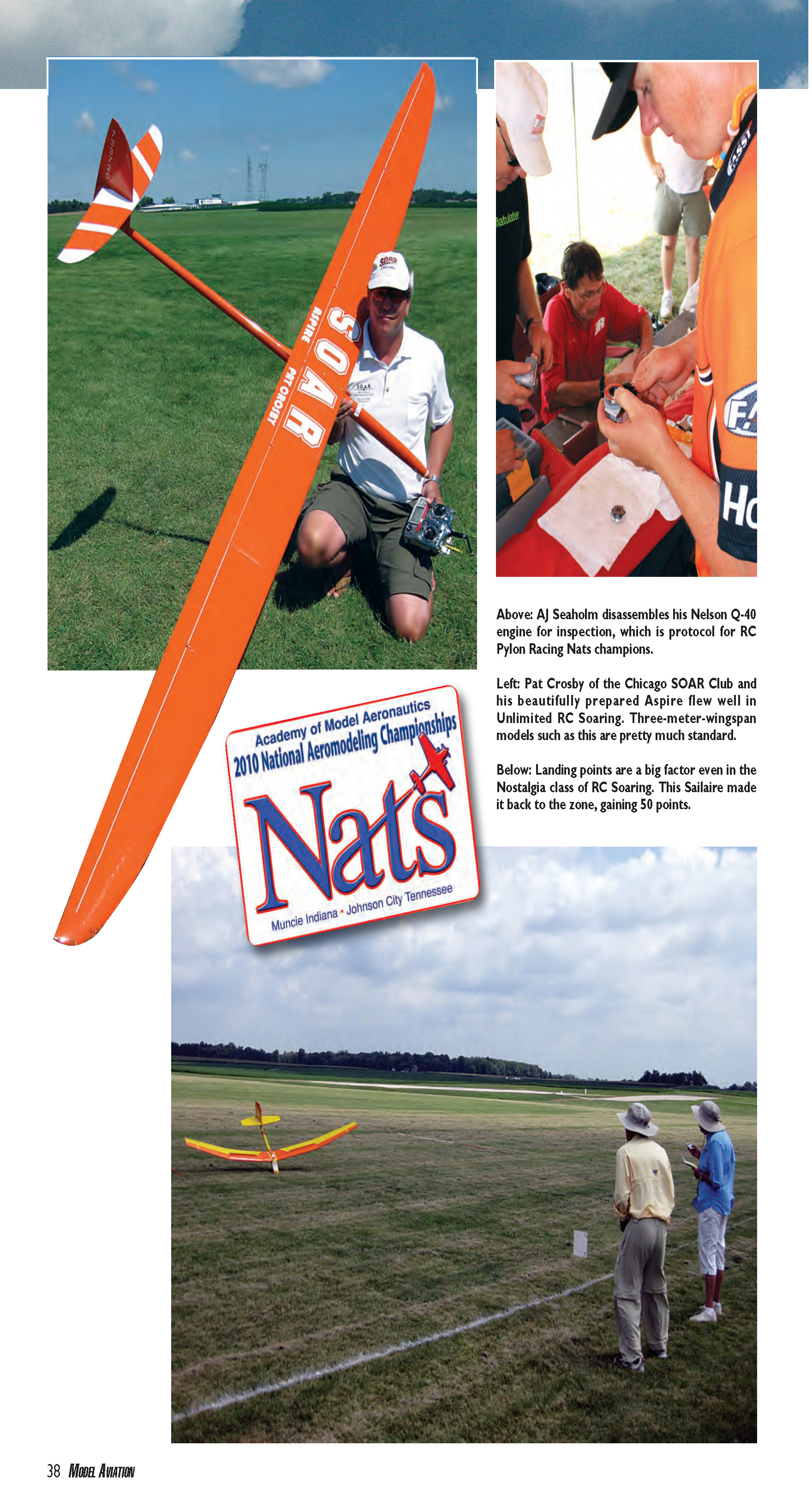
AJ Seaholm, last year's Q-40 victor and overall Nats champion, flew five rounds with a perfect score, finishing several points ahead of his nearest challengers. AJ's caller, Scott Causey, wrote a column for MA that emphasized the importance of teamwork in racing; it paid off for AJ.
Ralph Renaldo, this year's Quickie 500 (Q-500) winner, was only a few points back, but his airplane failed to become airborne in the last heat. Super-smooth-flying Steve Vaclav was awarded second place. His dad, John, called for him—another example of well-executed teamwork.
A soft-spoken John McDermott placed third. He had to switch to his number-two engine the night before the final round. Although most of the contestants are good people, you will have a hard time finding a nicer person than John. His caller, Terry Frazer, helped him race his way to the top of the field by performing consistently, even if they didn't win every heat.
Rounding out the top spots was Gino Del Ponte, with the fast-time award of 1:03 and some change. Gino's dad, Mike, called for him; they are hard to beat as a team.
This put both father/son teams in the winner's circle, proving the value of focus and cooperation. Mike and Gino even practiced Wednesday night after everyone else had called it quits, in an effort to perfect their flying and timing.
Ralph Renaldo was awarded the overall Nats Pylon Racing trophy. In addition to winning Q-500, he managed a fourth place in Q-40 despite a last-round zero score. Ralph and his caller, Lloyd Burnham, worked steadily throughout the contest to win this well-deserved title.
Dedication, practice, skill, teamwork, and a little bit of self-made luck allowed each top competitor to obtain a well-deserved award. CD Gary Freeman Jr. and his helpers made this a great event.
Alexandria and Matt Russell [email protected]
RC Aerobatics
The Nats was not the kindest to the Masters pilots. When the finals began, four of the eight contestants were flying models other than those they started with on Day One. Three had airplanes that other pilots loaned them for the finals, and the fourth borrowed parts from a competitor's aircraft to make his complete.
When I mentioned to Ed Alt how gracious it was of him to loan his airplane to another pilot, he sort of dismissed this amazing gesture—as if anyone would lend someone an airplane costing thousands of dollars. However, Ed's attitude is common among the amazing and wonderful people we see at the Nats each year.
Paul Mathis attended his first Nats this year, not as a competitor but as an observer. He had an exciting week. The size of this contest is awesome. Many aeromodellers dream of attending the Nats, but Paul said that to experience it is better than he thought it would be. He said:
"This is the number-one place for modelers to be. The museum, well that is an extra gift, like whipped cream on top of a dish of strawberries. The library blew me away.
"I now have a better appreciation for all AMA does for us. The people here were the best part of it all. I'll be back."
Were you here for the day or were you here for the week, as most of us were? Did you finish first or last in your class? Did you run a line, tabulate a score, do a sound check, or simply run the whole show? If you did any of that, give yourself a trophy; you are a winner.
Start making plans to attend the FAI F3A (RC Aerobatics) World Championships in 2011, which will be held at the AMA's International Aeromodeling Center. Immediately following the closing ceremonies we will begin the AMA Nats competition.
For the past seven years we've had the pleasure of attending the Nats and enjoying Dave Guerin's steady hand in resolving every issue and dissolving every challenge that has come his way. Since Dave will be heading the World Champs next year, he is handing the responsibility of the Nats to the extremely capable Rusty Fried.
Jim Quinn [email protected]
RC Soaring
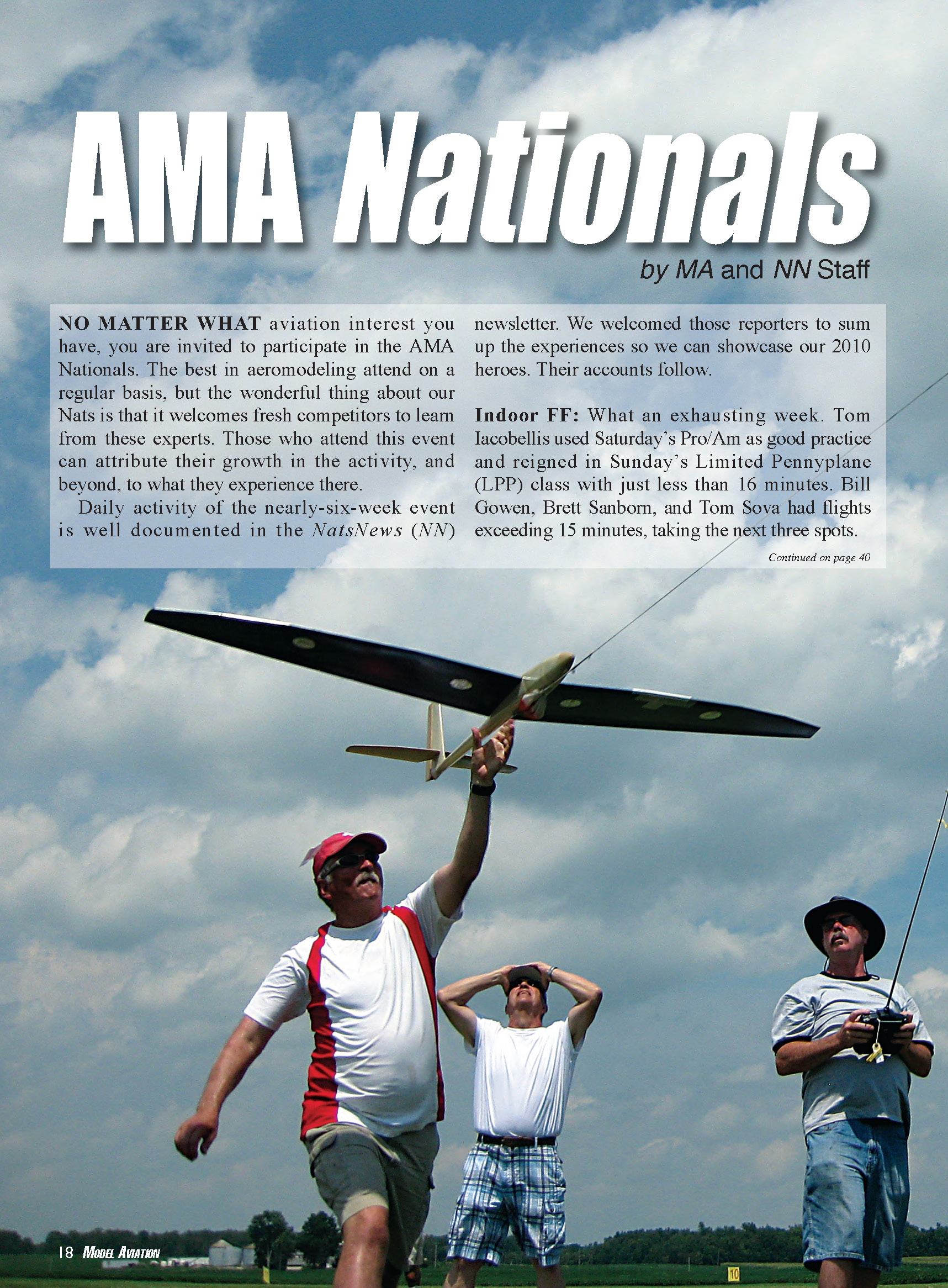
This continues to be one of the most popular disciplines in aeromodeling, as 118 pilots arrived at the site to do battle in late July. This number of individual Nats contestants is second only to CL (144) and FF (160), and it shows that the lure of chasing thermals continues to attract many participants to Muncie for the largest RC Soaring contest in the world.
This was some competitors' first Nats, even though they had been flying for years. One such "newbie" was Mark Groves of Columbus, Ohio, who flew a Paragon in NOS (Nostalgia) on a day when the wind was gusting at more than 20 mph.
"To have survived my first day of competition at the Nats I felt like a winner," he said. "Sharon and I met some really nice people and we'll certainly come back to compete at this level again."
Rather fickle winds caused the volunteer flightline crew to switch direction of the winches a couple of times, only to find that contestants were launching downwind anyway as the wind switched back during the day. Combined with fairly short winch lines of 500–600 feet to the turnarounds, occasional downwind starts had pilots "scratching" at lower-than-normal altitudes early in their flights.
"We used 185-pound-test line for RES [Rudder/Elevator/Spoiler Function] and 2M [Two-Meter], and 275-pound line for Unlimited," said Flightline Director Jim Thomas. "We used two spools on each winch, then adjusted the turnarounds to the flat distance available."
Despite the winds on the ground, soaring conditions were some of the best; gloriously warm weather produced solid lift every day. With the MOM (man on man) flight-group format, each contestant flew in the same air as the others in his group.
The flightline staff did a fabulous job of getting the set of eight or nine aircraft in the air quickly and with little fuss. In fact the League of Silent Flight (LSF) Nats would have to be the smoothest-organized Soaring contest in the country, with an able group of dedicated volunteers ensuring that all who attend have a great experience and get to fly their sailplanes in fair and fun competition.
For many pilots the yearly sojourn to Muncie is more about the friendships and camaraderie than the contest itself. There are old friends to catch up with and new friends with whom to forge future relationships.
No doubt the LSF Soaring Nats is the best opportunity available for glider pilots to share their unique passion with many other Soaring aficionados and have a lot of fun. If you haven't experienced "Glider Camp," start planning to be there next July. I think you'll have a terrific time.
Gordon Buckland [email protected]
Outdoor FF
Dan Berry had tried before, with no luck. But on Friday morning he had his model—a beaten and battered Gollywock—humming.
Tens of thousands of aeromodellers have built the venerable old rubber design since it was originally kitted in the late 1930s. It's the DC-3 of FF—a reliable, predictable performer. And Dan Berry knows it.
He wound his model up for flight after flight, knowing that each perfect "max" attempt would get him closer to his goal: winning. Numerous challengers gave chase, but at the day's end Dan had done it. He posted six perfect maxes to become the National Champion, besting 17 fellow fliers.
The National Model Airplane Championships began in 1926 with only one type of aircraft: FF. Those models offered autonomous stability and flight-control.
In 2011—84 years later—the tradition continued, at Muncie's International Aeromodeling Center. A total of 216 competitors registered for this year's FF Nats, held August 2–6, making it one of the largest of the last 10 years. Charlie Jones was a first-time event director, and he did an outstanding job.
FF Nats weeks in recent years have featured volatile weather. This summer it was relatively predictable throughout the week, with generally light winds and no major weather-related impacts on flying. A squall line moved through on Wednesday near lunchtime, but it quickly blew past and interrupted the action for only approximately 15 minutes.
Long after flying had ended, at roughly 3 a.m. Thursday, a draconian wind gust awakened campers and even flattened some tents. A local flier noted that it "…was one of the top five nastiest storms ever seen."
Major storylines of this FF Nats involved 20-somethings; three young men won three of the premier events. Tim Barron was victorious in F1A, Kyle Jones took F1H, and Evan Simon took first place in F1B. All are former US Junior FF team members, so they're no strangers to top-level competition.
A large menu of Flying Aces Club (FAC) events was added to the Nats this year. It was a great success and will surely grow in popularity. Premier FAC fliers such as Chris Starleaf and Ted Allebone competed.
The 2010 FF Grand National Champions are: AMA Rubber, David Sechrist; AMA Gas, Ronnie Thompson; AMA Classic Gas, Brad Bane; AMA Glider, Tim Batiuk; Nostalgia Gas, Bob Sowder; Nostalgia Rubber, Joe Williams; and Senior, Ricardo Samario.
Don DeLoach [email protected]
RC Helicopters
A few things made 2010 a banner year for the RC Helicopter Nats. The season leading up to the four-day multiclass contest consisted of a rash of "primer" events held across the country, as an International Radio Controlled Helicopter Association (IRCHA) initiative to prepare and welcome new pilots into the helicopter competition pool.
By Nats time, those efforts increased participation in Class I to a level matching that of the FAI class, filled with mostly untested world-class talent. Close to 40 pilots registered to fly in aerobatics. Classes II and III consisted of more than enough contestants to take home all of the wood that was engraved.
However, the trick, as usual, was to get enough judges in the seats. Perhaps it was expected that some of those who planned to participate in the following week's IRCHA Jamboree would show up to help, but that didn't seem to happen. Competitors are tough by nature, and they endured the pauses between rounds as well as they did the brutal heat. At least they had the IRCHA Jamboree to pal up and visit.
Being a Team Selection year, the FAI class, F3C, welcomed back the 2009 team members and several pilots who were looking to unseat them. That international team taught us that electric power is the only way to go, and this season reflected the demanded rules update: higher maximum weight [smile], allowing more batteries. A higher-voltage system can be geared to run at a lower draw and therefore reduce stress on the power system.
The new F3C schedules demanded fun stuff from the pilots: a touch of 3-D talent. Perhaps that is why Nick Maxwell took a seat on the team. He won the second chair, between Curtis Youngblood, the captain, and Wayne Mann.
Although many beautiful machines were on display at the Scale venue (set up at the IRCHA Jamboree site), only nine went before Nats judges. The crowds of spectators were thick, which was a good thing about using the Jamboree site.
A wide range of static scores was awarded, but in-air points were given out like birthday presents. Scale pilots flew magnificently, with complex machines. Only a few years ago, these models had mechanics that were frightening because of flybarless stability issues. Today we have outstanding electronic stabilization systems, and they greatly helped the Scale pilots.
On the topic of flybarless, the controversy is that those systems make helicopters so stable that their use has been prohibited in competition. A few pilots played in classes I and II to find out whether or not a flybarless machine could be judged as a leader against the others. Witnesses noted that the flybarless systems bobbled as the others did in a hover but did appear to groove better in flying maneuvers. It showed that a prepared pilot is more likely to impress, which is a concept as old as aeromodeling sportsmanship.
Michael Ramsey [email protected]
Sources
NatsNews www.modelaircraft.org/events/nats/natsnews.aspx
Official Nats scores: www.modelaircraft.org/events/nats/scores.aspx
National Free Flight Society http://freeflight.org
International Miniature Aerobatic Club www.mini-iac.com
National Association of Scale Aeromodelers www.nasascale.org
Precision Model Aircraft Pilots Association www.control-line.org
National Control Line Racing Association www.nclra.org
Miniature Aircraft Combat Association www.maca.hobby-site.com:3535
Navy Carrier Society clflyer.tripod.com/ncs/ncs.htm
National Miniature Pylon Racing Association www.nmpra.org
National Society of Radio Controlled Aerobatics http://nsrca.us
League of Silent Flight www.silentflight.org
International Radio Controlled Helicopter Association www.ircha.org
North American Speed Society www.clspeed.com
RC Combat Association www.rccombat.com
Society of Antique Modelers www.antiquemodeler.org
Transcribed from original scans by AI. Minor OCR errors may remain.

