
A TALE OF TWO CITIES?
Here in the greater Phoenix metropolitan area, otherwise known as The Valley, flying sites are at a premium largely because of the risk-management people in the many neighboring municipalities. Until they sit down with people who are knowledgeable about our sport, they harbor misconceptions ranging from uncontrolled projectiles screaming wildly above their heads to large “model” airplanes being towed behind automobiles. Their reluctance is understandable.
Background
Approximately 18 months ago I was approached by a parks and recreation superintendent for a local city. He was aware of some helicopter flying being conducted on a piece of city property and wondered if it was an appropriate activity at that location.
We met at the site—a large retention basin surrounded on three sides by high-density residential developments—and determined that small electric aircraft would be the best option. The city representative is a modeler and a solid proponent of the concept.
That was 18 months ago, and although there has been no official designation of that site as an RC venue within the city, one can find 20 or more electric modelers flying there every Saturday and Sunday morning. They had tacit approval for the time being.
The Mesa Meeting
Fast-forward to February of this year. A man named Bob White, Parks and Recreation Superintendent for the City of Mesa, Arizona, called to set up a meeting to discuss RC aviation in general. He said the local Risk Manager was not enthusiastic about model aviation, but he wanted to get a realistic perspective.
A local helicopter modeler had contacted Bob relative to a potential flying site in a retention basin. For various reasons, we had to reschedule our meeting until finally the Cactus League baseball season started. That took all of Bob’s attention, and we had to postpone our discussion until April.
During my attempts to set up a meeting with Bob, AMA member Jeremy Turner, who lives in Mesa, contacted me. Jeremy was the prime mover in the effort to obtain use of the retention basin and was anxious to hear the results of our meeting. While he was disappointed in our lack of progress, he was not deterred.
Bob White’s initial call to me was the result of Jeremy’s efforts to attain use of the retention basin. Jeremy’s club, the Superstition Radio Controlled Helicopter Association (SRCHA), was given informal use of the basin until one morning the fliers found a “No flying of any model airplanes without a permit” sign posted at the field.
Jeremy is a calm and reasonable AMA member — just like the rest of us — but tenacity is his middle name. He asked for a face-to-face meeting with the Mesa Parks and Recreation people, but again, scheduling conflicts thwarted those efforts. Jeremy asked for a copy of the permit for park use, and somehow that request got bogged down.
He asked for support from his local city councilwoman, Janie Thom, and for advice from an attorney through his employer’s Employee Assistance Program. Smart!
He called the city again and asked for a copy of the park use permit so that an attorney could review it.
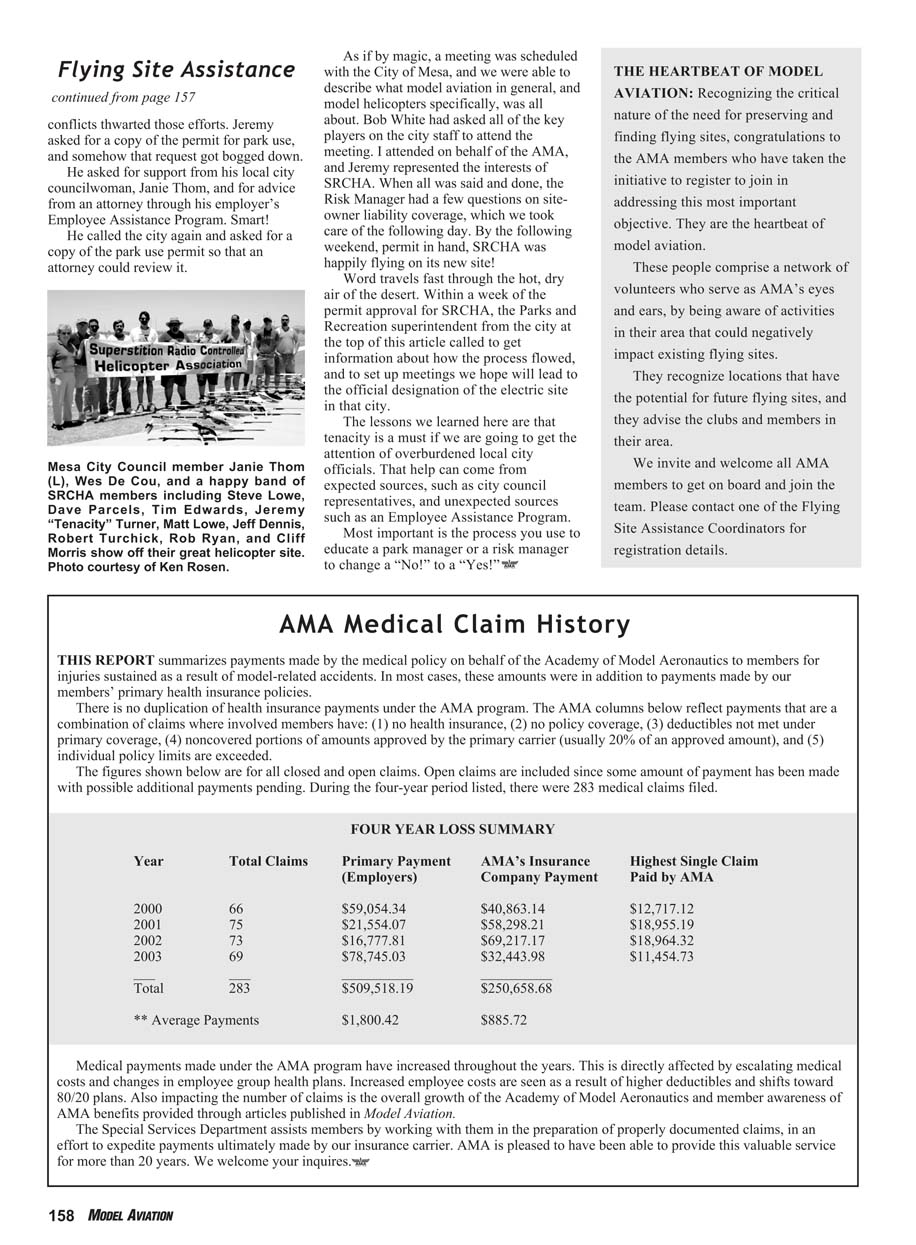
As if by magic, a meeting was scheduled with the City of Mesa, and we were able to describe what model aviation in general, and model helicopters specifically, was all about. Bob White had asked all of the key players on the city staff to attend the meeting. I attended on behalf of the AMA, and Jeremy represented the interests of SRCHA. When all was said and done, the Risk Manager had a few questions on site-owner liability coverage, which we took care of the following day. By the following weekend, permit in hand, SRCHA was happily flying on its new site!
Outcome
Word travels fast through the hot, dry air of the desert. Within a week of the permit approval for SRCHA, the Parks and Recreation superintendent from the city at the top of this article called to get information about how the process flowed and to set up meetings we hope will lead to the official designation of the electric site in that city.
Lessons Learned
- Tenacity is a must if we are going to get the attention of overburdened local city officials.
- Help can come from expected sources, such as city council representatives, and unexpected sources, such as an Employee Assistance Program.
- Most important is the process you use to educate a park manager or a risk manager to change a “No!” to a “Yes!”
Transcribed from original scans by AI. Minor OCR errors may remain.

