
Model Aviation Hall of Fame
Class of 2007
Established in 1969, the Model Aviation Hall of Fame honors those men and women who have made significant contributions to the sport of aeromodeling.
The list of members is long and distinguished. These people have made contributions to model aviation through volunteer or administrative activities, product development, competition performance, or a variety or combination of activities.
The Hall of Fame Selection Committee is composed of past AMA presidents and one Hall of Fame member selected from each of the 11 districts by the respective vice presidents.
Each year a new class is inducted into the Model Aviation Hall of Fame and the winners are announced in MA. Anyone may submit a Hall of Fame nomination form.
For a nomination form or further information, contact Jackie Shalberg at (765) 287-1256, ext. 511, or find the current form online at www.modelaircraft.org, document 152.
The committee has selected the following people for the 2007 Model Aviation Hall of Fame.
Verlin (Bud) Atkinson
1925–2007
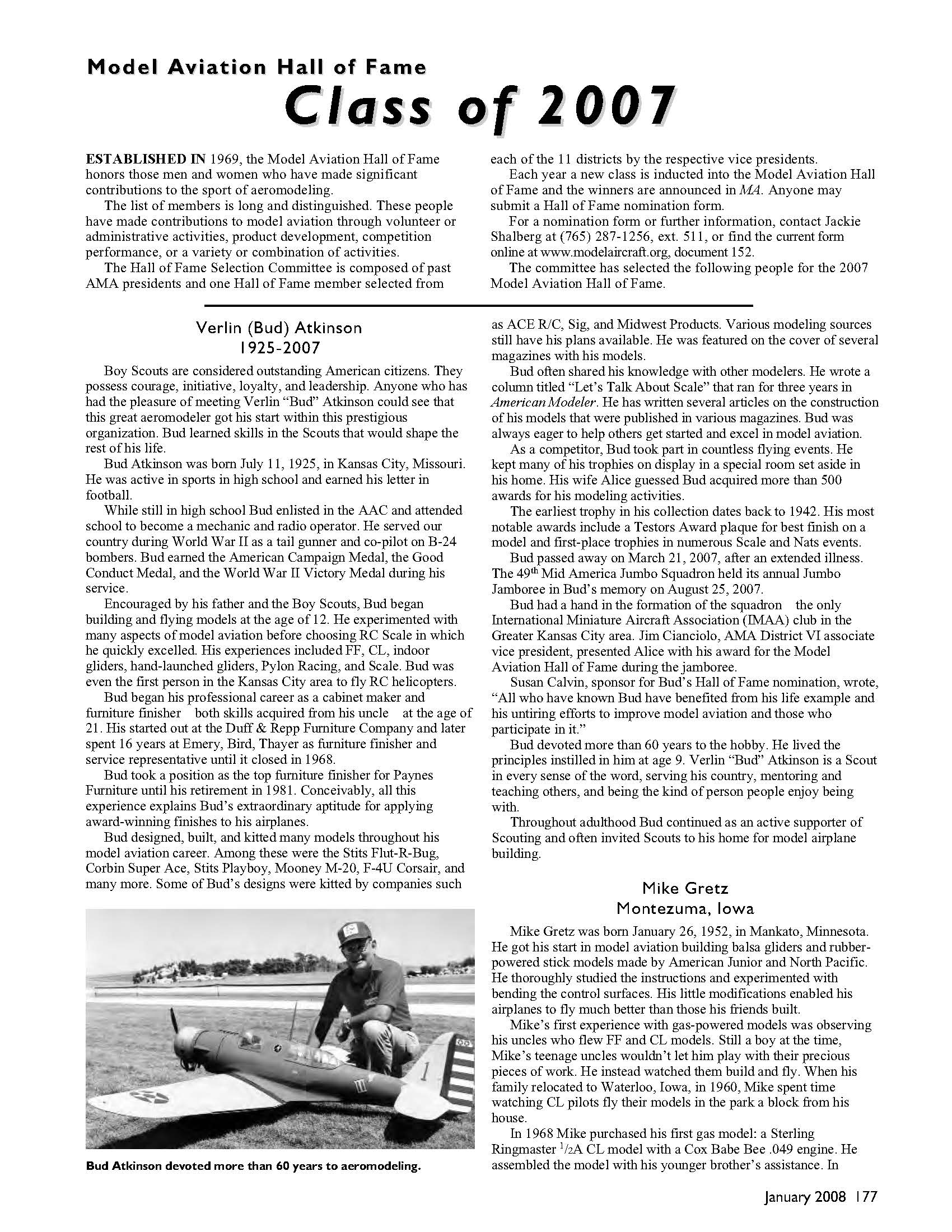
Boy Scouts are considered outstanding American citizens. They possess courage, initiative, loyalty, and leadership. Anyone who had the pleasure of meeting Verlin “Bud” Atkinson could see that this great aeromodeler got his start within this prestigious organization. Bud learned skills in the Scouts that would shape the rest of his life.
Bud Atkinson was born July 11, 1925, in Kansas City, Missouri. He was active in sports in high school and earned his letter in football.
While still in high school Bud enlisted in the Army Air Corps (AAC) and attended school to become a mechanic and radio operator. He served our country during World War II as a tail gunner and co-pilot on B-24 bombers. Bud earned the American Campaign Medal, the Good Conduct Medal, and the World War II Victory Medal during his service.
Encouraged by his father and the Boy Scouts, Bud began building and flying models at the age of 12. He experimented with many aspects of model aviation before choosing RC Scale, in which he quickly excelled. His experiences included free flight (FF), control line (CL), indoor gliders, hand-launched gliders, pylon racing, and scale. Bud was even the first person in the Kansas City area to fly RC helicopters.
Bud began his professional career as a cabinet maker and furniture finisher—both skills acquired from his uncle—at the age of 21. He started at the Duff & Repp Furniture Company and later spent 16 years at Emery, Bird, Thayer as a furniture finisher and service representative until it closed in 1968. Bud took a position as the top furniture finisher for Paynes Furniture until his retirement in 1981. Conceivably, all this experience explains Bud’s extraordinary aptitude for applying award-winning finishes to his airplanes.
Bud designed, built, and kitted many models throughout his model aviation career. Among these were the Stits Flut-R-Bug, Corbin Super Ace, Stits Playboy, Mooney M-20, F4U Corsair, and many more. Some of Bud’s designs were kitted by companies such as ACE R/C, Sig, and Midwest Products. Various modeling sources still have his plans available. He was featured on the cover of several magazines with his models.
Bud often shared his knowledge with other modelers. He wrote a column titled “Let’s Talk About Scale” that ran for three years in American Modeler. He wrote several articles on the construction of his models that were published in various magazines. Bud was always eager to help others get started and excel in model aviation.
As a competitor, Bud took part in countless flying events. He kept many of his trophies on display in a special room set aside in his home. His wife Alice guessed Bud acquired more than 500 awards for his modeling activities. The earliest trophy in his collection dates back to 1942. His most notable awards include a Testors Award plaque for best finish on a model and first-place trophies in numerous scale and Nats events.
Bud passed away on March 21, 2007, after an extended illness. The 49th Mid America Jumbo Squadron held its annual Jumbo Jamboree in Bud’s memory on August 25, 2007.
Bud had a hand in the formation of the squadron—the only International Miniature Aircraft Association (IMAA) club in the Greater Kansas City area. Jim Cianciolo, AMA District VI associate vice president, presented Alice with his award for the Model Aviation Hall of Fame during the jamboree.
Susan Calvin, sponsor for Bud’s Hall of Fame nomination, wrote, “All who have known Bud have benefited from his life example and his untiring efforts to improve model aviation and those who participate in it.”
Bud devoted more than 60 years to the hobby. He lived the principles instilled in him at age 9. Verlin “Bud” Atkinson was a Scout in every sense of the word—serving his country, mentoring and teaching others, and being the kind of person people enjoy being with.
Throughout adulthood Bud continued as an active supporter of Scouting and often invited Scouts to his home for model airplane building.
Mike Gretz
Montezuma, Iowa
Mike Gretz was born January 26, 1952, in Mankato, Minnesota. He got his start in model aviation building balsa gliders and rubber-powered stick models made by American Junior and North Pacific. He thoroughly studied the instructions and experimented with bending the control surfaces. His little modifications enabled his airplanes to fly much better than those his friends built.
Mike’s first experience with gas-powered models was observing his uncles who flew FF and CL models. Still a boy at the time, Mike’s teenage uncles wouldn’t let him play with their precious pieces of work. He instead watched them build and fly. When his family relocated to Waterloo, Iowa, in 1960, Mike spent time watching CL pilots fly their models in the park a block from his house.
In 1968 Mike purchased his first gas model: a Sterling Ringmaster 1/2A CL model with a Cox Babe Bee .049 engine. He assembled the model with his younger brother’s assistance. In exchange for his help, Mike had to let his brother fly it. The brothers taught themselves how to run the engine and fly the aircraft in only a few days.
His family moved back to Mankato in 1969 where Mike became acquainted with Michael Stott and his father Arnold, operator of the local hobby shop. Arnold saw his attraction to model airplanes and became his mentor. Mike credits Arnold with showing him that model aircraft could be more than just a hobby.
Mike entered his first contest at age 18. He placed first at the 1970 Mankato Modelers AAA-rated CL contest in the Senior Stunt category, flying a hybrid airplane consisting of a salvaged Sig Chipmunk wing and a profile fuselage of his own design.
Mike participated in numerous contests after his first win in Mankato and in 1974, after only six years in the hobby, he competed in his first World Championships, placing fourth overall.
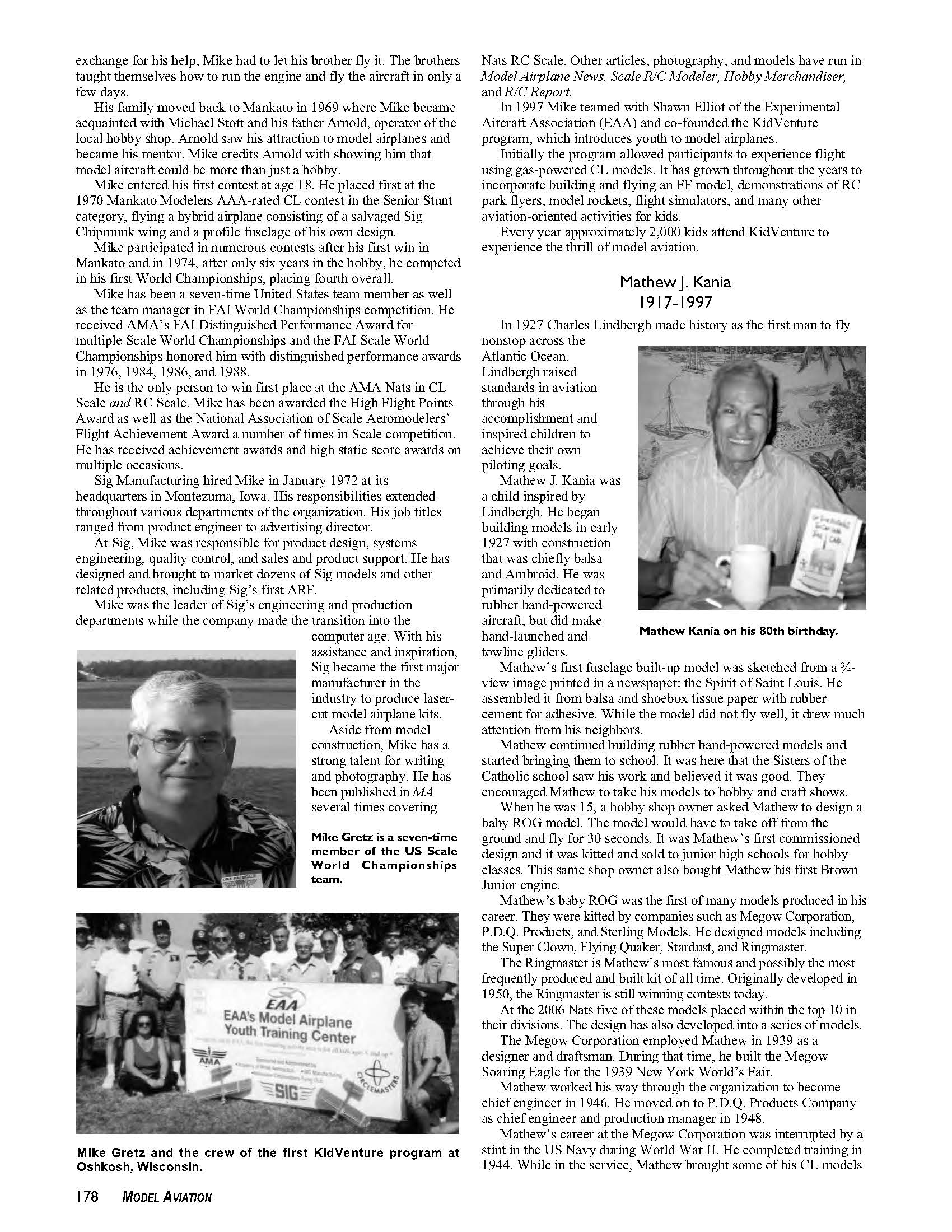
Mike has been a seven-time United States team member as well as the team manager in FAI World Championships competition. He received AMA's FAI Distinguished Performance Award for multiple scale World Championships and the FAI Scale World Championships honored him with distinguished performance awards in 1976, 1984, 1986, and 1988.
He is the only person to win first place at the AMA Nats in both CL Scale and RC Scale. Mike has been awarded the High Flight Points Award as well as the National Association of Scale Aeromodellers' Flight Achievement Award numerous times in scale competition. He has received achievement awards and high static score awards on multiple occasions.
Sig Manufacturing hired Mike in January 1972 at its headquarters in Montezuma, Iowa. His responsibilities extended throughout various departments of the organization. His job titles ranged from product engineer to advertising director.
At Sig, Mike was responsible for product design, systems engineering, quality control, and sales and product support. He has designed and brought to market dozens of Sig models and other related products, including Sig's first ARF.
Mike led Sig's engineering and production departments while the company made the transition into the computer age. With his assistance and inspiration, Sig became the first major manufacturer in the industry to produce laser-cut model airplane kits.
Aside from model construction, Mike has a strong talent for writing and photography. He has been published in MA several times covering Nats RC Scale. Other articles, photography, and models have run in Model Airplane News, Scale R/C Modeler, Hobby Merchandiser, and R/C Report.
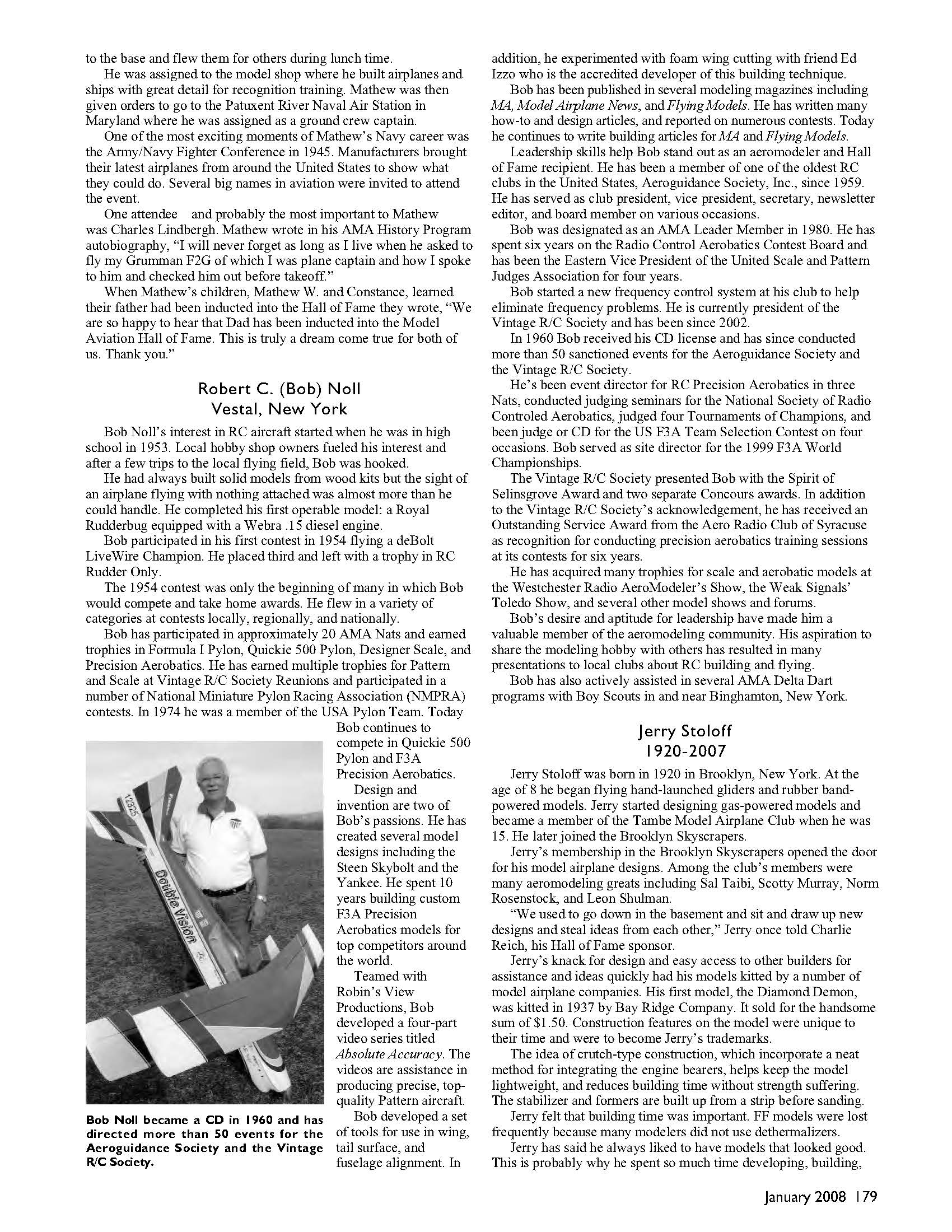
In 1997 Mike teamed with Shawn Elliot of the Experimental Aircraft Association (EAA) and co-founded the KidVenture program, which introduces youth to model airplanes.
Initially the program allowed participants to experience flight using gas-powered CL models. It has grown throughout the years to incorporate building and flying an FF model, demonstrations of RC park flyers, model rockets, flight simulators, and many other aviation-oriented activities for kids.
Every year approximately 2,000 kids attend KidVenture to experience the thrill of model aviation.
Mathew J. Kania
1917–1997
In 1927 Charles Lindbergh made history as the first man to fly nonstop across the Atlantic Ocean. Lindbergh raised standards in aviation through his accomplishment and inspired children to achieve their own piloting goals.
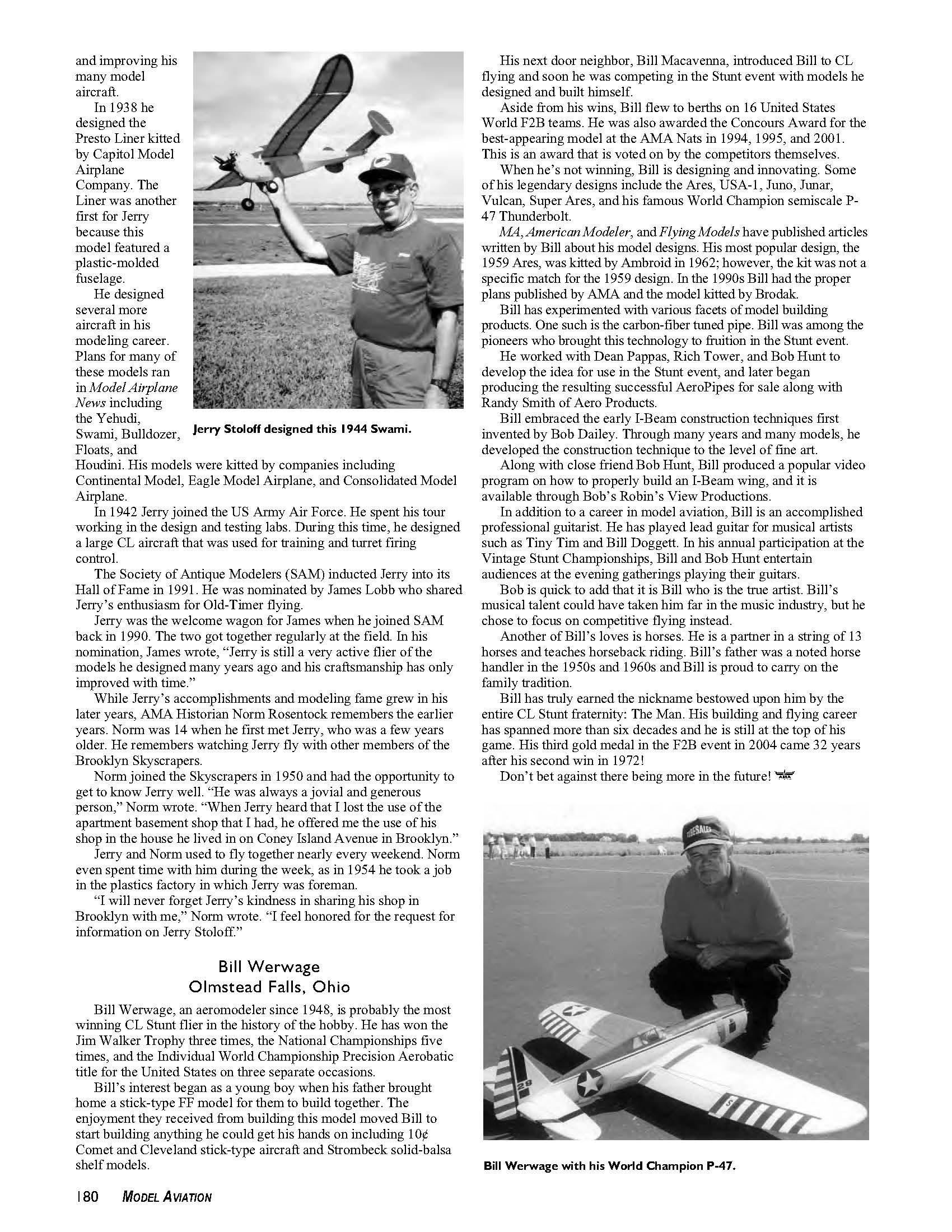
Mathew J. Kania was a child inspired by Lindbergh. He began building models in early 1927 with construction that was chiefly balsa and Ambroid. He was primarily dedicated to rubber band-powered aircraft, but did make hand-launched and towline gliders.
Mathew's first fuselage built-up model was sketched from a 3/4-view image printed in a newspaper: the Spirit of St. Louis. He assembled it from balsa and shoebox tissue paper with rubber cement for adhesive. While the model did not fly well, it drew much attention from his neighbors.
Mathew continued building rubber band-powered models and started bringing them to school. It was here that the Sisters of the Catholic school saw his work and believed it was good. They encouraged Mathew to take his models to hobby and craft shows.
When he was 15, a hobby shop owner asked Mathew to design a baby ROG model. The model would have to take off from the ground and fly for 30 seconds. It was Mathew's first commissioned design and it was kitted and sold to junior high schools for hobby classes. This same shop owner also bought Mathew his first Brown Junior engine.
Mathew's baby ROG was the first of many models produced in his career. They were kitted by companies such as Megow Corporation, P.D.Q. Products, and Sterling Models. He designed models including the Super Clown, Flying Quaker, Stardust, and Ringmaster.
The Ringmaster is Mathew's most famous and possibly the most frequently produced and built kit of all time. Originally developed in 1950, the Ringmaster is still winning contests today. At the 2006 Nats five of these models placed within the top 10 in their divisions. The design has also developed into a series of models.
The Megow Corporation employed Mathew in 1939 as a designer and draftsman. During that time, he built the Megow Soaring Eagle for the 1939 New York World's Fair.
Mathew worked his way through the organization to become chief engineer in 1946. He moved on to P.D.Q. Products Company as chief engineer and production manager in 1948.
Mathew's career at the Megow Corporation was interrupted by a stint in the U.S. Navy during World War II. He completed training in 1944. While in the service, Mathew brought some of his CL models to the base and flew them for others during lunch time.
He was assigned to the model shop where he built airplanes and ships with great detail for recognition training. Mathew was then given orders to go to the Patuxent River Naval Air Station in Maryland where he was assigned as a ground crew captain.
One of the most exciting moments of Mathew's Navy career was the Army/Navy Fighter Conference in 1945. Manufacturers brought their latest airplanes from around the United States to show what they could do. Several big names in aviation were invited to attend the event.
One attendee and probably the most important to Mathew was Charles Lindbergh. Mathew wrote in his AMA History Program autobiography, "I will never forget as long as I live when he asked to fly my Grumman F2G of which I was plane captain and how I spoke to him and checked him out before takeoff."
When Mathew's children, Mathew W. and Constance, learned their father had been inducted into the Hall of Fame they wrote, "We are so happy to hear that Dad has been inducted into the Model Aviation Hall of Fame. This is truly a dream come true for both of us. Thank you."
Robert C. (Bob) Noll
Vestal, New York
Bob Noll's interest in RC aircraft started when he was in high school in 1953. Local hobby shop owners fueled his interest and after a few trips to the local flying field, Bob was hooked.
He had always built solid models from wood kits but the sight of an airplane flying with nothing attached was almost more than he could handle. He completed his first operable model: a Royal Rudderbug equipped with a Webra .15 diesel engine.
Bob participated in his first contest in 1954 flying a deBolt LiveWire Champion. He placed third and left with a trophy in RC Rudder Only.
The 1954 contest was only the beginning of many in which Bob would compete and take home awards. He flew in a variety of categories at contests locally, regionally, and nationally.
Bob has participated in approximately 20 AMA Nats and earned trophies in Formula I Pylon, Quickie 500 Pylon, Designer Scale, and Precision Aerobatics. He has earned multiple trophies for Pattern and Scale at Vintage R/C Society Reunions and participated in a number of National Miniature Pylon Racing Association (NMPRA) contests. In 1974 he was a member of the USA Pylon Team.
Today Bob continues to compete in Quickie 500 Pylon and F3A Precision Aerobatics.
Design and invention are two of Bob's passions. He has created several model designs including the Steen Skybolt and the Yankee. He spent 10 years building custom F3A Precision Aerobatics models for top competitors around the world.
Teamed with Robin's View Productions, Bob developed a four-part video series titled Absolute Accuracy. The videos assist in producing precise, top-quality Pattern aircraft.
Bob developed a set of tools for use in wing, tail surface, and fuselage alignment. In addition, he experimented with foam wing cutting with friend Ed Izzo, who is the accredited developer of this building technique.
Bob has been published in several modeling magazines including MA, Model Airplane News, and Flying Models. He has written many how-to and design articles, and reported on numerous contests. He continues to write building articles for MA and Flying Models.
Leadership skills help Bob stand out as an aeromodeler and Hall of Fame recipient. He has been a member of one of the oldest RC clubs in the United States, Aeroguidance Society, Inc., since 1959. He has served as club president, vice president, secretary, newsletter editor, and board member on various occasions.
Bob was designated as an AMA Leader Member in 1980. He has spent six years on the Radio Control Aerobatics Contest Board and has been the Eastern Vice President of the United Scale and Pattern Judges Association for four years.
Bob started a new frequency control system at his club to help eliminate frequency problems. He is currently president of the Vintage R/C Society and has been since 2002.
In 1960 Bob received his CD license and has since conducted more than 50 sanctioned events for the Aeroguidance Society and the Vintage R/C Society.
He's been event director for RC Precision Aerobatics in three Nats, conducted judging seminars for the National Society of Radio Controlled Aerobatics, judged four Tournaments of Champions, and been judge or CD for the US F3A Team Selection Contest on four occasions. Bob served as site director for the 1999 F3A World Championships.
The Vintage R/C Society presented Bob with the Spirit of Selinsgrove Award and two separate Concours awards. In addition to the Vintage R/C Society's acknowledgement, he has received an Outstanding Service Award from the Aero Radio Club of Syracuse as recognition for conducting precision aerobatics training sessions at its contests for six years.
He has acquired many trophies for scale and aerobatic models at the Westchester Radio AeroModeler's Show, the Weak Signals' Toledo Show, and several other model shows and forums.
Bob's desire and aptitude for leadership have made him a valuable member of the aeromodeling community. His aspiration to share the modeling hobby with others has resulted in many presentations to local clubs about RC building and flying.
Bob has also actively assisted in several AMA Delta Dart programs with Boy Scouts in and near Binghamton, New York.
Jerry Stoloff
1920–2007
Jerry Stoloff was born in 1920 in Brooklyn, New York. At the age of 8 he began flying hand-launched gliders and rubber band-powered models. Jerry started designing gas-powered models and became a member of the Tambe Model Airplane Club when he was 15. He later joined the Brooklyn Skyscrapers.
Jerry's membership in the Brooklyn Skyscrapers opened the door for his model airplane designs. Among the club's members were many aeromodeling greats including Sal Taibi, Scotty Murray, Norm Rosenstock, and Leon Shulman.
"We used to go down in the basement and sit and draw up new designs and steal ideas from each other," Jerry once told Charlie Reich, his Hall of Fame sponsor.
Jerry's knack for design and easy access to other builders for assistance and ideas quickly had his models kitted by a number of model airplane companies. His first model, the Diamond Demon, was kitted in 1937 by Bay Ridge Company. It sold for the handsome sum of $1.50. Construction features on the model were unique to their time and were to become Jerry's trademarks.
The idea of crutch-type construction—which incorporates a neat method for integrating the engine bearers—helps keep the model lightweight and reduces building time without sacrificing strength. The stabilizer and formers are built up from a strip before sanding.
Jerry felt that building time was important. FF models were lost frequently because many modelers did not use dethermalizers. Jerry said he always liked to have models that looked good. This is probably why he spent so much time developing, building, and improving his many model aircraft.
In 1938 he designed the Presto Liner, kitted by Capitol Model Airplane Company. The Liner was another first for Jerry because this model featured a plastic-molded fuselage.
He designed several more aircraft in his modeling career. Plans for many of these models ran in Model Airplane News including the Yehudi, Swami, Bulldozer, Floats, and Houdini. His models were kitted by companies including Continental Model, Eagle Model Airplane, and Consolidated Model Airplane.
In 1942 Jerry joined the U.S. Army Air Force. He spent his tour working in the design and testing labs. During this time, he designed a large CL aircraft that was used for training and turret firing control.
The Society of Antique Modelers (SAM) inducted Jerry into its Hall of Fame in 1991. He was nominated by James Lobb, who shared Jerry’s enthusiasm for Old-Timer flying.
Jerry was the welcome wagon for James when he joined SAM back in 1990. The two got together regularly at the field. In his nomination, James wrote, “Jerry is still a very active flier of the models he designed many years ago and his craftsmanship has only improved with time.”
While Jerry’s accomplishments and modeling fame grew in his later years, AMA Historian Norm Rosenstock remembers the earlier years. Norm was 14 when he first met Jerry, who was a few years older. He remembers watching Jerry fly with other members of the Brooklyn Skyscrapers.
Norm joined the Skyscrapers in 1950 and had the opportunity to get to know Jerry well. “He was always a jovial and generous person,” Norm wrote. “When Jerry heard that I lost the use of the apartment basement shop that I had, he offered me the use of his shop in the house he lived in on Coney Island Avenue in Brooklyn.”
Jerry and Norm used to fly together nearly every weekend. Norm even spent time with him during the week; in 1954 he took a job in the plastics factory in which Jerry was foreman.
“I will never forget Jerry’s kindness in sharing his shop in Brooklyn with me,” Norm wrote. “I feel honored for the request for information on Jerry Stoloff.”
Bill Werwage
Olmsted Falls, Ohio
Bill Werwage, an aeromodeler since 1948, is probably the most winning CL Stunt flier in the history of the hobby. He has won the Jim Walker Trophy three times, the National Championships five times, and the Individual World Championship Precision Aerobatic title for the United States on three separate occasions.
Bill’s interest began as a young boy when his father brought home a stick-type FF model for them to build together. The enjoyment they received from building this model moved Bill to start building anything he could get his hands on including 10¢ Comet and Cleveland stick-type aircraft and Strombeck solid-balsa shelf models.
His next-door neighbor, Bill Macavenna, introduced Bill to CL flying and soon he was competing in the Stunt event with models he designed and built himself.
Aside from his wins, Bill flew to berths on 16 United States World F2B teams. He was also awarded the Concours Award for the best-appearing model at the AMA Nats in 1994, 1995, and 2001. This is an award that is voted on by the competitors themselves.
When he’s not winning, Bill is designing and innovating. Some of his legendary designs include the Ares, USA-1, Juno, Junar, Vulcan, Super Ares, and his famous World Champion semiclassic P-47 Thunderbolt.
MA, American Modeler, and Flying Models have published articles written by Bill about his model designs. His most popular design, the 1959 Ares, was kitted by Ambroid in 1962; however, the kit was not a specific match for the 1959 design. In the 1990s Bill had the proper plans published by AMA and the model kitted by Brodak.
Bill has experimented with various facets of model building products. One such is the carbon-fiber tuned pipe. Bill was among the pioneers who brought this technology to fruition in the Stunt event.
He worked with Dean Pappas, Rich Tower, and Bob Hunt to develop the idea for use in the Stunt event, and later began producing the resulting successful AeroPipes for sale along with Randy Smith of Aero Products.
Bill embraced the early I-beam construction techniques first invented by Bob Dailey. Through many years and many models, he developed the construction technique to the level of fine art.
Along with close friend Bob Hunt, Bill produced a popular video program on how to properly build an I-beam wing, available through Bob & Robin’s View Productions.
In addition to a career in model aviation, Bill is an accomplished professional guitarist. He has played lead guitar for musical artists such as Tiny Tim and Bill Doggett. In his annual participation at the Vintage Stunt Championships, Bill and Bob Hunt entertain audiences at the evening gatherings playing their guitars.
Bob is quick to add that it is Bill who is the true artist. Bill’s musical talent could have taken him far in the music industry, but he chose to focus on competitive flying instead.
Another of Bill’s loves is horses. He is a partner in a string of 13 horses and teaches horseback riding. Bill’s father was a noted horse handler in the 1950s and 1960s and Bill is proud to carry on the family tradition.
Bill has truly earned the nickname bestowed upon him by the entire CL Stunt fraternity: The Man. His building and flying career has spanned more than six decades and he is still at the top of his game. His third gold medal in the F2B event in 2004 came 32 years after his second win in 1972!
Don't bet against there being more in the future!
Transcribed from original scans by AI. Minor OCR errors may remain.

