
AMA News
Academy of Model Aeronautics 5151 E. Memorial Dr., Muncie IN 47302
Model Aviation's editor's note:
The following article has been submitted by an active group of East Coast indoor modelers. Prior to the AMA Safety Committee recommending adoption of indoor guidelines, we are asking for input from other AMA indoor fliers from other parts of the country. If you have an interest in indoor flying, please read this and respond with changes and/or additions. Forward your comments to the AMA—ATTN: Safety Committee at 5151 E. Memorial Drive, Muncie IN 47302.
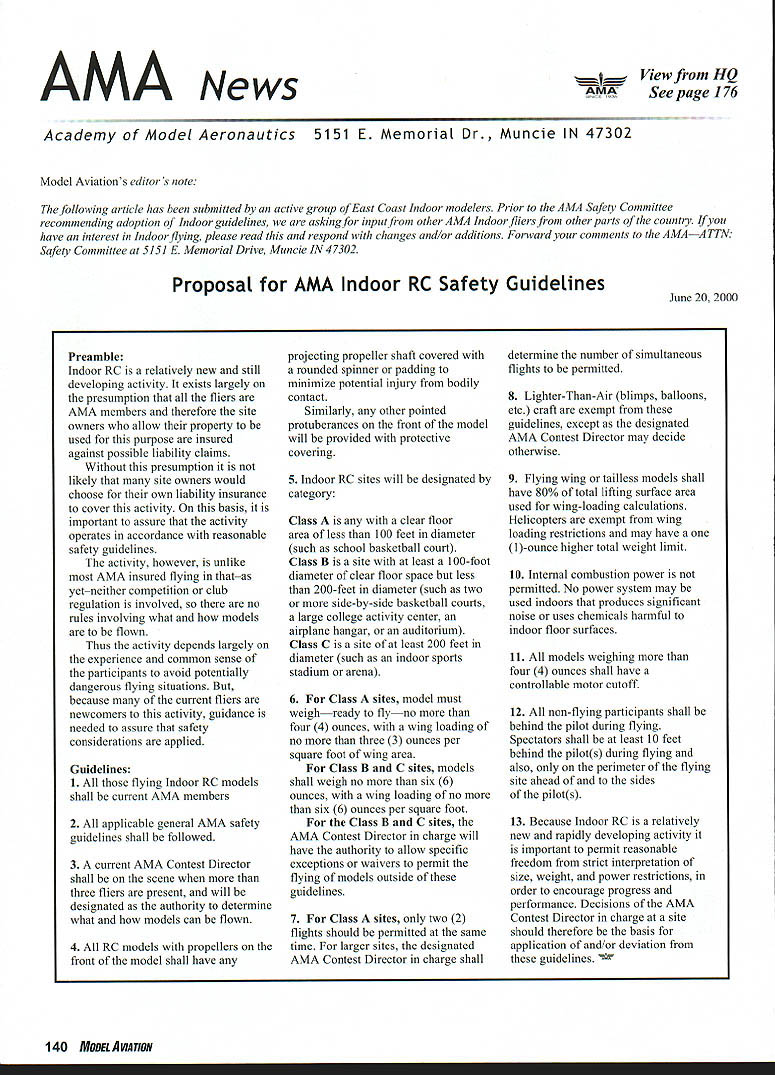
Proposal for AMA Indoor RC Safety Guidelines
June 20, 2000
Preamble: Indoor RC is a relatively new and still developing activity. It exists largely on the presumption that all the fliers are AMA members and therefore the site owners who allow their property to be used for this purpose are insured against possible liability claims.
Without this presumption it is not likely that many site owners would choose for their own liability insurance to cover this activity. On this basis, it is important to assure that the activity operates in accordance with reasonable safety guidelines.
The activity, however, is unlike most AMA insured flying in that—as yet—neither competition nor club regulation is involved, so there are no rules involving what and how models are to be flown.
Thus the activity depends largely on the experience and common sense of the participants to avoid potentially dangerous flying situations. But, because many of the current fliers are newcomers to this activity, guidance is needed to assure that safety considerations are applied.
Guidelines
- All those flying indoor RC models shall be current AMA members.
- All applicable general AMA safety guidelines shall be followed.
- A current AMA Contest Director shall be on the scene when more than three fliers are present, and will be designated as the authority to determine what and how models can be flown.
- All RC models with propellers on the front of the model shall have any projecting propeller shaft covered with a rounded spinner or padding to minimize potential injury from bodily contact. Similarly, any other pointed protuberances on the front of the model will be provided with protective covering.
- Indoor RC sites will be designated by category:
- Class A: clear floor area less than 100 feet in diameter (such as a school basketball court).
- Class B: at least a 100-foot diameter of clear floor space but less than 200 feet in diameter (such as two or more side-by-side basketball courts, a large college activity center, an airplane hangar, or an auditorium).
- Class C: at least 200 feet in diameter (such as an indoor sports stadium or arena).
- Weight and wing loading limits:
- For Class A sites: models must weigh—ready to fly—no more than four (4) ounces, with a wing loading of no more than three (3) ounces per square foot of wing area.
- For Class B and C sites: models shall weigh no more than six (6) ounces, with a wing loading of no more than six (6) ounces per square foot.
- For Class B and C sites, the AMA Contest Director in charge will have the authority to allow specific exceptions or waivers to permit the flying of models outside of these guidelines.
- For Class A sites, only two (2) flights should be permitted at the same time. For larger sites, the designated AMA Contest Director in charge shall determine the number of simultaneous flights to be permitted.
- Lighter-than-air craft (blimps, balloons, etc.) are exempt from these guidelines, except as the designated AMA Contest Director may decide otherwise.
- Flying wing or tailless models shall have 80% of total lifting surface area used for wing-loading calculations. Helicopters are exempt from wing loading restrictions and may have a one (1)-ounce higher total weight limit.
- Internal combustion power is not permitted. No power system may be used indoors that produces significant noise or uses chemicals harmful to indoor floor surfaces.
- All models weighing more than four (4) ounces shall have a controllable motor cutoff.
- All non-flying participants shall be behind the pilot during flying. Spectators shall be at least 10 feet behind the pilot(s) during flying and also only on the perimeter of the flying site ahead of and to the sides of the pilot(s).
- Because indoor RC is a relatively new and rapidly developing activity it is important to permit reasonable freedom from strict interpretation of size, weight, and power restrictions, in order to encourage progress and performance. Decisions of the AMA Contest Director in charge at a site should therefore be the basis for application of and/or deviation from these guidelines.
AMA News
So, you ask, what has this activity done for AMA and modeling in general? Can we quantify the impact all this energy and money spent has made? Tough questions indeed!
In 1998 and 1999, membership was up about 3% each year. So far in 2000, we have about doubled that percentage. Certainly, the $1 Youth Membership has been responsible for some of the increase, but interestingly, we often find at trade shows that it's the youth who often are bringing mom and/or dad along as members!
Could the growth be attributed to other factors? Certainly! The one compelling factor that we must keep in mind is that many of the youth, and in some cases adults, being reached may not be an "immediate modeler," but, because of the exposure and pleasant experiences, they will be down the road.
We are aware that educational activities are needed for a broad range of subjects. These include not only specific building and flying instruction, but even help at the club level for officers and others.
The committee's effectiveness will be enhanced by the addition of advisors. These individuals will be valuable by providing their expertise in a variety of areas. It will also help the committee maintain its focus and help it recognize areas of real need.
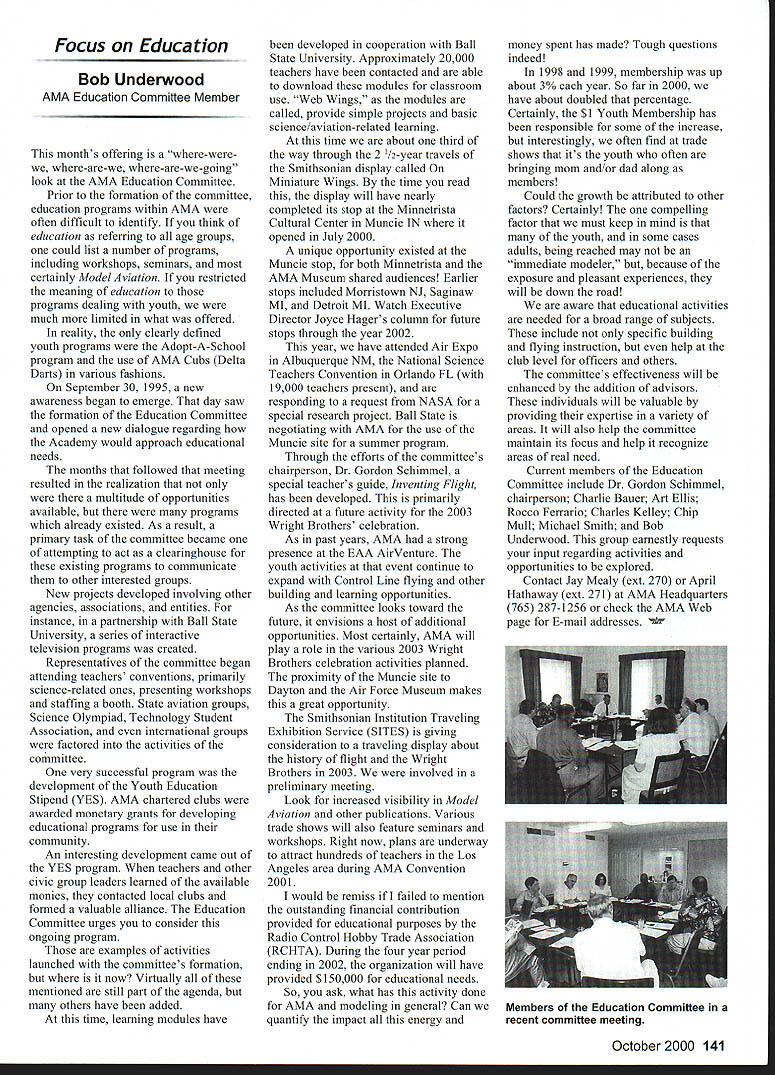
Current members of the Education Committee include Dr. Gordon Schimmel, chairperson; Charlie Bauer; Art Ellis; Rocco Ferrario; Charles Kelsey; Chip Mull; Michael Smith; and Bob Underwood. This group earnestly requests your input regarding activities and opportunities to be explored.
Contact Jay Mealy (ext. 270) or April Hathaway (ext. 271) at AMA Headquarters (765) 287-1256 or check the AMA Web page for e-mail addresses.
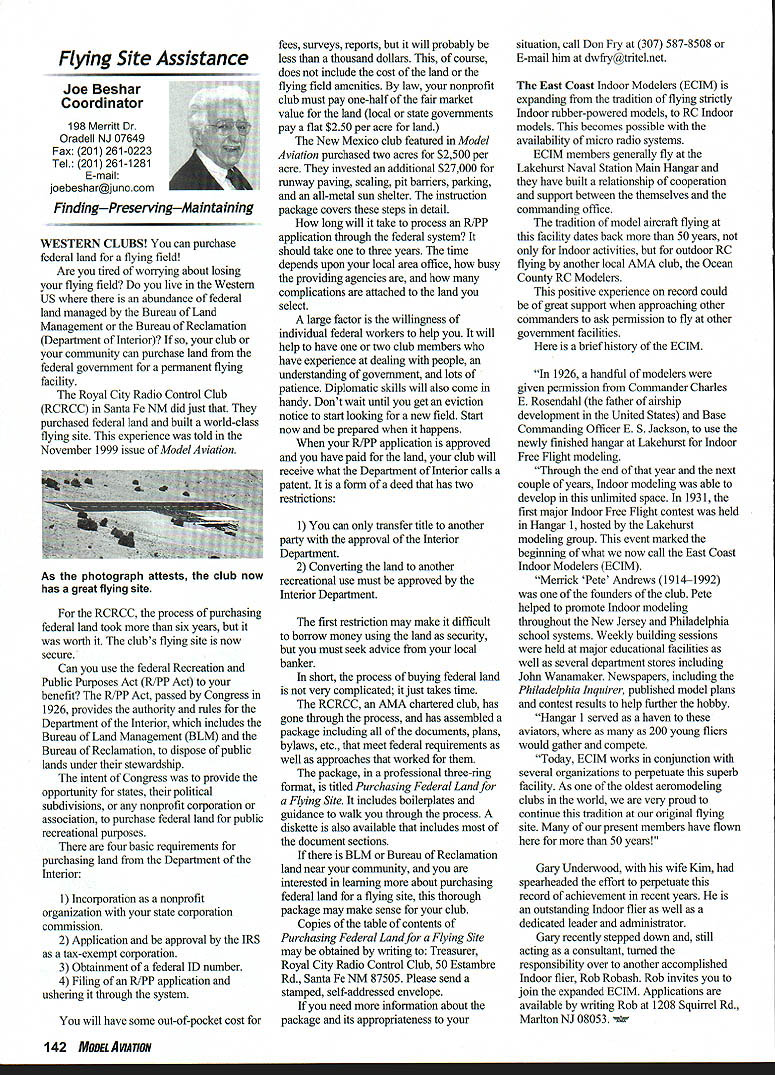
Purchasing Federal Land for a Flying Site (excerpt)
Fees, surveys, reports will probably be less than a thousand dollars. This, of course, does not include the cost of the land or the flying field amenities. By law, your nonprofit club must pay one-half of the fair market value for the land (local or state governments pay a flat $2.50 per acre for land).
The New Mexico club featured in Model Aviation purchased two acres for $2,500 per acre. They invested an additional $27,000 for runway paving, scaling, pit barriers, parking, and an all-metal sun shelter. The instruction package covers these steps in detail.
How long will it take to process an R/P application through the federal system? It should take one to three years. The time depends upon your local area office, how busy the providing agencies are, and how many complications are attached to the land you select.
A large factor is the willingness of individual federal workers to help you. It will help to have one or two club members who have experience at dealing with people, an understanding of government, and lots of patience. Diplomatic skills will also come in handy. Don't wait until you get an eviction notice to start looking for a new field. Start now and be prepared when it happens.
When your R/P application is approved and you have paid for the land, your club will receive what the Department of Interior calls a patent. It is a form of a deed that has two restrictions:
- You can only transfer title to another party with the approval of the Interior Department.
- Converting the land to another recreational use must be approved by the Interior Department.
The first restriction may make it difficult to borrow money using the land as security, but you must seek advice from your local banker.
In short, the process of buying federal land is not very complicated; it just takes time.
The RCRCC, an AMA chartered club, has gone through the process, and has assembled a package including all of the documents, plans, bylaws, etc., that meet federal requirements as well as approaches that worked for them.
The package, in a professional three-ring format, is titled Purchasing Federal Land for a Flying Site. It includes blueprints and guidance to walk you through the process. A diskette is also available that includes most of the document sections.
If there is BLM or Bureau of Reclamation land near your community, and you are interested in learning more about purchasing federal land for a flying site, this thorough package may make sense for your club.
Copies of the table of contents of Purchasing Federal Land for a Flying Site may be obtained by writing to: Treasurer, Royal City Radio Control Club, 50 Estambre Rd., Santa Fe NM 87505. Please send a stamped, self-addressed envelope.
If you need more information about the package and its appropriateness to your situation, call Don Fry at (307) 587-8508 or e-mail him at [email protected].
East Coast Indoor Modelers (ECIM)
The East Coast Indoor Modelers (ECIM) is expanding from the tradition of flying strictly indoor rubber-powered models to RC indoor models. This becomes possible with the availability of micro radio systems.
ECIM members generally fly at the Lakehurst Naval Station Main Hangar and they have built a relationship of cooperation and support between themselves and the commanding office.
The tradition of model aircraft flying at this facility dates back more than 50 years, not only for indoor activities, but for outdoor RC flying by another local AMA club, the Ocean County RC Modelers.
This positive experience on record could be of great support when approaching other governments for permission to fly at other government facilities.
History of ECIM (excerpt)
- In 1926, a handful of modelers were given permission from Commander Charles E. Rosendahl and Base Commanding Officer C. S. Jackson to use the newly finished hangar at Lakehurst for indoor free flight modeling.
- Through the end of that year and the next couple of years, indoor modeling was able to develop in the unlimited space. In 1931, the first major indoor free flight contest was held in Hangar 1, hosted by the Lakehurst modeling group. This event marked the beginning of what we now call the East Coast Indoor Modelers (ECIM).
- Merrick "Pete" Andrews (1914–1992) was one of the founders of the club. Pete helped to promote indoor modeling throughout the New Jersey and Philadelphia areas. He organized many indoor contests, participated in department stores, published model plans and contest results to help further the hobby.
- Hangar 1 served as a haven to these flyers, where as many as 200 young fliers would gather and compete.
Today, ECIM works in conjunction with several organizations to perpetuate this superb facility. As one of the oldest aeromodeling clubs in the world, we are very proud to continue this tradition at our original flying site. Many of our present members have flown here for more than 50 years.
Gary Underwood, with his wife Kim, spearheaded the effort to perpetuate this record of achievement in recent years. He is an outstanding indoor flyer as well as a dedicated leader and administrator.
Gary recently stepped down and, still acting as a consultant, turned the responsibility over to another accomplished indoor flyer, Rob Robash. Rob invites you to join the expanded ECIM. Applications are available by writing Rob at 1208 Squirrel Rd., Marlton NJ 08053.
Executive VP's Report
Doug Holland AMA Executive VP
3517 Fernwood Dr. Raleigh NC 27612 (Home) (919) 787-5163 (Office) (919) 787-7454
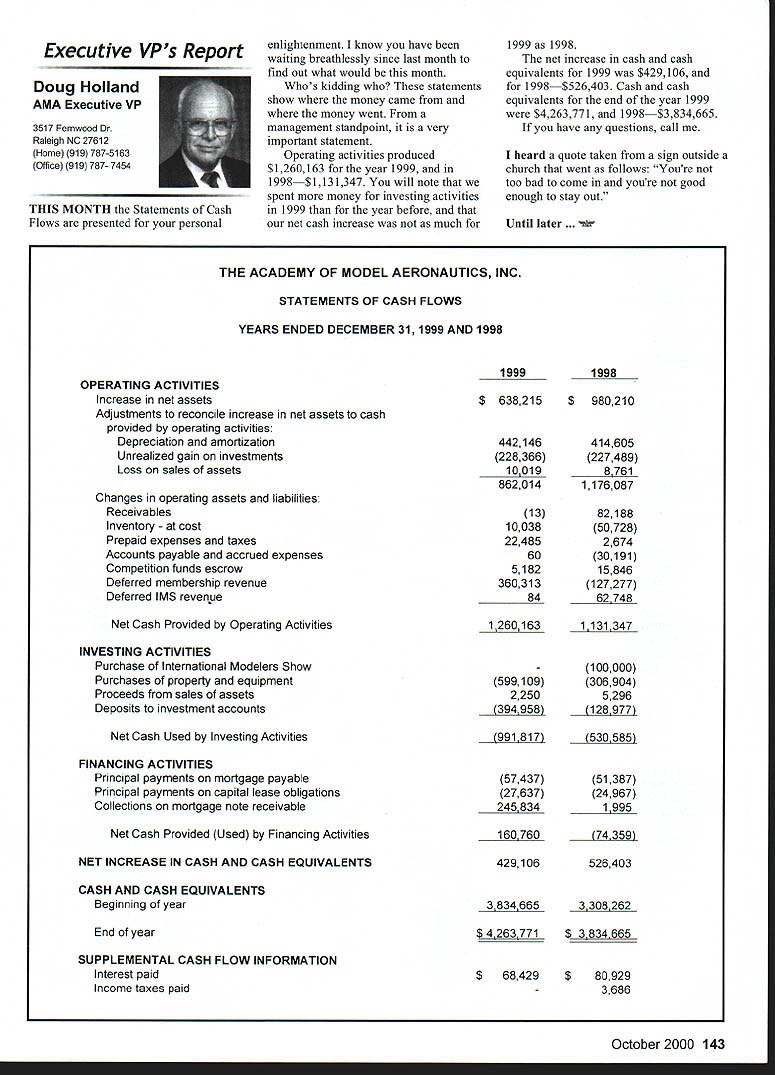
This month the Statements of Cash Flows are presented for your personal enlightenment. These statements show where the money came from and where the money went. From a management standpoint, it is a very important statement.
Operating activities produced $1,260,163 for the year 1999, and in 1998—$1,131,347. You will note that we spent more money for investing activities in 1999 than for the year before, and that our net cash increase was not as much for 1999 as 1998.
The net increase in cash and cash equivalents for 1999 was $429,106, and for 1998—$526,403. Cash and cash equivalents at the end of the year 1999 were $4,263,771, and 1998—$3,834,665.
If you have any questions, call me.
I heard a quote taken from a sign outside a church that went as follows: "You're not too bad to come in and you're not good enough to stay out."
Until later ... dh
District I Report
Connecticut / Maine / Massachusetts / New Hampshire / Rhode Island / Vermont
Don Krafft Vice President
PO Box 1828 Duxbury MA 02331-1828 (781) 934-6248
Associate Vice Presidents
- James M. Senonain, 166 Allen Road, Billerica MA 01821-5240
- M.C. McGuffin, 116 Hillview Avenue, Houlton ME 04730-2312
- Harry S. Newman, 36 Sherwood Drive, Hooksett NH 03106-1077
- Richard Sherman, 30 High Street, Plymouth NH 03264-1223
- Andrew Argenio, 3 Sheila Ave., Smithfield RI 02917
- Bob Wallace, 91 Sylvan Street, Avon CT 06001-2230
Frequency Coordinator Joel Chappell, 21 Billings Street, Milford NH 03055-3906 Ph. (603) 885-3876
REMINDER: Toys for Tots. This is a repeat of a portion of last month’s column to remind you of this program. You can drop off a toy, register, and get directions to the field at any of these hobby shops beginning in August 2000: Alex’s RC Hobby Works in Belmont MA; Bill’s Hobby Barn in Salem NH; Dave’s Hobby Shop in Beverly MA; The Hobby Emporium in Tyngsboro MA; Hobbies Etc. in Nashua NH; R/C Buyers Warehouse in Nashua NH.
You can also donate a toy and register at the event. If you forget to bring a toy, a toy purchase kitty will be set up at the field.
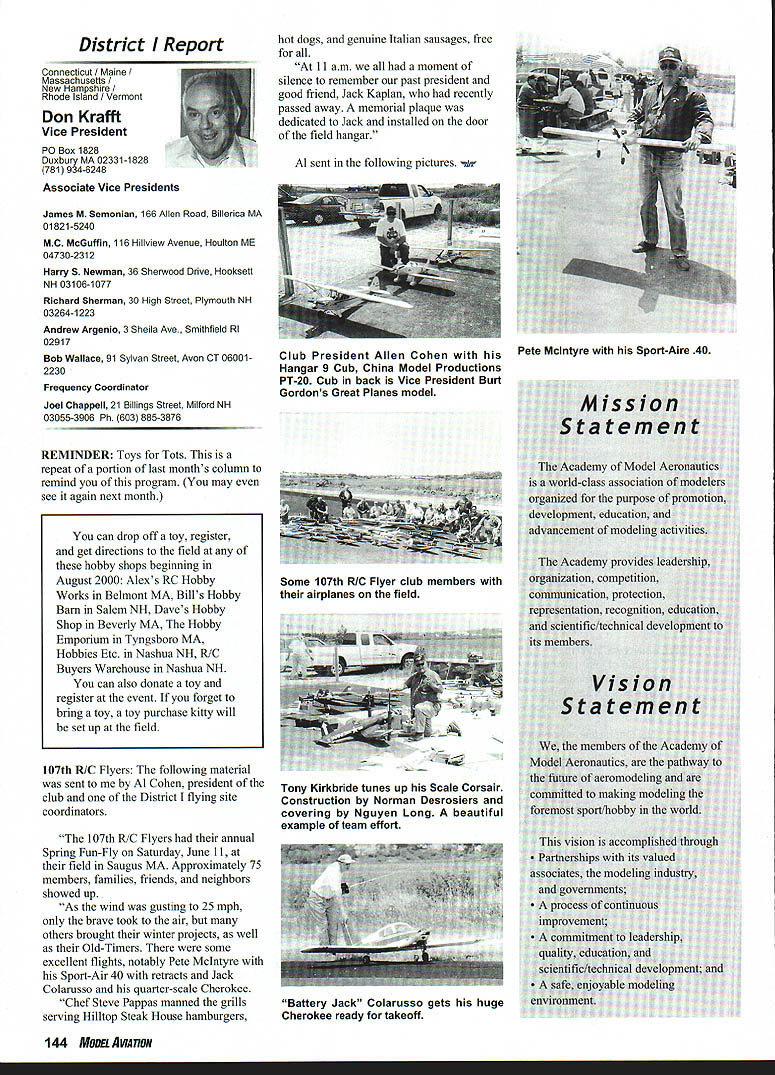
107th R/C Flyers: The following material was sent by Al Cohen, president of the club and one of the District I flying site coordinators.
“The 107th R/C Flyers had their annual Spring Fun-Fly on Saturday, June 11, at their field in Saugus MA. Approximately 75 members, families, friends, and neighbors showed up.
“As the wind was gusting to 25 mph, only the brave took to the air, but many others brought their winter projects, as well as their Old-Timers. There were some excellent flights, notably Pete McIntyre with his Sport-Aire 40 with retracts and Jack Colarusso and his quarter-scale Cherokee.
“Chief Steve Pappas manned the grills serving Hilltop Steak House hamburgers, hot dogs, and genuine Italian sausages, free for all.
“At 11 a.m. we all had a moment of silence to remember our past president and good friend, Jack Kaplan, who had recently passed away. A memorial plaque was dedicated to Jack and installed on the door of the field hangar.”
Al sent in the following pictures.
AMA News
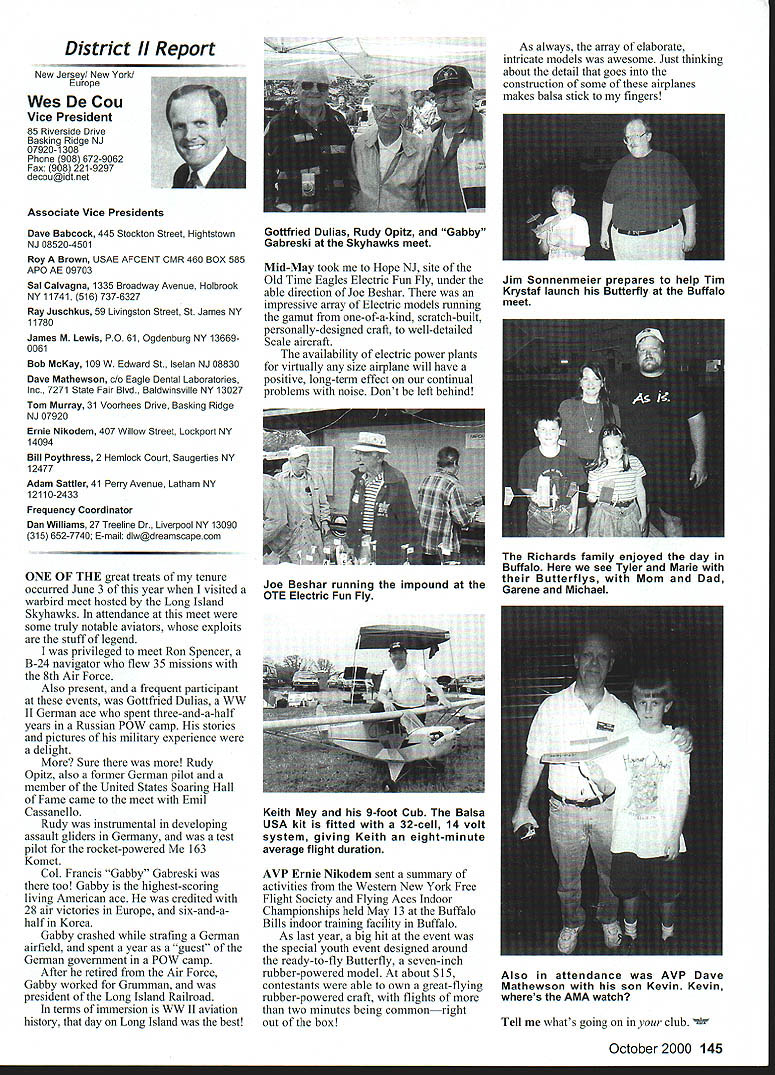
One of the great treats of my tenure occurred June 3 of this year when I visited a warbird meet hosted by the Long Island Skyhawks. In attendance at this meet were some truly notable aviators, whose exploits are the stuff of legend.
I was privileged to meet Ron Spencer, a B-24 navigator who flew 35 missions with the 8th Air Force.
Also present, and a frequent participant at these events, was Gottfried Duliaß, a WWII German ace who spent three-and-a-half years in a Russian POW camp. His stories and pictures of his military experience were a delight.
More? Sure there was more! Rudy Opitz, also a former German pilot and a member of the United States Soaring Hall of Fame, came to the meet with Emil Cassano. Rudy was instrumental in developing gliders in Germany, and was a test pilot for the rocket-powered Me 163 Komet.
Col. Francis "Gabby" Gabreski was there too! Gabby is the highest-scoring living American ace. He was credited with 28 air victories in Europe, and six-and-a-half in Korea. Gabby crashed while strafing a German airfield, and spent a year as a POW. After he retired from the Air Force, Gabby worked for Grumman and was president of the Long Island Railroad.
In terms of immersion in WWII aviation history, that day on Long Island was the best!
Mid-May took me to Hope NJ, site of the Old Time Eagles Electric Fun Fly, under the able direction of Joe Beshar. There was an impressive array of electric models running the gamut from one-of-a-kind, scratch-built, personally designed craft, to well-detailed scale aircraft.
The availability of electric power plants for virtually any size airplane will have a positive, long-term effect on our continual problems with noise. Don't be left behind!
AVP Ernie Nikodem sent a summary of activities from the Western New York Free Flight Society and Flying Aces Indoor Championships held May 13 at the Buffalo Bills indoor training facility in Buffalo.
As last year, a big hit at the event was the ready-to-fly Butterfly, a seven-inch rubber-powered model. At about $1.25, contestants were able to own a great-flying rubber-powered craft, with flights of more than two minutes being common—right out of the box!
As always, the array of elaborate, intricate models was awesome. Just thinking about the detail that goes into the construction of some of these airplanes makes balsa stick to my fingers!
District III Report
Ohio / Pennsylvania / West Virginia
Bob Brown Vice President
35 Sanford Street Bradford, PA 16701 (814) 368-7655 E-mail: [email protected]
Associate Vice Presidents
- Mike Barbee, 6581 Calgary Court, Columbus OH 43229-2008, (614) 891-1643
- David H. Ellis, 5261 DeWitt Road, Cross Lanes WV 25313-1209 (304) 776-1408
- Nelson Gould, 1944 Idaho Street, Allentown PA 18103-8519 (610) 797-6597
- Donald Klopc, 637 Hamilton Court, Trappe PA 19426-2259 (610) 409-0129
- Tom Morris, 5131 Delford, Pittsburgh PA 15207 (412) 461-7346
- Frank Noll, 5492 Waterloo Road, Dayton OH 45459 (937) 435-9232
- Joe Otto, 13065 Heath Road, Chesterland OH 44026-3225 (440) 729-0185, E-mail: [email protected]
- Matthew Turowski, 5 Dogwood Road, Drums, PA 18222 (717) 788-0661
- Joseph S. Vislay, 1381 Cranbrook Drive, PO Box 851, Maumee OH 43537-3062 (419) 893-9537 E-mail: [email protected]
Frequency Coordinator John Cottle, 1012 Wyoming Avenue, Forty Fort PA 18704 (717) 287-8970
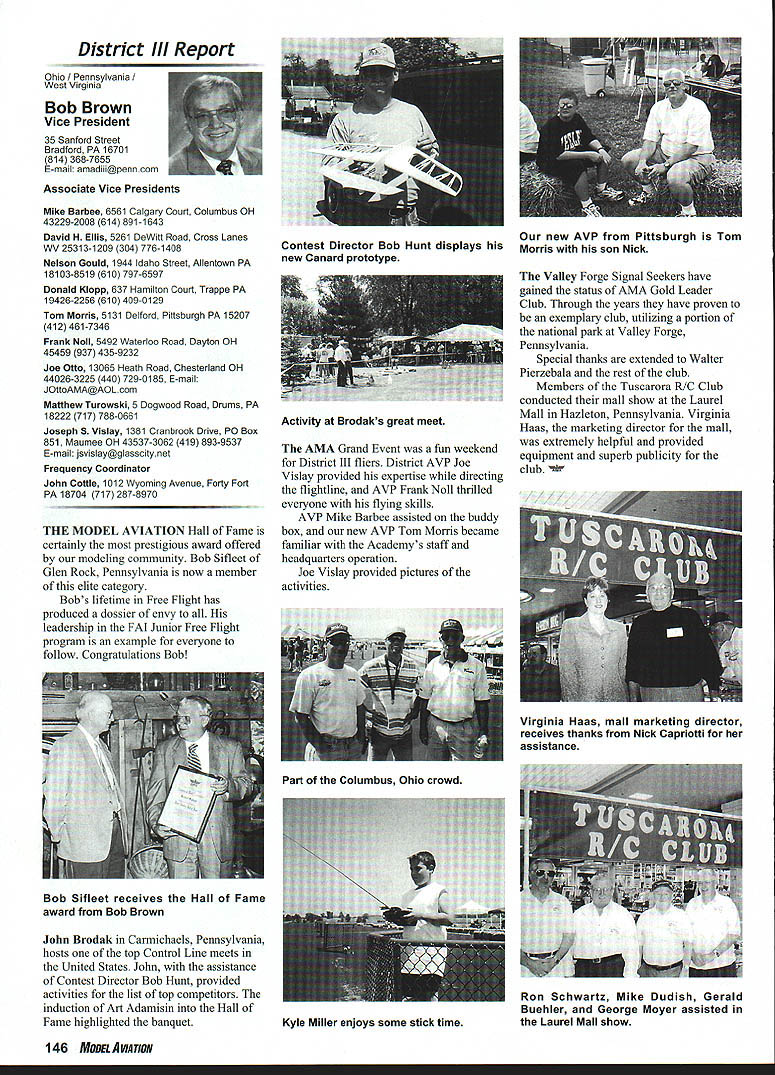
The Model Aviation Hall of Fame is certainly the most prestigious award offered by our modeling community. Bob Sifelet of Glen Rock, Pennsylvania is now a member of this elite category.
Bob's lifetime in Free Flight has produced an enviable dossier. His leadership in the FAI Junior Free Flight program is an example for everyone to follow. Congratulations, Bob!
John Brodak in Carmichaels, Pennsylvania hosts one of the top Control Line meets in the United States. John, with the assistance of Contest Director Bob Hunt, provided activities for the list of top competitors. The induction of Art Adamisin into the Hall of Fame highlighted the banquet.
The AMA Grand Event was a fun weekend for District III fliers. District AVP Joe Vislay provided his expertise while directing the flightline, and AVP Frank Noll thrilled everyone with his flying skills.
AVP Mike Barbee assisted on the buddy box, and our new AVP Tom Morris became familiar with the Academy's staff and headquarters operation.
Joe Vislay provided pictures of the activities.
Our new AVP from Pittsburgh is Tom Morris with his son Nick.
The Valley Forge Signal Seekers have gained the status of AMA Gold Leader Club. Through the years they have proven to be an exemplary club, utilizing a portion of the national park at Valley Forge, Pennsylvania.
Special thanks are extended to Walter Pierzebala and the rest of the club.
Members of the Tuscarora R/C Club conducted their mall show at the Laurel Mall in Hazleton, Pennsylvania. Virginia Haas, the marketing director for the mall, was extremely helpful and provided equipment and superb publicity for the club.
Ron Schwartz, Mike Dudish, Gerald Buehler, and George Moyer assisted in the Laurel Mall show.
AMA News
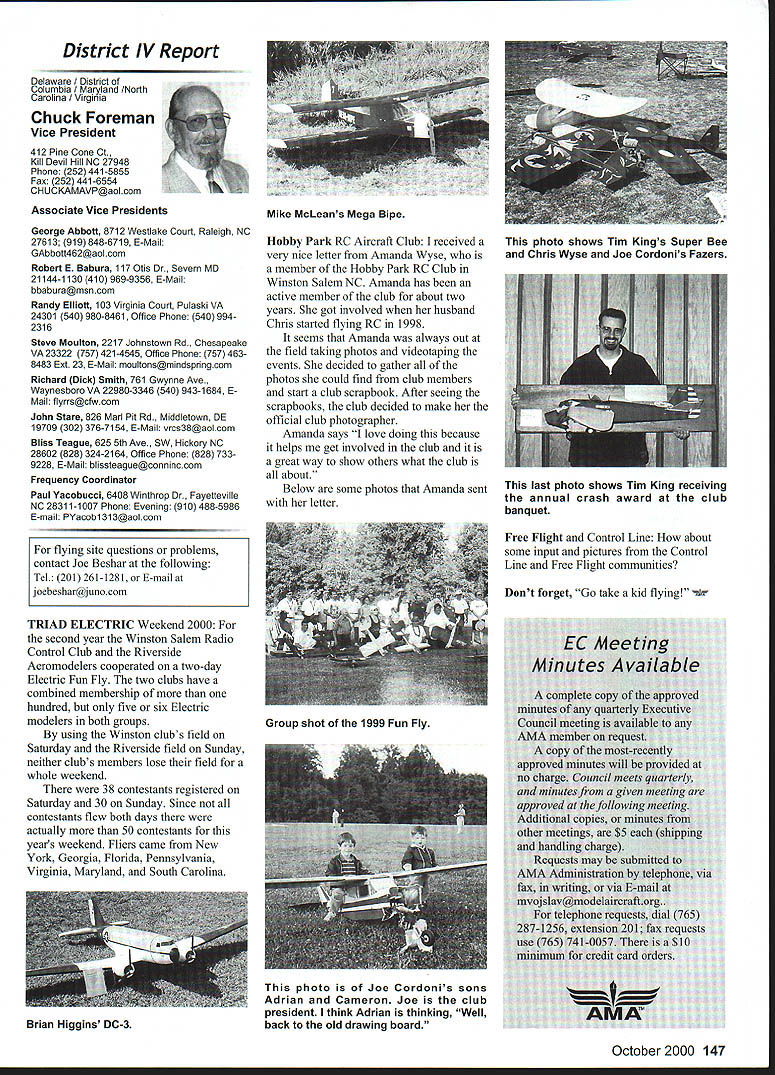
Triad Electric Weekend 2000: For the second year the Winston Salem Radio Control Club and the Riverside Aeromodelers cooperated on a two-day Electric Fun Fly. The two clubs have a combined membership of more than one hundred, but only five or six electric modelers in both groups.
By using the Winston club's field on Saturday and the Riverside field on Sunday, neither club's members lose their field for a whole weekend.
There were 38 contestants registered on Saturday and 30 on Sunday. Since not all contestants flew both days there were actually more than 50 contestants for this year's weekend. Fliers came from New York, Georgia, Florida, Pennsylvania, Virginia, Maryland, and South Carolina.
A model was retrieved by a powered 4x4 with flotation tires. The model was retrieved; it belongs to John Miller, a Canadian member.
A model belonging to George Janzen was also retrieved in the same way. By way of thanks, Bill asked George to make a small donation to AMA. George has mailed a check made out to AMA for AMA's Adopt-a-School Program. George, on behalf of AMA, we accept your donation and we thank you for your generosity.
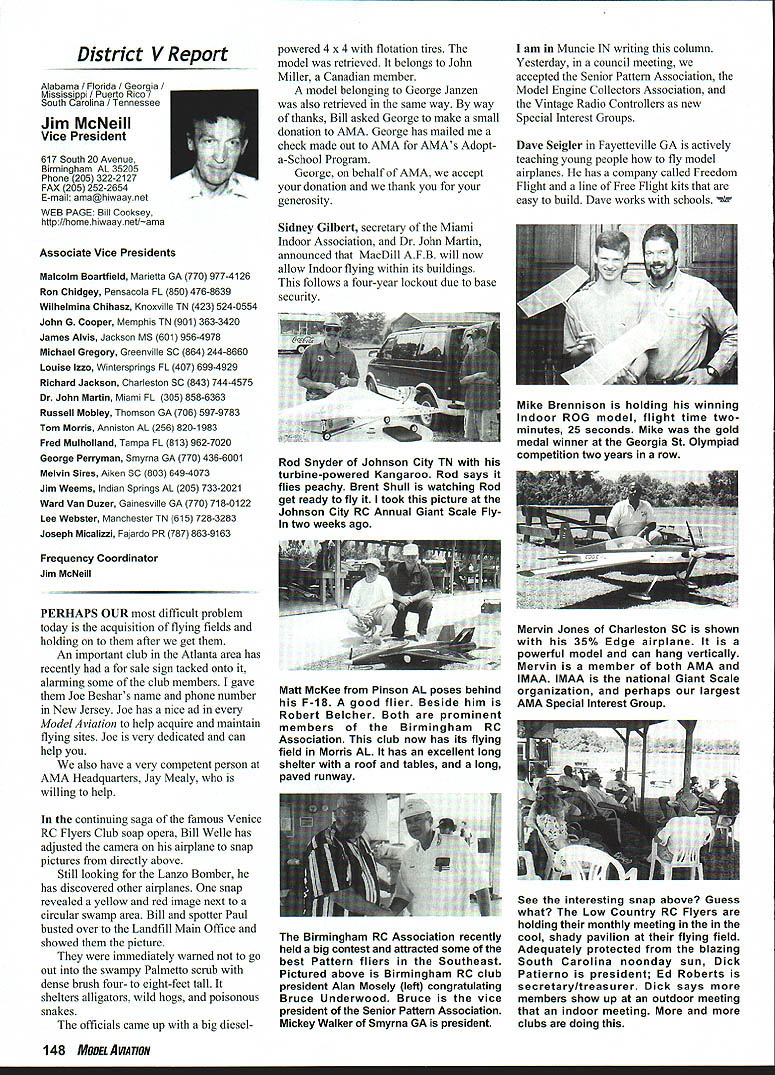
Sidney Gilbert, secretary of the Miami Indoor Association, and Dr. John Martin announced that MacDill A.F.B. will now allow indoor flying within its buildings. This follows a four-year lockout due to base security.
I am in Muncie IN writing this column. Yesterday, in a council meeting, we accepted the Senior Pattern Association, the Model Engine Collectors Association, and the Vintage Radio Controllers as new Special Interest Groups.
Dave Seigler in Fayetteville GA is actively teaching young people how to fly model airplanes. He has a company called Freedom Flight and a line of Free Flight kits that are easy to build. Dave works with schools.
I received an e-mail from a club president. He wanted to know why club activities in his area had not appeared in my column.
My answer to him was that I had not received anything from the clubs.
Do you want an activity of your club to appear in this monthly column? If so, then send photographs and information to me by regular mail. Send plenty of text and 10 to 15 good pictures and you might just get the entire column.
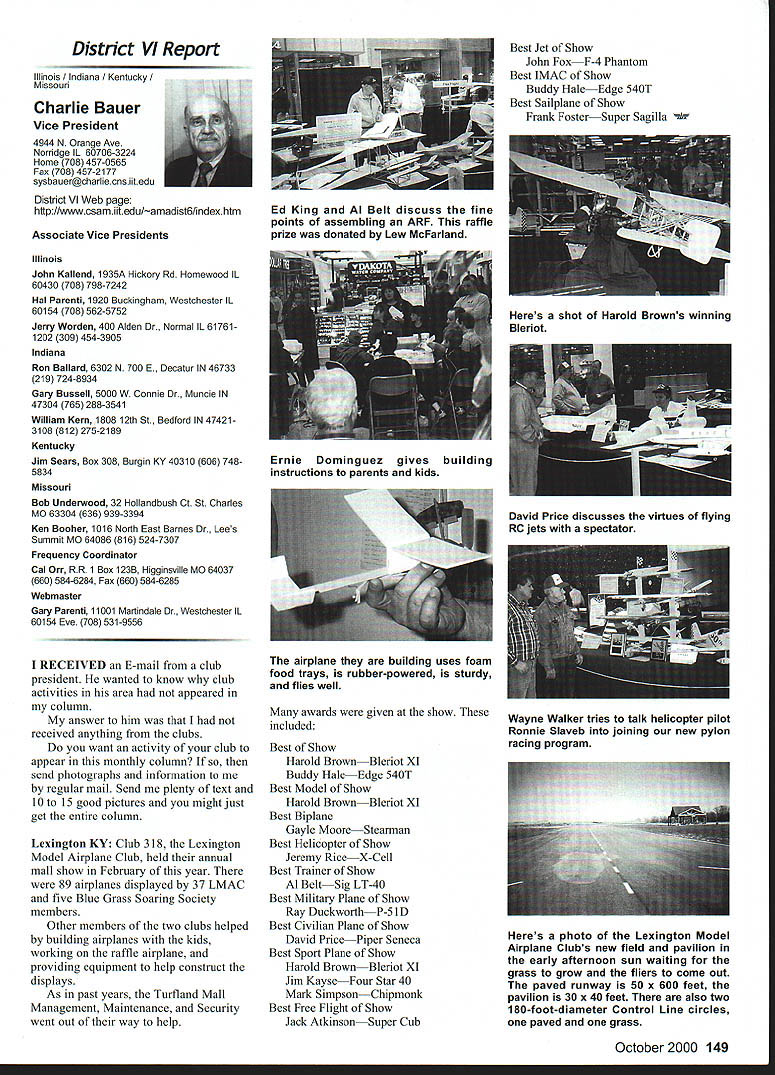
Lexington KY: Club 318, the Lexington Model Airplane Club, held their annual mall show in February of this year. There were 89 airplanes displayed by 37 LMAC and five Blue Grass Soaring Society members.
Other members of the two clubs helped by building airplanes with the kids, working on the raffle airplane, and providing equipment to help construct the displays.
As in past years, the Turrald Mall Management, Maintenance, and Security went out of their way to help.
Ernie Dominguez gives building instructions to parents and kids.
The airplane they are building uses foam food trays, is rubber-powered, is sturdy, and flies well.
Many awards were given at the show, including:
- Best of Show: Harold Brown — Bleriot XI; Buddy Hale — Edge 540T
- Best Model of Show: Harold Brown — Bleriot XI
- Best Biplane: Gayle Moore — Stearman
- Best Helicopter of Show: Jeremy Rice — X-Cell
- Best Trainer of Show: Al Belt — Sig LT-40
- Best Military Plane of Show: Ray Duckworth — P-51D
- Best Civilian Plane of Show: David Price — Piper Seneca
- Best Sport Plane of Show: Harold Brown — Bleriot XI; Jim Kayser — Four Star 40; Mark Simpson — Chipmunk
- Best Free Flight of Show: Jack Atkinson — Super Cub
- Best Jet of Show: John Fox — F-4 Phantom
- Best IMAC of Show: Buddy Hale — Edge 540T
- Best Sailplane of Show: Frank Foster — Super Sagitta
David Price discusses the virtues of flying RC jets with a spectator.
Wayne Walker tries to talk helicopter pilot Ronnie Slawbe into joining our new pylon racing program.
Here's a photo of the Lexington Model Airplane Club's new field and pavilion in the early afternoon sun waiting for the grass to grow and the fliers to come out. The paved runway is 50 x 600 feet, the pavilion is 30 x 40 feet. There are also two 180-foot-diameter Control Line circles, one paved and one grass.
AMA News
Here it is, October already, and in the northern climes we have signs that our outdoor flying season is about over. There is a crispness in the early morning hours, and maybe even a touch of overnight frost.
It is also time to turn our thoughts toward indoor functions at the club level. Usually this means the election of club officers, the Christmas party or annual banquet, and the ever-popular swap meets where we can offer to others equipment we no longer need or look for something for ourselves that we just cannot do without. There are some good deals available occasionally.
This month is the start of catch-up time, where I will have articles and pictures of events that have happened and did not have sufficient space in previous columns.
If your club has not sent in anything to date, now is the time. Remember this column has a three-month lead time. Let us all share in your experiences.
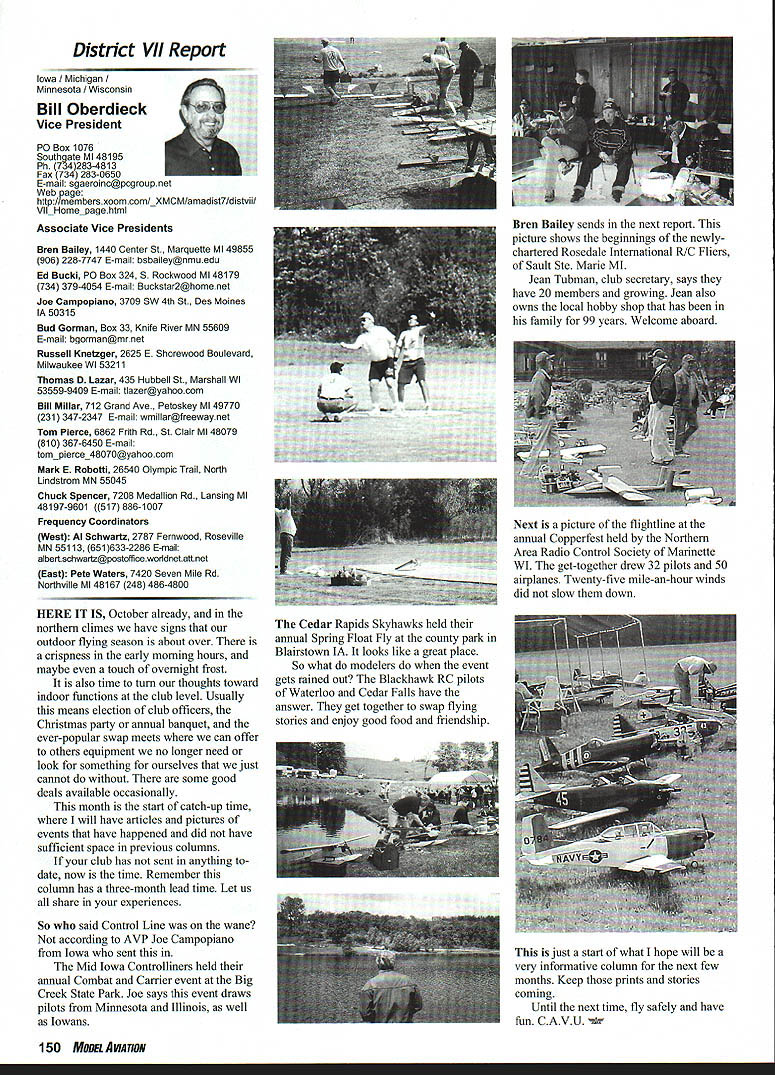
So who said Control Line was on the wane? Not according to AVP Joe Campopiano from Iowa who sent this in.
The Mid Iowa Controlliners held their annual Combat and Carrier event at the Big Creek State Park. Joe says this event draws pilots from Minnesota and Illinois, as well as Iowans.
The Cedar Rapids Skyhawks held their annual Spring Float Fly at the county park in Blairstown IA. It looks like a great place.
So what do modelers do when the event gets rained out? The Blackhawk RC pilots of Waterloo and Cedar Falls have the answer. They get together to swap flying stories and enjoy good food and friendship.
Bren Bailey sends in the next report. This picture shows the beginnings of the newly-chartered Rosedale International R/C Fliers, of Sault Ste. Marie MI.
Jean Tubman, club secretary, says they have 20 members and growing. Jean also owns the local hobby shop that has been in his family for 99 years. Welcome aboard.
Next is a picture of the flightline at the annual Copperfest held by the Northern Area Radio Control Society of Marinette WI. The get-together drew 32 pilots and 50 airplanes. Twenty-five mile-an-hour winds did not slow them down.
This is just a start of what I hope will be a very informative column for the next few months. Keep those prints and stories coming.
Until the next time, fly safely and have fun. C.A.V.U.
AMA News
As an organization, the AMA respects the privacy of its membership.
There are instances when a member seeks to locate another member of the organization. A long-lost friend or modeling contact is sought, technical information and/or modeling assistance is desired, or another valid reason may exist.
Rather than releasing personal information about any member, I choose to use an indirect approach to solve such problems. If for such valid reasons, you have the need to contact a member of the AMA, especially one who resides within AMA District VIII (TX, NM, OK, AR, or LA), please contact me directly at the above address.
Please do not be offended when I ask the modeling reason or need to contact this member!
I will contact the member by telephone, U.S. Mail, or e-mail, and pass along the modeling reason that you are seeking to contact him or her. I will provide this individual the means to contact you if they choose to do so. Continuing contact will be strictly up to that individual and his or her assessment of your need to contact them.
For further explanation of this procedure please contact me.
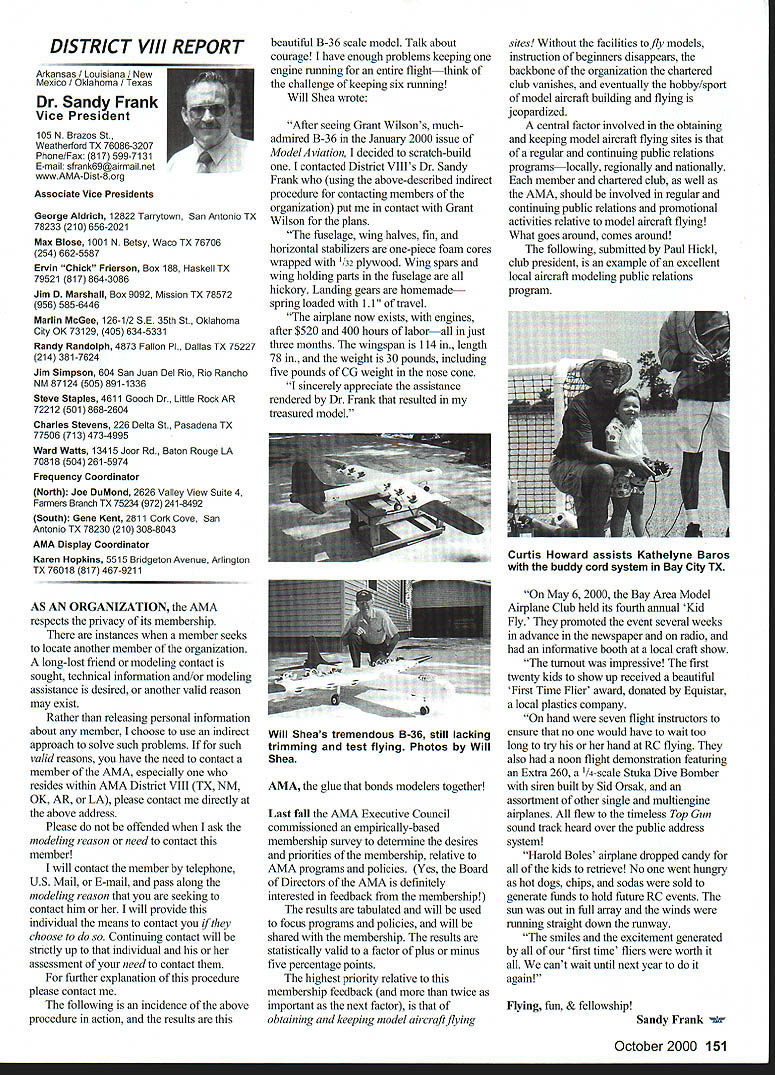
The following is an instance of the above procedure in action, and the results are this beautiful B-36 scale model. Talk about courage! I have enough problems keeping one engine running for an entire flight—think of the challenge of keeping six running!
Will Shea wrote: "After seeing Grant Wilson's much-admired B-36 in the January 2000 issue of Model Aviation, I decided to scratch-build one. I contacted District VIII's Dr. Sandy Frank who (using the above-described indirect procedure for contacting members of the organization) put me in contact with Grant Wilson for the plans.
"The fuselage, wing halves, fin, and horizontal stabilizers are one-piece foam cores wrapped with 1/32 plywood. Wing spars and wing holding parts in the fuselage are all hickory. Landing gears are monomacs—spring loaded with 1-1/4" of travel.
"The airplane now exists, with engines, after $250 and 400 hours of labor—all in just three months. The wingspan is 114 in., length 78 in., and the weight is 30 pounds, including five pounds of CG weight in the nose cone.
"I sincerely appreciate the assistance rendered by Dr. Frank that resulted in my treasured model."
AMA, the glue that bonds modelers together!
Membership Survey and Priorities
Last fall the AMA Executive Council commissioned an empirically-based membership survey to determine the desires and priorities of the membership, relative to AMA programs and policies. The results are tabulated and will be used to focus programs and policies, and will be shared with the membership. The results are statistically valid to a factor of plus or minus five percentage points.
The highest priority relative to the membership feedback (and more than twice as important as the next factor) is obtaining and keeping model aircraft flying sites. Without the facilities to fly models, instruction of beginners disappears, the backbone of the organization—the chartered club—vanishes, and eventually the hobby/sport of model aircraft building and flying is jeopardized.
A central factor involved in obtaining and keeping model aircraft flying sites is a regular and continuing public relations program—locally, regionally and nationally. Each member and chartered club, as well as the AMA, should be involved in regular and continuing public relations and promotional activities relative to model aircraft flying.
The following, submitted by Paul Hickl, club president, is an example of an excellent local aircraft modeling public relations program.
"On May 6, 2000, the Bay Area Model Airplane Club held its fourth annual 'Kid Fly.' They promoted the event several weeks in advance in the newspaper and on radio, and had an informative booth at a local craft show.
"The turnout was impressive! The first twenty kids to show up received a beautiful 'First Time Flier' award, donated by Equestar, a local plastics company.
"On hand were seven flight instructors to ensure that no one would have to wait too long to try his or her hand at RC flying. They also had a noon flight demonstration featuring an Extra 260, a 1/4-scale Stuka Dive Bomber with siren built by Sid Orsak, and an assortment of other single- and multi-engine airplanes. All flew to the timeless Top Gun soundtrack through the public address system!
"Harold Boles' airplane dropped candy for all of the kids to retrieve! No one went hungry as hot dogs, chips, and sodas were sold to help raise funds for future RC events. The sun was out in full array and the winds were running straight down the runway.
"The smiles and excitement generated by all of our 'first time' fliers were worth it all. We can't wait until next year to do it again!"
Flying, fun, & fellowship!
Sandy Frank
District IX Report
Colorado / Kansas / Nebraska / North Dakota / South Dakota / Wyoming
Russ Miller Vice President 980 N. 3rd St. Carrington ND 58421 Phone: (701) 652-2321 Fax: (701) 652-2994 E-mail: [email protected]
Associate Vice Presidents
- Max Hansen, 1909 Wisconsin SW, Huron SD 57350
- Nathan Lancaster, 3597 S. Kendall Street, Denver CO 80235
- Troy Lapp, 1619 Wichita Dr., Bismarck ND 58504
- Travis McGinnis, 8027 W. 81st Circle, Arvada CO 80005
- Don Moden, 410 Hart St., Salina KS 67401
- Jim Ricketts, 4921 Fernwood Drive, Sioux Falls SD 57103-5573
- Jack L. Sibert, 3611 Kimberly Circle, Lincoln NE 68506-4524
- Chuck Smith, 1091 Cheshire Street, Casper WY 82609-3214
- Mike Weidner, 6535 Foxdale Circle, Colorado Springs CO 80919-1788
Frequency Coordinator Steve Mangles, c/o Radio Service Center, 918 S. Sheridan, Denver CO 80226
News from Nebraska
This year's "Up, Up, and Away" portion of the Summer Challenge Program is now history. It taught 11- and 12-year-old students how to build and fly control-line model airplanes.
The aircraft were Sig Skyraays, powered by Cox .049s. Eleven students built and flew their own airplanes during the four-day session.
Students: James Adams, Robby Pinkelman, Kevin Pinkelman, DJ Hubbard, Patrick Roy, Aaron Brewer, Justin Kathers, Bryan Burgess, Tony Reed, Heather Furr, Ronnie Wieler, Alex Wieler.
Construction instructors: Bob Furr and George Leib. Representing the Omahawks: Fred Wilke, Stephen Peck, Eugene Alexander, Ed Splitgerber, Ed Jelinek. Round-and-round flight instructors: Tom Egbert, George Leid, Bob Furr, Ed Jelinek.
This is a very rewarding program from the standpoint of both teacher and student. Thanks to Steve Peck who spearheaded the effort, and to the loyal assistants without whom it would never have come to pass.
News from Colorado
Monthly contest report from the newsletter of the Magnificent Mountain Men, by Bill Ettingron.
The contest started at 9:00 a.m. with a 10 mph wind blowing from the northwest. By noon the wind was nearly gone and plenty of thermals provided ideal flying conditions.
- Frank Mennano flew an original Slow Open Poser model with a very fast vertical climb and an extremely flat glide. Norm Roglitz won this event with his Satellite, soaring in a thermal for more than seven minutes.
- Pete McQuade demonstrated F1A (Nordic Glider) skills by putting up a perfect score of eight max flights (180 seconds each) for a total time of 1,440 seconds. Jerry Murphy assisted by launching and timing.
- John Anders' rubber-powered model won the Mulvihill event with three max flights for a total of 540 seconds.
- The Hand Launched Glider (HLG) and Catapult Launched Glider (CLG) events drew so much interest they were separately scored. Jack Ivey won HLG; Bill Gieseking won CLG with three max flights (120 seconds each).
- Seven modelers competed in the HLG/CLG shootout; Jack Ivey won the event.
Truly a glorious day for Free Flight models, with maxes scored on 45% of the official flights.
Last month I ran a story about a mall show held by the Rocky Mountain Aeromodelers Control Line Club. Here are some more photos from this May event.
---
(End of provided text.)
Transcribed from original scans by AI. Minor OCR errors may remain.

