
AMA News
Focus on Education
Rocco Ferrario AMA Education Committee Member
Yeah, sure—I could teach traditional summer school, but why would I want to?
Like many school districts across the nation, Napa Valley Unified Schools only offers summer school for remedial students—those who need extra help in the most basic skills. But what about the families of students who are at grade level? Is there anything exciting for the gifted child to sink his or her teeth into and help keep those intellectual juices flowing during the doldrums of summer vacation?
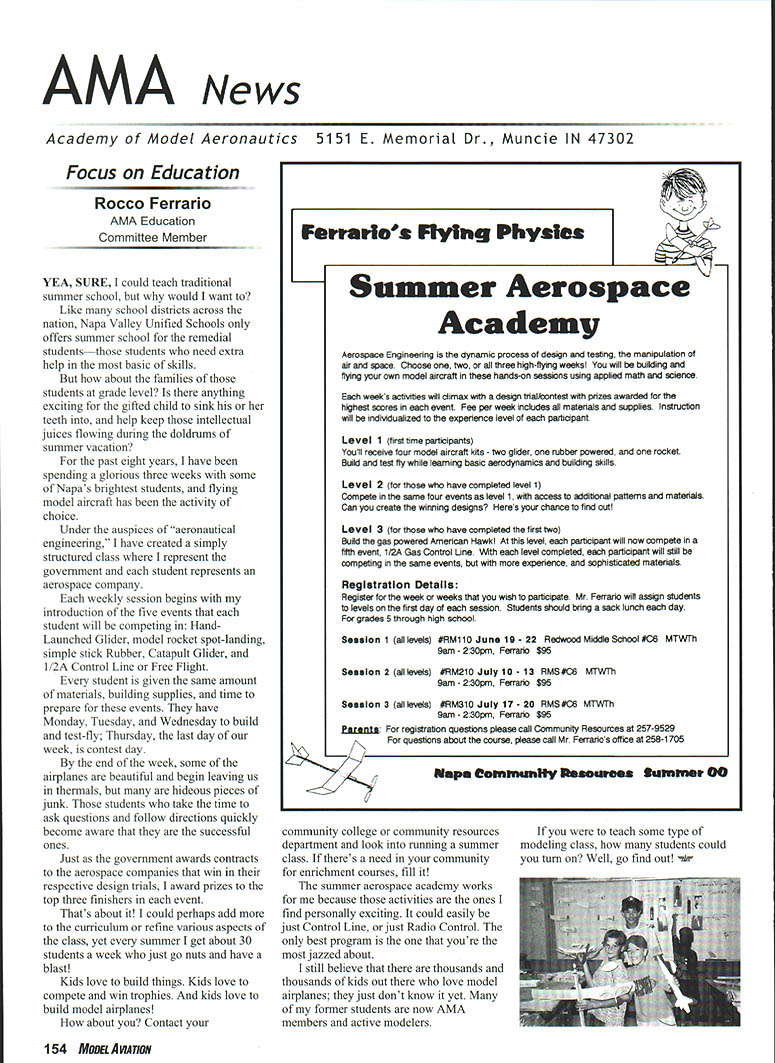
For the past eight years I have spent a glorious three weeks with some of Napa's brightest students, and flying model aircraft has been the activity of choice. Under the auspices of "aeronautical engineering," I created a simply structured class where I represent the government and each student represents an aerospace company.
Each weekly session begins with my introduction of the five events that each student will be competing in:
- Hand-Launched Glider
- Model rocket spot-landing
- Simple stick Rubber
- Catapult Glider
- 1/2A Control Line or Free Flight
Every student is given the same amount of materials, building supplies, and time to prepare for these events. They have Monday, Tuesday, and Wednesday to build and test-fly. Thursday, the last day of our week, is contest day.
By the end of the week, some of the airplanes are beautiful and begin leaving us in thermals, but many are hideous pieces of junk. Those students who take the time to ask questions and follow directions quickly become aware that they are the successful ones.
Just as the government awards contracts to the aerospace companies that win in their respective design trials, I award prizes to the top three finishers in each event.
That's about it! I could perhaps add more to the curriculum to refine various aspects of the class, yet every summer I get about 30 students a week who just go nuts and have a blast!
Kids love to build things. Kids love to compete and win trophies. And kids love to build model airplanes!
How about you? Contact your community college or community resources department and look into running a summer class. If there's a need in your community for enrichment courses, fill it!
The summer aerospace academy works for me because those activities are the ones I find personally exciting. It could easily be just Control Line, or just Radio Control. The only best program is the one that you're the most jazzed about.
I still believe that there are thousands and thousands of kids out there who love model airplanes; they just don't know it yet. Many of my former students are now AMA members and active modelers.
If you were to teach some type of modeling class, how many students could you turn on? Well, go find out!
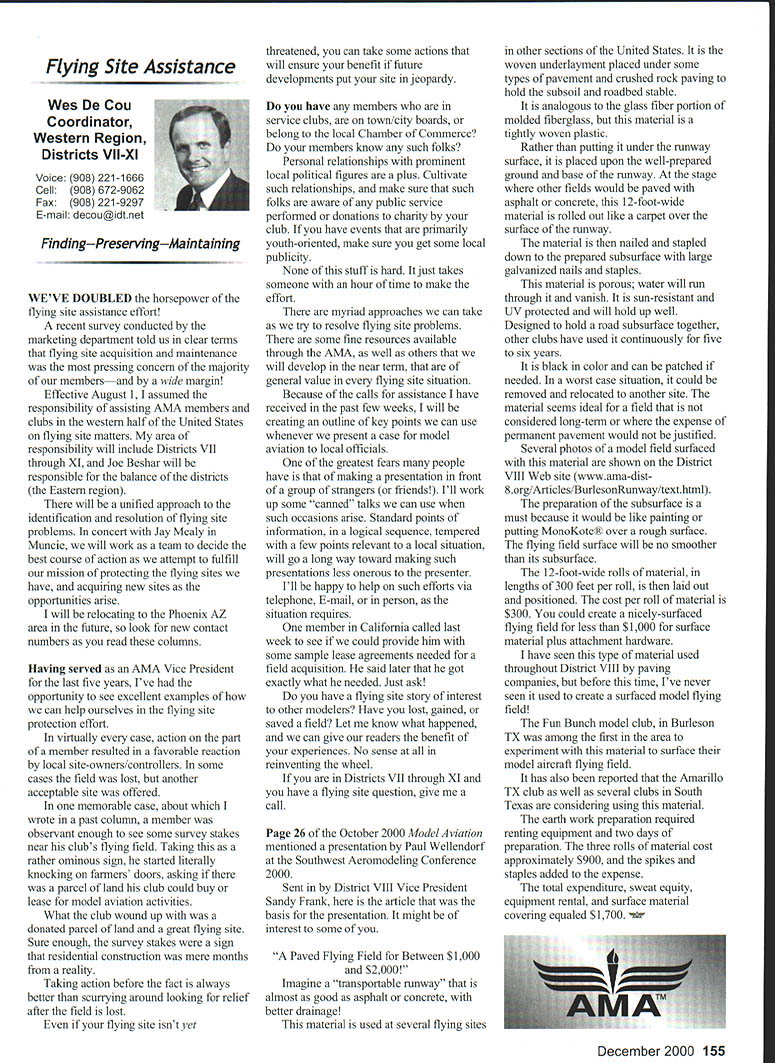
Flying Site Assistance
Wes De Cou Coordinator, Western Region, Districts VII–XI
Voice: (908) 221-1666 Cell: (908) 672-9062 Fax: (908) 221-9297 E-mail: [email protected]
Finding—Preserving—Maintaining
We've doubled the horsepower of the flying site assistance effort!
A recent survey conducted by the marketing department told us in clear terms that flying site acquisition and maintenance was the most pressing concern of the majority of our members—and by a wide margin.
Effective August 1, I assumed the responsibility of assisting AMA members and clubs in the western half of the United States on flying site matters. My area of responsibility will include Districts VII through XI, and Joe Beshar will be responsible for the balance of the districts (the Eastern region).
There will be a unified approach to the identification and resolution of flying site problems. In concert with Jay Mealy in Muncie, we will work as a team to decide the best course of action as we attempt to fulfill our mission of protecting the flying sites we have and acquiring new sites as opportunities arise.
I will be relocating to the Phoenix, AZ area in the future, so look for new contact numbers as you read these columns.
Having served as an AMA Vice President for the last five years, I've had the opportunity to see excellent examples of how we can help ourselves in the flying site protection effort.
In virtually every case, action on the part of a member resulted in a favorable reaction by local site owners/controllers. In some cases the field was lost, but another acceptable site was offered.
In one memorable case, about which I wrote in a past column, a member was observant enough to see some survey stakes near his club's flying field. Taking this as a rather ominous sign, he started literally knocking on farmers' doors, asking if there was a parcel of land his club could buy or lease for model aviation activities.
What the club found was a donated parcel of land and a great flying site. Sure enough, the survey stakes were a sign that residential construction was mere months from reality.
Taking action before the fact is always better than scurrying around looking for relief after the field is lost.
Even if your flying site isn't yet threatened, you can take some actions that will ensure your benefit if future developments put your site in jeopardy.
Do you have any members who are in service clubs, are on town/city boards, or belong to the local Chamber of Commerce? Do your members know any such folks? Personal relationships with prominent local political figures are a plus. Cultivate such relationships, and make sure that such folks are aware of any public service performed or donations to charity by your club. If you have events that are primarily youth-oriented, make sure you get some local publicity.
None of this is hard. It just takes someone with an hour of time to make the effort.
There are myriad approaches we can take as we try to resolve flying site problems. There are some fine resources available through the AMA, as well as others that we will develop in the near term, that are of general value in every flying site situation.
Because of the calls for assistance I have received in the past few weeks, I will be creating an outline of key points we can use whenever we present a case for model aviation to local officials.
One of the greatest fears many people have is that of making a presentation in front of a group of strangers (or friends!). I'll work up some "canned" talks we can use when such occasions arise. Standard points of information, in a logical sequence, tempered with a few points relevant to a local situation, will go a long way toward making such presentations less onerous to the presenter.
I'll be happy to help on such efforts via telephone, e-mail, or in person, as the situation requires.
One member in California called last week to see if we could provide him with some sample lease agreements needed for a field acquisition. He said later that he got exactly what he needed. Just ask!
Do you have a flying site story of interest to other modelers? Have you lost, gained, or saved a field? Let me know what happened, and we can give our readers the benefit of your experiences. No sense at all in reinventing the wheel.
If you are in Districts VII through XI and you have a flying site question, give me a call.
Page 26 of the October 2000 Model Aviation mentioned a presentation by Paul Wellendorf at the Southwest Aeromodelling Conference 2000. Sent in by District VIII Vice President Sandy Frank, here is the article that was the basis for the presentation. It might be of interest to some of you.
"A Paved Flying Field for Between $1,000 and $2,000"
Imagine a "transportable runway" that is almost as good as asphalt or concrete, with better drainage.
This material is used at several flying sites in other sections of the United States. It is the woven underlayment placed under some types of pavement and crushed rock paving to hold the subsoil and roadbed stable.
It is analogous to the glass fiber portion of molded fiberglass, but this material is a tightly woven plastic.
Rather than putting it under the runway surface, it is placed upon the well-prepared ground and base of the runway. At the stage where other fields would be paved with asphalt or concrete, this 12-foot-wide material is rolled out like a carpet over the surface of the runway.
The material is then nailed and stapled down to the prepared subsurface with large galvanized nails and staples.
This material is porous; water will run through it and vanish. It is sun-resistant and UV-protected and will hold up well.
Designed to hold a road subsurface together, other clubs have used it continuously for five to six years.
It is black in color and can be patched if needed. In a worst-case situation, it could be removed and relocated to another site. The material seems ideal for a field that is not considered long-term or where the expense of permanent pavement would not be justified.
Several photos of a model field surfaced with this material are shown on the District VIII web site (www.ama-district8.org/Articles/BurlsonRunway/text.html).
The preparation of the subsurface is a must because it would be like painting or putting MonoKote over a rough surface. The flying field surface will be no smoother than its subsurface.
The 12-foot-wide rolls of material, in lengths of 300 feet per roll, are then laid out and positioned. The cost per roll of material is $300. You could create a nicely surfaced flying field for less than $1,000 for surface material plus attachment hardware.
I have seen this type of material used throughout District VIII by paving companies, but before this time I had never seen it used to create a surfaced model flying field.
The Fun Bunch model club in Burleson, TX was among the first in the area to experiment with this material to surface their model aircraft flying field.
It has also been reported that the Amarillo, TX club as well as several clubs in South Texas are considering using this material.
The earthwork preparation required, equipment, and two days of labor are proportionate. The rolls of material cost approximately $900, and the spikes and staples added to the expense.
The total expenditure—sweat equity, equipment rental, and surface material covering—equaled $1,700.
Transcribed from original scans by AI. Minor OCR errors may remain.

