
Executive Council Meeting Highlights
Motions made at the October 27, 2001 Executive Council Meeting in Muncie, IN
The motions below are part of the unofficial minutes of the meeting. Minutes from a given meeting are not official until they are approved at the next quarterly Council meeting. Questions or comments on the motions should be addressed to your District Vice President.
It was moved, and approved by acclamation, to accept the minutes of the July 9, 2001 Executive Council meeting.
Mail Vote of August 16, 2001: To approve the revised wording in the Safety Code for Organized Radio Control Racing Events. 7) c. Distance from the pylon to the nearest spectators (line) will be in accordance with the current Competition Regulations under the RC Pylon Racing section for the specific event pending two or three pylon course layout. Motion passed.
It was moved, and approved by acclamation, to award 5A status to the 2002 Nationals. Dates will be Indoor May 29–June 2 in Johnson City, TN; Outdoor July 5–August 9 in Muncie, IN.
It was moved, and approved by acclamation, a new member who causes our membership to reach 200,000 will be awarded Life Membership.
Motion I: Moved by J. McNeill (V), seconded by C. Bauer (VI), Bylaws for clubs will be mandatory for new clubs in 2002 and for all clubs in 2003 and beyond. Headquarters will create samples of bylaws and minimum requirements for such bylaws. Motion passed unanimously.
Motion II: Moved by C. Bauer (VI), seconded by S. Frank (VIII), to accept the 2002 Operating/Capital budget as presented. Motion passed unanimously.
Motion III: Moved by D. Krafft (I), seconded by B. Nelson (XI), that the AMA Royal General Liability Policy be amended to exclude coverage for libel, slander, or defamation of character claims or suits between or among members and clubs. This exclusion will not apply to bodily injury or property damage claims or suits. Motion passed unanimously.
Motion IV: Moved by J. McNeill (V), seconded by C. Bauer (VI), to accept the document Proposed Method of Handling Complaints re: Contest Directors (below). Complaints regarding a Contest Director (CD) while acting in their official capacity as a representative of the Academy of Model Aeronautics should be made in writing to AMA Headquarters, who in turn will forward to the Vice President (VP) of the District where the complaint originated or where the infraction occurred. The VP would review the written complaints and contact the complainant if additional information or clarification is required. The VP would then contact the CD, explain the complaint and request a response in writing. The VP will review the complaint and the CD's response, and take whatever course of action is appropriate to resolve the problem, whether it is a warning or a prohibition of the CD's license. If there is a revocation given, it should be in writing. The CD may appeal any action taken by the VP in writing and request the matter be reviewed by the Executive Council. The Executive Council could uphold the action taken by the VP, overturn it, or refuse to hear it. Any elected officer of the Academy of Model Aeronautics shall have the same rights as a VP for purposes of the document. Motion passed: 8 yes; 4 no (II, IV, VII, VIII); 1 abstain (NAA).
Motion V: Moved by C. Bauer (VI), seconded by C. Foreman (IV), that a five member Flying Site Development/Improvement Grant Committee be established. (Members of the committee to be appointed by the President.) Motion passed: 12 yes; 1 no (VIII).
Motion VI: Moved by S. Frank (VIII), seconded by J. McNeill (V), to approve "Designation Status by Executive Council" for the District VIII Southwestern Aeromodeling Conference retroactively to May 2001. This retrospective approval being limited to twelve (12) earned memberships. Motion passed: 7 yes; 5 no (I, II, IV, IX, EVP); 1 abstain (NAA).
Motion VII: Moved by C. Bauer (VI), seconded by C. Foreman (IV), when the President is elected or re-elected, at the first meeting of the Executive Council all committee chairpersons appointed by the President are removed as chairs. The President can then reappoint the chairpersons or appoint new persons. Motion passed unanimously.
Motion VIII: Moved by S. Frank (VIII), seconded by R. Hanson (X), to add #6 to Criteria for Special Interest Groups. (#6— I attest that my Special Interest Group has an open membership regardless of race, color, creed, national origin, gender, age, or disability.) Motion passed unanimously.
Motion IX: Moved by C. Bauer (VI), seconded by C. Foreman (IV), when a class or event is added by election or personal choice, that person is automatically removed from all committees. Reappointment to a committee under the rules for committee appointment is allowed. Motion passed unanimously.
Motion X: Moved by S. Frank (VIII), seconded by C. Bauer (VI), beginning in 2002, to subdivide the existing Control Line (CL) Contest Board into five (5) freestanding boards. Those boards are designated as: CL Combat; CL Racing; CL Precision Aerobatics; CL Speed; and CL Carrier. Motion passed unanimously.
Motion XI: Moved by S. Frank (VIII), seconded by C. Bauer (VI), beginning in 2002, the Executive Council shall create a new, separate and freestanding Contest Board for R/C Combat. Motion passed unanimously.
Awards:
- One Superior Service award.
- One Distinguished Service award.
AMA News
Election 2001 Results
President Dave Brown 16,339 Rich Hanson 4,710 Frank Tiano 6,739
District I Vice President Don Krafft 1,231
District V Vice President Jim McNeill 2,065 Manny Sousa 804 Tony Stillman 1,985
District IX Vice President Russ Miller 673 P.M. McGuigan 568
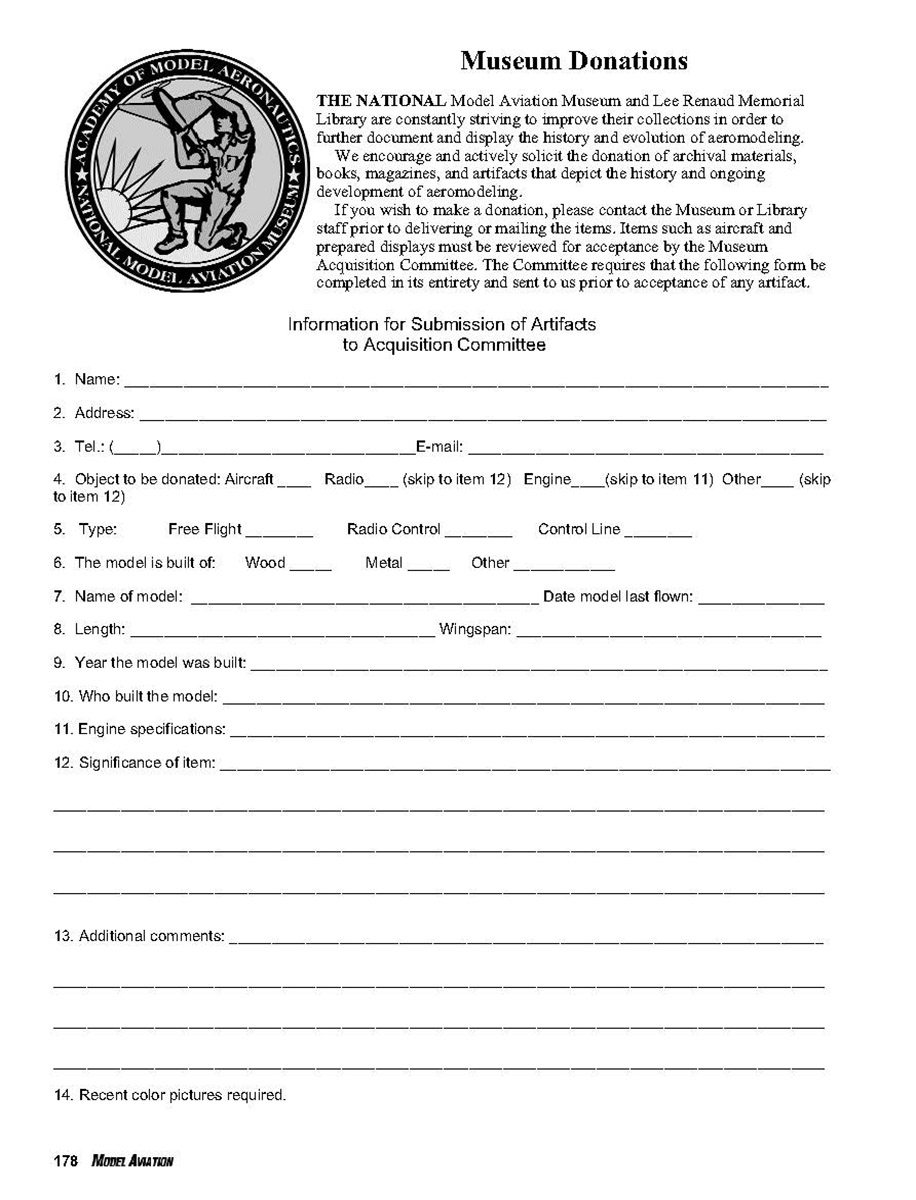
Model Aviation Hall of Fame
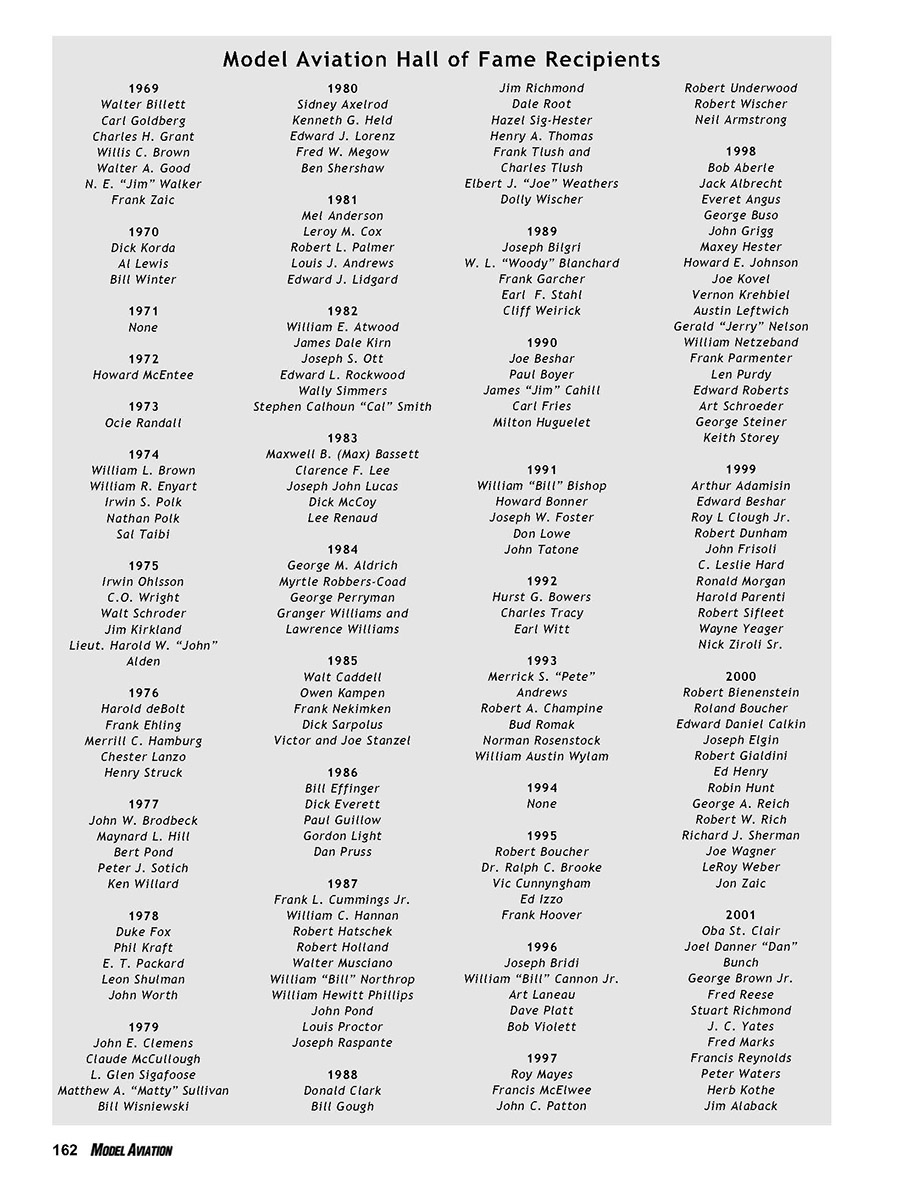
ESTABLISHED IN 1969, the Model Aviation Hall of Fame honors those men and women who have made significant contributions to the sport of aeromodeling.
The list of members is long and distinguished. Contributions may be in volunteer or administrative activities, product development, competition performance, or a variety or combination of activities.
The selection committee is composed of past and present AMA presidents and one individual selected from each of the 11 districts by the respective vice presidents. Each year, the new class is inducted into the Model Aviation Hall of Fame, and the winners are announced in Model Aviation magazine.
Any AMA member can submit a Hall of Fame nomination. For a nomination form or further information, contact Michael Smith (765) 287-1256, ext. 500.
The committee has selected the following modelers to the 2001 Model Aviation Hall of Fame.
G. James Alaback
James (Jim) Alaback, 75, has been involved in aeromodeling for more than 65 years. He has been a competitor, designer, experimenter, editor, writer, and model historian.
Jim has belonged to many clubs throughout the years, including the Hawthorn Model Airplane Club which he helped establish and served as president of; the Purdue Aeromodelers in the 1940s; the Southwestern Michigan Whirlwinds; and the Chicago Aeronuts. From 1985 to the present, Jim has been with the San Diego Scale Staffel, Orbiters, and Aeroneers, where he has served as newsletter editor, club secretary, and president.
Jim was the secretary of the AMA Special Interest Group for the Model Engine Collectors Association and has been the president of the Kits and Plans Antiquitous since 1992.
Jim was the club champion of the Hawthorn Model Airplane Club in the categories of Solid Scale and Indoor Rubber. These were the first of a long string of accomplishments in model competition. He was the winner in two Chicago suburban-area Scale model contests, and took second place in the Midwestern States Gas Model Championships, had a third-place finish in the San Diego Scale Staffel Annual Contests, and was recently the winner of numerous events in an area named Grand Champion in the Staffel contests.
Jim also competed in the National Aeromodeling Championships (Nats) and the Society of Antique Modelers Championships, placing in the categories of Rubber, Gas Free Flight, Gas R/C, and Old-Time RC Gas events.
Jim's articles, more than 125, have been published in nine different national publications. He has had plans published for the Bellanca Skyrocket, the Mauboussin Type 40, the Taylor Cub J-2, and the Heath Racer.
Jim served as a consultant and historian for the San Diego Aerospace Museum, where he developed the exhibit "History of Model Aviation." The exhibit opened to the public in 1997.
George W. Brown Jr.
George W. Brown Jr., better known as Brownie, began his modeling career in 1932 when he built a rubber-powered Taylorcraft. He has been an active proponent and avid ambassador of the hobby since.
Brownie began flying Control Line (CL) airplanes in the 1940s after many years of flying Free Flight (FF). He has since competed in almost all aspects of model aviation including FF, Radio Control (RC), Pylon, and CL speed. Brownie's first love is CL Speed, and in 1990 he became the Speed Grand National Champion.
In 1966, Brownie was the recipient of the Sportsmanship Award at the National Aeromodeling Championships (Nats). He has amassed more than 400 trophies in his career.
Brownie was a charter member and president of one of the original Sky Devil Model Flying Clubs in the mid-1940s. He was a charter member and president of the Santa Aeronauts, a local flying club during the 1950s, and a member of the Staten Island Speed Team from 1963 to the present as well as a past-president of the club. Brownie is also a member of the Staten Island Modelers, a group composed of model enthusiasts of airplanes, model boats, and model cars.
In 1996 Brownie opened a model shop near his Staten Island home and is making a positive impact on the youth in his neighborhood.
Joel Danner Bunch
Joel Danner Bunch was only 44 years old when he died in 1948, but in his short lifetime he made a lasting impact on the history of model aviation.
Known to everyone as Dan, he produced many model airplane articles dealing with the design and flying of model airplanes prior to forming his own company. Dan began the Bunch Model Airplane Company in South Central Los Angeles in 1934.
In 1935, Dan and his staff designed and manufactured a gas model engine. It was introduced to the public in 1936 and was reviewed in the August 1936 Model Airplane News.
Their next engine was the Mighty Midget which could be purchased in kit form for as little as $9.95 in 1937. Other model airplane engines of the day were selling for at least twice this amount, which made Dan Bunch the "Henry Ford" of model aviation. This engine enabled many young modelers to get a start in model aviation.
Other engines followed, including the Mighty Marine, the Warrior, the Speedway, and the powerful Tiger Aero series.
The last engine that Dan was associated with was the Contestor, which was produced in 1946. The Lucas and Smith Mfg. Co. were the manufacturers of the engine.
Herb Kothe
Herb Kothe, 73, has been involved in aeromodeling for more than 63 years. His competition endeavors include Wakefield, Payload, and Society of Antique Modelers (SAM) events.
Herb built many dimer models in the 1940s, but his first serious model was the Comet Zipper powered by a Brown D. By 1945, Herb was flying in contests and even won the Grand Champion Award in the Omaha World Herald competition for all ages.
He won first place in the 1948 Olathe National Aeromodeling Championships (Nats) in the Payload event, which made possible an article and plans published in the 1949 Air Trails magazine.
Herb's victories and achievements became a long list. He placed in three Plymouth International competitions, took first place three times in the Nats, was a Wakefield team contestant in seven World Championships, won the SAM Grand Championship three years in a row, and won Grand Champion at the 1998 SAM Champs. Herb also placed first in the 1998 Great Gathering of Turkeys and first in Old Timer Rubber at the 1998 Flying Aces Club (FAC) Nats. His entire list of awards is too numerous to mention.
Herb has these thoughts on success: "Learn to concentrate on the event you want to excel in and win. Do a lot of testing. Fly, fly, fly, and keep on flying."
Fred M. Marks
Fred M. Marks, 67, has been a modeler for more than 40 years. He is founder and CEO of FMA, Inc., which he started in 1985. The hobby-products distribution arm of FMA, Inc. is FMA Direct, which includes a line of model RC receivers, servos, switches, and electronic speed controls.
Fred also designed the Ace Digital Commander, the Silver Seven Series, RC section of the Micro Pro 8000, various Ace servos, and collaborated with Signetics in the design and manufacture of the NE544 servo chip, which is the foundation of all modern RC microservos.
He has been a member of the Academy of Model Aeronautics and the District of Columbia Radio Control Club since 1959.
A member of the AMA Frequency Committee from 1978 to the present, Fred served as the chairman of the committee from 1987 to 1991. The Frequency Committee established the 1991 RC specifications to which all current RC equipment must adhere. The Frequency Committee was responsible for coordinating efforts with the Federal Communications Commission to provide the RC industry with the 70 RC channels, which are used by all RC models in the United States.
Fred has authored two books on RC modeling, Getting the Most from Radio Control Systems and Basics of Radio Controlled Models, both of which were instrumental for added success in the RC hobby.
Fred L. Reese
Fred Reese began his modeling career in third grade when he built his first model of a nonflying Super Zilch from scratch. He designed numerous models, excelled as a writer, editor, publisher, and columnist, served as an officer in many clubs, and was a successful Contest Director (CD) and competitor.
Fred was a Leader Member and CD of the AMA. He was one of the organizers of the Quarter Midget Racing Club of Orange County, CA, which was instrumental in making Quarter Midget RC racing an official event. He won many honors placing in local and national contests.
One of the most prolific and successful model designers of our time, Fred had 55 construction articles and original designs published between 1971 and 2000. These designs included RC, CL, and FF, as well as model boats. Seven of these models adorned the cover of various aeromodeling magazines, and 34 were manufactured into kits.
Fred wrote articles for RCM and Model Aviation, monthly columns for Model Builder and RCM, and was a contributing editor for RCM.
He was the in-house designer for House of Balsa, the owner of Golden Age Models, a designer for ACE R/C, and was a designer for Thunder Tiger ARF and House of Balsa®. Fred was the owner of Fred Reese Models which, at the time of his death in November 2000, produced RC kits.
Francis Reynolds
Francis Reynolds, 81, has been involved in aeromodeling for more than 60 years. His endeavors include design, competition, consulting, and writing. In the years between 1941 and 1981 he was an engineer for Boeing, holding eight patents.
In the June 1946 issue of Air Trails, his article "Control Line Aerobatics" outlined the problems encountered in flying a CL model inverted and doing outside stunts. Francis discovered how these problems could be solved. His solutions were based on more than two years of experimentation culminating in an aircraft, the Moskito, which was capable of successfully completing the maneuvers.
Unlike earlier CL models such as the A.J. Walker Fireball, which had a flat-bottom...
(Swampscott Daily Item excerpt)
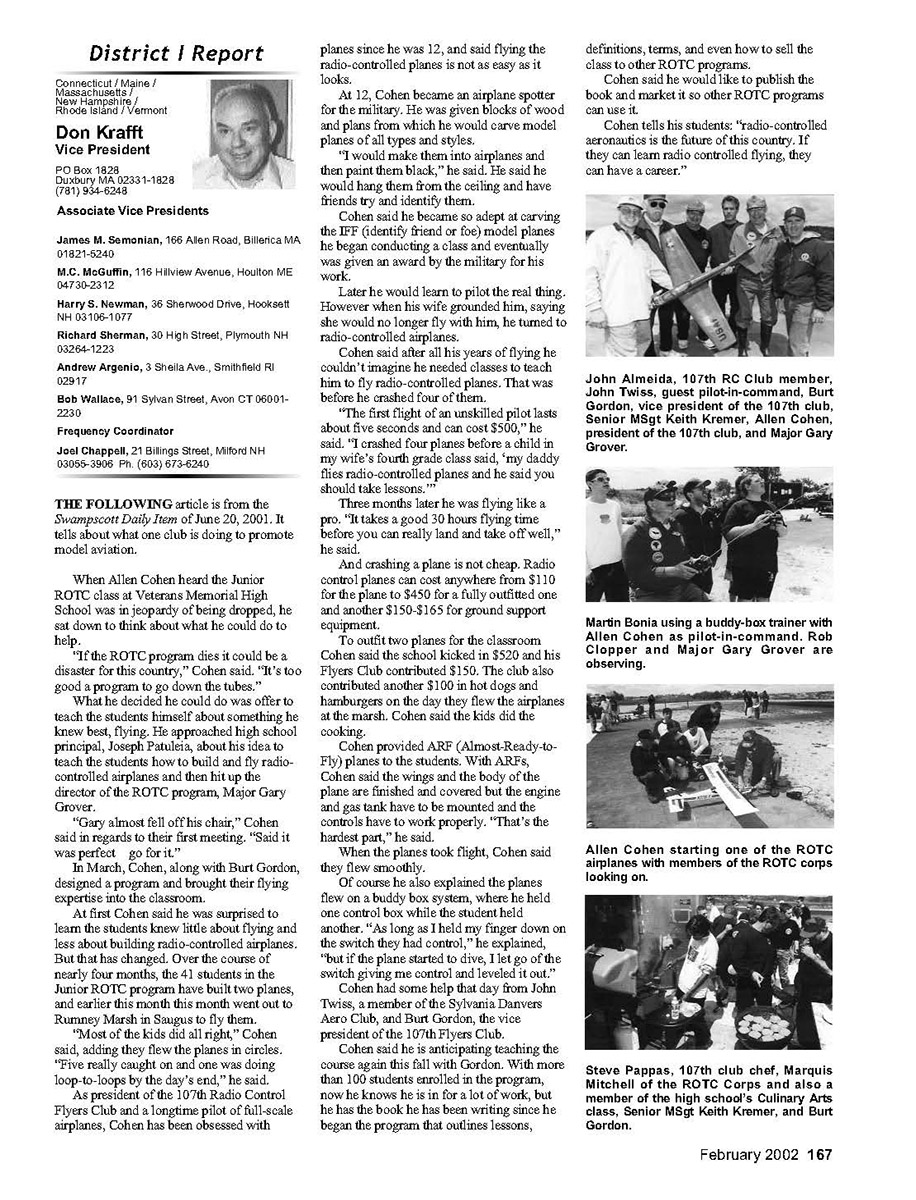
THE FOLLOWING article is from the Swampscott Daily Item of June 20, 2001. It tells about what one club is doing to promote model aviation.
When Allen Cohen heard the Junior ROTC class at Veterans Memorial High School was in jeopardy of being dropped, he sat down to think about what he could do to help.
"If the ROTC program dies it could be a disaster for this country," Cohen said. "It's too good a program to go down the tubes."
What he decided he could do was offer to teach the students how to build and fly radio-controlled airplanes and then hit up the director of the ROTC program, Major Gary Grover.
"Gary almost fell off his chair," Cohen said in regards to their first meeting. "Said it was perfect for us."
In March, Cohen, along with Burt Gordon, designed a program and brought their flying expertise into the classroom.
At first Cohen said he was surprised to learn the students knew little about flying and less about building radio-controlled airplanes. But that has changed. Over the course of nearly four months, the 41 students in the Junior ROTC program have built two planes and earlier this month the students went out to Rumney Marsh in Saugus to fly them.
"Most of the kids did all right," Cohen said, adding they flew the planes in circles. "Five really caught on and one was doing loop-to-loops by the day's end," he said.
As president of the 107th Radio Control Flyers Club and a longtime pilot of full-scale airplanes, Cohen has been obsessed with planes since he was 12, and said flying the radio-controlled planes is not as easy as it looks.
At 12, Cohen became an airplane spotter for the military. He was given blocks of wood and plans from which he could carve model planes of all types and styles.
"I would make them into airplanes and then paint them black," he said. He said he would hang them from the ceiling and have friends try and identify them.
Cohen said he became so adept at carving the IFF (identify friend or foe) model planes he began conducting a class and eventually was given an award by the military for his work.
Later he would learn to pilot the real thing. However when his wife grounded him, saying she would no longer fly with him, he turned to radio-controlled airplanes.
Cohen said after all his years of flying he couldn't imagine he needed classes to teach him to fly radio-controlled planes. That was before he crashed four of them.
"The first flight of an unskilled pilot lasts about five seconds and can cost $500," he said. "I crashed four planes before a child in my wife's fourth grade class said, 'my daddy flies radio-controlled planes and he said you should take lessons.'"
Three months later he was flying like a pro. "It takes a good 30 hours flying time before you can really land and take off well," he said.
And crashing a plane is not cheap. Radio control planes can cost anywhere from $110 for the plane to $450 for a fully outfitted one and another $150–$165 for ground support equipment.
To outfit two planes for the classroom Cohen said the school kicked in $520 and his Flyers Club contributed $150. The club also contributed another $100 in hot dogs and hamburgers on the day they flew the airplanes at the marsh. Cohen said the kids did the cooking.
Cohen provided ARF (Almost-Ready-to-Fly) planes to the students. With ARFs, Cohen said the wings and the body of the plane are finished and covered but the engine and gas tank have to be mounted and the controls have to work properly. "That's the hardest part," he said.
When the planes took flight, Cohen said they flew smoothly.
Of course he also explained the planes flew on a buddy box system, where he held one control box while the student held another. "As long as I held my finger down on the switch they had control," he explained, "but if the plane started to dive, I let go of the switch giving me control and leveled it out."
Cohen had some help that day from John Twiss, a member of the Sylvania Danvers Aero Club, and Burt Gordon, the vice president of the 107th Flyers Club.
Cohen said he is anticipating teaching the course again this fall with Gordon. With more than 100 students enrolled in the program, now he knows he is in for a lot of work, but he has the book he has been writing since he began the program that outlines lessons, definitions, terms, and even how to sell the class to other ROTC programs.
Cohen said he would like to publish the book and market it so other ROTC programs can use it.
Cohen tells his students: "radio-controlled aeronautics is the future of this country. If they can learn radio controlled flying, they can have a career."
AMA News
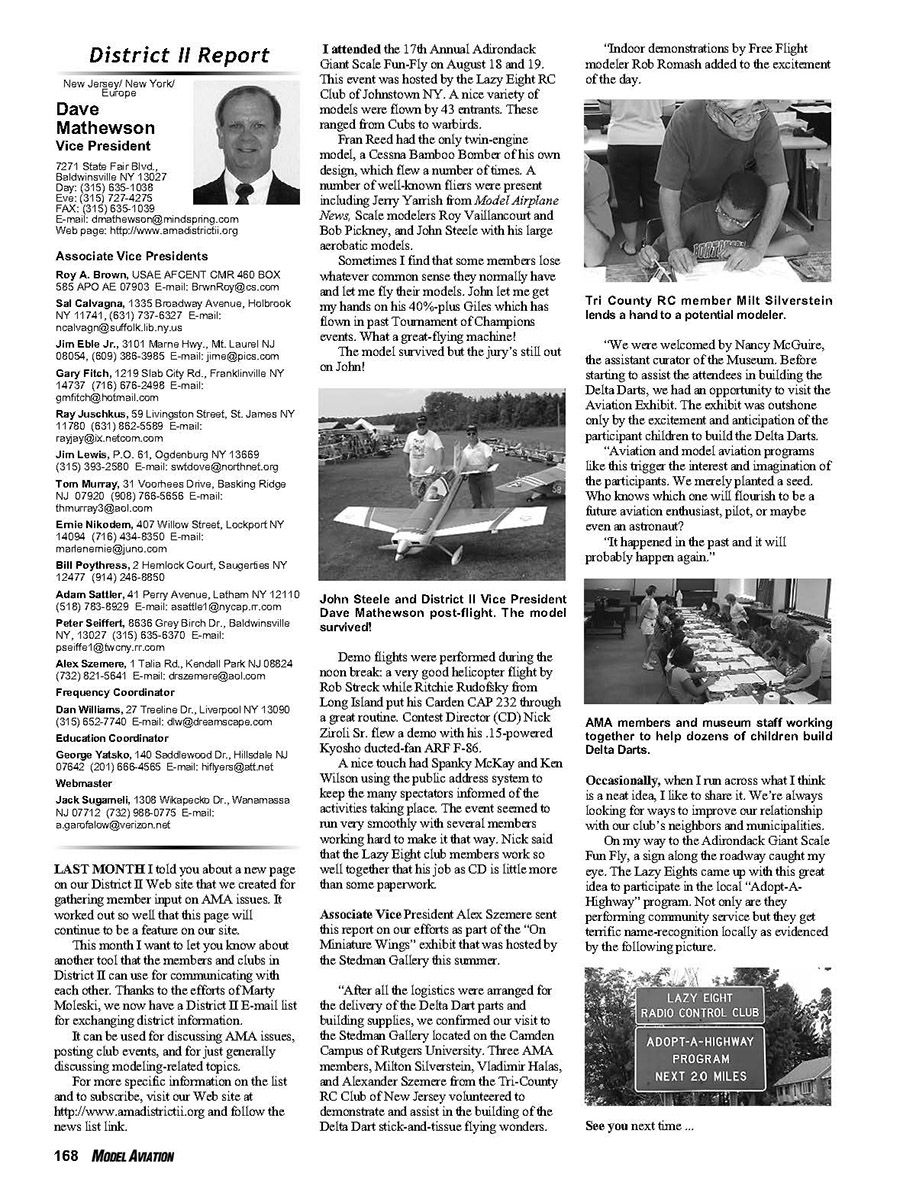
I attended the 17th Annual Adirondack Giant Scale Fun-Fly on August 18 and 19. This event was hosted by the Lazy Eight RC Club of Johnstown, NY. A nice variety of models were flown by 43 entrants. These ranged from Cubs to warbirds.
Fran Reed had the only twin-engine model, a Cessna Bamboo Bomber of his own design, which flew a number of times. A number of well-known fliers were present including Jerry Yarnish from Model Airplane News, scale modelers Roy Vaillancourt and Bob Pickney, and John Steele with his large aerobatic models.
Sometimes I find that some members lose whatever common sense they normally have and let me fly their models. John let me get my hands on his 40%-plus Giles which has flown in past Tournament of Champions events. What a great-flying machine!
The model survived but the jury's still out on John!
Demo flights were performed during the noon break: a very good helicopter flight by Rob Streck while Ritchie Rudofsky from Long Island put his Carden CAP 232 through a great routine. Contest Director (CD) Nick Zirolli Sr. flew a demo with his .15-powered Kyosho ducted-fan ARF F-86.
A nice touch had Spanky McKay and Ken Wilson using the public address system to keep the many spectators informed of the activities taking place. The event seemed to run very smoothly with several members working hard to make it that way. Nick said that the Lazy Eight club members work so well together that his job as CD is little more than some paperwork.
Associate Vice President Alex Szemere sent this report on our efforts as part of the "On Miniature Wings" exhibit that was hosted by the Stedman Gallery this summer.
"After all the logistics were arranged for the delivery of the Delta Dart parts and building supplies, we confirmed our visit to the Stedman Gallery located on the Camden Campus of Rutgers University. Three AMA members, Milton Silverstein, Vladimir Halas, and Alexander Szemere from the Tri-County RC Club of New Jersey volunteered to demonstrate and assist in the building of the Delta Dart stick-and-tissue flying wonders.
"Indoor demonstrations by Free Flight modeler Rob Romash added to the excitement of the day.
"We were welcomed by Nancy McGuire, the assistant curator of the Museum. Before starting to assist the attendees in building the Delta Darts, we had an opportunity to visit the Aviation Exhibit. The exhibit was outshone only by the excitement and anticipation of the participants chosen to build the Delta Darts.
"Aviation and model aviation programs like this trigger the interest and imagination of the participants. We merely planted a seed. Who knows which one will flourish to be a future aviation enthusiast, pilot, or maybe even an astronaut?
"It happened in the past and it will probably happen again."
Occasionally, when I run across what I think is a neat idea, I like to share it. We're always looking for ways to improve our relationship with our club's neighbors and municipalities.
On my way to the Adirondack Giant Scale Fun-Fly, a sign along the roadway caught my eye. The Lazy Eights came up with this great idea to participate in the local "Adopt-A-Highway" program. Not only are they performing community service but they get terrific name-recognition locally as evidenced by the following picture.
See you next time ...
AMA News
Sheila Nitsch is now the Contest Coordinator for the Ohio and West Virginia portions of District III. Sheila and her husband Terry are certainly a family that is recognized within the contest arena in a very positive manner.
If you are a Contest Director (CD) in need of a sanction for the upcoming year, please file the application as soon as possible. I am often amazed by CDs who apply for a sanction with little time to spare and then wonder why the contest did not attract numerous competitors.
Sheila's address is 5650 Boyd Road, Grove City, Ohio 43123. Her telephone number and E-mail address are: (614) 877-3453 and [email protected]
Please allow this great lady the time and courtesy needed to assist you.
The modelers in District III should be proud of three members of the Westerville Model Aeronautics Association (WMAA). Tom Hayden has been elected president of the IMAA, Bob Bush has been elected vice president, and Gary Smith is the new District III IMAA director.
It is obvious that these gentlemen had a very positive effect on their local club and will certainly be a big asset for the IMAA. If you are interested in large Radio Control aircraft, you should consider membership in the IMAA!
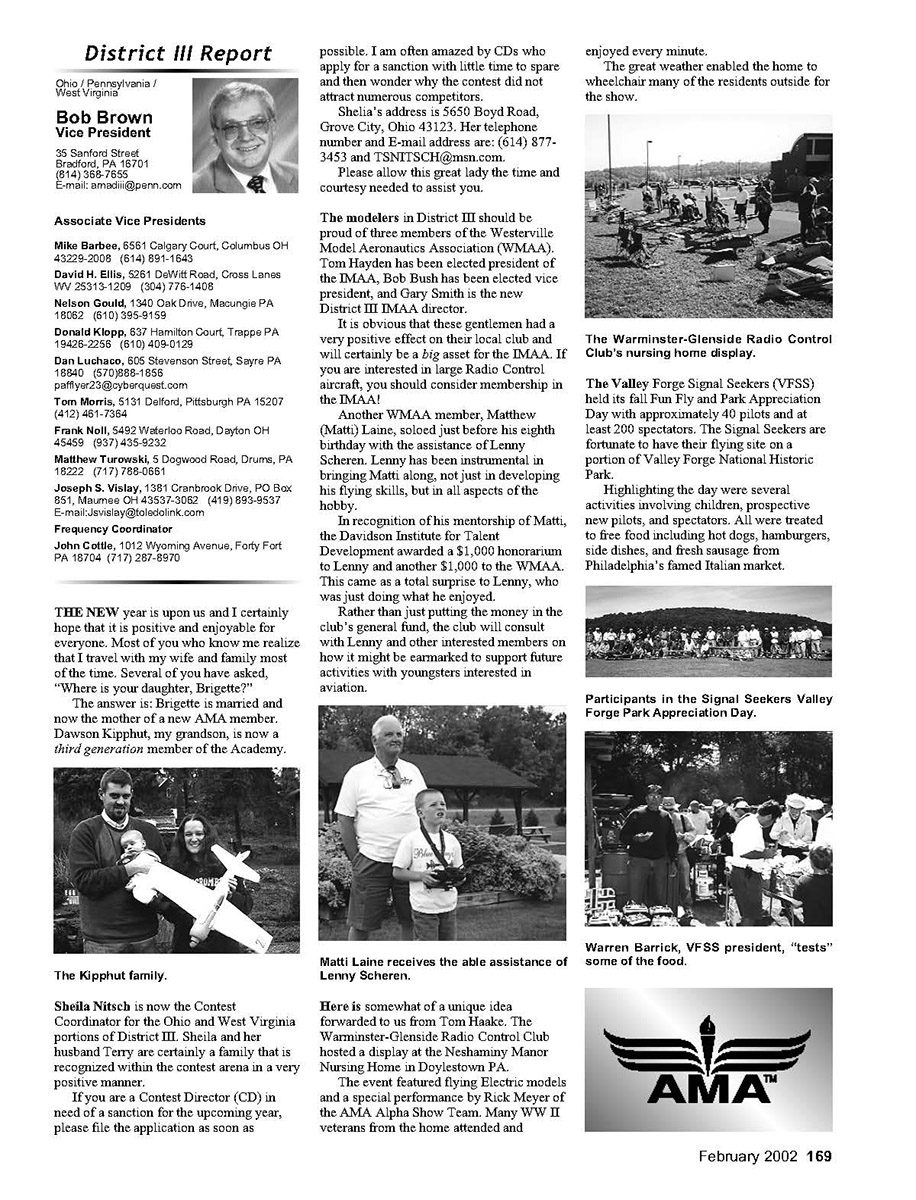
Another WMAA member, Matthew (Matti) Laine, soloed just before his eighth birthday with the assistance of Lenny Scheren. Lenny has been instrumental in bringing Matti along, not just in developing his flying skills, but in all aspects of the hobby.
In recognition of his mentorship of Matti, the Davidson Institute for Talent Development awarded a $1,000 honorarium to Lenny and another $1,000 to the WMAA. This came as a total surprise to Lenny, who was just doing what he enjoyed.
Rather than just putting the money in the club's general fund, the club will consult with Lenny and other interested members on how it might be earmarked to support future activities with youngsters interested in aviation.
Here is somewhat of a unique idea forwarded to us from Tom Haake. The Warminster-Glenside Radio Control Club hosted a display at the Neshaminy Manor Nursing Home in Doylestown, PA.
The event featured flying Electric models and a special performance by Rick Meyer of the AMA Alpha Show Team. Many WWII veterans from the home attended and enjoyed every minute.
The great weather enabled the home to wheelchair many of the residents outside for the show.
The Valley Forge Signal Seekers (VFSS) held its fall Fun Fly and Park Appreciation Day with approximately 40 pilots and at least 200 spectators. The Signal Seekers are fortunate to have their flying site on a portion of Valley Forge National Historic Park.
Highlighting the day were several activities involving children, prospective new pilots, and spectators. All were treated to free food including hot dogs, hamburgers, side dishes, and fresh sausage from Philadelphia's famed Italian market.
AMA News
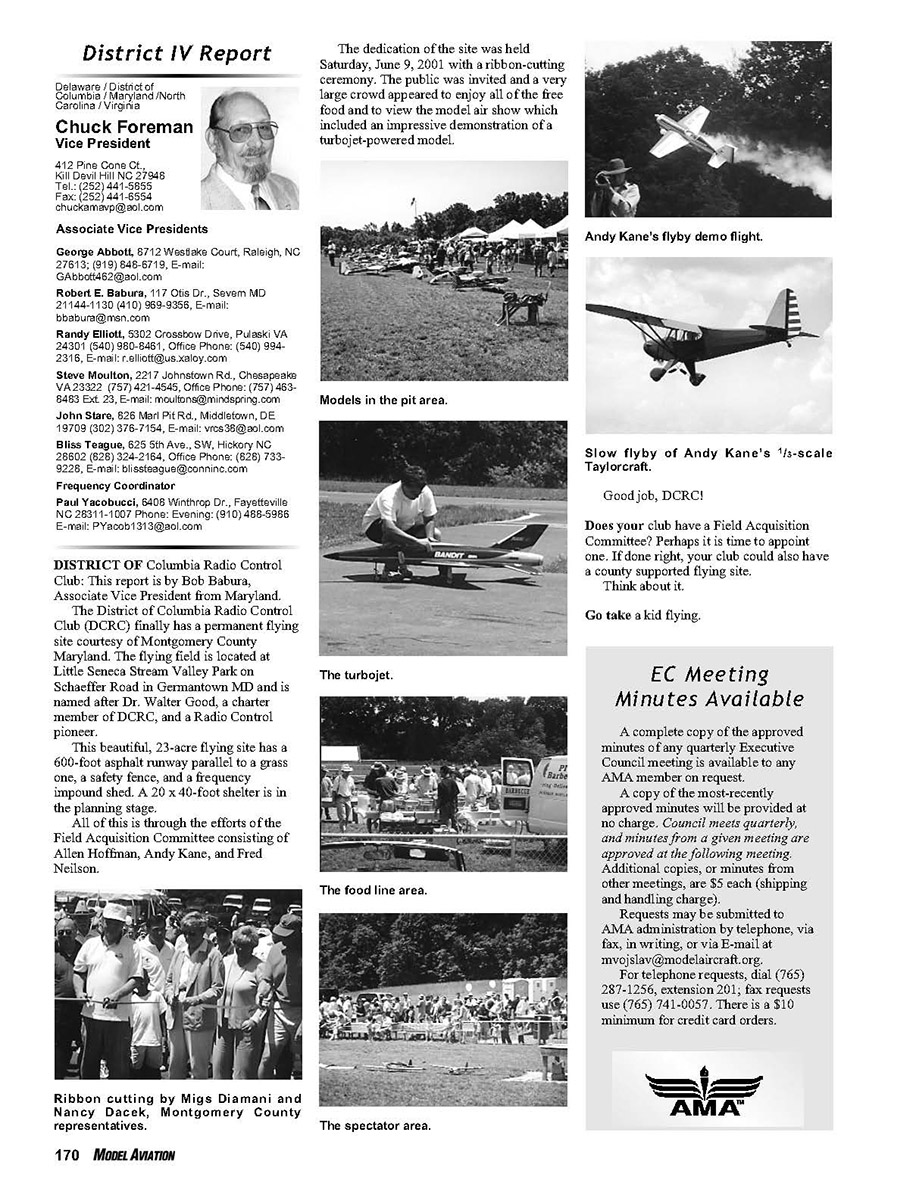
The dedication of the site was held Saturday, June 9, 2001 with a ribbon-cutting ceremony. The public was invited and a very large crowd appeared to enjoy all of the free food and to view the model air show which included an impressive demonstration of a turbojet-powered model.
Good job, DCRC!
Does your club have a Field Acquisition Committee? Perhaps it is time to appoint one. If done right, your club could also have a county supported flying site.
Think about it.
Go take a kid flying.
This time of the year clubs are electing new officers. If you need a Robert's Rules of Order, write or call me and I'll mail you one at no charge. I also have some pamphlets on Getting and Keeping Flying Sites by AMA. The new AMA Competition Regulations should be out by the time you receive this magazine. If you need any of these, let me know.
Our district has a new Web site, www.modelair.org. We have fun-flys and contests on the site with pictures. Check it out!
For those of you who have never seen our AMA museum—and some of you will probably never go to Muncie, IN—we have a presentation of the museum on our district Web site with lots of color pictures so you can see some of the priceless models and engines on display.
If we get favorable comments on the museum pictures on the site, we can add more pictures.
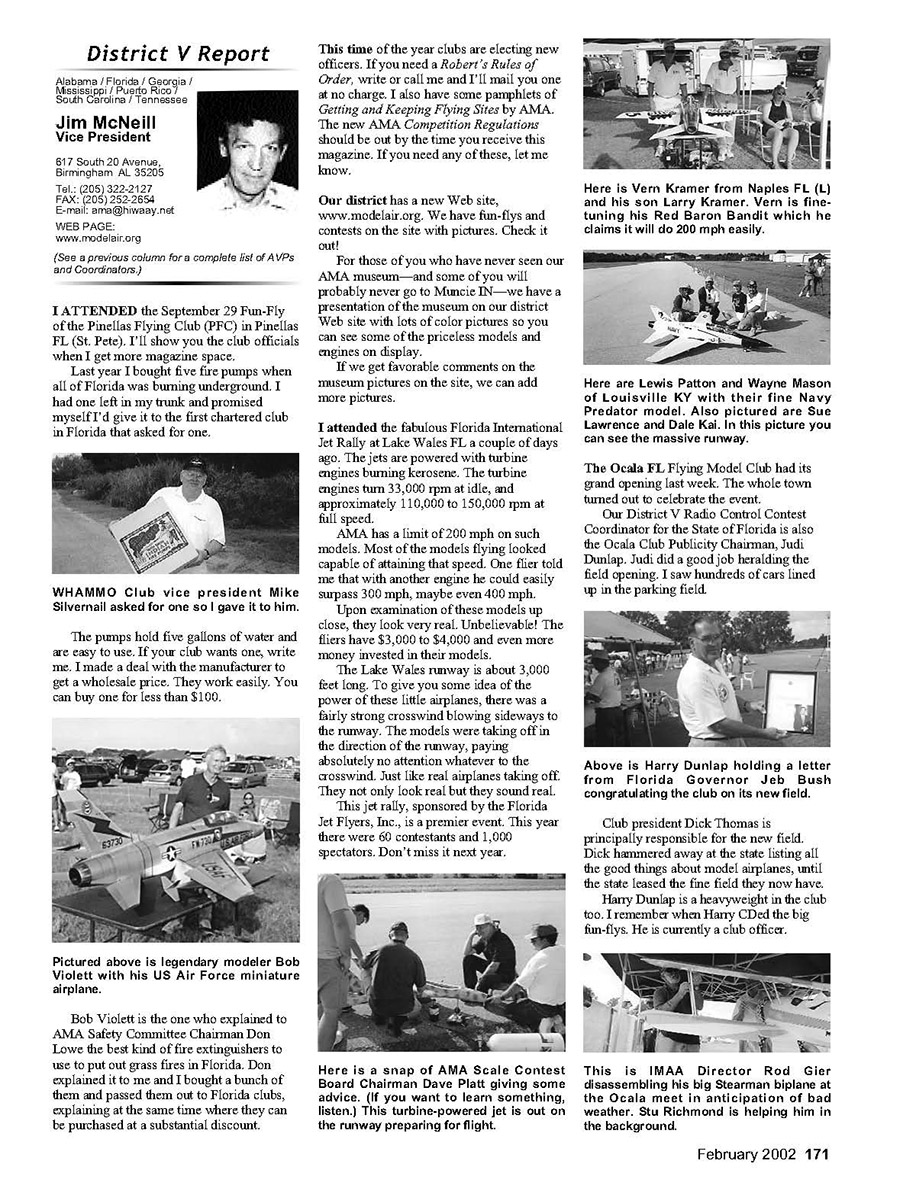
I attended the fabulous Florida International Jet Rally at Lake Wales, FL a couple of days ago. The jets are powered with turbine engines burning kerosene. The turbine engines turn 33,000 rpm at idle, and approximately 110,000 to 150,000 rpm at full speed.
AMA has a limit of 200 mph on such models. Most of the models flying looked capable of attaining that speed. One flier told me that with another engine he could easily surpass 300 mph, maybe even 400 mph.
Upon examination of these models up close, they look very real. Unbelievable! The fliers have $3,000 to $4,000 and even more money invested in their models.
The Lake Wales runway is about 3,000 feet long. To give you some idea of the power of these little planes, there was a fairly strong crosswind blowing sideways to the runway. The models were taking off in the direction of the runway, paying absolutely no attention whatever to the crosswind. Just like real airplanes taking off. They not only look real but they sound real.
This jet rally, sponsored by the Florida Jet Flyers, Inc., is a premier event. This year there were 60 contestants and 1,000 spectators. Don't miss it next year.
The Ocala, FL Flying Model Club had its grand opening last week. The whole town turned out to celebrate the event.
Our District V Radio Control Contest Coordinator for the State of Florida is also the Ocala Club Publicity Chairman, Judi Dunlap. Judi did a good job heralding the opening. I saw hundreds of cars lined up in the parking field.
Club president Dick Thomas is principally responsible for the new field. Dick hammered away at the state listing all the good things about model airplanes, until the state leased the fine field they now have.
Harry Dunlap is a heavyweight in the club too. I remember when Harry CDed the big fun-flys. He is currently a club officer.
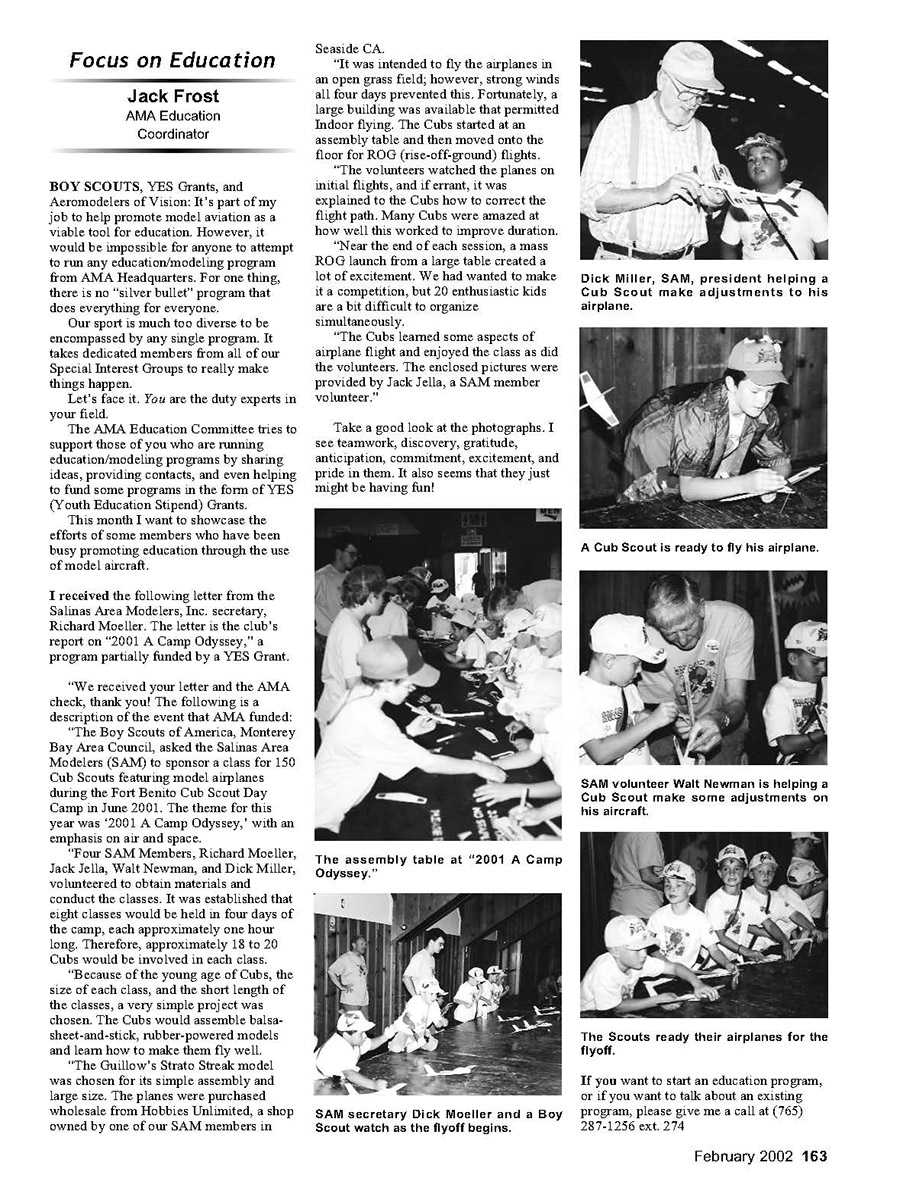
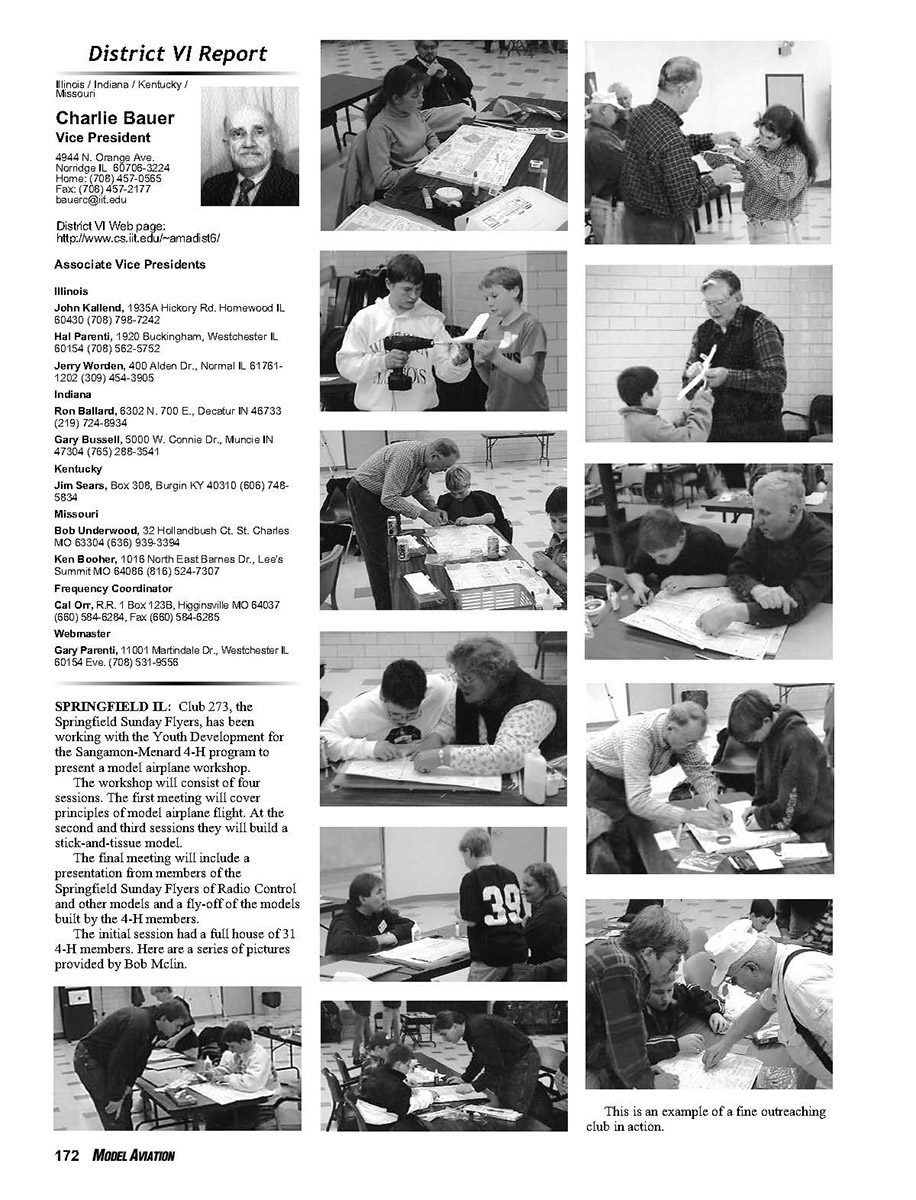
SPRINGFIELD, IL: Club 273, the Springfield Sunday Flyers, has been working with the Youth Development for the Sangamon-Menard 4-H program to present a model airplane workshop.
The workshop will consist of four sessions. The first meeting will cover principles of model airplane flight. At the second and third sessions they will build a stick-and-tissue model.
The final meeting will include a presentation from members of the Springfield Sunday Flyers of radio control and other models and a fly-off of the models built by the 4-H members.
The initial session had a full house of 31 4-H members. Here are a series of pictures provided by Bob Melin.
AMA News
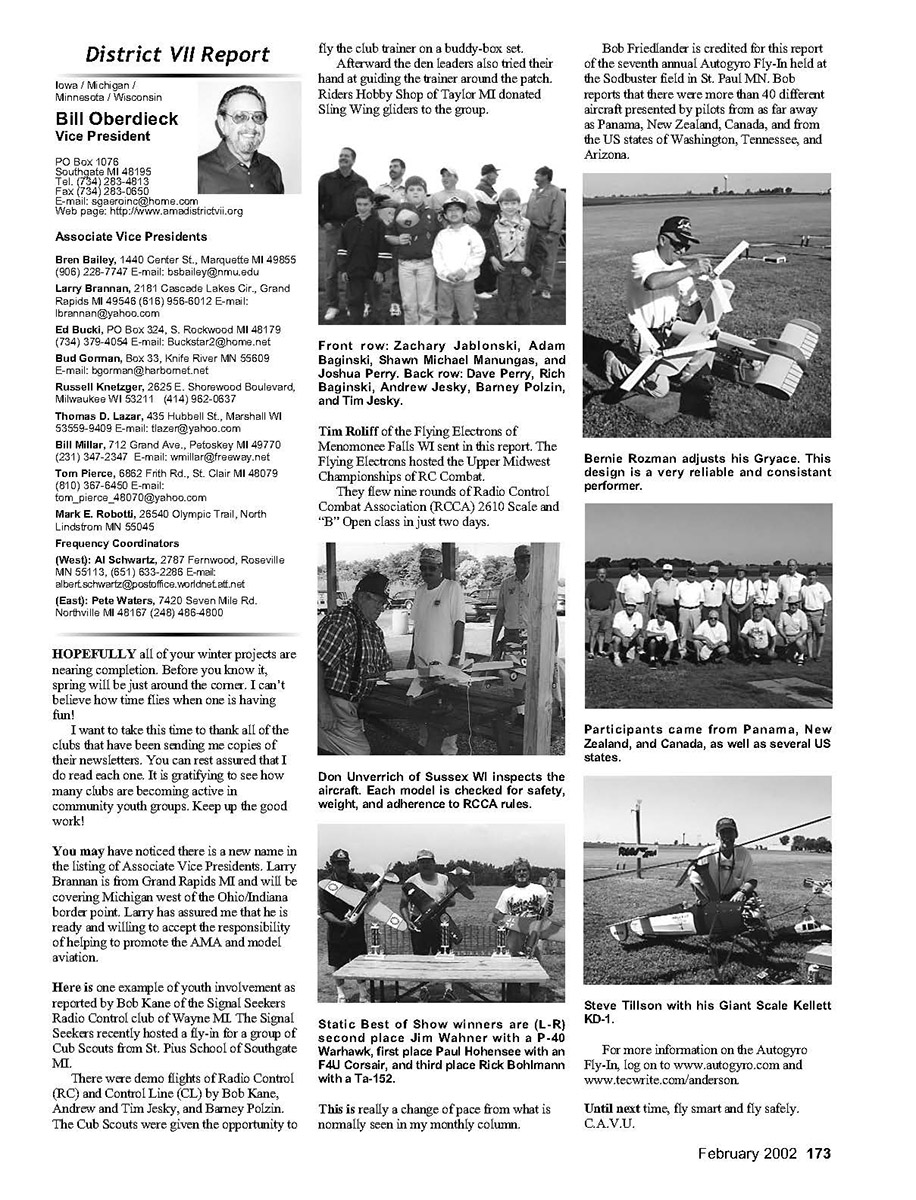
There were demo flights of Radio Control (RC) and Control Line (CL) by Bob Kane, Andrew and Tim Jesky, and Barney Polzin. The Cub Scouts were given the opportunity to fly the club trainer on a buddy-box set.
Afterward the den leaders also tried their hand at guiding the trainer around the patch. Riders Hobby Shop of Taylor, MI donated Sling Wing gliders to the group.
Bob Friedlander is credited for this report of the seventh annual Autogyro Fly-In held at the Sodbuster field in St. Paul, MN. Bob reports that there were more than 40 different aircraft presented by pilots from as far away as Panama, New Zealand, Canada, and from the US states of Washington, Tennessee, and Arizona.
Tim Roliff of the Flying Electrons of Menomonee Falls, WI sent in this report. The Flying Electrons hosted the Upper Midwest Championships of RCCA Combat. They flew nine rounds of Radio Control Combat Association (RCCA) 2610 Scale and "B" open class in just two days.
This is really a change of pace from what is normally seen in my monthly column.
For more information on the Autogyro Fly-In, log on to www.autogyro.com and www.tecnic.com/anderson.
Until next time, fly smart and fly safely. C.A.V.U.
The Chartered Club listing on the District VIII Web page is being modified to allow the authorized club contact person to update the club's information. This will allow us to keep the club listings accurate and current. These changes will be included on the Web site by the time you read this column.
Please visit the District Web site at http://www.AMA-Dist-8.org/Clubs/. You can then visit your club's listing. If you are the club's contact person, you will have received a letter from me outlining the ability to change the club information via the Web site. If anything about the club listing is incorrect on the Web site, it can be changed there.
Let me also remind everyone that we need an E-mail contact person and a listing for your newsletter editor where applicable for every club in the district. If your club's listing on the Web page does not include an E-mail contact and newsletter editor, please supply a name and E-mail address to me at [email protected].
I cannot overstate the need for each club to have an E-mail contact person and a newsletter editor listed! This may be any designated member. It is this way that open channels of communication can exist between your AMA leadership and local modeling activities.
A Joyous Occasion: At the conclusion of the October 2001 EC meeting on Sunday, October 28, Dave Mathewson, the District II Vice President, entered the bonds of holy matrimony in the new AMA Headquarters building.
This is, to the best of all recollections, the first time that a marriage ceremony has been performed on AMA property—and we all thought that our national Headquarters was just a flying site!
Congratulations and best wishes to both Dave and Ginger. May the joyous happiness we share in modeling be your experience throughout your married life!
Dave and Ginger Mathewson were married in the lobby of AMA's Headquarters building on October 28, 2001.
AMA, the glue that bonds modelers—and marriages—together!
AMA chartered clubs need bylaws. Within the next year the AMA will be requesting all chartered clubs to have on file at AMA Headquarters copies of the club's bylaws. As our society becomes even more litigious, it is necessary for all clubs to have written bylaws in place. All club activities should transpire within the parameters of its own established bylaws and rules.
As a service to chartered clubs there is an outline for the establishment and adoption of chartered-club bylaws available on our District VIII Web site. During the upcoming year, please establish a written set of bylaws for your club's operation.
At the October Executive Council (EC) meeting I was appointed to an ad hoc committee to investigate the possibility of returning portions of our National Aeromodeling Championships (Nats) to a rotating program where it would again be held at sites throughout the United States.
If you are interested in bringing portions of the Nats to regional locations, please let me have your input. Send them to me at [email protected]. If your club would be interested in sponsoring a portion of Nats hosted in your region, please contact me.
Very soon your AMA
Transcribed from original scans by AI. Minor OCR errors may remain.

