
AMA News
Focus on Education
Jack Frost AMA Education Coordinator
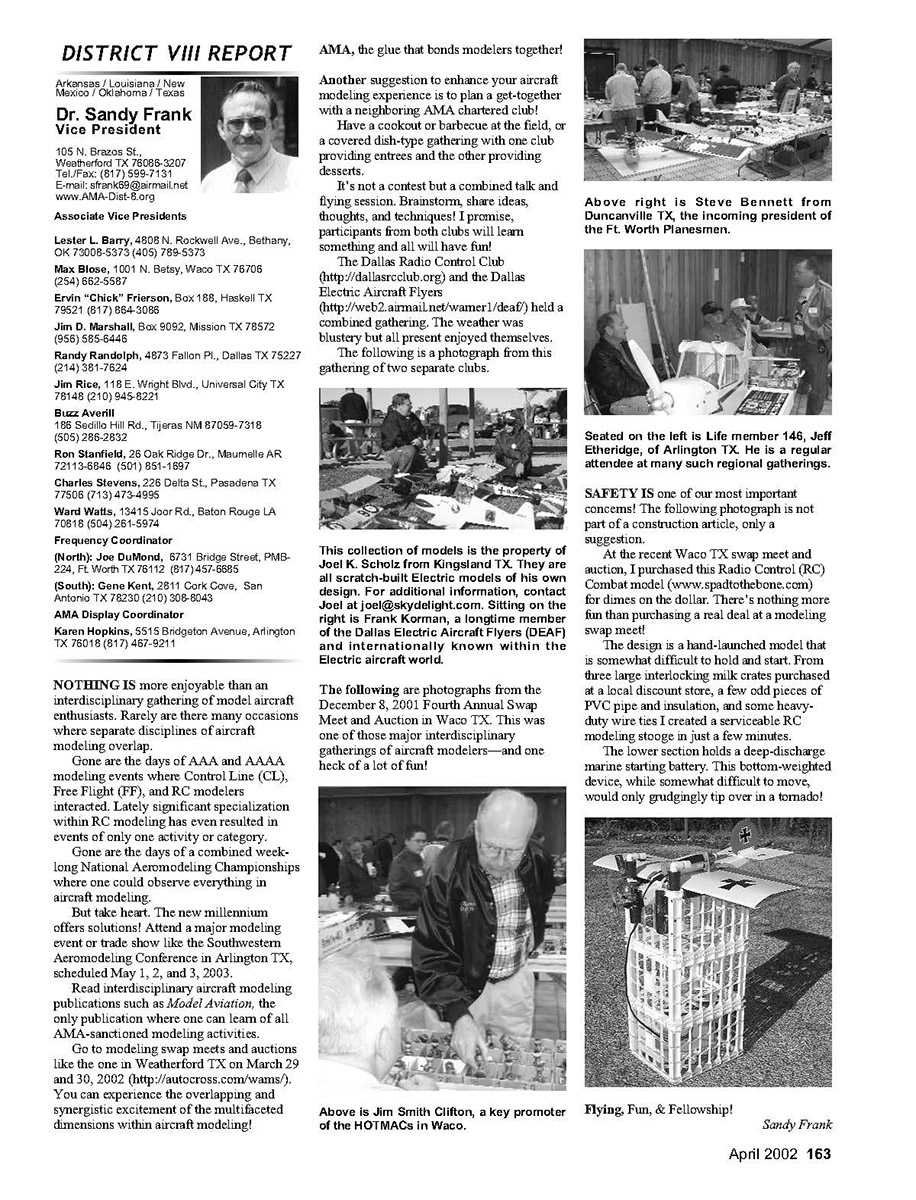
THE FOLLOWING letter comes from Gregg Stockdale, president of the Santa Fe Dam R/C Modelers. Gregg and his club have come to realize how important community involvement can be to any club, but especially to clubs that have flying sites on public property.
The Santa Fe Dam club chose to involve themselves with the Boy Scouts of America and it seems to be a great match! Gregg’s letter is a little tongue-in-cheek, but I’m sure you will see the value of his words.
“Have you noticed that the majority of your club members are gray-haired (or no hair)? Do you wonder where the next group of guys will come from to continue this great hobby?
“How about those clubs (those remaining) that are on public property and only take care of club matters—flying, field fix-up (if permitted), some competition and just basic ‘spiritual naval-gazing’?
“Our club has all these attributes and our Parks and Recreation contact is in the process of retiring. The first words out of the new guy’s mouth were, ‘What are you doing for the public?’
“Good question. In our case, not much. How do you rectify that situation? Here’s what we are doing.
“First, two of us attended the club training and site preservation program put on by the AMA at the Pasadena show (AMA Convention) in January. There are (or used to be) more than 100 clubs in Southern California and my friend and I made up 40% of the audience. You would have thought site preservation would have been a bigger draw. We have had some well-known sites closed in recent history in our area—and more are endangered.
“Second, we got creative. What group would be naturals for being interested in the aviation hobby and be potential club members? Hmmm? Well, my wife is a teacher and I did an after-school program on aviation using the AMA Delta Darts that went over very well.
“By the way, I found quite a few Web sites to assist in this project. I have provided some good URLs at the end of this article. Another teacher asked if I would do the same for her Scout troop. That also was a successful adventure. (Rule #1: take small steps and learn as you expand.)
“What about us forming our own troop?
“Third, contact the local BSA Council (Boy Scouts of America). There are more than 19,000 Boy Scouts in Southern California! Wow! What potential.
“They were real slow on the take-up, as they never have folks looking for them—they usually have to go looking. This is in late January.
“I was/am an Eagle Scout but all my credentials are gone, so I had to write the folks in Texas to obtain my proof/certificate. The council is now warming up to the idea, but I’m still getting the raised-eyebrow look.
“In March I get a commitment from them to allow us to have a booth at the Scout Expo set for June. (Rule #2—be very patient.) I inform the guys at the club and I’m surprised to get a very positive response (lots of old Boy Scouts in the group).
“The big day finally comes and we have five club members with airplanes to show off, Electric ‘park’ flying, marketing collateral, and sign-up sheets for guys interested in an aviation ‘crew.’ (Note: Crew—ages 14 and up, Varsity—ages 11 and up, Troop—younger guys.)
“We obtained the names and phone numbers of 21 interested kids. (The weather was terrible for Southern California. It misted all day and we had an out-of-the-way location.)
“After contacting them and the Council, it was determined that we would form a Troop as the age thing wasn’t disclosed to us prior to the event and we signed up whomever came. (Rule #3—be flexible.)
“Every time we were ready to jump through the hoop to get the troop formed, just one more thing was explained that changed our direction.
“Fourth, obtain funding. YES grants are available from AMA for up to $2,500 over three years to fund your efforts. We applied and were granted $1,000 to obtain equipment for the troop.
“I also requested/begged equipment donations from various suppliers. Thank you Airtronics, Hitec, Dave Brown Industries, R/C Modeler magazine, and ZAP.
“Fifth, obtain a meeting site. As this is different in nature than your regular meeting, set up its own date and location to suit your needs. Our BSA Council recommended a meeting site and we were provided a date/time commitment at no charge.
“Sixth, finish the paperwork for a troop. The BSA costs for eight youth and four adults were $125 for the first year, and $80 for each additional year. AMA cost is $1 each for youth.
“Have your club members donate their used RC magazines for reading material. The youth are not actual club members, so they don’t pay any dues and don’t obtain the gate key for access. This limits our liability of having an unsupervised child at the field.
“Special note—our BSA Council allowed us to form a troop exclusively dedicated to the field of aviation. We have a troop number, but we do not have ranks (Tenderfoot to Eagle), nor do we wear the standard Boy Scout uniform. As we only meet once a month, we are able to attract existing Boy Scouts even if they meet on the same night as we do.
“Our first meeting was in August and we had six young aviators attend. A big surprise was that the parents came and sat through the entire meeting with their kids. Parents didn’t drop and dash for this experience. We now have a new AMA adult member as a result of this program!
“We covered the basics of the hobby and each person was given a Delta Dart to construct and crash. Our second meeting was in September and we now have eight young aviators and had 12 adults at the meeting.
“We reviewed the construction of a kit. I brought a kit in a box, a framed-up kit that wasn’t covered yet, and a completed kit with radio and engine installed. As we only meet 1.5 hours per month, that is about all we have time for and, because everything takes one hour to do and out, we are not going to do actual construction at our meetings.
“Our future projects are the review of an ARF (the one we are going to fly), the engines types available, flight training on a flight simulator, trips to the field for flying with a buddy box, visiting local airports, museums, full-scale airfields, and flying events.
“We have scheduled a field day for later this month to introduce the guys to our field and get some buddy-box time. My goal is to keep it moving and interesting. I want to introduce and expose them to the wide variety of interests within our great hobby.
"Keep it fun for you as well as the kids: it's a hobby, not work!
"If you are interested in finding out more information about our progress and plans, or just have questions, feel free to contact me at [email protected].
"Outline used for the first meeting: "Aviation Scout Troop: "Troop Number - TBD "Minimum age - nine "Focus: Aviation (not Tenderfoot to Eagle) "Studies: Aerodynamics theory and practice; "Projects: Rubber-powered airplanes, flight simulator for practicing techniques and building flying skills, balsa airplane construction (progressions in construction and techniques for demonstration and future reference, not as a student project), ARF (almost-ready-to-fly) construction and flying, visit RC flying sites (Santa Fe Dam and Whittier Narrows) for safety regulations and observing field procedures, testing and flying completed ARF, and visiting other flying sites (Chino Air Museum and Planes of Fame). "Fund raising projects: Teaching aerodynamics, with written materials and construction of Delta Darts at $5 each. Take to schools, malls, Scout expos, etc. "Membership costs: Scouting fees-$10, AMA insurance-$1/year, Model Aviation magazine-$12/year-optional, RC club membership-$25/year-optional, T-shirt-$12 (no scout uniforms required) to identify our troop.
"Equipment: Much has been donated. My intent is that the balance will come from fund raising events.
"Travel: Parents are the best. We'll make it fun for Dad (or Mom) too!
"Goal: Learn and have fun! "These are sites to visit for more information regarding aviation that you might find of interest. The last one is kind of neat. It is an actual college course that you can view for free. It has some interesting information but requires a high-speed Internet connection. You can learn a lot from the first few weeks, as it is very basic and not too hard.
"www.luminet.net/~bkuhl/rubber.htm "www.nas.nasa.gov/Services/Education/Resources/tutorials/mccabe/aerodynam... "www.aa.washington.edu/faculty/eberhardt/flight.html "www.nas.nasa.gov/www/K-12/airplane/index.html "www.bluemaxrc.com/BeginnerCorner.htm "www.bluemaxrc.com/maiden_flight_checklist.html "www.bluemaxrc.com/teaching_rc_flying.html "www.midwestproducts.com/eduavi.htm "www.frozensmoke.com/aviation/school/classroom/aerodynamics/week1.html
I want to touch on a couple of points that Gregg made. Two years ago, Gregg and his friend made up 40% of the audience at the club training and site preservation program at the AMA Convention in Pasadena, CA.
This year, a week before the convention, we have 17 club representatives, out of 78 clubs invited, signed up to attend a roundtable discussion about aeromodeling education programs.
This may sound like apples and oranges as far as the purposes of the meetings but keep in mind that an aeromodeling education program that benefits your local community becomes a great asset when you fly from the public lands of your community.
I wish that we had a better response for this round table but we have made some progress in attendance.
Gregg says, "Keep it fun for you as well as the kids: it's a hobby, not work!"
This is very true. If you dread your program every step of the way, something is very wrong!
Often, well-meaning people unintentionally overreach. Sometimes the scope of a new program continues to grow until it seems to take on a life of its own. It becomes a huge juggernaut that no one can control but no one wants to admit that the program needs to be downsized.
Bringing this type of program to a halt for closer scrutiny does not denote failure but rather learning.
Very few things work perfectly the first time they are attempted, and this is no different. Start small, do the best you can, learn from your mistakes, and realize that there are always going to be ways to improve.
Finding—Preserving—Maintaining
IN my previous article, I reviewed a very successful flying site acquisition involving the US Bureau of Land Management. This month, as promised, we will review another successful site acquisition, this time involving the US Bureau of Reclamation. I don’t know about you, but as I read these two accounts, I was impressed with the fact that in both cases, planning and follow-through were the apparent keys to success.
Spokesperson and project manager Ron Vincent and his wife Eva of the Coachella Valley R/C club in Southern California submitted the following account.
“Someone once said, ‘Necessity is the mother of invention’ and it was necessity that first motivated our club to begin to look for land that would enable us to have a permanent flying site.
“For 20 years the club had been flying off various sand-gravel fields, never having its own permanent site until this year when necessity, coupled with the resourcefulness and inventiveness of the club, resulted in securing a terrific site for our new field. We are happy to share some of our information with others who may be embarking on the same journey.
“Basic ingredients needed:
“(1) One (or two) project manager(s) with strong communication and PR skills who can convince private and public entities of the importance of this project. Manager should feel comfortable communicating with a variety of people from various professions and organizations. He/she should have adequate time and dedication to do lots of research directed toward handling the objections that public and private entities might raise.
“(2) Strong club president who keeps project manager shielded from too much interference, and yet solicits input from members and keeps them informed of progress being made. He keeps club meetings positive and focused on solutions rather than problems.
“(3) An excellent club secretary who keeps accurate minutes of every meeting so that there is minimal confusion about prior discussions and/or decisions.
“(4) A predominant one-for-all attitude within the club and a willingness to do whatever it takes to serve for the good of the project rather than the good of an individual or a small group.
“(5) Take an inventory of the talents and abilities of club members and then utilize these as project develops (i.e., lawyers, architects, computer buffs, engineers, builders, developers).
“Steps to Secure Land for the Model Airpark:
“(1) Secured five-plus R/C model airparks in Southern California for ideas.
“(2) Designed and built a three-dimensional diorama of proposed model airpark to be used for presentations.
“(3) Obtained two very useful tapes from Jay Malav of AMA: State Parks—Model Airplane Flying Sites (10 minutes) and All America’s Model Airplanes (27 minutes).
“(4) Contacted Palm Springs Air Museum to solicit support of our project.
“(5) Sought community support by organizing a mall show to display aircraft and collect signatures (800 signatures in six hours) to indicate public desire for park. Solicited input from individuals and community leaders who showed up at mall as to possible sites for airpark. Obtained media coverage (radio, television, and newspaper) for any club activity.
“(6) Asked for letters of support from professional pilots, astronauts, youth organizations, the Sheriff Department, aeronautical engineers, Senators, and other government leaders. Quotes from these letters were included with our proposal.
“(7) Project manager, president, and other club members drove around and located vacant land in Valley that would be used for the airpark. The land fell into five categories: privately owned land, Native American land, marginal flood lands under Bureau of Reclamation and Bureau of Land Management control, and city- and county-owned land.
“(8) Secured an estimate of cost of asphalt complex for model airpark so that proposal could be constructed around cost. Also conferred with Disabled American Veterans who gave access requirements for physically challenged.
“(9) Prepared a quality proposal stating our purpose, plans, community needs, resource backing, etc., to be sent or given to groups/individuals who might have land that we could secure.
“(10) After proposal was completed, lots of contacts and presentations were made to:
“a) Prime Time Agricultural Company and California Biomass. Has possible sites but were short term and/or temporary locations.
“b) Waste Management of the Desert, Riverside County. Closed landfill sites proved to be too far away for our use. Director suggested we check on old sand/gravel extraction areas. Some were in process of developing it.
“c) Native American Tribal Lands. Although some good sites were available, they could not be secured for the project.
“d) Coachella Valley Recreation and Park District. Realizing we needed more political support for our project, I subsequently made a presentation to Don Martin and the Board of Directors. They suggested if we developed the park and put it under their parks system, federal entities like Bureau of Land Management and Bureau of Reclamation would look more favorably upon our model airpark project.
“e) Bureau of Land Management (BLM). Got map showing all land holdings throughout the Valley. By physically looking at sites on map, we found several possibilities. One was extremely promising; however, it was not under the control of the BLM. Most of it was privately owned and a small part owned by Bureau of Reclamation (BOR), therefore, it was not available to us. However, the BLM suggested that we contact Ted Cook at the Bureau of Reclamation.
“f) Bureau of Reclamation. Worked with Ted Cook of the Realty Dept who carefully examined our proposals and the AMA 10 minute video State Parks and Model Airplane Flying Sites, and was convinced of the worthiness of our project. His enthusiasm was evident when he said ‘It was pure genius on your part to contact the Parks Department before coming to us because this land becomes more available if used for public parks.’
“Ted’s enthusiasm came also from the BOR’s need for a park that would provide protection for the majority of the aquifer recharging land. Our model airpark would require nine acres out of the 130—leaving the rest untouched and maintaining a watershed recharge. Ted spoke to many BOR sites throughout the Valley; however, a number of them were not workable for several reasons:
“a) Flash flooding and the danger it posed to model airport participants.
“b) Too small for our needs according to AMA site recommendations for airparks plus flyover area.
“c) Some too close to existing or future golf and country clubs or Native American housing, posing noise/usage issues. The land we proposed met the need for distance separation.
“d) Access issues. A 40-foot-high berm or dam was on some sites or another of the properties we looked at and our most promising site met with objections from the Coachella Valley (CV) Water District who managed and protected the dam and felt it would be unsafe to traverse at this site.
“Some clouds do have silver linings! Because the CV Water District could not give us access to this site, they offered us what turned out to be an even better piece of BOR land on the other side of the Valley. The 260-acre site, 130 of which we would use, had freeway access, huge flyover and safety zone areas, beautiful view of the Valley, and minimal wind problems—a perfect site!
“With the legal expertise of one of our members, we successfully negotiated the terms of the lease and have signed it for 25 years for $1 with first option to renew for another 25 years. A number of other members have begun to contribute their skills, services, labor, etc., to bring this project to completion.
“Coffers, originally at $17,000 have risen to $31,000. Other donations include a painting valued at $25-50,000; a bronze statue valued at $5,000; preparation of land for asphalt complex donated value $8-10,000; cleanup of land perimeter by an outstanding club member who organized work party and got equipment costs and dumping fees waived; donation of shade structure for 20 x 100-foot pit area; 30 x 30 steel shed with five roll-up doors donated by a club member; and tables and electrical wiring donated by electronics firm. Club president was very instrumental in securing many of these donations.
“How to Keep the Flying Site (Government-Leased Land):
“Club needs to analyze the requirements set forth by each of their site principals (BOR, Coachella Valley Water District, CV Recreation Park District) as to how they envision the land being used.
“(1) BOR environmentalists (protection of the aquifer recharging land and also plants and animals). Example of club response: Keep airpark as small as possible; therefore, a small footprint on the land.
“(2) BOR engineers (protection of people in any above ground structures because this is a flood zone). Example of club response: Limit structures to shade/temporary.
“(3) BOR HAZMAT Engineers (no hazardous materials get into aquifer recharging lands). Club response: Closed fuel-recovery system.
“(4) Coachella Valley Water District (their engineers would be looking to enforce BOR requirements because BOR is 90 miles away in Yuma AZ). Example of club response: Rules at airpark clearly posted and consistently enforced by club members.
“(5) Coachella Valley Recreation and Park District (park will be open to anyone in the Coachella Valley. Park will be maintained by the Coachella Valley RC Flying Club). Example of club responses: Flying permits will be issued after individual has necessary insurance and demonstrated flying proficiency, equipment safety, and willingness to follow flying site rules.
“Since the club is responsible for maintaining the field, the club reserves three weekends each year for contests to help raise maintenance funds. A possible user fee for those who fly may also be implemented.
“(6) One general requirement from all agency principals is to deal with one spokesperson as opposed to individual club members coming to them with requests. Club response: Select one spokesperson and have changes or additions to the park follow these procedures:
“a) Only at a club meeting will any changes or additions be raised so that all members have input opportunity at next meeting. Members are notified of this through the monthly newsletter before meeting occurs.
“b) At next meeting, club discusses pros and cons and then votes for change or addition. Any approved changes are turned over to a special committee that will do research and development. Then they present finished product at next meeting to entire club membership who has been alerted via newsletter. At meeting motion is followed by discussion and vote to either proceed or drop proposal.
“c) If change is approved, spokesperson prepares final draft and takes it to site principals for approval. Upon approval by principals, spokesperson notifies club and all follow-up steps are taken to implement the change or addition.”
A recent E-mail brought another success story, this time from the Lone Star State. Here’s the heads-up E-mail from Jeff Ellis, vice president of the Highland Lakes Flyers Club:
“Yesterday morning our proposed lease of a closed public landfill was approved unanimously by the Llano County Commissioner’s Court. We had 10 members present at the meeting and were moved from 12th place on the agenda to fourth in view of the number of us attending.
“Dave Schaefer and I made brief remarks, one commissioner had a few questions, and another showed the court a list of the other flying sites in Texas already operating on closed public landfill property (recently supplied by you thanks). Since TNRCC (Texas Natural Resource Conservation Commission), the regulating agency in Texas, has a requirement that the county not sell this type of property sooner than 30 years after closing, it made it much easier for them to consider a long-term lease.
“Our commissioner friend then made a motion to lease to us as proposed. The motion was seconded immediately and a vote showed all in favor. The county judge signed the lease, I signed for the Highland Lakes Flyers, and paid the $100 lease fee for 10 years. We also have an option to renew for another five years at the end of the lease.
“What do I say? Hoo Yah! Hah Hoo? Whoopie? Yes!
“All seems appropriate for the moment. Now comes the hard physical work, and we are ready. We will be working closely with the commissioner who was our primary backer, and he’s very pleased as well.
“I have a question, Wes. How do we help at this point? We would like to share whatever we can to help in your efforts toward securing flying sites for other clubs facing the loss of their sites.
“Would a copy of our revised lease be helpful? What questions do you have for us? Please let me know and we’ll be happy to respond.
“Our success would not have been possible without the work of many people, especially you and AMA by providing a road map, lots of support data, and a lease outline that was invaluable to us. Thank you!
I look forward to hearing from you.”
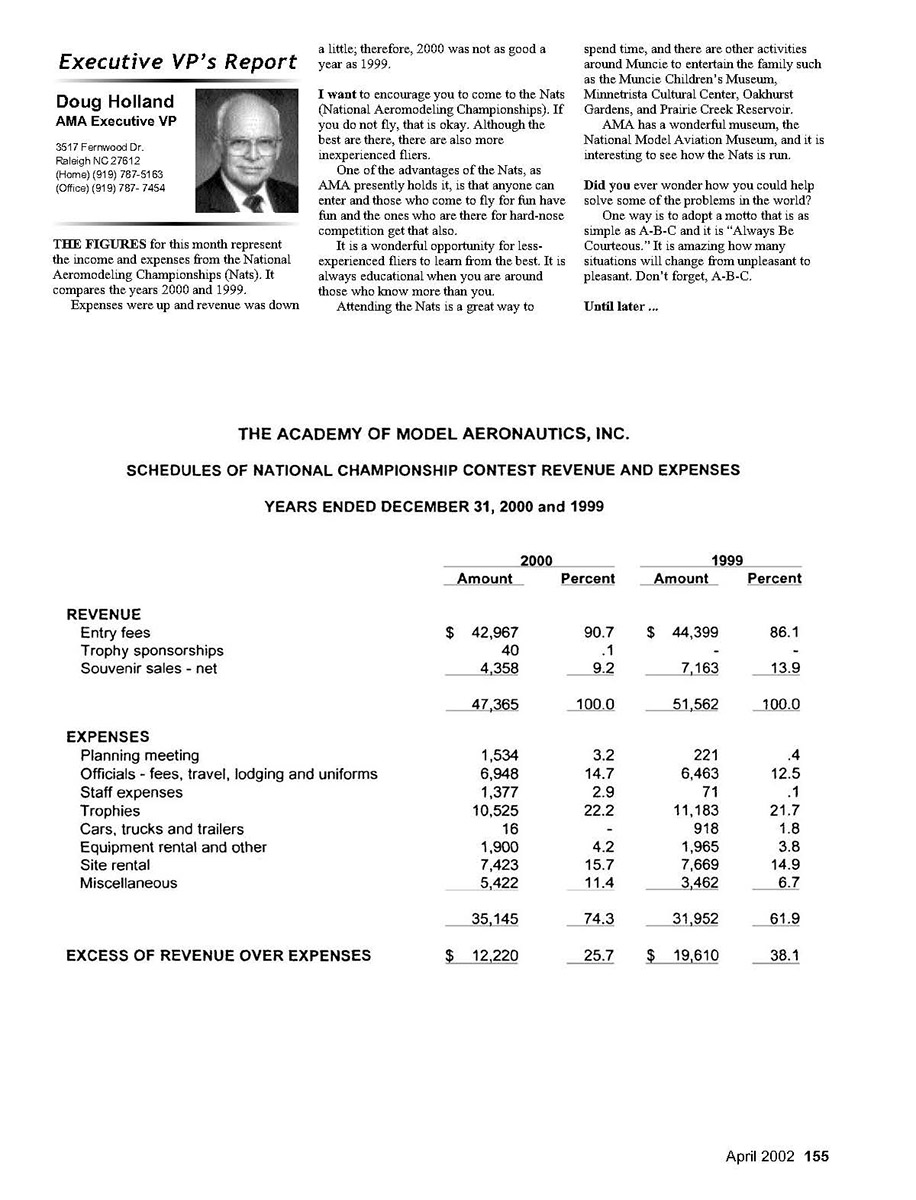
a little; therefore, 2000 was not as good a year as 1999.
I want to encourage you to come to the Nats (National Aeromodelling Championships). If you do not fly, that is okay. Although the best are there, there are also more inexperienced fliers.
One of the advantages of the Nats, as AMA presently holds it, is that anyone can enter and those who come to fly for fun have fun and the ones who are there for hard-nose competition get that also.
It is a wonderful opportunity for less-experienced fliers to learn from the best. It is always educational when you are around those who know more than you.
Attending the Nats is a great way to spend time, and there are other activities around Muncie to entertain the family such as the Muncie Children's Museum, Minnetrista Cultural Center, Oakhurst Gardens, and Prairie Creek Reservoir.
AMA has a wonderful museum, the National Model Aviation Museum, and it is interesting to see how the Nats is run.
Did you ever wonder how you could help solve some of the problems in the world? One way is to adopt a motto that is as simple as A-B-C and it is "Always Be Courteous." It is amazing how many situations will change from unpleasant to pleasant. Don't forget, A-B-C.
Until later ...
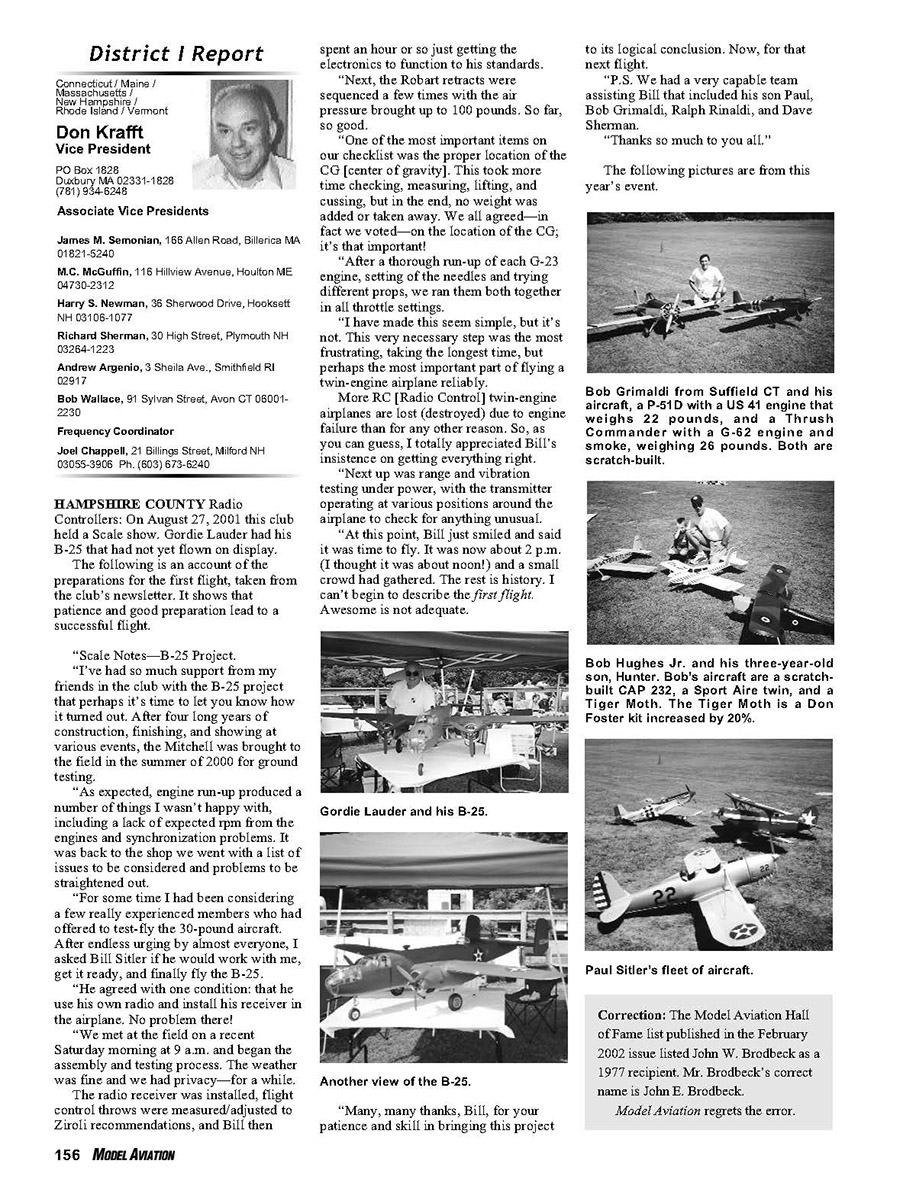
HAMPSHIRE COUNTY Radio Controllers: On August 27, 2001 this club held a Scale show. Gordie Lauder had his B-25 that had not yet flown on display. The following is an account of the preparations for the first flight, taken from the club's newsletter. It shows that patience and good preparation lead to a successful flight.
"Scale Notes—B-25 Project.
"I've had so much support from my friends in the club with the B-25 project that perhaps it's time to let you know how it turned out. After four long years of construction, finishing, and showing at various events, the Mitchell was brought to the field in the summer of 2000 for ground testing.
"As expected, engine run-up produced a number of things I wasn't happy with, including a lack of expected rpm from the engines and synchronization problems. It was back to the shop we went with a list of issues to be considered and problems to be straightened out.
"For some time I had been considering a few really experienced members who had offered to test-fly the 30-pound aircraft. After endless urging by almost everyone, I asked Bill Sitler if he would work with me, get it ready, and finally fly the B-25.
"He agreed with one condition; that he use his own radio and install his receiver in the airplane. No problem there!
"We met at the field on a recent Saturday morning at 9 a.m. and began the assembly and testing process. The weather was fine and we had privacy—for a while.
"The radio receiver was installed, flight control throws were measured/adjusted to Ziroli recommendations, and Bill then spent an hour or so just getting the electronics to function to his standards.
"Next, the Robart retracts were sequenced a few times with the air pressure brought up to 100 pounds. So far, so good.
"One of the most important items on our checklist was the proper location of the CG [center of gravity]. This took more time checking, measuring, lifting, and cussing, but in the end, no weight was added or taken away. We all agreed—in fact we voted—on the location of the CG; it's that important!
"After a thorough run-up of each G-23 engine, setting of the needles and trying different props, we ran them both together in all throttle settings.
"I have made this seem simple, but it's not. This very necessary step was the most frustrating, taking the longest time, but perhaps the most important part of flying a twin-engine airplane reliably.
"More RC [Radio Control] twin-engine airplanes are lost (destroyed) due to engine failure than for any other reason. So, as you can guess, I totally appreciated Bill's insistence on getting everything right.
"Next up was range and vibration testing under power, with the transmitter operating at various power positions around the airplane to check for anything unusual.
"At this point, Bill just smiled and said it was time to fly. It was now about 2 p.m. (I thought it was about noon!) and a small crowd had gathered. The rest is history. I can't begin to describe the first flight. Awesome is not adequate.
"Many, many thanks, Bill, for your patience and skill in bringing this project to its logical conclusion. Now, for that next flight.
"P.S. We had a very capable team assisting Bill that included his son Paul, Bob Grimaldi, Ralph Rinaldi, and Dave Sherman.
"Thanks so much to you all."
ALMOST ANY District II AMA member who's been around for the last five years has probably heard the word Galeville more than once or twice. Galeville was a former Army Training Facility administered by West Point Military Academy.
For nearly three decades AMA members used the facility, considered one of the best flying sites in the Northeast if not the entire country, for Free Flight modeling. In 1995, control of the property was transferred to the US Fish and Wildlife Service to be used for "the protection and management of a migratory bird habitat, with a special emphasis on grassland dependent birds." Modelers, who enjoyed use of the property for nearly 30 years with no documented evidence of harm to either the habitat or the birds who migrated there, were banned from flying models at Galeville. Since then, the East Coast Free Flight Conference and AMA have been fighting a battle to regain use of the facility.
Late last year the US Department of Interior asked the US Fish and Wildlife Service to issue a Compatibility Determination regarding modeling activities at the facility, now known as Shawangunk Grasslands National Wildlife Refuge. This report, wrought with misinformation and inaccuracies, was released on November 26, 2001, with a 45-day response period. AMA requested and was granted a 30-day extension, which ended on February 8, 2002.
As I write this, AMA is putting the final touches on a mailing that will be sent to all AMA club presidents or contacts in District II, all AMA Leader Members in the US, and the presidents of many of AMA's Special Interest Groups. In this letter AMA is asking that our members voice their objection to the US Fish and Wildlife Service concerning the banning of modeling activities at Galeville.
I hope those who received a copy of the letter shared it with as many of our members as they could, and each took the time to respond. This is an issue where numbers may count and in an issue that, as modeling enthusiasts, is important to all of us.
Additionally, AMA has engaged an expert to review and offer rebuttal to the misinformation contained in the Determination. I want to thank AMA employees Jay Mealy, Programs Director, Carl Maroney, Special Services Director, and their respective staff members who put effort above and beyond into helping organize AMA's response.
If you happen to see them, make sure to let them know you appreciate their efforts on our behalf.
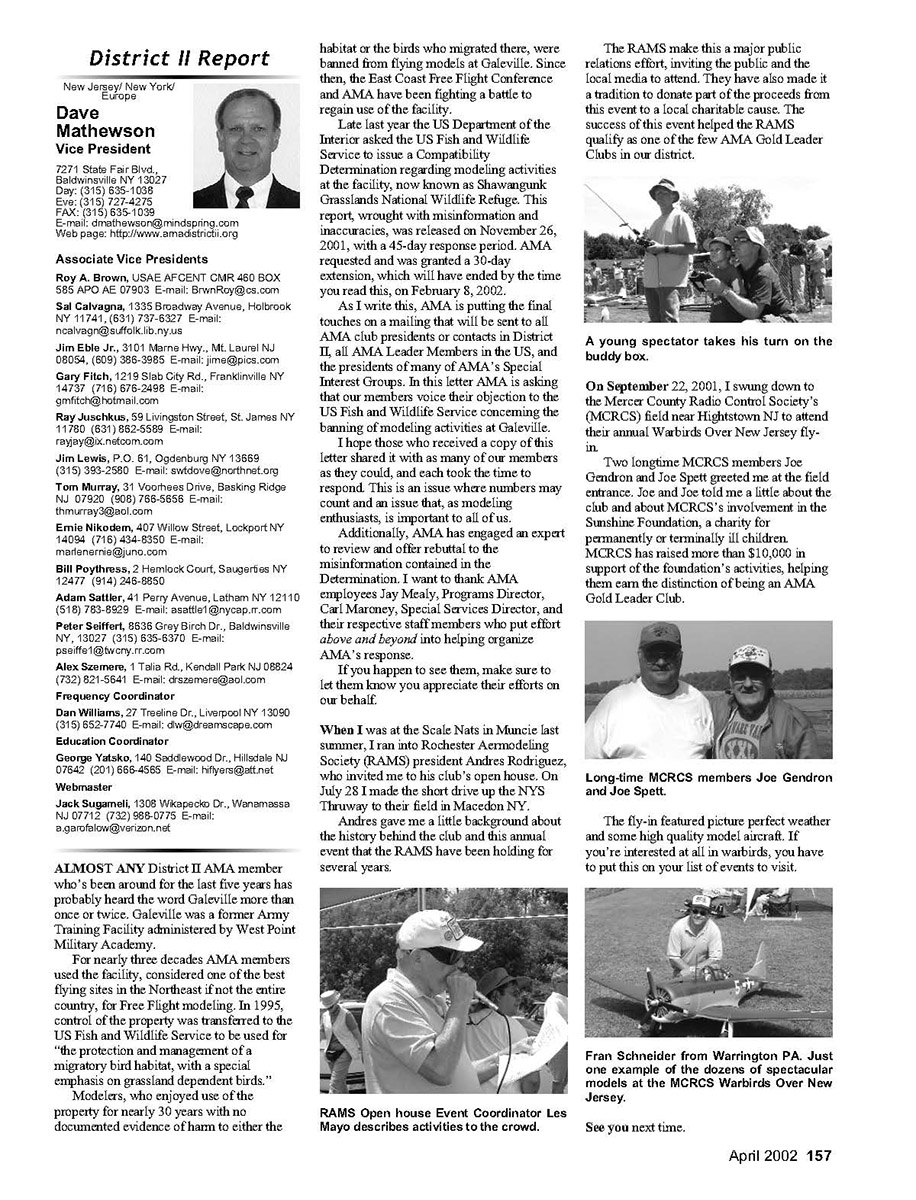
When I was at the Scale Nats in Muncie last summer, I ran into Rochester Aeromodeling Society (RAMS) president Andres Rodriguez, who invited me to his club's open house. On July 28 I made the short drive up the NYS Thruway to their field in Macedon NY.
Andres gave me a little background about the history behind the club and this annual event that the RAMS have been holding for several years.
The RAMS make this a major public relations effort, inviting the public and the local media to attend. They have also made it a tradition to donate part of the proceeds from this event to a local charitable cause. The success of this event helped the RAMS qualify as one of the few AMA Gold Leader Clubs in our district.
On September 22, 2001, I swung down to the Mercer County Radio Control Society's (MCRCS) field near Hightstown NJ to attend their annual Warbirds Over New Jersey fly-in.
Two longtime MCRCS members Joe Gendron and Joe Spett greeted me at the field entrance. Joe and Joe told me a little about the club and about MCRCS's involvement with the Sunshine Foundation, a charity for permanently or terminally ill children. MCRCS has raised more than $10,000 in support of the foundation's activities, helping them earn the distinction of being an AMA Gold Leader Club.
The fly-in featured picture perfect weather and some high quality model aircraft. If you're interested at all in warbirds, you have to put this on your list of events to visit.
See you next time.
AMA News
District III Report
Ohio / Pennsylvania / West Virginia
Bob Brown Vice President
35 Sanford Street Bradford, PA 16701 (814) 368-7655 E-mail: [email protected]
Associate Vice Presidents
Mike Barbee, 6561 Calgary Court, Columbus OH 43229-2008 (614) 891-1643 David H. Ellis, 5261 DeWitt Road, Cross Lanes WV 25313-1209 (304) 776-1408 Nelson Gould, 1340 Oak Drive, Macungie PA 18062 (610) 395-9159 Donald Klopp, 637 Hamilton Court, Trappe PA 19426-2256 (610) 409-0129 Dan Luchaco, 605 Stevenson Street, Sayre PA 18840 (570) 888-1856 [email protected] Tom Morris, 5131 Delford, Pittsburgh PA 15207 (412) 461-7364 Frank Noll, 5492 Waterloo Road, Dayton OH 45459 (937) 435-9232 Matthew Turowski, 5 Dogwood Road, Drums, PA 18222 (717) 788-0651 Joseph S. Vislay, 1381 Cranbrook Drive, PO Box 851, Maumee OH 43537-3087 (419) 893-9537 E-mail: [email protected]
Frequency Coordinator John Cottle, 1012 Wyoming Avenue, Forty Fort PA 18704 (717) 287-8970
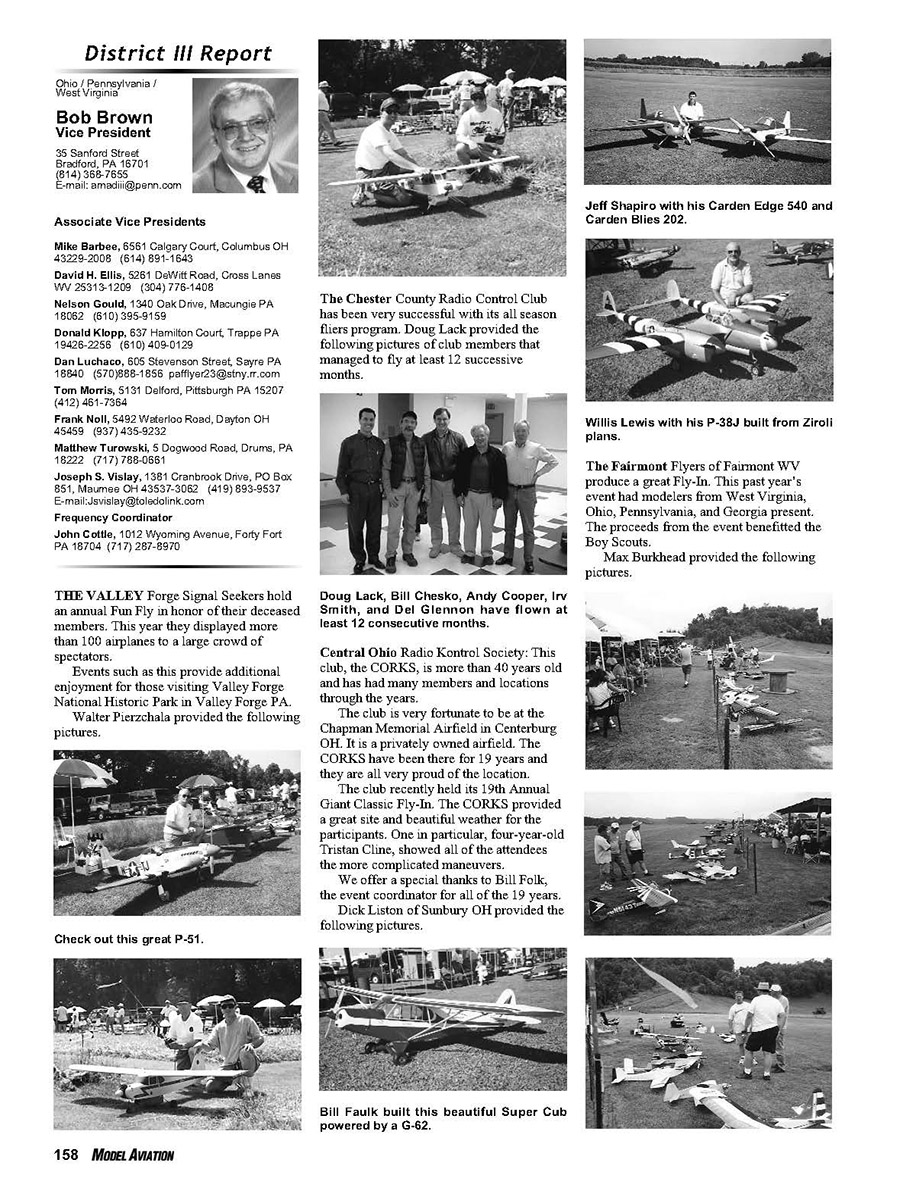
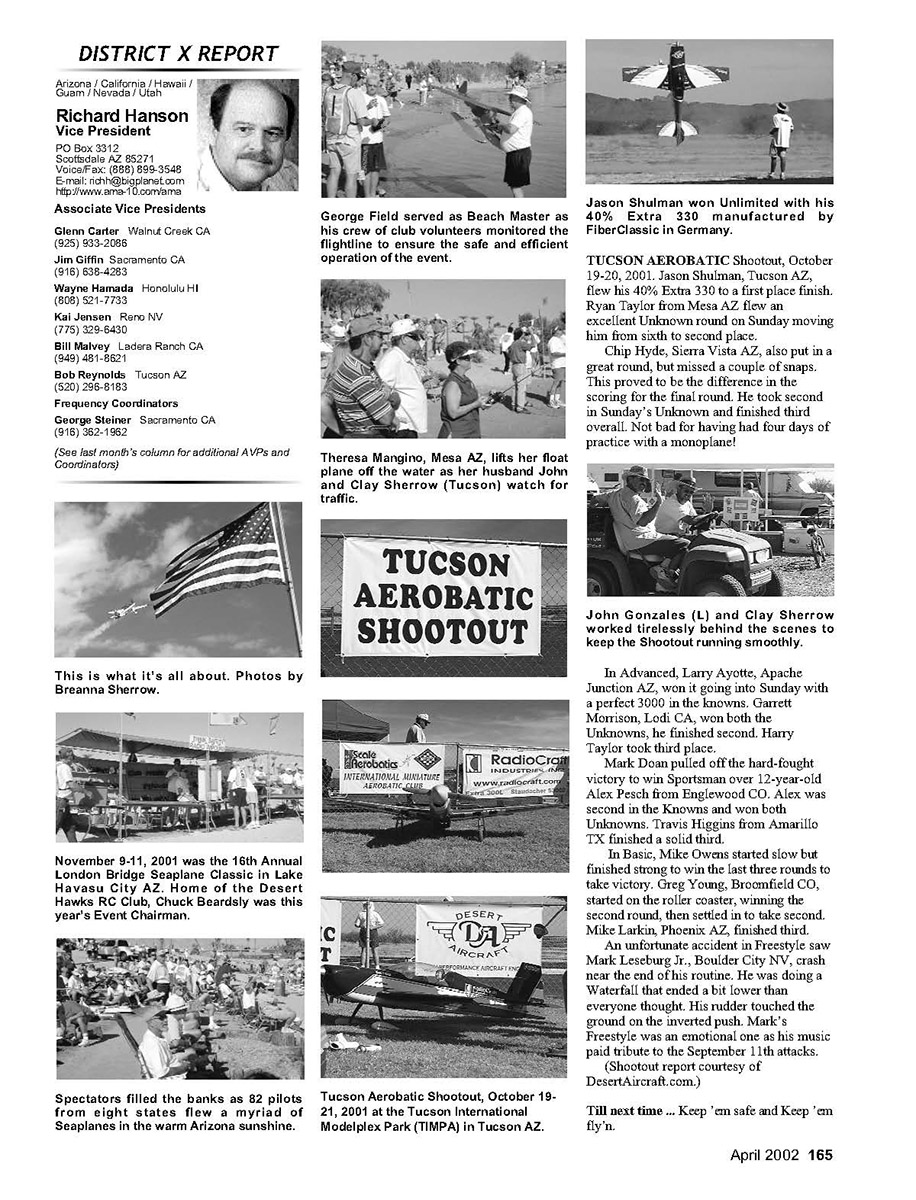
THE VALLEY Forge Signal Seekers hold an annual Fun Fly in honor of their deceased members. This year they displayed more than 100 airplanes to a large crowd of spectators.
Events such as this provide additional enjoyment for those visiting Valley Forge National Historic Park in Valley Forge PA.
Walter Pierzchala provided the following pictures.
The Chester County Radio Control Club has been very successful with its all season fliers program. Doug Lack provided the following pictures of club members that managed to fly at least 12 successive months.
Doug Lack, Bill Chesko, Andy Cooper, Irv Smith, and Del Glennon have flown at least 12 consecutive months.
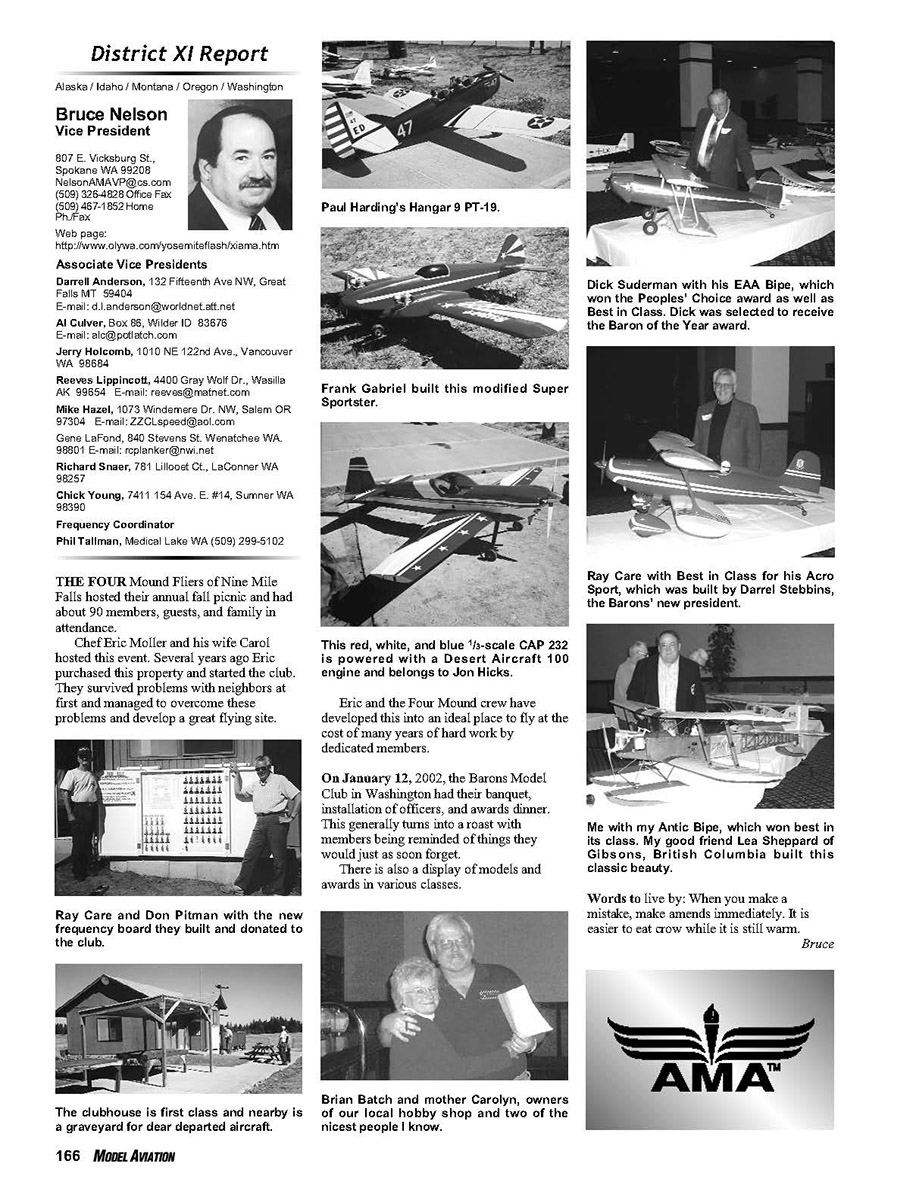
Central Ohio Radio Kontrol Society: This club, the CORKS, is more than 40 years old and has had many members and locations through the years.
The club is very fortunate to be at the Chapman Memorial Airfield in Centerburg OH. It is a privately owned airfield. The CORKS have been there for 19 years and they are all very proud of the location.
The club recently held its 19th Annual Giant Classic Fly-In. The CORKS provided a great site and beautiful weather for the participants. One in particular, four-year-old Tristan Cline, showed all of the attendees the more complicated maneuvers.
We offer a special thanks to Bill Folk, the event coordinator for all of the 19 years.
Dick Liston of Sunbury OH provided the following pictures.
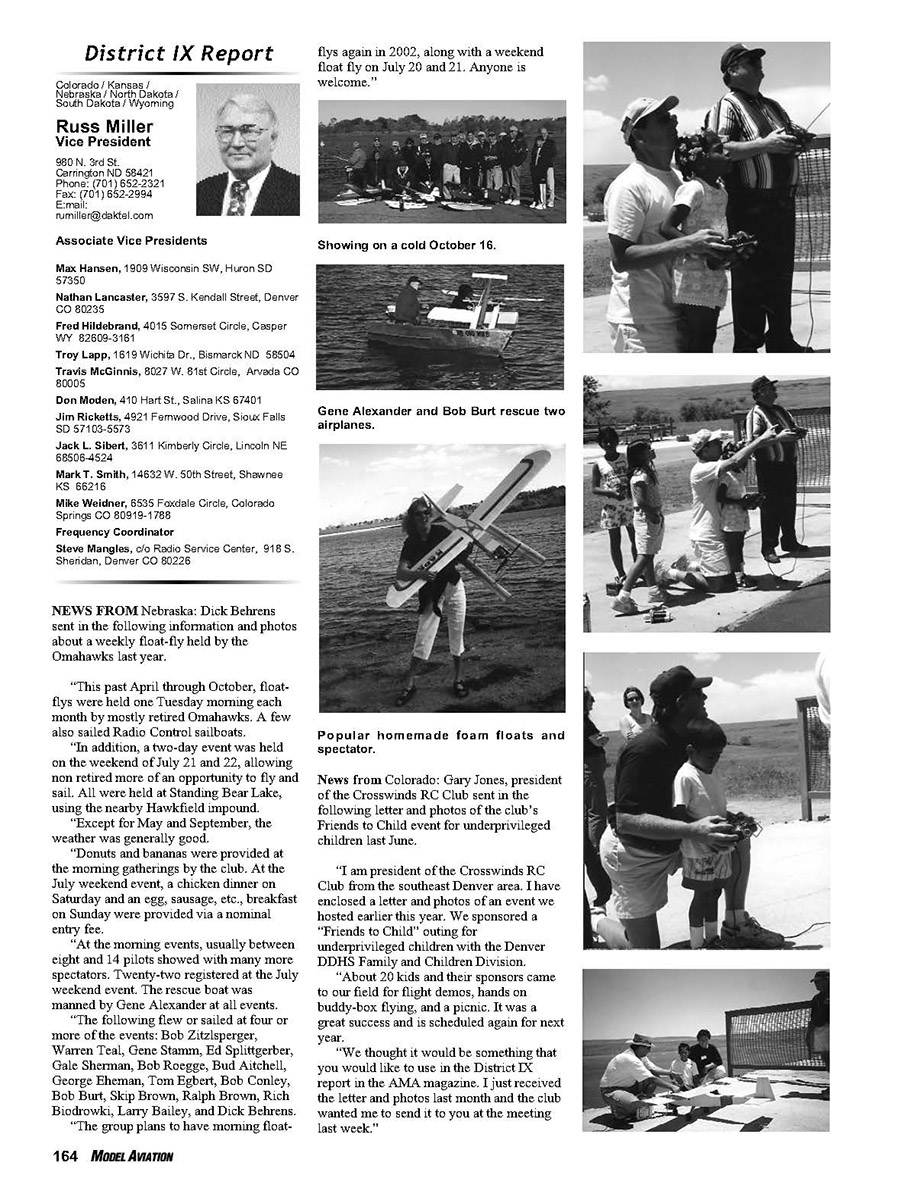
The Fairmont Flyers of Fairmont WV produce a great Fly-In. This past year's event had modelers from West Virginia, Ohio, Pennsylvania, and Georgia present. The proceeds from the event benefitted the Boy Scouts.
Max Burkhead provided the following pictures.
Bill Faulk built this beautiful Super Cub powered by a G-62.
AMA News
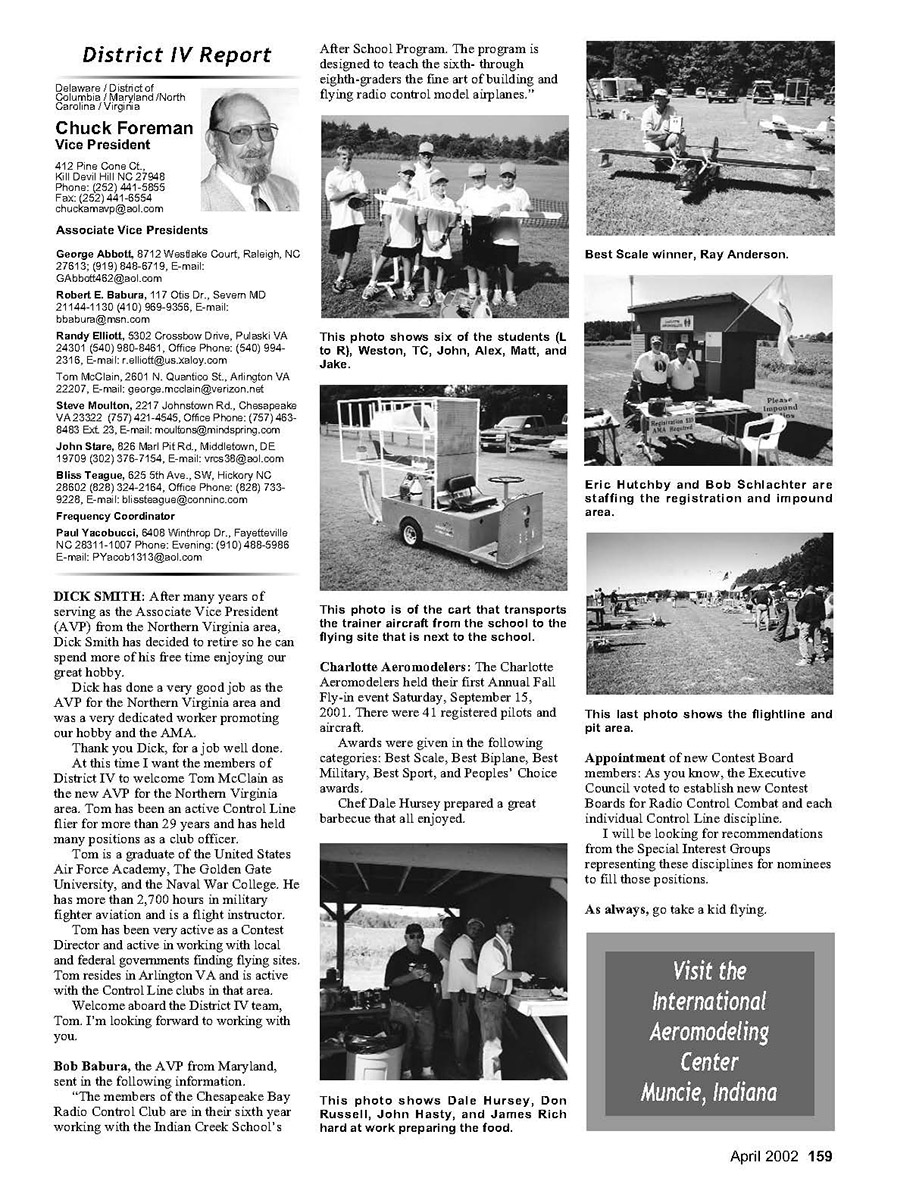
After School Program. The program is designed to teach the sixth- through eighth-graders the fine art of building and flying radio control model airplanes.
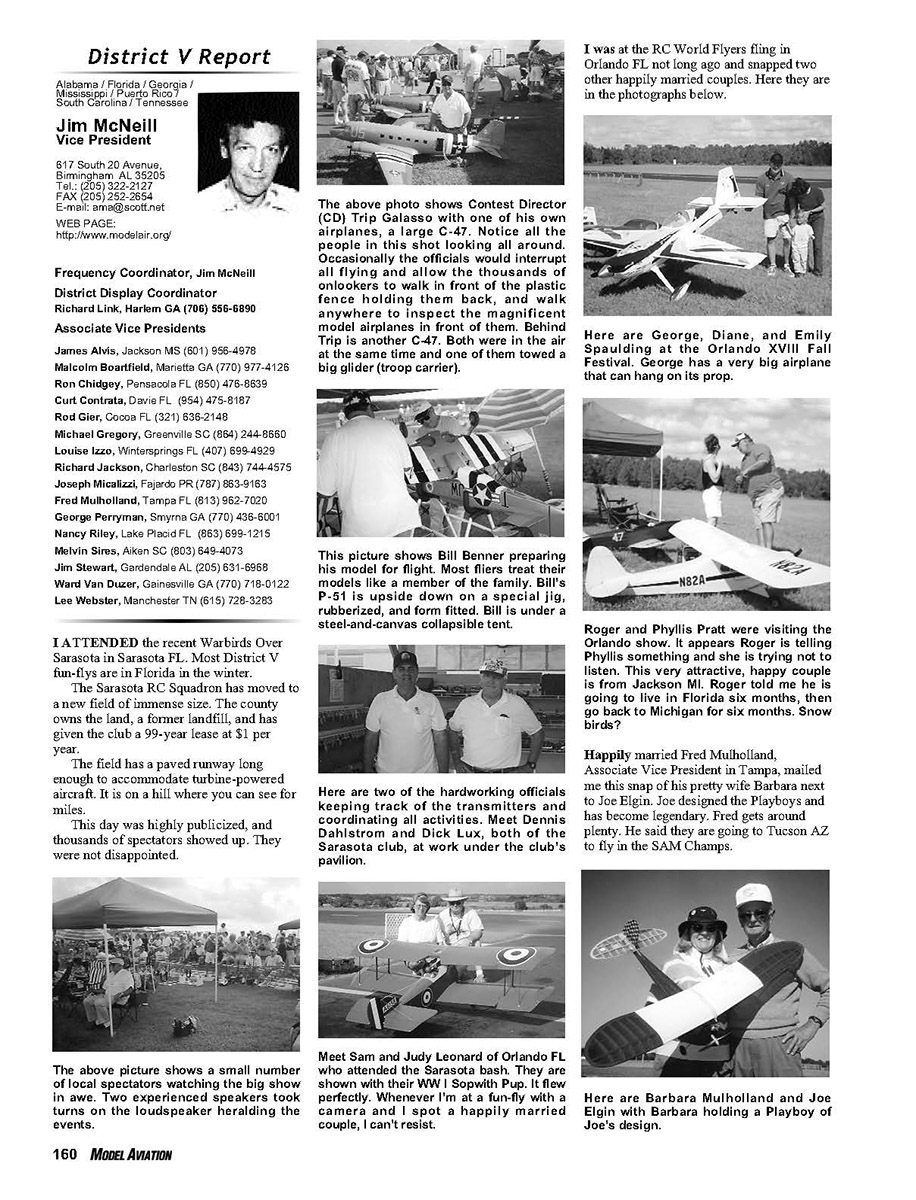
Charlotte Aeromodelers: The Charlotte Aeromodelers held their first Annual Fall Fly-in event Saturday, September 15, 2001. There were 41 registered pilots and aircraft.
Awards were given in the following categories: Best Scale, Best Biplane, Best Military, Best Sport, and Peoples' Choice awards.
Chef Dale Hursey prepared a great barbecue that all enjoyed.
Appointment of new Contest Board members: As you know, the Executive Council voted to establish new Contest Boards for Radio Control Combat and each individual Control Line discipline.
I will be looking for recommendations from the Special Interest Groups
Transcribed from original scans by AI. Minor OCR errors may remain.

