
AMA News
Academy of Model Aeronautics 5161 E. Memorial Dr., Muncie IN 47302
Focus on Education
Jack Frost AMA Education Coordinator Tel. (765) 287-1259 Ext. 274 [email protected]
RECENTLY, I saw a commercial on television advertising a pain reliever for arthritis. The commercial showed a middle-aged man dressed in a baseball uniform and obviously in much discomfort because of knee-joint pain. He was lamenting about how he feared he would have to give up a sport he loved because of his pain, until he discovered the pain reliever being advertised.
After taking the pain reliever he was again able to enjoy his chosen sport without further discomfort. The end of the commercial shows the man as a completely inept ball player who was waving at fly balls and booting grounders.
This somewhat surprising behavior ends with the man stating, "I said that I loved baseball—I didn't say I was good at it!"
The point I'm trying to make is that most of us, myself included, would imagine that anyone who loved an activity that much would be good at it. After all, doesn't practice make perfect?
No, perfect practice makes perfect. But who is trying to be perfect anyway?
We humans seem to have a habit of assigning a certain level of expectation to people, places, things, situations, etc. These levels of expectation are often inaccurate and sometimes even illogical.
Years ago, when the boom-fuselage, fun-fly type of airplanes were just hitting the scene, my buddy, Keith Bryan, and I decided to design and build our own. We had never even seen one of these airplanes except in pictures in magazines. We started designing/building on a Friday night and flew the airplane late Sunday afternoon. We drank a lot of coffee, got a little sleep, and made a complete mess of both of our workshops, and it was one of the best weekends of my modeling life!
We drew a thick symmetrical airfoil, built it light as we could with the materials that we had on hand, and bolted a .40 engine on the front. We didn't know how it would fly. We didn't know if it would fly. We didn't even know if we could fly it if it did fly! We honestly didn't know what to expect, but we were having some kind of fun!
Before the test flight we ensured the engine was running reliably, rechecked the location of the center of gravity, and wondered why we ever built this thing to begin with. Now we had to fly it!
Keith volunteered to hand launch the aircraft for the first flight (on the premise that the grass was kind of long). I just think he didn't want to fly it. For the first few seconds it was a wild ride. I wasn't as much trying to fly it as I was trying not to crash it. The control surfaces were effective to say the least. It was like trying to sandpaper a wildcat's tail in a telephone booth. I was very, very busy.
Sometime later in the flight, when my heartbeats per minute dropped from 300 or so, I actually started to feel like I was doing a little more than just holding on to the transmitter waiting for our new creation to hurtle itself onto solid ground. That's when Keith asked me how long I thought it would fly on that two-ounce fuel tank.
Oh, great! Just when I think I've figured out how to avoid the ground, I have to worry about it intentionally! I reduced power and started to descend, simultaneously wondering why I didn't have the sense to use a radio with dual rates. Boy, was I ever missing those dual rates. I fought the control twitchiness throughout base turn and final. I was moving the sticks fast enough to mix paint.
As if by magic, the airplane touched down gently and stopped within a few feet. It was over. It was really over—and the airplane still looked as it did when it took off! I killed the engine, Keith turned off the airplane, and I switched off the transmitter with a big sigh of relief.
After a few minutes of yips, yahoos, and a very creative 'high five' dance, Keith and I looked at each other with the same thought going through our minds: Decrease the control throws!
A few days later we had everything adjusted to allow us to enjoy flying the airplane. A fellow came up to us and asked us what kind of airplane it was. We told him it was our own design. He asked as to the airplane's weight. When we told him it was two-and-a-half pounds, his comment was, "If it weighs more than two pounds, it will never be competitive!"
We were puzzled. Why would he assume that we were going to compete with this airplane? If you build an airplane of this type, is there some law that states that you must enter a competition? Couldn't we build it and fly just because it was fun?
AMA News
We sometimes try to force our likes and dislikes on unsuspecting newcomers to our hobby, simply because we feel passionately about what we are building and flying at the time. I think that sometimes this is intentional but for the most part it is quite unintentional. This often causes the newcomer to form a level of expectation that he or she may not have formed if left alone.
When I looked at the possibility of flying Free Flight airplanes the first time, I imagined how easy it would be since I was accustomed to building and flying airplanes containing high-tech propulsion and control equipment. I quickly realized how completely inadequate a Delta Dart could make me feel. How could this simple little airplane not do what I wanted it to do? I had made the mistake of assigning a level of expectation based on nothing more than supposition. This was another case of a negative level of expectation.
Fortunately, there are positive cases as well. I have noticed this when showing newcomers how to build and fly models. Many people have told me about their efforts to build and fly rubber-powered balsa airplanes only to have the airplane auger itself into the ground 10 feet in front of them after one or two seconds of flight. It doesn't take long for this activity to lose its appeal.
This problem is most often due to the individual's lack of expertise in trimming the airplane. The result is the creation of some level of expectation. The person thinks that there is either a problem with the airplane or that he or she must be doing something wrong.
When the same individual watches someone else fly the same type of aircraft for 10 or 12 seconds the person is generally amazed and usually wants to know how it was accomplished. The "level of expectation" has just been modified. When he or she sees the airplane fly for 30 seconds, expectation is again influenced.
Whether in the role of teacher or student, we should each try to be mindful of our counterparts' level of expectation and realize that ours may be different.
As a famous cavalry rider once said, "When the horse is dead, dismount."
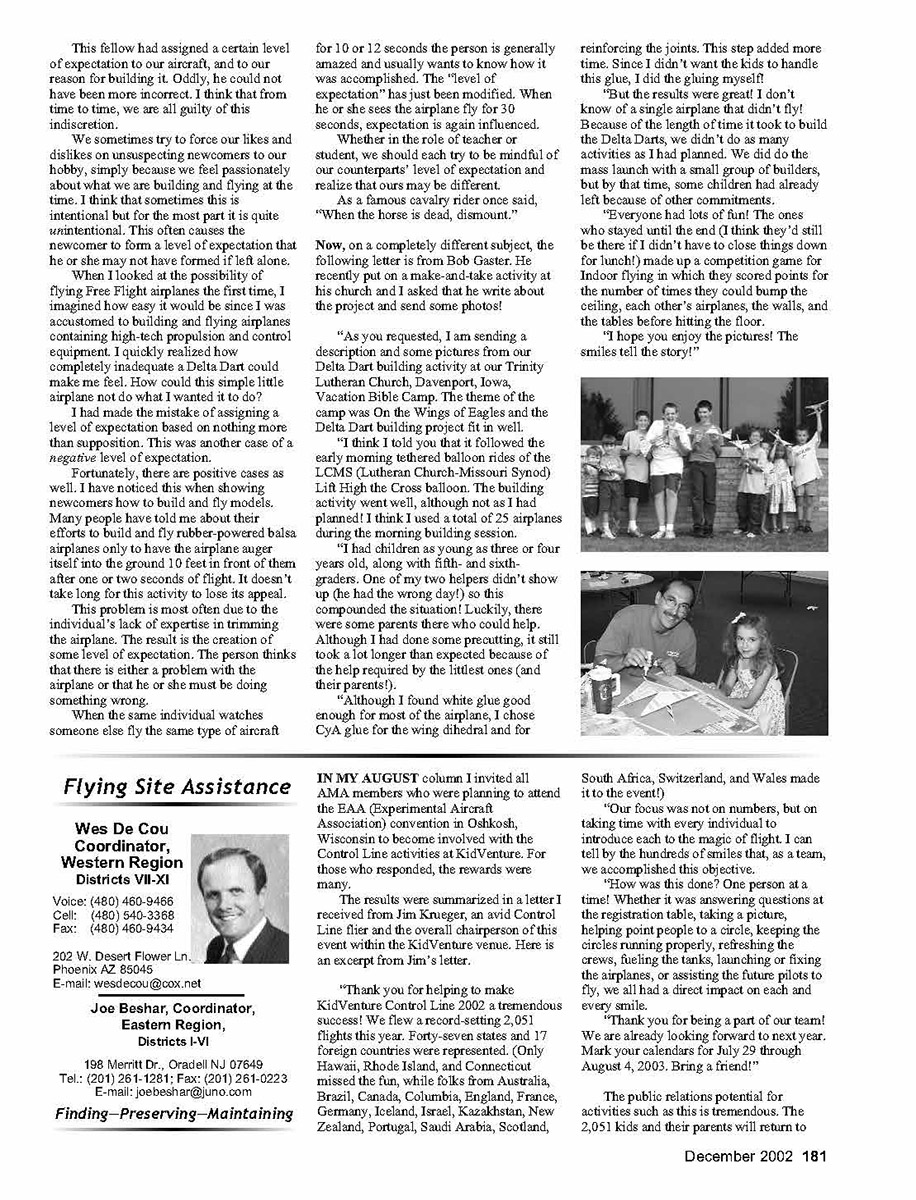
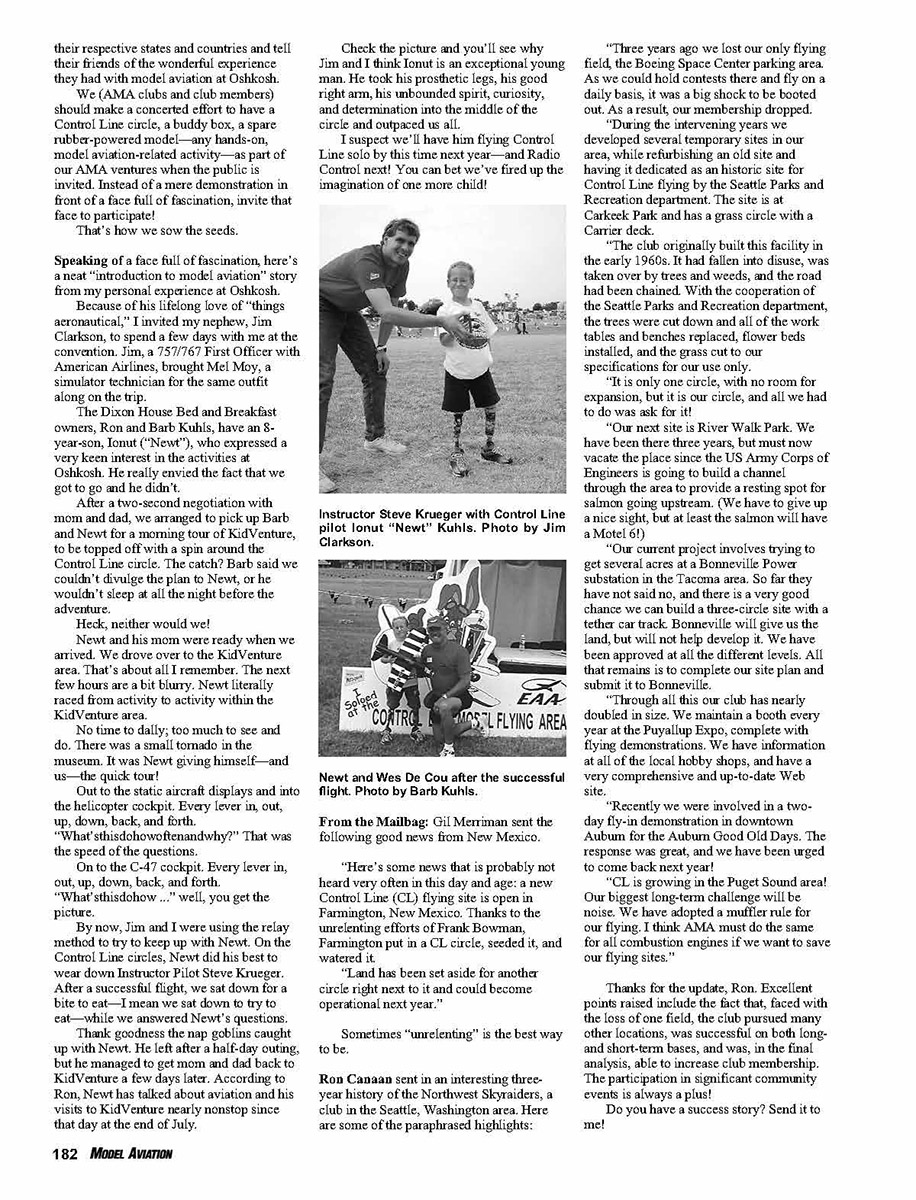
Now, on a completely different subject, the following letter is from Bob Gaster. He recently put on a make-and-take activity at his church and I asked that he write about the project and send some photos!
"As you requested, I am sending a description and some pictures from our Delta Dart building activity at our Trinity Lutheran Church, Davenport, Iowa, Vacation Bible Camp. The theme of the camp was On the Wings of Eagles and the Delta Dart building project fit in well.
"I think I told you that it followed the early morning tethered balloon rides of the LCMS (Lutheran Church-Missouri Synod) Lift High the Cross balloon. The building activity went well, although not as I had planned! I think I used a total of 25 airplanes during the morning building session.
"I had children as young as three or four years old, along with fifth- and sixth-graders. One of my two helpers didn't show up (he had the wrong day!) so this compounded the situation! Luckily, there were some parents there who could help. Although I had done some precutting, it still took a lot longer than expected because of the help required by the littlest ones (and their parents!).
"Although I found white glue good enough for most of the airplane, I chose CYA glue for the wing dihedral and for reinforcing the joints. This step added more time. Since I didn't want the kids to handle this glue, I did the gluing myself!
"But the results were great! I don't know of a single airplane that didn't fly! Because of the length of time it took to build the Delta Darts, we didn't do as many activities as I had planned. We did the mass launch with a small group of builders, but by that time, some children had already left because of other commitments.
"Everyone had lots of fun! The ones who stayed until the end (I think they'd still be there if I didn't have to close things down for lunch!) made up a competition game for Indoor flying in which they scored points for the number of times they could bump the ceiling, each other's airplanes, the walls, and the tables before hitting the floor.
"I hope you enjoy the pictures! The smiles tell the story!"
AMA News
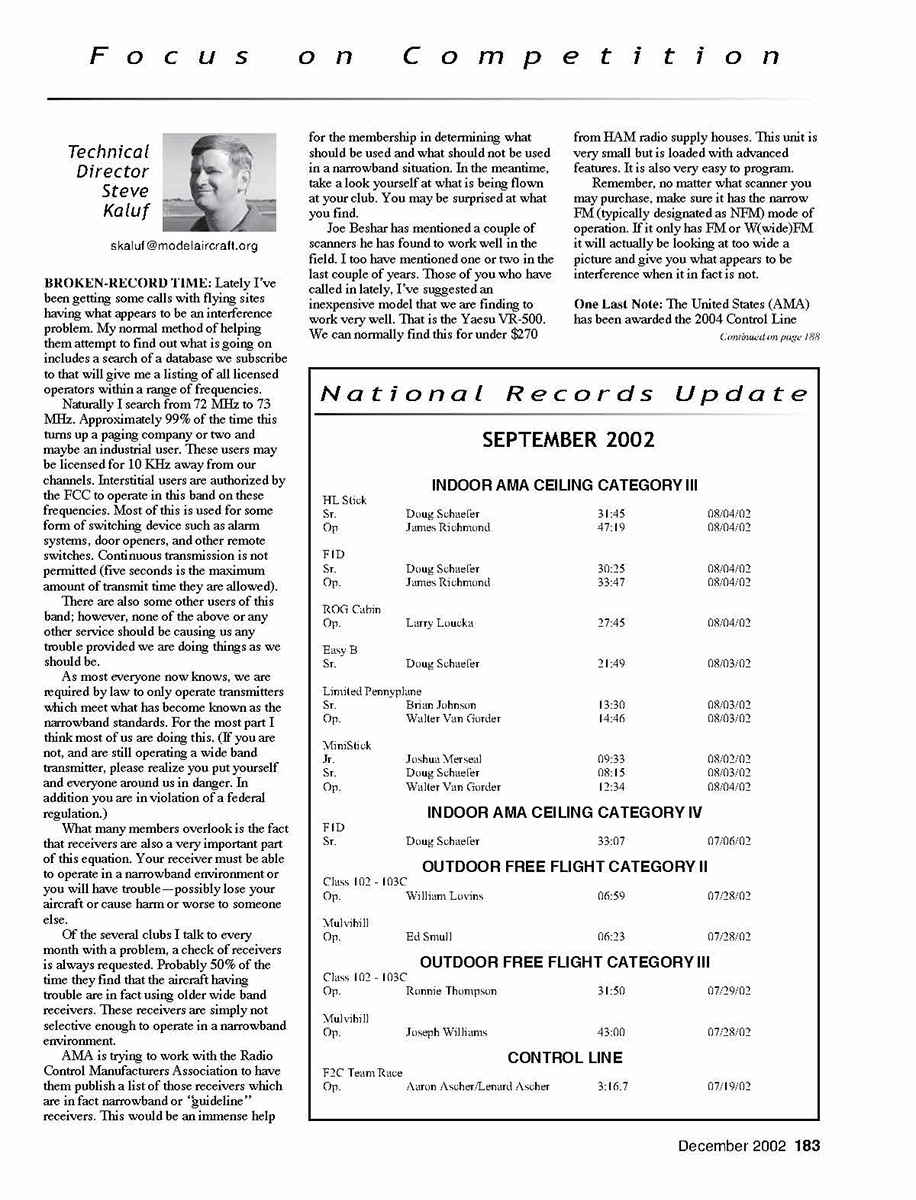
Check the picture and you'll see why Jim and I think Ionut is an exceptional young man. He took his prosthetic legs, his good right arm, his unbounded spirit, curiosity, and determination into the middle of the circle and outpaced us all.
I suspect we'll have him flying Control Line solo by this time next year—and Radio Control next! You can bet we've fired up the imagination of one more child!
"Three years ago we lost our only flying field, the Boeing Space Center parking area. As we could hold contests there and fly on a daily basis, it was a big shock to be booted out. As a result, our membership dropped.
"During the intervening years we developed several temporary sites in our area, while refurbishing an old site and having it dedicated as an historic site for Control Line flying by the Seattle Parks and Recreation department. The site is at Carkeek Park and has a grass circle and Carrier deck.
"The club originally built this facility in the early 1960s. It had fallen into disuse, was taken over by trees and weeds, and the road had been chained. With the cooperation of the Seattle Parks and Recreation department, the trees were cut down and all of the work tables and benches replaced, flower beds installed, and the grass cut to our specifications for our use only.
"It is only one circle, with no room for expansion, but it is our circle, and all we had to do was ask for it!
"Our next site is River Walk Park. We have been there three years, but must now vacate the place since the US Army Corps of Engineers is going to build a channel through the area to provide a resting spot for salmon going upstream. (We have to give up a nice sight, but at least the salmon will have a Motel 6!)
"Our current project involves trying to get several acres at a Bonneville Power substation in the Tacoma area. So far they have not said no, and there is a very good chance we can build a three-circle site with a tether car track. Bonneville will give us the land, but will not help develop it. We have been approved at all the different levels. All that remains is to complete our site plan and submit it to Bonneville.
"Through all this our club has nearly doubled in size. We maintain a booth every year at the Puyallup Expo, complete with flying demonstrations. We have information at all of the local hobby shops, and have a very comprehensive and up-to-date Web site.
"Recently we were involved in a two-day fly-in demonstration in downtown Auburn for the Auburn Good Old Days. The response was great, and we have been urged to come back next year!
"CL is growing in the Puget Sound area! Our biggest long-term challenge will be noise. We have adopted a muffler rule for our flying. I think AMA must do the same for all combustion engines if we want to save our flying sites."
Thanks for the update, Ron. Excellent points raised include the fact that, faced with the loss of one field, the club pursued many other locations, was successful on both long- and short-term bases, and, in the final analysis, was able to increase club membership. The participation in significant community events is always a plus!
Do you have a success story? Send it to me!
From the Mailbag: Gil Merriman sent the following good news from New Mexico.
"Here's some news that is probably not heard very often in this day and age: a new Control Line (CL) flying site is open in Farmington, New Mexico. Thanks to the unrelenting efforts of Frank Bowman, Farmington put in a CL circle, seeded it, and watered it.
"Land has been set aside for another circle right next to it and could become operational next year."
Sometimes "unrelenting" is the best way to be.
Ron Canaan sent in an interesting three-year history of the Northwest Skyraiders, a club in the Seattle, Washington area. Here are some of the paraphrased highlights:
Technical Director
Steve Kaluf [email protected]
BROKEN-RECORD TIME: Lately I've been getting some calls with flying sites having what appears to be an interference problem. My normal method of helping them attempt to find out what is going on includes a search of a database we subscribe to that will give me a listing of all licensed operators within a range of frequencies.
Naturally I search from 72 MHz to 73 MHz. Approximately 99% of the time this turns up a paging company or two and maybe an industrial user. These users may be licensed for 10 kHz away from our channels. Interstitial users are authorized by the FCC to operate in this band on these frequencies. Most of this is used for some form of switch device such as alarm systems, door openers, and other remote switches. Continuous transmission is not permitted (five seconds is the maximum amount of transmit time they are allowed).
There are also some other users of this band; however, none of the above or any other service should be causing us any trouble provided we are doing things as we should be.
As most everyone now knows, we are required by law to only operate transmitters which meet what has become known as the narrowband standards. For the most part I think most of us are doing this. (If you are not, and are still operating a wide band transmitter, please realize you put yourself and everyone around us in danger. In addition you are in violation of a federal regulation.)
What many members overlook is the fact that receivers are also a very important part of this equation. Your receiver must be able to operate in a narrowband environment or you will have trouble—possibly lose your aircraft or cause harm or worse to someone else.
Of the several clubs I talk to every month with a problem, a check of receivers is always requested. Probably 50% of the time they find that the aircraft having trouble are in fact using older wide band receivers. These receivers are simply not selective enough to operate in a narrowband environment.
AMA is trying to work with the Radio Control Manufacturers Association to have them publish a list of those receivers which are in fact narrowband or “guideline” receivers. This would be an immense help for the membership in determining what should be used and what should not be used in a narrowband situation. In the meantime, take a look yourself at what is being flown at your club. You may be surprised at what you find.
Joe Beshar has mentioned a couple of scanners he has found to work well in the field. I too have mentioned one or two in the last couple of years. Those of you who have called in lately, I've suggested an inexpensive model that we are finding to work very well. That is the Yaesu VR-500. We can normally find this for under $270 from HAM radio supply houses. This unit is very small but is loaded with advanced features. It is also very easy to program.
Remember, no matter what scanner you may purchase, make sure it has the narrow FM (typically designated as NFM) mode of operation. If it only has FM or W(F wide)FM it will actually be looking at too wide a picture and give you what appears to be the interference when in fact is not.
One Last Note: The United States (AMA) has been awarded the 2004 Control Line
Transcribed from original scans by AI. Minor OCR errors may remain.

