

AMA Receives a Bequest from George Buso
AMA IS PLEASED and proud to announce the acceptance of a large monetary bequest by George Buso. George has gifted the academy with $53,230.
George and his wife, Olive, have been important and beloved fixtures on the RC Scale scene for many years, and according to George, had established a trust fund some time ago to be distributed to three charitable organizations: two local hospitals and AMA. Sadly, Olive recently passed away, and George decided that the AMA gift should be distributed now in her memory while he was still here to enjoy seeing it put to good use.
The name George Buso should be immediately recognizable by those who have had an interest in any type of scale model airplanes. George's involvement with scale modeling covers all the bases from being a winning Nats, Fédération Aéronautique Internationale (FAI), and Top Gun competitor to judging at FAI World Championships in RC and CL events. He was the team manager of several United States' World Championships teams, and served for several years as a United States delegate to CIAM meetings, the International Aeromodelling Commission of FAI, formerly in Paris, France.
Longtime enthusiasts might remember George's awesome Nieuport 28 that he built from a highly modified Proctor kit. With it George placed first in the Precision Scale category at the 1990 Weak Signals RC Exposition, commonly referred to as the Toledo Show.
At Toledo, George was also presented the Director's Technical Achievement Award for the amazingly detailed Gnome engine that he designed and constructed to hide the actual two-stroke engine that powered the model. Many modelers were convinced that the Gnome was an actual running engine! This airplane placed seventh overall at the 1992 Top Gun event, posting the second highest static score in the process.
George started modeling at age 10, and is now 81 years old. He started out in modeling with FF models and then tried CL flying. He met the legendary Ed Lorenz in 1952 and was introduced to RC flying at that point.
Modeling was put aside for a while during the World War II years while George served as a naval aviator, piloting multiple-engine patrol airplanes such as the PBY Catalina and the PBM Mariner.
Among his many talents, George is an outstanding model designer. He flew RC Pattern for many years on the East Coast, and had two Pattern designs published. In 1974, his Configurator appeared in American Aircraft Modeler, and in 1982 his Big One was published in Flying Models magazine.
Recently Lloyd Roberts and George have identified a need for educating potential United States' FAI competitors on proper presentation and flying techniques to garner more points in FAI Scale competition. They have run two symposia to teach these subjects. One was conducted in Phoenix, Arizona, and one was in Huntersville, North Carolina. It is noteworthy that Lloyd and George did all of this at their own expense. Now that's dedication to the cause!
George is still deeply involved with active model flying, and is a regular at the annual Old Rhinebeck Fly-In each September. He is also still active in FAI competition affairs and will judge at the upcoming FAI F4C (RC Scale) Team Selection that will determine the United States team that will represent us at the World Championships next year in Sweden.
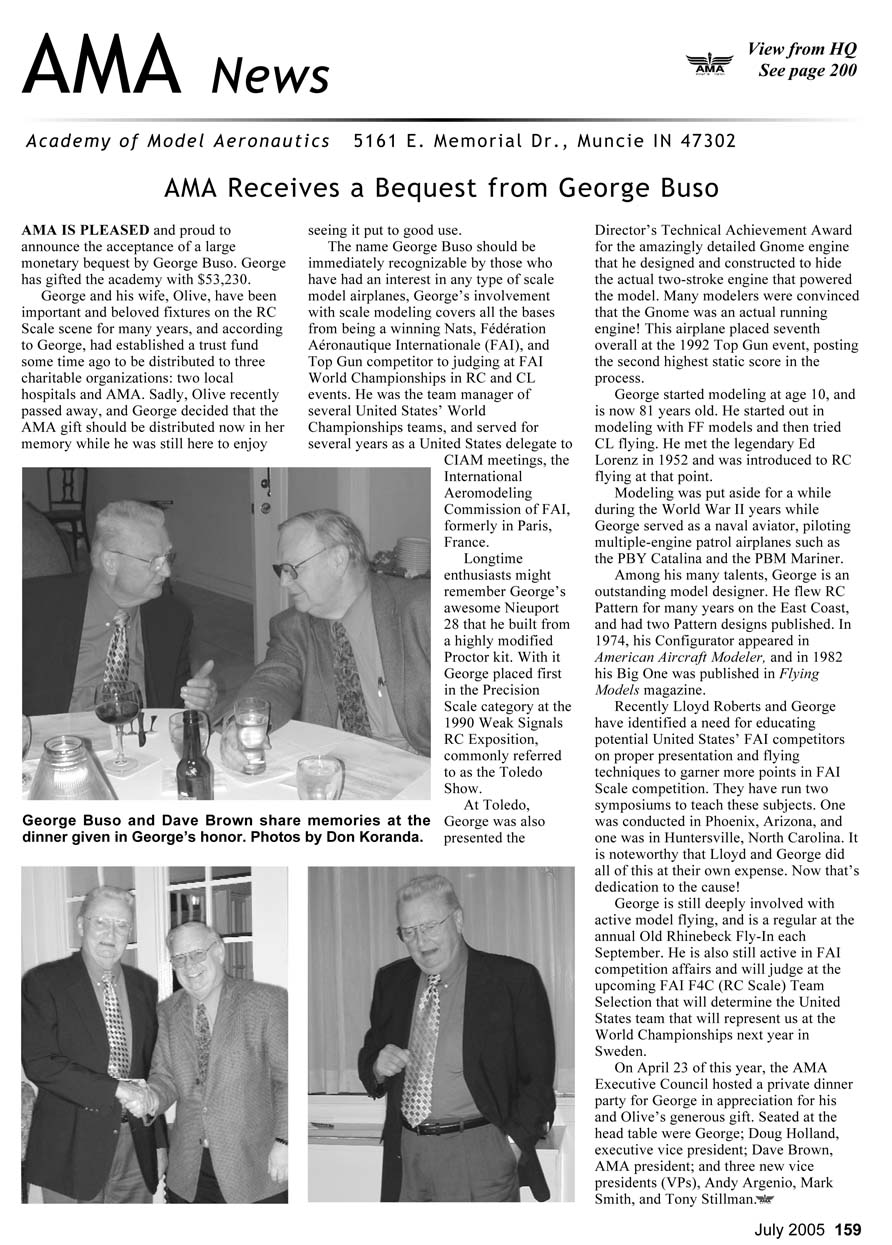
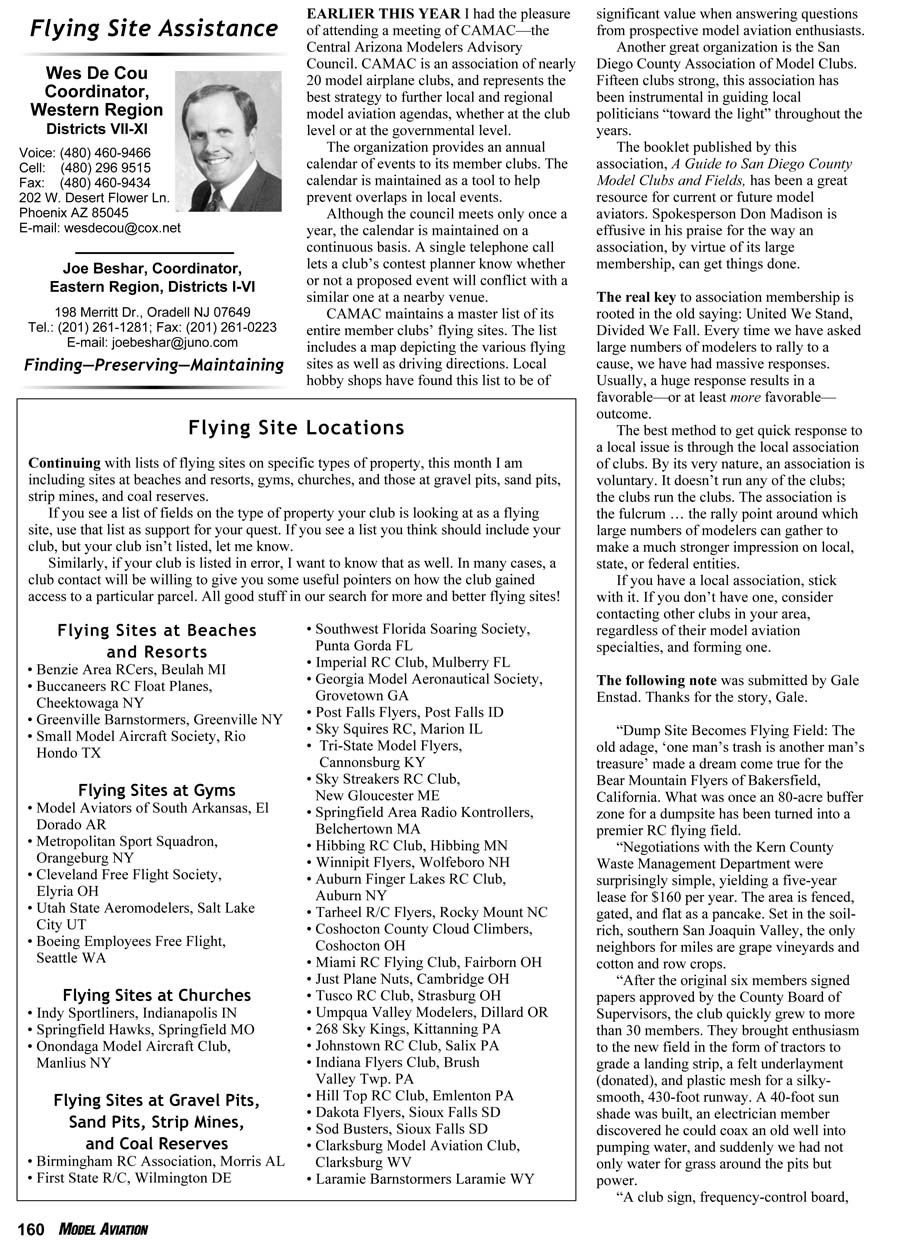
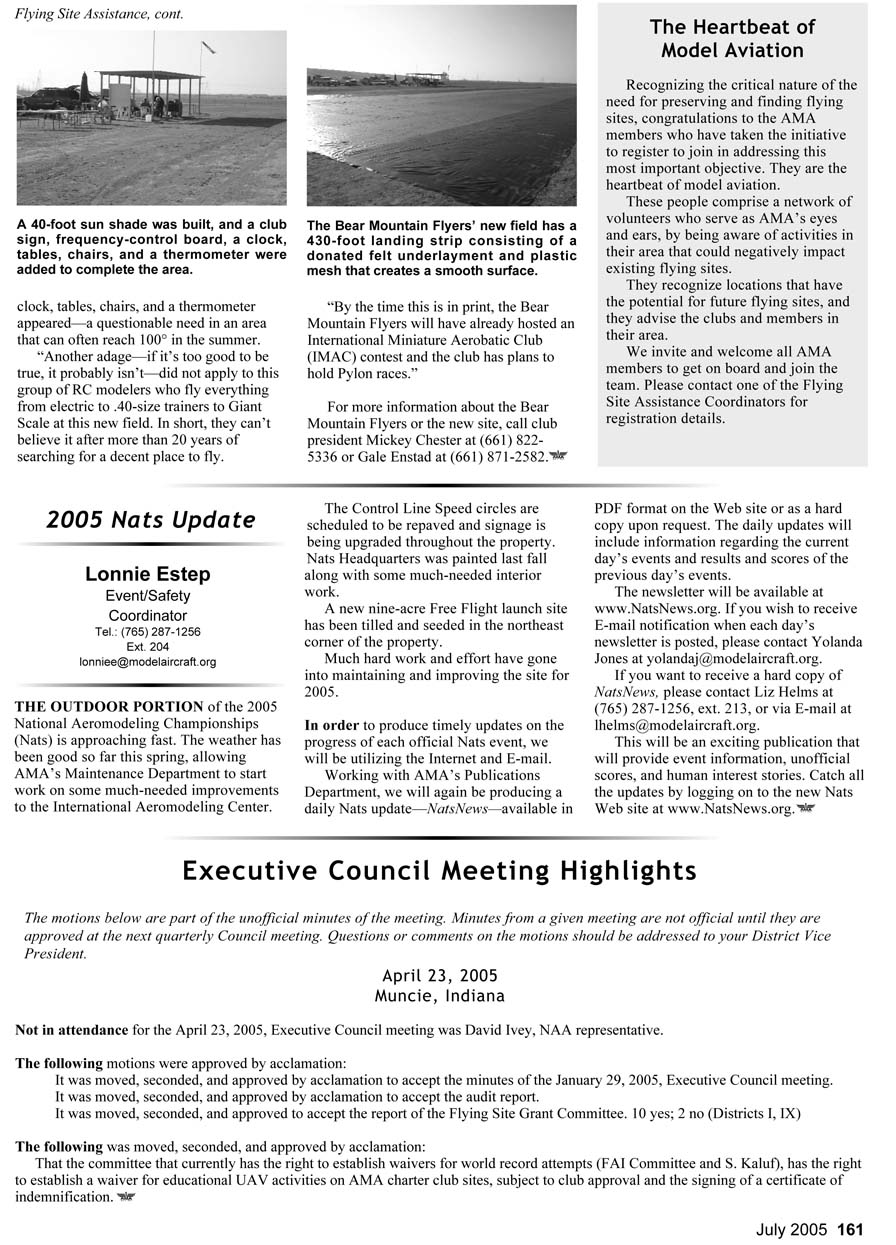
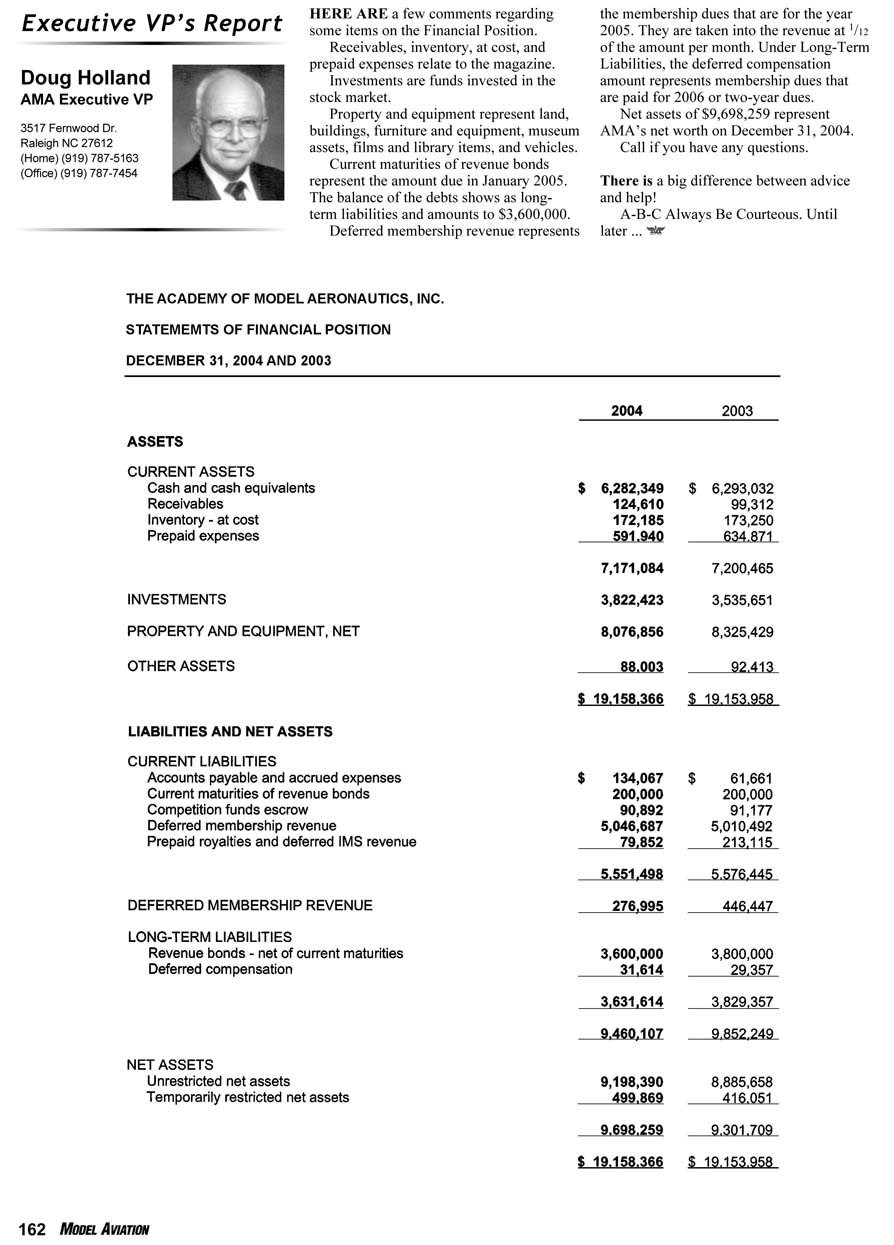
On April 23 of this year, the AMA Executive Council hosted a private dinner party for George in appreciation for his and Olive's generous gift. Seated at the head table were George; Doug Holland, executive vice president; Dave Brown, AMA president; and three new vice presidents (VPs), Andy Argenio, Mark Smith, and Tony Stillman.
EARLIER THIS YEAR I had the pleasure of attending a meeting of CAMAC—the Central Arizona Modelers Advisory Council. CAMAC is an association of nearly 20 model airplane clubs, and represents the best strategy to further local and regional model aviation agendas, whether at the club level or at the governmental level.
The organization provides an annual calendar of events to its member clubs. The calendar is maintained as a tool to help prevent overlaps in local events.
Although the council meets only once a year, the calendar is maintained on a continuous basis. A single telephone call lets a club's contest planner know whether or not a proposed event will conflict with a similar one at a nearby venue.
CAMAC maintains a master list of its entire member clubs' flying sites. The list includes a map depicting the various flying sites as well as driving directions. Local hobby shops have found this list to be of significant value when answering questions from prospective model aviation enthusiasts.
Another great organization is the San Diego County Association of Model Clubs. Fifteen clubs strong, this association has been instrumental in guiding local politicians "toward the light" throughout the years.
The booklet published by this association, A Guide to San Diego County Model Clubs and Fields, has been a great resource for current or future model aviators. Spokesperson Don Madison is effusive in his praise for the way an association, by virtue of its large membership, can get things done.
The real key to association membership is rooted in the old saying: United We Stand, Divided We Fall. Every time we have asked large numbers of modelers to rally to a cause, we have had massive responses. Usually, a huge response results in a favorable—or at least more favorable—outcome.
The best method to get quick response to a local issue is through the local association of clubs. By its very nature, an association is voluntary. It doesn't run any of the clubs; the clubs run the clubs. The association is the fulcrum ... the rally point around which large numbers of modelers can gather to make a much stronger impression on local, state, or federal entities.
If you have a local association, stick with it. If you don't have one, consider contacting other clubs in your area, regardless of their model aviation specialties, and forming one.
The following note was submitted by Gale Enstad. Thanks for the story, Gale.
"Dump Site Becomes Flying Field: The old adage, 'one man's trash is another man's treasure' made a dream come true for the Bear Mountain Flyers of Bakersfield, California. What was once an 80-acre buffer zone for a dumpsite has been turned into a premier RC flying field.
"Negotiations with the Kern County Waste Management Department were surprisingly simple, yielding a five-year lease for $160 per year. The area is fenced, gated, and flat as a pancake. Set in the sun-baked, southern San Joaquin Valley, the only neighbors for miles are grape vineyards and cotton and row crops.
"After the original six members signed papers approved by the County Board of Supervisors, the club quickly grew to more than 30 members. They brought enthusiasm to the new field in the form of tractors to grade a landing strip, a felt underlayment (donated), and plastic mesh for a silky-smooth, 430-foot runway. A 40-foot sun shade was built, an electrician member discovered he could coax an old well into pumping water, and suddenly we had not only water for grass around the pits but power.
"A club sign, frequency-control board, a clock, tables, chairs, and a thermometer were added to complete the area.
"Another adage—if it's too good to be true, it probably isn't—did not apply to this group of RC modelers who fly everything from electric to .40-size trainers to Giant Scale at this new field. In short, they can't believe it after more than 20 years of searching for a decent place to fly.
"By the time this is in print, the Bear Mountain Flyers will have already hosted an International Miniature Aerobatic Club (IMAC) contest and the club has plans to hold Pylon races."
For more information about the Bear Mountain Flyers or the new site, call club president Mickey Chester at (661) 822-5336 or Gale Enstad at (661) 871-2582.
HERE ARE a few comments regarding some items on the Financial Position.
Receivables, inventory, at cost, and prepaid expenses relate to the magazine.
Investments are funds invested in the stock market.
Property and equipment represent land, buildings, furniture and equipment, museum assets, films and library items, and vehicles.
Current maturities of revenue bonds represent the amount due in January 2005. The balance of the debts shows as long-term liabilities and amounts to $3,600,000. Deferred membership revenue represents the membership dues that are for the year 2005. They are taken into the revenue at 1/12 of the amount per month. Under Long-Term Liabilities, the deferred compensation amount represents membership dues that are paid for 2006 or two-year dues.
Net assets of $9,698,259 represent AMA's net worth on December 31, 2004.
Call if you have any questions.
There is a big difference between advice and help! A-B-C Always Be Courteous. Until later ...
THE ACADEMY OF MODEL AERONAUTICS, INC.
STATEMENTS OF FINANCIAL POSITION
DECEMBER 31, 2004 AND 2003
ASSETS
CURRENT ASSETS Cash and cash equivalents $ 6,282,349 $ 6,293,032 Receivables 124,610 99,312 Inventory - at cost 172,185 173,250 Prepaid expenses 591,940 634,871
7,171,084 7,200,465
INVESTMENTS 3,822,423 3,535,651
PROPERTY AND EQUIPMENT, NET 8,076,856 8,325,429
OTHER ASSETS 88,003 92,413
$19,158,366 $19,153,958
LIABILITIES AND NET ASSETS
CURRENT LIABILITIES Accounts payable and accrued expenses $ 134,067 $ 61,661 Current maturities of revenue bonds 200,000 200,000 Competition funds escrow 90,892 91,177 Deferred membership revenue 5,046,687 5,010,492 Prepaid royalties and deferred IMS revenue 79,852 213,115
5,551,498 5,576,445
DEFERRED MEMBERSHIP REVENUE 276,995 446,447
LONG-TERM LIABILITIES Revenue bonds - net of current maturities 3,600,000 3,800,000 Deferred compensation 31,614 29,357
3,631,614 3,829,357
9,460,107 9,852,249
NET ASSETS Unrestricted net assets 9,198,390 8,885,658 Temporarily restricted net assets 499,869 416,051
9,698,259 9,301,709
$19,158,366 $19,153,958
District VII Report
I KEEP PUTTING in our Web address at the beginning of each column for a reason. I want to continue reminding District VII clubs that we have our own Web site and to take advantage of it.
I don't understand why more clubs don't take advantage of posting their events on our calendar, so as a reminder, it is www.amadistrictvii.org.
Thanks to all of the people who stopped by to say hello during the Weak Signals' Toledo Show. It is always a pleasure to meet members from the district in person.
Of course, one of my first questions is "do you have any suggestions or complaints?" Oddly enough, I don't hear many complaints, but I do receive suggestions, and some of them are pretty darn good.
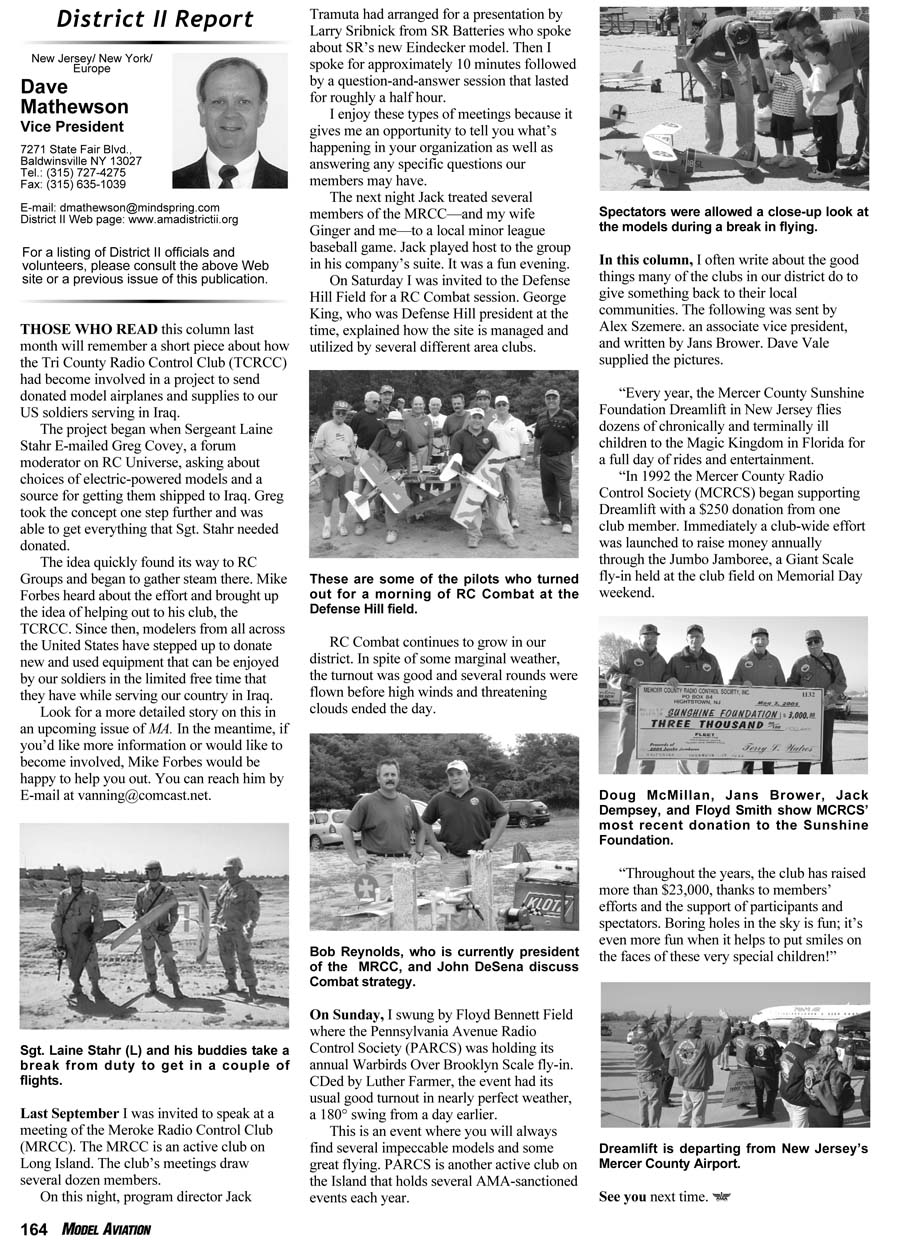
I received this report from Tim Feathers of the Wausau R/C Sportsmen. The club puts on an event called The Sky's The Limit.
Tim is a seventh-grade teacher at D.C. Everest Middle School in Schofield, Wisconsin. With the help of members Bob Weller, Ron Earnhardt, Joe Osimitz, and Brian Kling, they managed to build two trainers in two groups of seven students each.
The club had a flight simulator available for the youngsters to try their hands at flying.
This is another example of how a club can get youngsters involved in model aviation. The following pictures will tell the rest of the story.
Wausau R/C Sportsmen member Bob Weller is explaining the covering process.
Wausau R/C Sportsmen member Joe Osimitz works with Mike Abel and Ben Lehman.
Kendra Feathers is working on the flight simulator.
Bob Weller works with Sam Stranz and Garitt Bloch.
This is a group picture of The Sky's the Limit students and instructors.
Till next time, fly safely. C.A.V.U.
District VIII Report
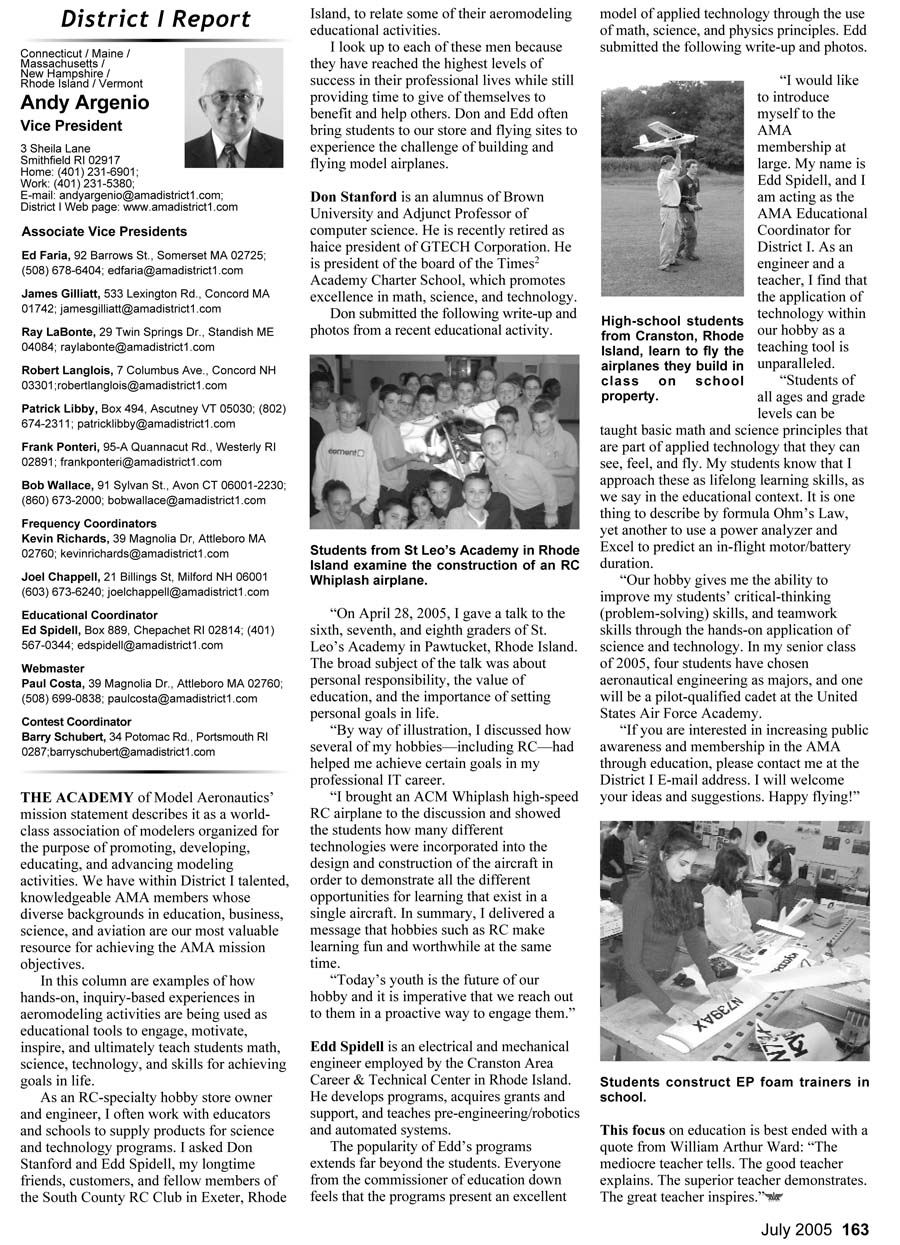
THANKS TO Doug "Chief" Powell, District VIII associate vice president (AVP), for this story about the third Oklahoma City 3-D Extreme Challenge Indoor Electric Aircraft Competition and Fun-Fly!
"April 16 dawned, a beautiful, clear—but decidedly windy and cool—spring morning. Promptly at 8 a.m., I pointed my trusty steed pony north and fired up the CD player for the drive to Oklahoma City. By 10:30 I was turning into the parking lot of the Oklahoma National Guard Armory at 200 NE 23rd Street, and trying to find a parking spot.
"I was greeted inside the door by a smiling Kelly Flannigan (below), wife of CD Jim Flannigan. I checked out the pile of nice raffle prizes and bought some raffle tickets. One never knows!
"Noticing that Jim was busy getting things in order for the first round of competition, I decided to tour the facility and check out the vendors' wares and bargains before things got underway.
"The facility is spacious on the inside and extremely well-suited to indoor flight activity. There are two levels above the ground floor which encircle the central flying area, but access was restricted to the ground floor and the second story perimeter balcony.
"There was some loose-mesh, lightweight, nylon netting protecting the spectators and vendors on the second floor balcony. Good thinking and planning!
"The first round of 3-D Freestyle competition got underway at 11 a.m. sharp, as advertised. Each of the 12 top-notch competitors flew their two-minute routine, and did so in fairly rapid-fire succession and they were nothing short of perfection. Each flight was capped by a round of applause.
"The arena was open to noncompetitive, just-for-fun flying while the competitors readied themselves for the second round of the 3-D contest. When the second round concluded, the call to lunch sounded.
"Throughout the lunch hour, there were three to five airplanes in the air at all times. One thing that can be said for Indoor fliers is that they are willing to experiment. The wide variety of shapes, sizes, colors, and construction techniques evident in the aircraft flown at this event bore that out.
"Competition resumed for the third and final round of 3-D Freestyle at approximately 2 p.m. then while the scores were tallied and recorded, the arena was again opened to the many fly-for-fun event entrants.
"The competitors and spectators gathered for the announcement of the final standings and the presentation of awards. The 12th-place finisher was called and as he stepped forward to receive his award, I snapped my shutter only to be rewarded with no flash and a low-battery indicator! Rats! Big, fat, hairy rats!
I beat a hasty retreat to the parking lot to change batteries and returned in time to see the second-place finisher walking away with his check and to hear the winner announced.
"I regret not getting pictures of all of the award presentations, especially since all of the competitors were certainly winners in my book. I will list their names and placement in the 3-D competition I hope there will be additional coverage of the event on the club's Web site.
1) Sean McMurtry 2000.00 2) Josh Glavin 1971.83 3) Jeff Pfeifer 1815.70 4) Brandon Chitty 1794.41 5) John Woundra 1757.54 6) Mike Hill 1695.33 7) Steven Carrol 1414.14 8) Brett Wickizer 1383.30 9) Sony White 1254.08 10) Chris Mcnair 1125.43 11) Scott Dilley 1025.51 12) Jared Clark 622.48
"From what I saw and heard from the competition fliers, the just-for-fun fliers, and the many spectators and vendors, this was possibly the premier Indoor events in District VIII so far this year.
"Thank you, Jim Flannigan (above), and your outstanding crew of workers for a most enjoyable and well-run event!"
SANE—Safe Aeromodeling is No accidEnt. Dr. Sandy Frank
AMA News
I tabulated scores for the Navy Carrier event for several years. In 1993 I was the event director for the Navy Carrier event in Lawrenceville, Indiana. I also worked as the CL director for part of the week. In 1994, I assumed the position of CL director under Bev Wisnewski. In 1996 I assumed the position of CL Manager when Bev retired.
I tell Melvin that I work the Nats so he can play, but I really enjoy doing what I can to make the participant’s time at the Nats an enjoyable experience.
In 1999 Melvin and I started MBS Model Supply with the encouragement of Bob “Bear” Beardon. It is a small but successful CL mail-order business.
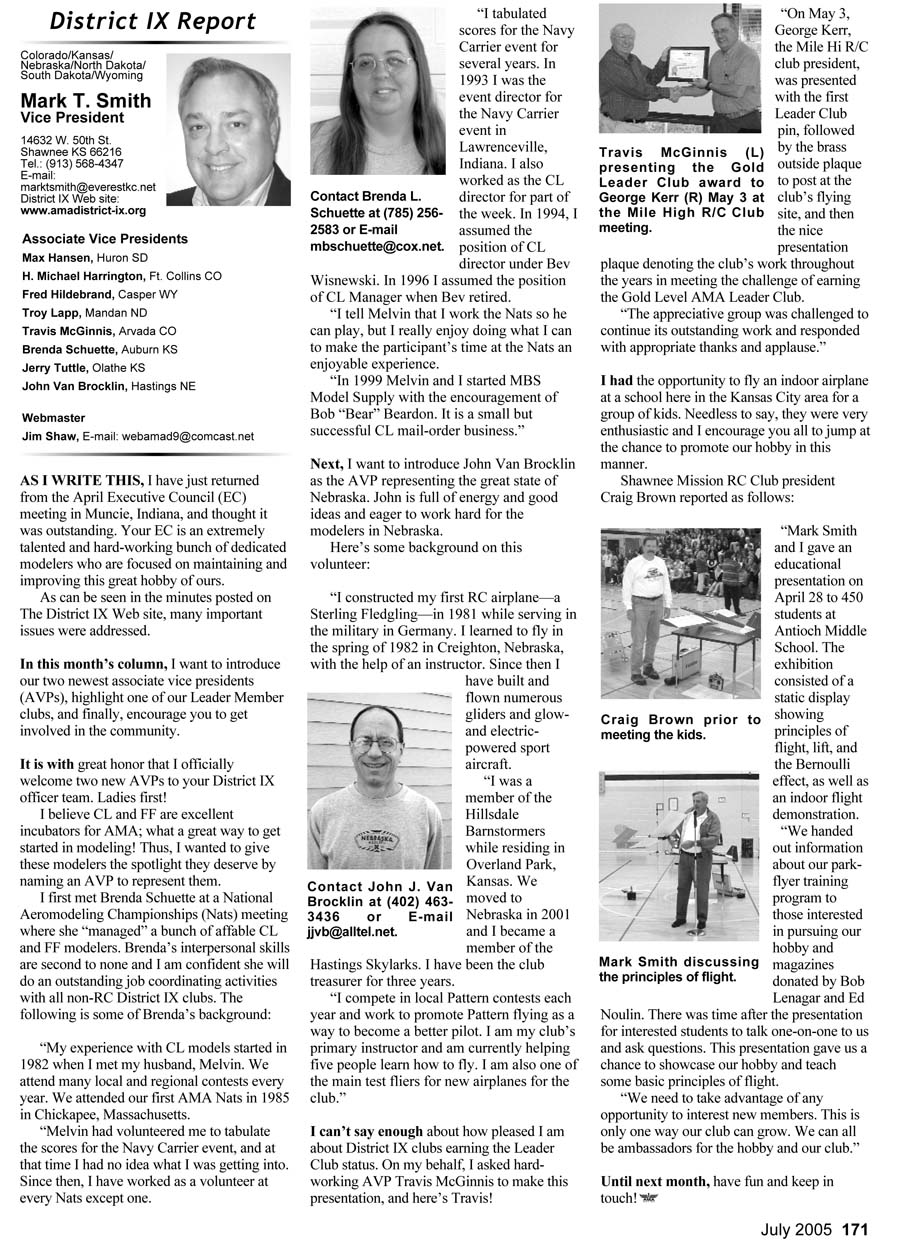
Next, I want to introduce John Van Brocklin as the AVP representing the great state of Nebraska. John is full of energy and good ideas and eager to work hard for the modelers in Nebraska.
Here’s some background on this volunteer:
“I constructed my first RC airplane—a Sterling Fledgling—in 1981 while serving in the military in Germany. I learned to fly in the spring of 1982 in Creighton, Nebraska, with the help of an instructor. Since then I have built and flown numerous gliders and glow- and electric-powered sport aircraft.
“I was a member of the Hillsdale Barnstormers while residing in Overland Park, Kansas. We moved to Nebraska in 2001 and I became a member of the Hastings Skylarks. I have been the club treasurer for three years.
“I compete in local Pattern contests each year and work to promote Pattern flying as a way to become a better pilot. I am my club’s primary instructor and am currently helping five people learn how to fly. I am also one of the main test fliers for new airplanes for the club.”
Contact John J. Van Brocklin at (402) 463-3436 or E-mail [email protected].
I can’t say enough about how pleased I am about District IX clubs earning the Leader Club status. On my behalf, I asked hard-working AVP Travis McGinnis to make this presentation, and here’s Travis!
I had the opportunity to fly an indoor airplane at a school here in the Kansas City area for a group of kids. Needless to say, they were very enthusiastic and I encourage you all to jump at the chance to promote our hobby in this manner.
Shawnee Mission RC Club president Craig Brown reported as follows:
“Mark Smith and I gave an educational presentation on April 28 to 450 students at Antioch Middle School. The exhibition consisted of a static display showing principles of flight, lift, and the Bernoulli effect, as well as an indoor flight demonstration. We handed out information about our park-flyer training program to those interested in pursuing our hobby and magazines donated by Bob Lenagar and Ed Noulin. There was time after the presentation for interested students to talk one-on-one to us and ask questions. This presentation gave us a chance to showcase our hobby and teach some basic principles of flight.
“We need to take advantage of any opportunity to interest new members. This is only one way our club can grow. We can all be ambassadors for the hobby and our club.”
Until next month, have fun and keep in touch!
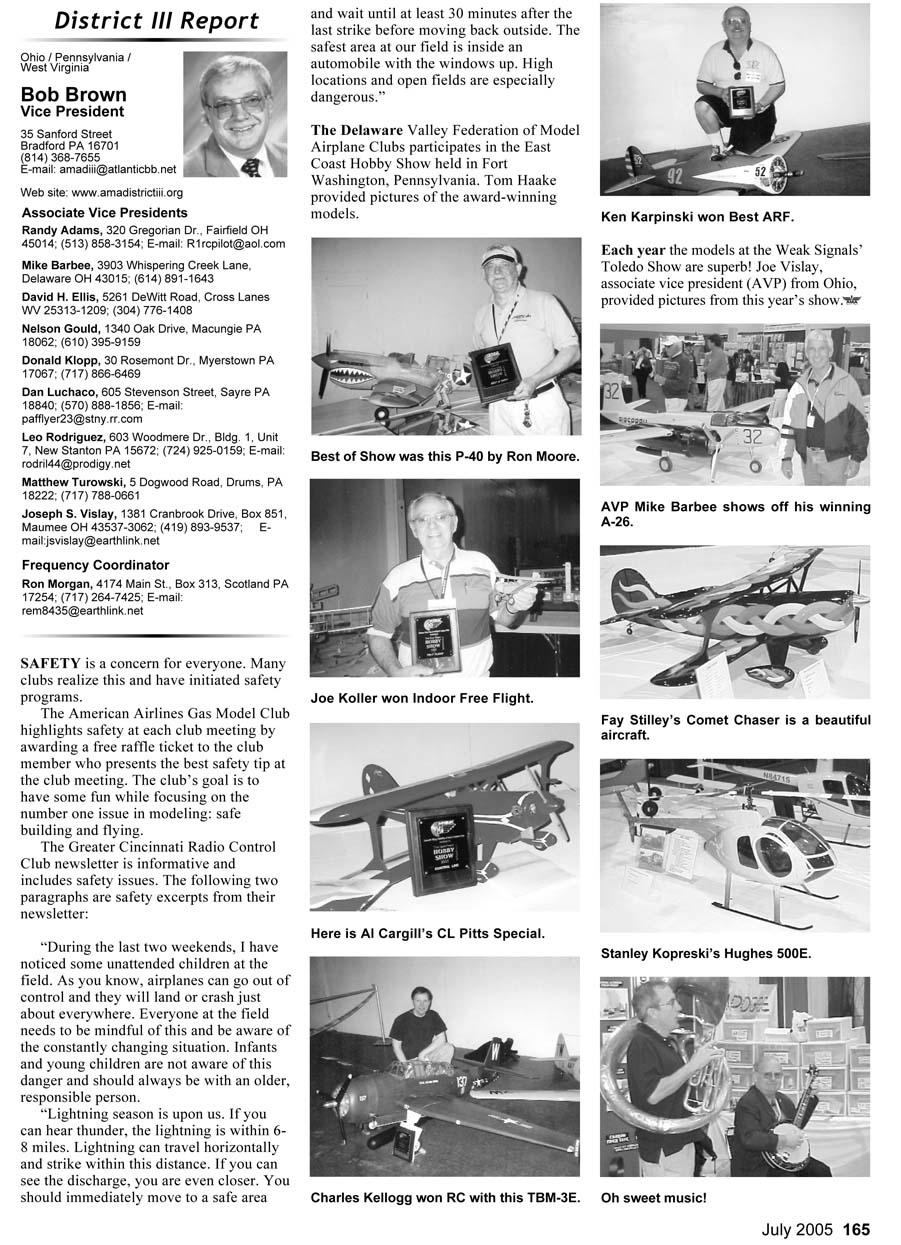
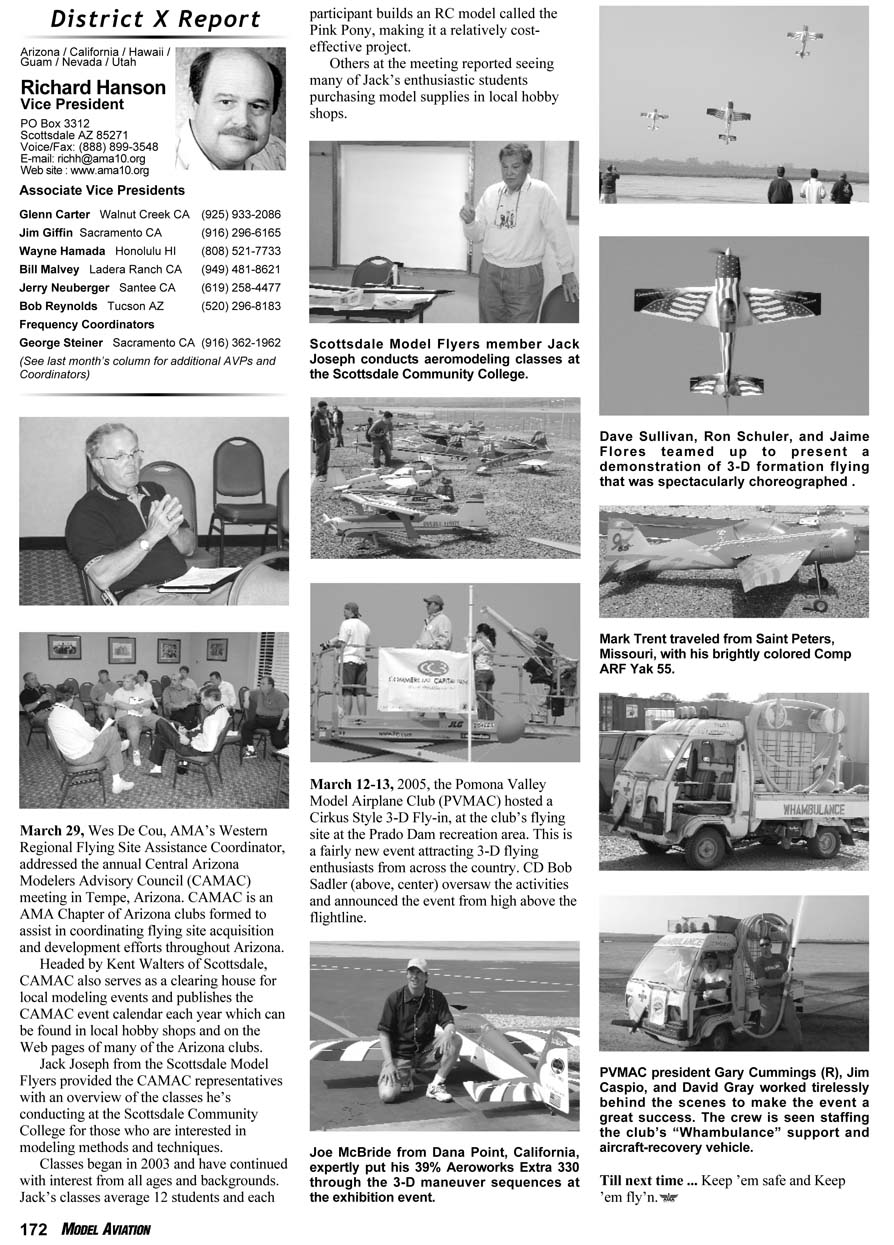
March 29, Wes De Cou, AMA’s Western Regional Flying Site Assistance Coordinator, addressed the annual Central Arizona Modelers Advisory Council (CAMAC) meeting in Tempe, Arizona. CAMAC is an AMA Chapter of Arizona clubs formed to assist in coordinating flying site acquisition and development efforts throughout Arizona.
Headed by Kent Walters of Scottsdale, CAMAC also serves as a clearing house for local modeling events and publishes the CAMAC event calendar each year which can be found in local hobby shops and on the Web pages of many of the Arizona clubs.
Jack Joseph from the Scottsdale Model Flyers provided the CAMAC representatives with an overview of the classes he’s conducting at the Scottsdale Community College for those who are interested in modeling methods and techniques.
Classes began in 2003 and have continued with interest from all ages and backgrounds. Jack’s classes average 12 students and each participant builds an RC model called the Pink Pony, making it a relatively cost-effective project.
Others at the meeting reported seeing many of Jack’s enthusiastic students purchasing model supplies in local hobby shops.
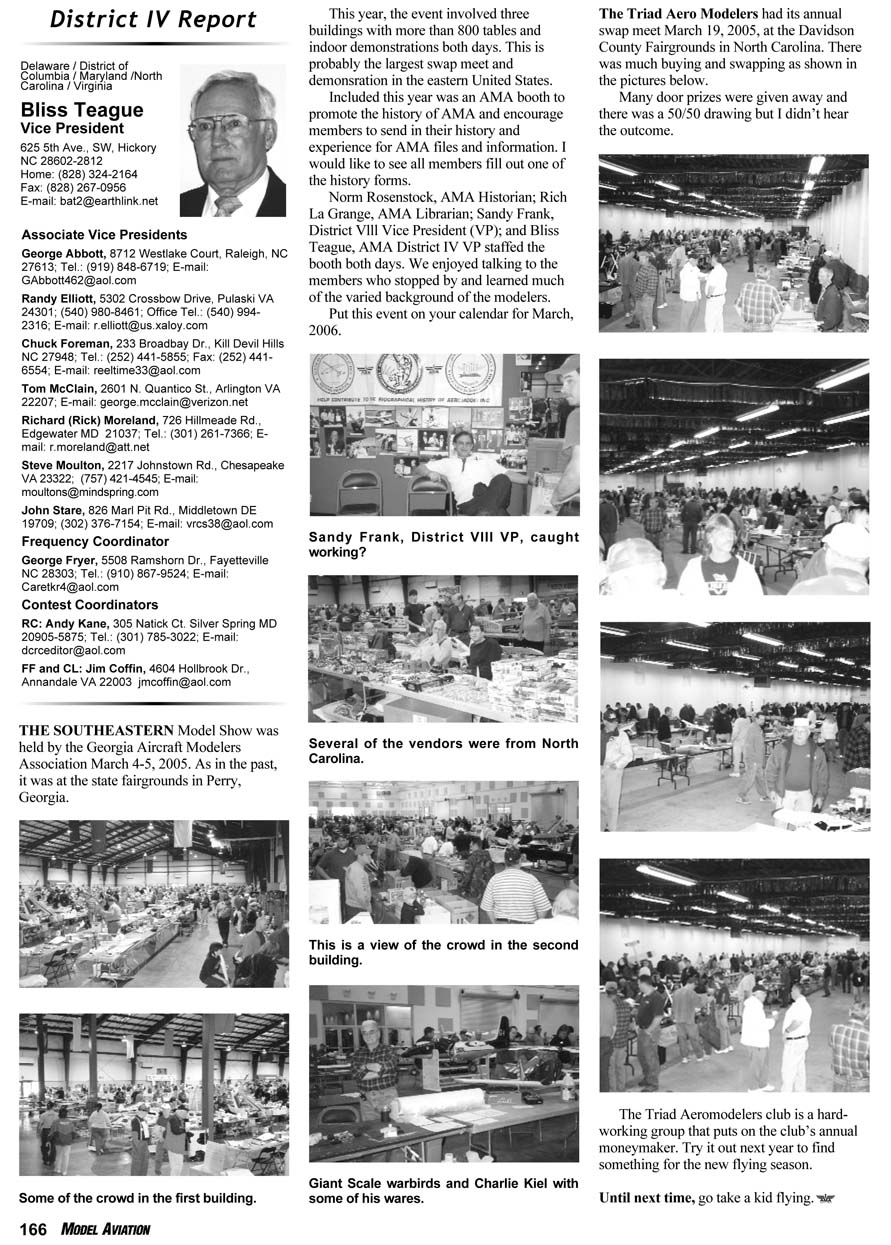
March 12-13, 2005, the Pomona Valley Model Airplane Club (PVMAC) hosted a Cirkus Style 3-D Fly-in, at the club’s flying site at the Prado Dam recreation area. This is a fairly new event attracting 3-D flying enthusiasts from across the country. CD Bob Sadler (above, center) oversaw the activities and announced the event from high above the flightline.
Joe McBride from Dana Point, California, expertly put his 39% Aeroworks Extra 330 through the 3-D maneuver sequences at the exhibition event.
Dave Sullivan, Ron Schuler, and Jaime Flores teamed up to present a demonstration of 3-D formation flying that was spectacularly choreographed.
Mark Trent traveled from Saint Peters, Missouri, with his brightly colored Comp ARF Yak 55.
PVMAC president Gary Cummings (R), Jim Caspio, and David Gray worked tirelessly behind the scenes to make the event a great success. The crew is seen staffing the club’s “Whambulance” support and aircraft-recovery vehicle.
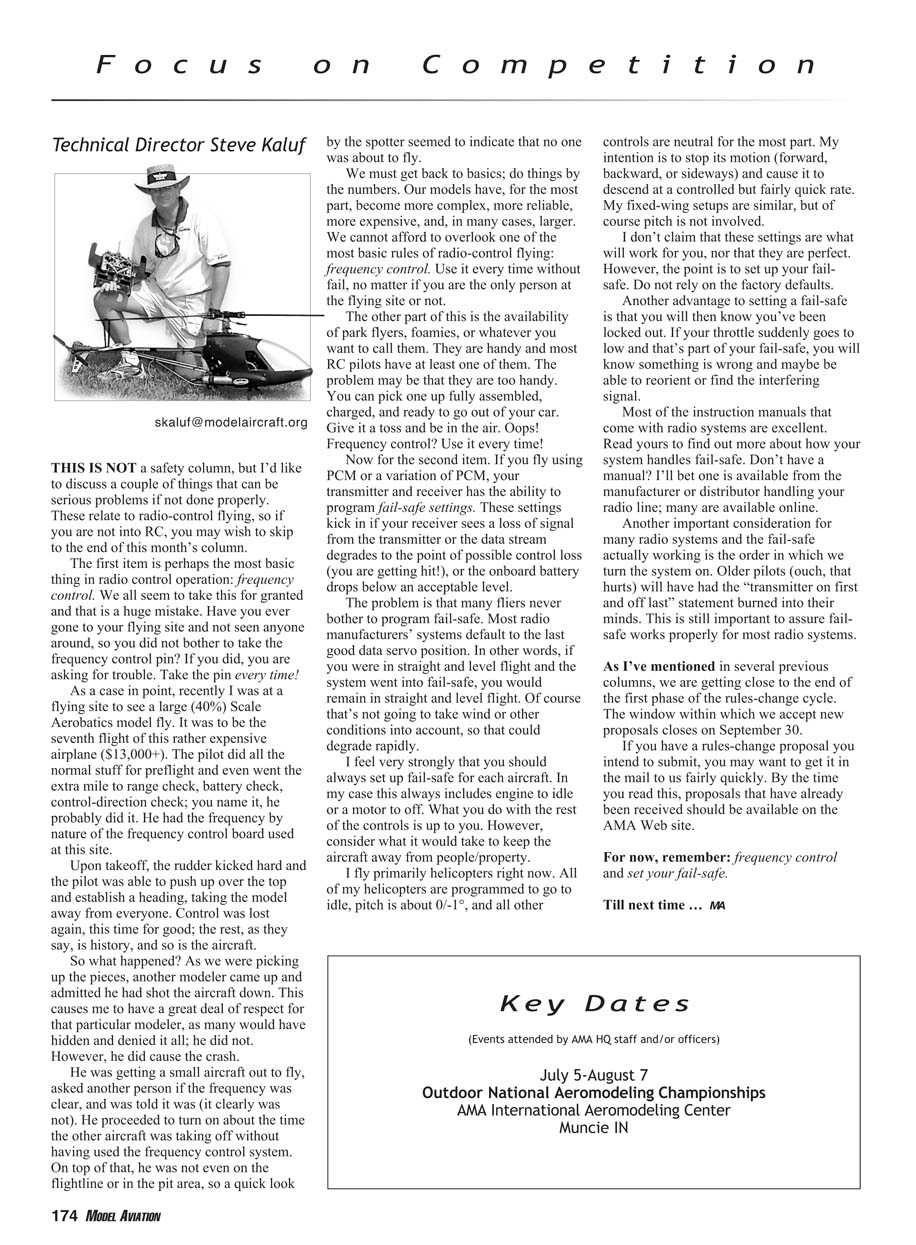
Till next time ... Keep ’em safe and Keep ’em fly’n.
AMA News
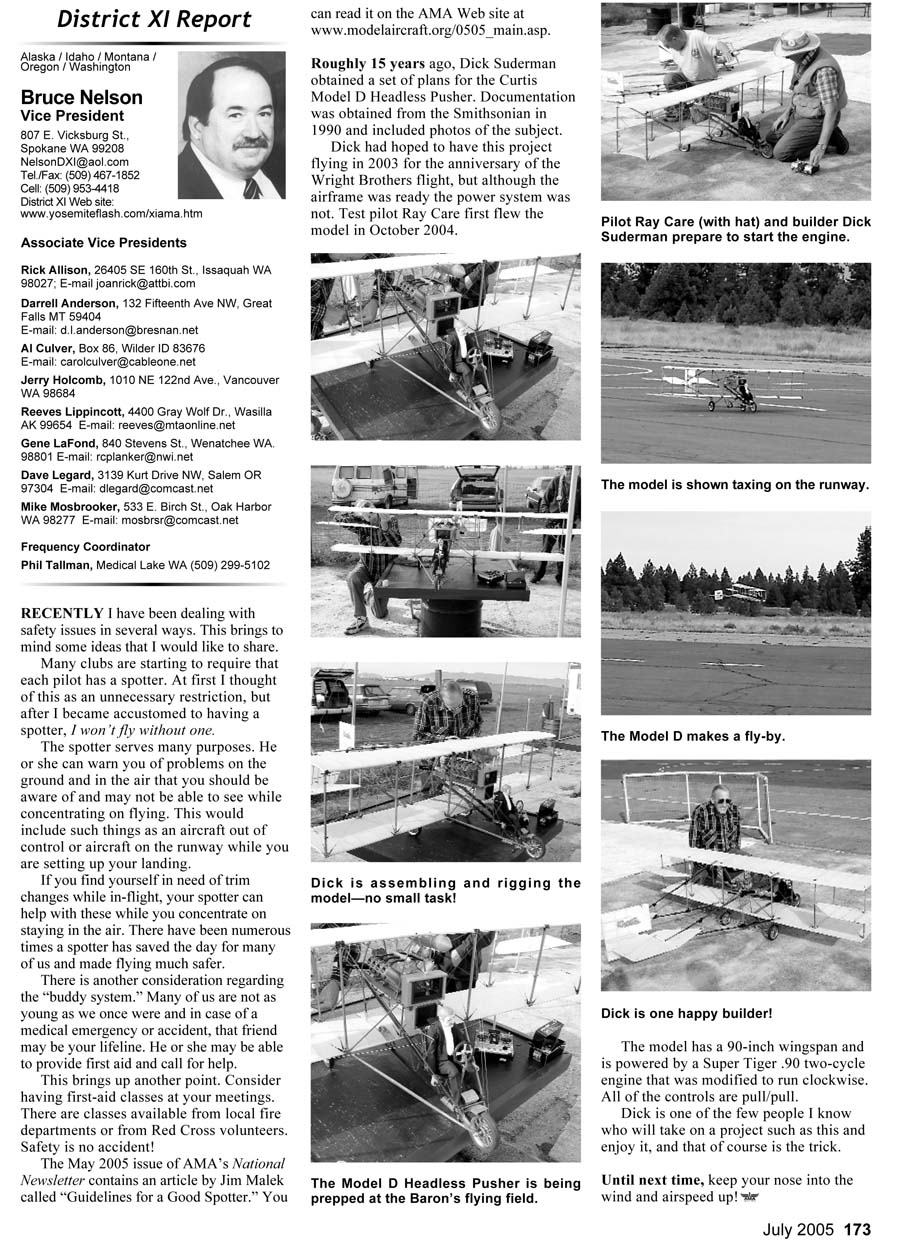
Roughly 15 years ago, Dick Suderman obtained a set of plans for the Curtis Model D Headless Pusher. Documentation was obtained from the Smithsonian in 1990 and included photos of the subject.
Dick had hoped to have this project flying in 2003 for the anniversary of the Wright Brothers flight, but although the airframe was ready the power system was not. Test pilot Ray Care first flew the model in October 2004.
The model is shown taxing on the runway.
The Model D makes a fly-by.
Dick is assembling and rigging the model—no small task!
The Model D Headless Pusher is being prepped at the Baron’s flying field.
Pilot Ray Care (with hat) and builder Dick Suderman prepare to start the engine.
Dick is one happy builder!
The model has a 90-inch wingspan and is powered by a Super Tiger .90 two-cycle engine that was modified to run clockwise. All of the controls are pull/pull.
Dick is one of the few people I know who will take on a project such as this and enjoy it, and that of course is the trick.
Until next time, keep your nose into the wind and airspeed up!
Transcribed from original scans by AI. Minor OCR errors may remain.

