
Flying Site Assistance
Wes De Cou [[email protected]]
"These aren't just airplanes; they're hopes and dreams."
THE SHAWNEE Mission Radio Control Club contacted District IX vice president Mark Smith asking for some thoughts concerning the burgeoning popularity of electric RC.
At Mark's request, Ron Evans, vice president of the Rocky Mountain Electric Flyers (RMEF) club, put together some worthwhile suggestions about how to attract some of the myriad new park-flyer or backyard-flyer owners to your club and to the AMA.
From a flying-site-development perspective, the evolution of electric-powered flight has been an absolute boon. We see flying sites being developed in the midst of urban sprawl. Indeed, I receive E-mails now from modelers who can literally pick up their airplane and transmitter and walk to the flying field!
From a club's and AMA's perspective, the tens of thousands of new electric park-flyer owners represent an opportunity for substantial growth; they portend a healthy future for the hobby.
Here, with thanks from Mark and from me, are Ron's thoughts:
"The Shawnee Mission RC club is beginning a training program geared toward the thousands of people who are getting involved with small electric model aircraft. These $100 ARFs or RTFs are flying out the door of hobby shops everywhere. If we can help them early enough—before their airplane gets too wrecked—they'll have a much better chance of becoming modelers.
"We have to recognize that the park-flyer genre is where the new people start now. As avid modelers ourselves, we have an opportunity to get them on the right track.
"Let's make a couple of assumptions to begin. One: we're talking about Slo Stik or Aerobird-type or electric aircraft, and two: we're dealing with absolute novices. These are people who have little or no previous experience flying.
"The first thing we do is try to settle them down. We talk a bit and find out what they already know about RC in general and electric power in particular. We explain the control system from the transmitter controls to the airplane controls and what the model will do when the controls are actuated.
"The best and most reliable resource to have is a couple (or more) scratch-builders or very knowledgeable fliers who can check out the airplanes when the novice fliers bring them out. I mean check everything, including the Velcro battery retaining mount (we've lost one brand-new, first-flight Stik when the battery bailed out in a strong thermal!) to pushrods, control throws, clevises, servo mounts, motor mounts, wing hold-downs, etc.
"It's a good idea to have a supply of five-minute epoxy, foam-safe cyanoacrylate glue, Velcro, plastic ties (great for motor mounts), servo screws and arms (yes, we've seen airplanes without servo screws in place), some scrap balsa or cardboard for epoxy mixing, a small drill for new pushrod holes, and just in case, a first-aid kit. Maybe a club can pitch in and make up a kit with everything and designate one regular to bring it to the field each week.
"We've eliminated most of this hassle by being lucky enough to have airplanes donated by local hobby shops. We have a few such trainer models in our club. It doesn't hurt to ask. Most hobby shops understand the long-term benefits of a successful first flight.
"What most of us forget is the big emotional investment that new people have in going out to the field in the first place. 'What if I crash? What if I look stupid and they laugh? Maybe my model's not right ...' Get the idea? Handle them as if they were your close relatives. These aren't just airplanes; they're hopes and dreams.
"More than one novice has told me that it made them feel better just because I remembered their name! They're the new people, the strangers. We all know each other. We all speak 'modelese,' dihedral, incidence, power-to-weight, frequency, channels ... How do you think that sounds to the new person?
"After having the airplane thoroughly checked out, run the motor away from the pits and people. Does the arming function work? How about the throttle response? Is the propeller turning in the correct direction?
"Shut it down, disconnect the battery (remember, they're watching everything you do) and tug on the motor. Is it still tight? Is it too hot? Is the battery hot? Maybe the propeller's too small or the battery's overworked. Check the leads and connectors. If they're hot after a short run they will surely melt in flight. No battery, no control, no airplane.
"If it checks out, hook up a buddy cord; don't fly without it. Have a club member launch the airplane and have the instructor fly it initially. The instructor should trim out the aircraft to fly level at or near half-throttle. Don't trim for a slight climb; the novice will get disoriented when the airplane gets too high.
"The single biggest problem we see is control reversal when the model is heading toward the novice. Practice is the key here, with competent help in the beginning. Let the novice fly as long as possible. Don't have five people nearby yelling 'Left, give it left. Up! More up!' I'm not trying to be patronizing. You'd be surprised how many well-intentioned club members will yell out their 'help' at the wrong time.
"One instructor, one calm, clear voice is all it takes. After the flight, praise everything they did right. Build them up, and then mention a few things they could work on or practice. It's not that they were wrong, they just need to get better (which to them means they were already good, not bad) and you'll see them respond. Don't be critical; be helpful. To a new person, there's a big difference.
"We have an RC flight simulator at every meeting and it's the most popular and we have. If you have one at your meetings, invite the novice to attend.
"As a last suggestion, have somebody in the club make up a list of recommended airplanes, radios, and motor upgrades. Run off a few dozen copies and give them to anyone who comes out. Most clubs use their Web site for this. If this is the case with your club, make sure the novice pilot has your Web address.
"I hope some of this helps. These suggestions are based on my experience and observations. Your experiences may have been different, but the bottom line, from my perspective, is more satisfied novice pilots, more club members, and a stronger AMA through increased membership."
Ron can be contacted at [email protected]. The RMEF club Web site is www.rmeflyers.org.
AMA News
Danville which is just a few miles from their field.
Fifteen members (including four junior members) participated in the cleanup. The club picks up trash four times a year. This is the second year in the program. The information and picture were sent in by John Louden.
Indiana to Florida: Jack Sheeks sent in the following story of a flier and model reunited.
"Enclosed is a picture of a 45-year reunion of Jim Vorholt and his 1960 Nats-winning Caresol model by Charles Mackey. Jim won the Junior CL Stunt Nats with this very model. It seems that he sold it after repainting it from black to white, to Bill Davis, who resold it to Dave Gatewood.
"Mr. Gatewood passed on recently and I saw it hanging in his garage. I spoke to Dave's wife and asked if I could take it to Florida and give it back to Jim. She agreed, so I hauled it to Florida and called Jim and gave it to him.
"Jim was very excited and promised to rework it and get the Caresol ready to go again."
Nice story!
Jacksonville, Illinois: The Jacksonville Proppickers recently spent the weekend erecting a 12 x 16-foot equipment shed at the club's field. It took a year and a half to plan and finance the project, but with willing hands, the building went up in one weekend.
This is a small club, and local businesses made significant contributions of equipment and materials. John Althoff sent in the information and picture.
District VIII
Arkansas, Louisiana, New Mexico, Oklahoma, Texas
Dr. Sandy Frank District VIII Vice President
BEGINNING WITH this issue and MA's new format, all information presented within this district column shall be through membership submission! Please send your information and photographs to District VIII Vice President, Dr. Sandy Frank, 105 N. Brazos St., Weatherford TX 76086; (817) 791-6079; E-mail: [email protected].
For digital photography, use the equivalent of 300 dpi (high-resolution). Please limit your text and descriptions to 100-200 words.
If you would like to see your special interests showcased in this column, please send your submission as soon as possible!
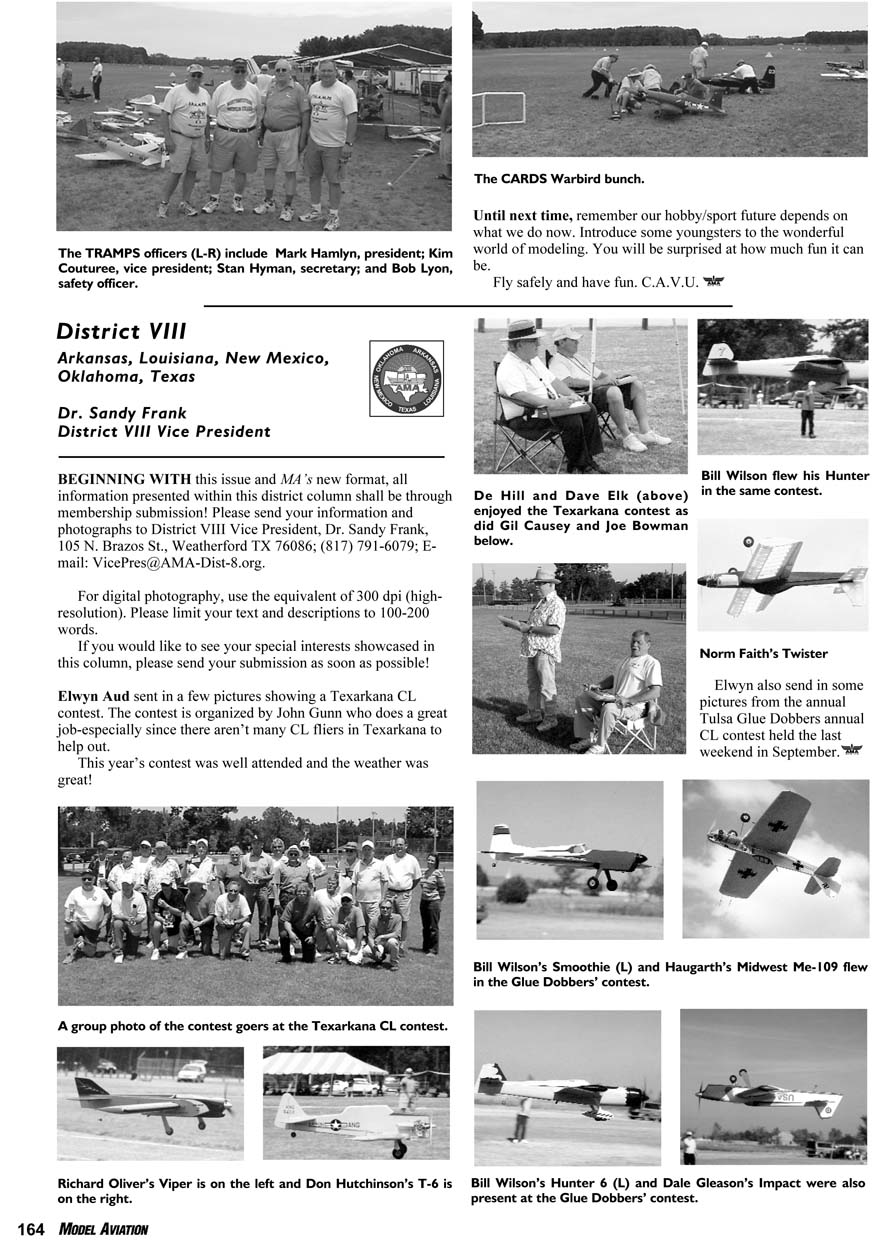
Elwyn Aud sent in a few pictures showing a Texarkana CL contest. The contest is organized by John Gunn who does a great job—especially since there aren't many CL fliers in Texarkana to help out.
This year's contest was well attended and the weather was great!
Elwyn also sent in some pictures from the annual Tulsa Glue Dobbers annual CL contest held the last weekend in September.
District IX
Colorado, Kansas, Nebraska, North Dakota, South Dakota, Wyoming
Mark Smith District IX Vice President
WOW! I'm writing this on the 4th of July and this is literally the first weekend I have been home since May!
I had a great time at the nationally acclaimed Slope Soaring event at Wilson Lake, Kansas, and the float-fly in Baldwin, Kansas. We also had an excellent inaugural AMA Membership Development Committee meeting that I chaired.
I am so pleased that you have sent me some outstanding articles to include in this column. I will cover the Slope Soaring and float-flying events next month. This month I want to focus on three clubs that have some exciting news to share.
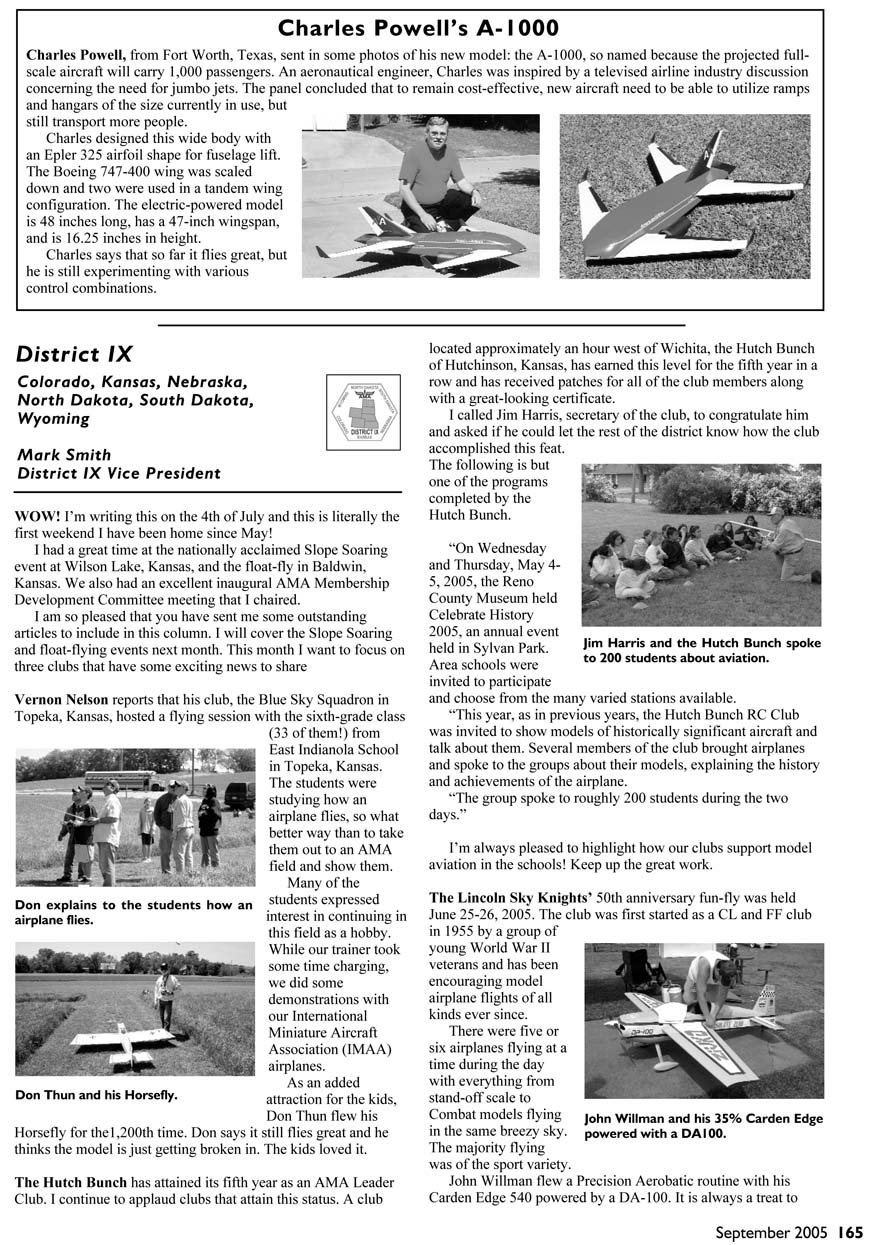
Vernon Nelson reports that his club, the Blue Sky Squadron in Topeka, Kansas, hosted a flying session with the sixth-grade class (33 of them!) from East Indianola School in Topeka, Kansas. The students were studying how an airplane flies, so what better way than to take them out to an AMA field and show them.
Many of the students expressed interest in continuing in this field as a hobby. While our trainer took some time charging, we did some demonstrations with our International Miniature Aircraft Association (IMAA) airplanes.
As an added attraction for the kids, Don Thun flew his Horsefly for the 1,200th time. Don says it still flies great and he thinks the model is just getting broken in. The kids loved it.
The Hutch Bunch has attained its fifth year as an AMA Leader Club. I continue to applaud clubs that attain this status. A club located approximately an hour west of Wichita, the Hutch Bunch of Hutchinson, Kansas, has earned this level for the fifth year in a row and has received patches for all of the club members along with a great-looking certificate.
I called Jim Harris, secretary of the club, to congratulate him and asked if he could let the rest of the district know how the club accomplished this feat.
The following is but one of the programs completed by the Hutch Bunch.
"On Wednesday and Thursday, May 4-5, 2005, the Reno County Museum held Celebrate History 2005, an annual event held in Sylvan Park. Area schools were invited to participate and choose from the many varied stations available.
"This year, as in previous years, the Hutch Bunch RC Club was invited to show models of historically significant aircraft and talk about them. Several members of the club brought airplanes and spoke to the groups about their models, explaining the history and achievements of the airplane.
"The group spoke to roughly 200 students during the two days."
I'm always pleased to highlight how our clubs support model aviation in the schools! Keep up the great work.
The Lincoln Sky Knights' 50th anniversary fun-fly was held June 25-26, 2005. The club was first started as a CL and FF club in 1955 by a group of young World War II veterans and has been encouraging model airplane flights of all kinds ever since.
There were five or six airplanes flying at a time during the day with everything from stand-off scale to Combat models flying in the same breezy sky. The majority flying was of the sport variety.
John Willman flew a Precision Aerobatic routine with his Carden Edge 540 powered by a DA-100. It is always a treat to watch John fly. John also has an all-composite, rocket-launch flying thing. It is launched by bungee cord then the rockets are fired. It has a three-second burn straight up and glides down by radio control. It really moves and is quite a flight to see. John said that each flight costs about $16 and lasts about 30 seconds. Club president Wilson Hardy also launched his single-rocket-powered craft.
There were several events scheduled including an egg drop, balloon bust, and timed flights. Something for everyone!
The Sky Knights have a first-class flying field. If you are ever in Nebraska near Lincoln, stop by for a visit. They are located at 134th and Waverly Road.
Thanks to John Van Brocklin and Mike Yearley for this article and congratulations to the Lincoln Sky Knights.
Whew! That's it for this month. Until next month, have fun and keep in touch!
District X
Arizona, California, Hawaii, Nevada, Utah
Richard Hanson District X Vice President
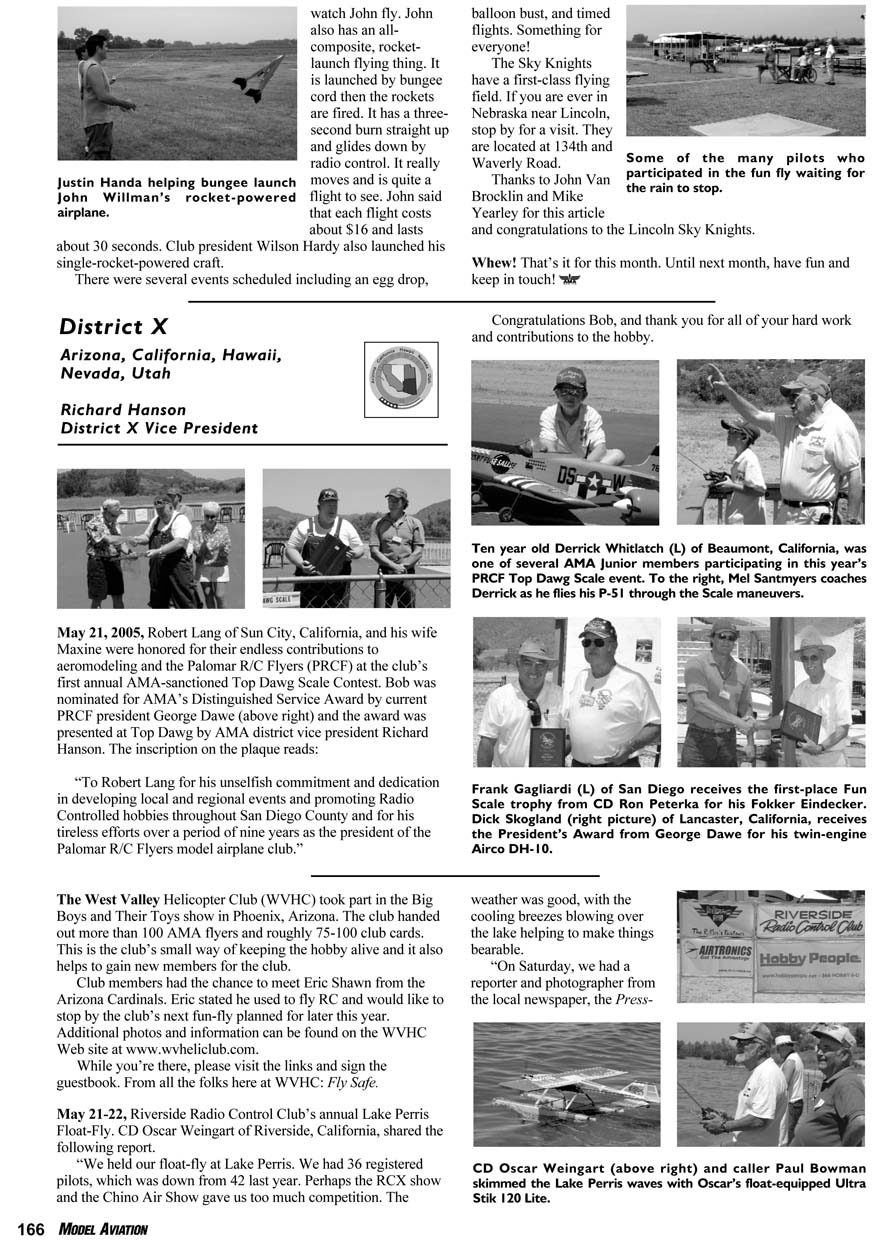
May 21, 2005, Robert Lang of Sun City, California, and his wife Maxine were honored for their endless contributions to aeromodelling and the Palomar R/C Flyers (PRCF) at the club's first annual AMA-sanctioned Top Dawg Scale Contest. Bob was nominated for AMA's Distinguished Service Award by current PRCF president George Dawe (above right) and the award was presented at Top Dawg by AMA district vice president Richard Hanson. The inscription on the plaque reads:
"To Robert Lang for his unselfish commitment and dedication in developing local and regional events and promoting Radio Controlled hobbies throughout San Diego County and for his tireless efforts over a period of nine years as the president of the Palomar R/C Flyers model airplane club."
The West Valley Helicopter Club (WVHC) took part in the Big Boys and Their Toys show in Phoenix, Arizona. The club handed out more than 1,000 AMA flyers and roughly 75-100 club cards. This is the club's small way of keeping the hobby alive and it also helps to gain new members for the club.
Club members had the chance to meet Eric Shawn from the Arizona Cardinals. Eric stated he used to fly RC and would like to stop by the club's next fun-fly planned for later this year. Additional photos and information can be found on the WVHC Web site at www.wvhciclub.com.
While you're there, please visit the links and sign the guestbook. From all the folks here at WVHC: Fly Safe.
May 21-22, Riverside Radio Control Club's annual Lake Perris Float-Fly. CD Oscar Weingart of Riverside, California, shared the following report.
"We held our float-fly at Lake Perris. We had 36 registered pilots, which was down from 42 last year. Perhaps the RCX show and the Chino Air Show gave us too much competition. The weather was good, with the cooling breezes blowing over the lake helping to make things bearable.
"On Saturday, we had a reporter and photographer from the local newspaper, the Press-
District XI
Alaska, Idaho, Montana, Oregon, Washington
Bruce Nelson District XI Vice President
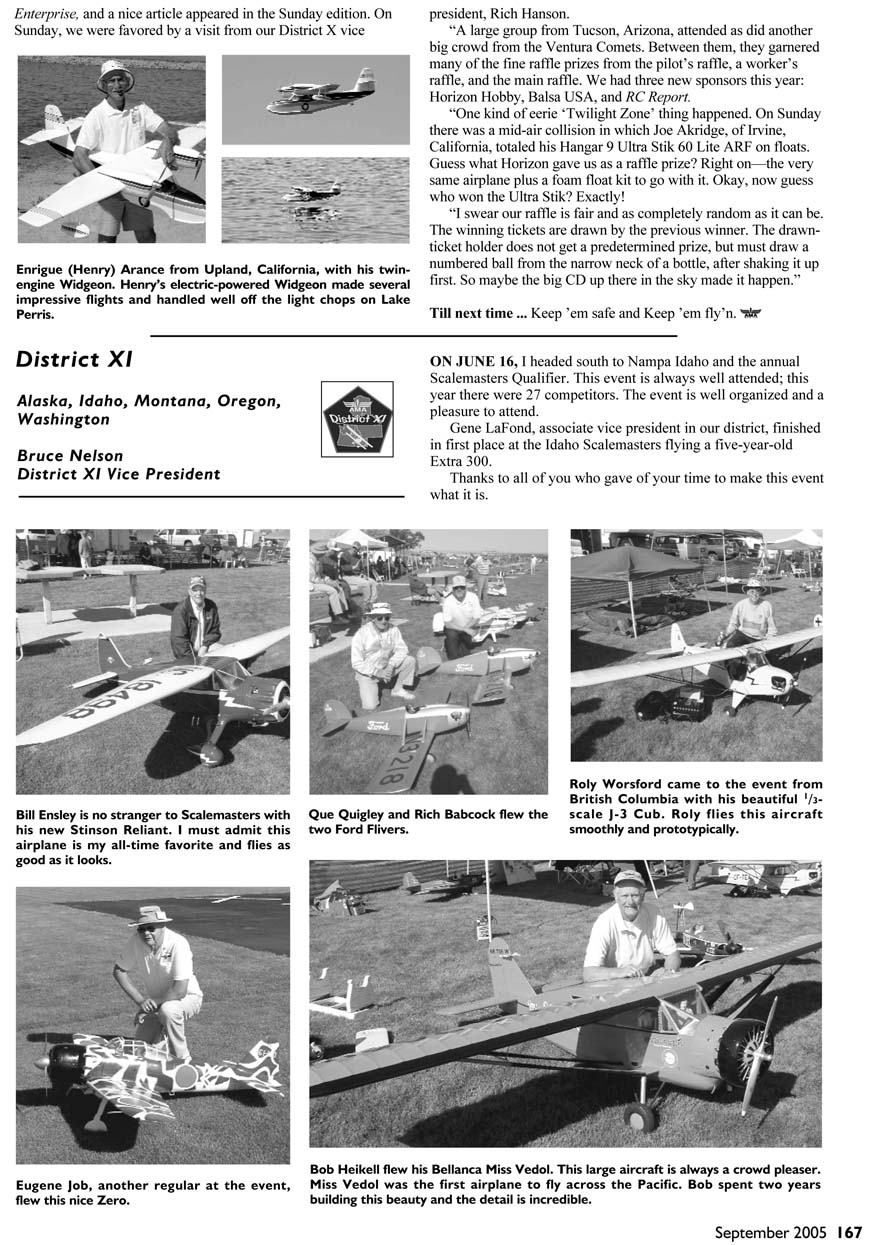
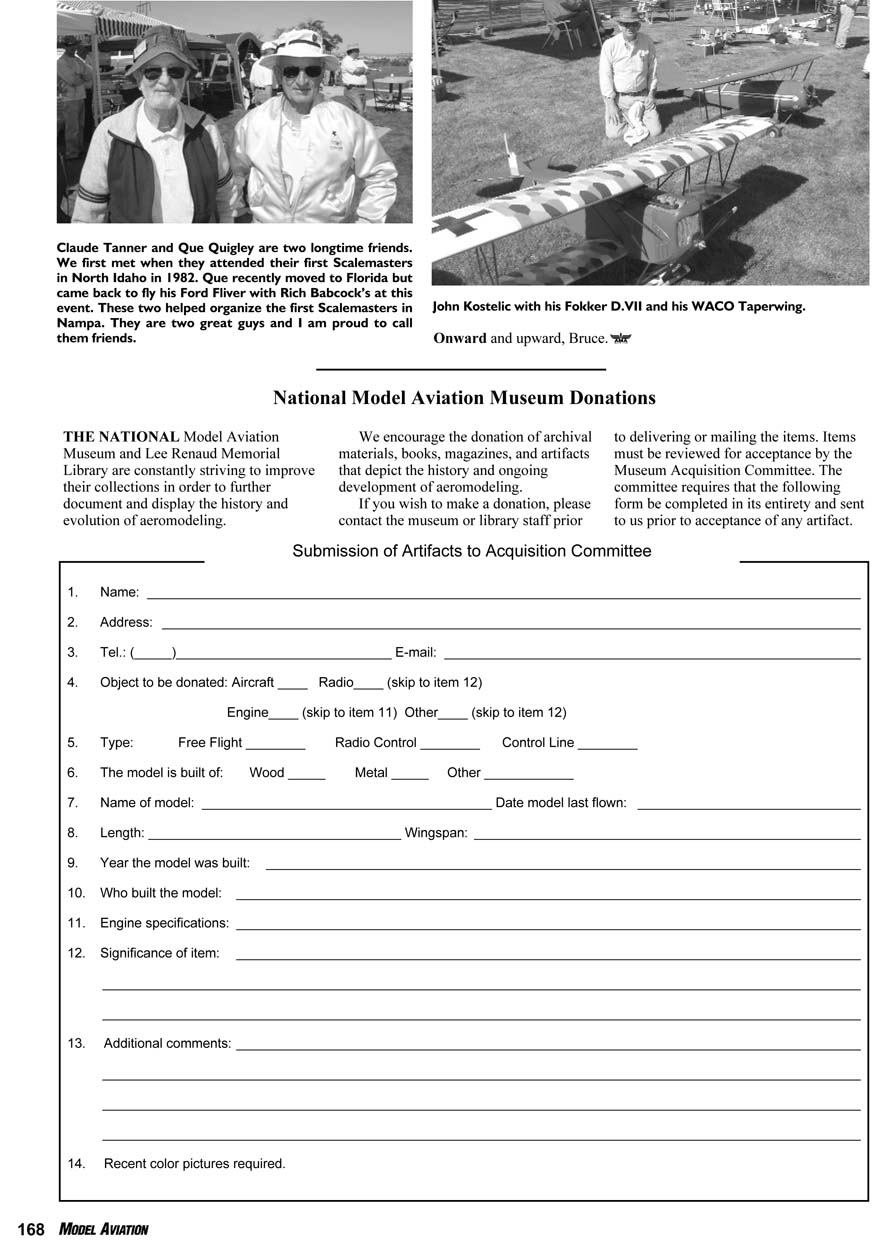
ON JUNE 16, I headed south to Nampa Idaho and the annual Scalemaster Qualifier. This event is always well attended; this year there were 27 competitors. The event is well organized and a pleasure to attend.
Gene LaFond, associate vice president in our district, finished in first place at the Idaho Scalemaster's flying a five-year-old Extra 300.
Thanks to all of you who gave of your time to make this event what it is.
Transcribed from original scans by AI. Minor OCR errors may remain.

