
EDUCATION THROUGH AVIATION
By Bill Pritchett, Education Director
“As a boy, because I was born and raised in Ohio, about 60 miles north of Dayton, the legends of the Wrights have been in my memories as long as I can remember.” — Neil Armstrong
We’ve lost Neil Armstrong, and it’s a perfect time to consider his life experiences and what in his background took him to the moon. I recently posted something about this on the AMA blogs and have been encouraged to also share it with you in MA, knowing that some of you don’t do blogging.
With the recent passing of aerospace legend Neil Armstrong, we look back on a time of great excitement and achievement that he and his fellow Apollo 11 astronauts brought us. One single leap onto the lunar surface electrified a nation and unified humanity. That was then.
That was when the average National Aeronautics and Space Administration (NASA) engineer in the Houston control room was in his or her 20s. Now, the average aerospace engineer is in his or her 50s.
A generation, such as mine, grew up dreaming of the stars. Today’s best and brightest minds seem to be dreaming of derivatives. So here we are, with the demise of Neil Armstrong, NASA’s manned space program, and a nation once again behind the eight ball of science.
Our nation and its industries are starved for engineers and scientists. Our schools are desperately trying to catch up to the rest of the world in science, technology, engineering, and math (STEM). We are caught in arrears, much like the time of Sputnik in the 1950s. Our children ... they are, according to author Cynthia Reynolds, the mechanically challenged generation.
“We advance to the unique ability to visualize an idea then create that vision with our hands. That’s meant everything from developing tools to imagining airplanes to performing open heart surgery. So what happens if that all-important hand-brain conversation gets short circuited at a young age?” Cynthia asked.
What is there to do other than handwringing? According to Dr. Frank Wilson, neurologist and author of The Hand: How Its Use Shapes the Brain, Language and Human Culture, there are serious consequences for ignoring hand-brain connectivity.
America is at a serious crossroads in preparing its latest generation to hold its own in the real world.
Neil Armstrong was a model builder. He was also in the Model Aviation Hall of Fame. He, like many of his generation who aspired to be aviators, knew that nearly every aeronautical principle and mechanical device keeping full-scale aircraft aloft could be found in a model airplane.
The first person to design a successful private spacecraft, Burt Rutan, also in the Model Aviation Hall of Fame, found a way to reenter the atmosphere at a lesser angle than a space shuttle. How did he do that? By calling up his aeromodeling experience as a youth and tossing a model off the roof of his California headquarters to test his design. His SpaceShipOne now hangs in the Smithsonian near John Glenn’s Mercury capsule and Chuck Yeager’s X-1.
Modeling is essential to math, science, and engineering, and in fact, to all creative thinking. The model is a metaphor; a way of understanding cause and effect, a context for an outcome.
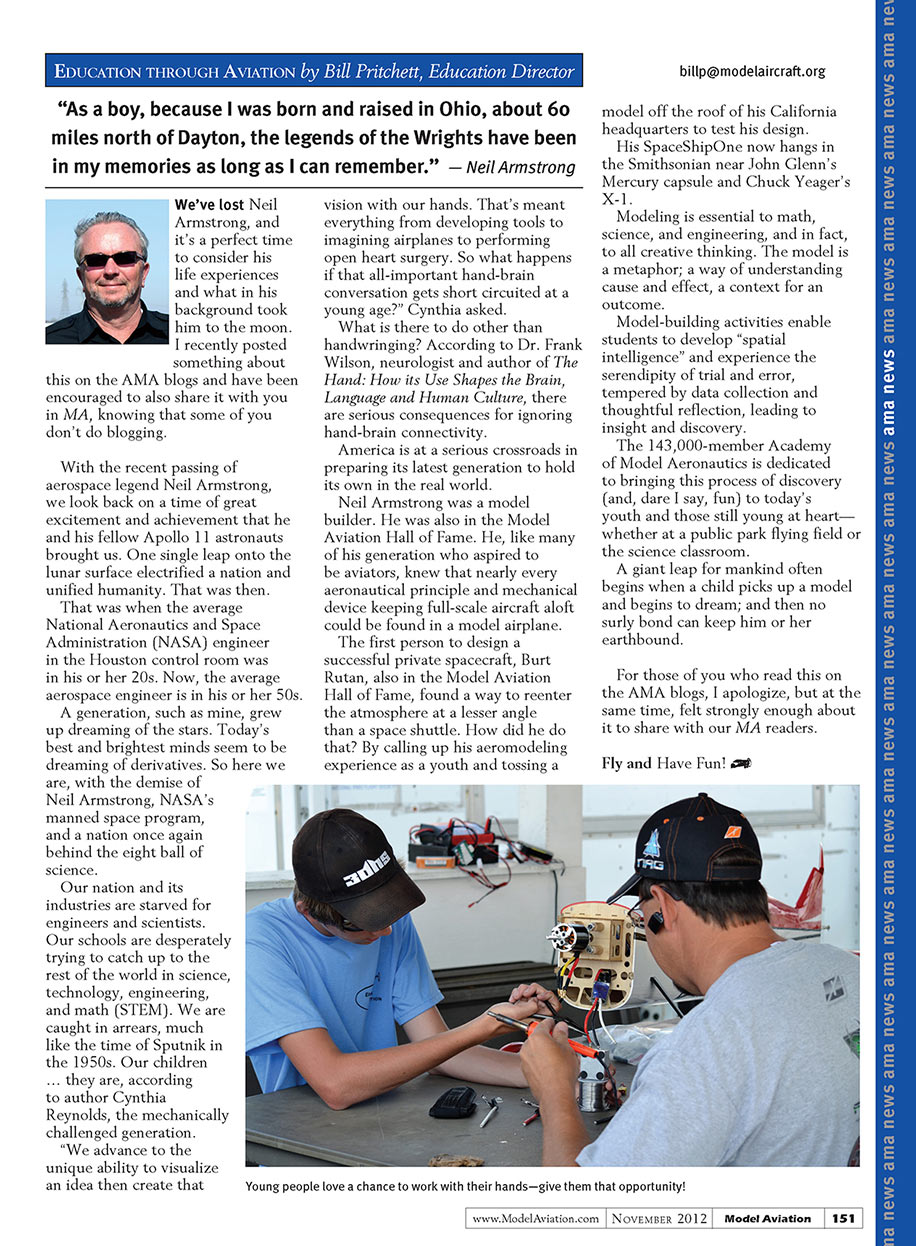
Model-building activities enable students to develop spatial intelligence and experience the serendipity of trial and error, tempered by data collection and thoughtful reflection, leading to insight and discovery.
The 143,000-member Academy of Model Aeronautics is dedicated to bringing this process of discovery (and, dare I say, fun) to today’s youth and those still young at heart—whether at a public park flying field or the science classroom.
A giant leap for mankind often begins when a child picks up a model and begins to dream; and then no earthly bond can keep him or her earthbound.
For those of you who read this on the AMA blogs, I apologize, but at the same time, I felt strongly enough about it to share with our MA readers.
Fly and have fun!
Transcribed from original scans by AI. Minor OCR errors may remain.

