
Flying Site Assistance
Wes De Cou | [email protected]
The great resource for new sites these days is — get ready — old sites!
This month you get a little bit of an old saw, a few paragraphs on a really obvious pool of potential flying sites, and below are a few paragraphs and some neat pictures of some innovative park flyer activity.
I've just returned from a meeting in San Diego, California. My usual meetings are with local clubs or with government officials at all levels as we try to hammer out agreements for new flying sites, or as we try to determine how best to save an existing site that might be in danger of being closed.
This meeting was an association meeting—an association of the many separate AMA flying clubs in the San Diego area. CL, soaring, RC fixed-propeller aircraft, RC helicopters ... virtually all disciplines were in the same room with the same cares and concerns. Forming the association was a smart move on the part of the local modelers.
There is safety in numbers as the old adage goes, but there is also strength in those same numbers. Every time I meet with elected officials to talk about flying-site issues, I am treated with dignity and respect. When I meet with elected officials I am also asked the I'm-only-here-because-they-voted-for-me question: "Who are you here to help?"
If I answer "These two fellows over here who want a place to fly," I get polite nods. If I answer "The 1,800 members of the XYZ Model Aviators Consortium," I get serious attention. There is political strength in numbers, and if you join or form an association of AMA flying clubs in your area, you can take advantage of that strength. If you can't be bothered, then prepare for polite nods.
Other advantages of association membership include a greater idea pool for solving local problems, a greater work-force network for projects with a common goal, and a greater publicity potential for local flying events through such things as club newsletter exchanges.
Of course, you also have the potential for meeting new friends who share your love for some form of model aviation. I knew a CL aficionado once who gave a great elevator linkage idea to an RC buff. Who knew?
On the really bright side, consider this: you can have all of the advantages of an association and meet as infrequently as once per year! The San Diego group meets infrequently. The CAMAC group (Central Arizona Modelers Advisory Council) meets once a year. That's a small inconvenience—or is it a convenience?—for such an advantage.
Between formal meetings the associations use e-mail as the prime means of communications. You can go ahead and call that one member who refuses to get a computer on the telephone ...
Park Flyers
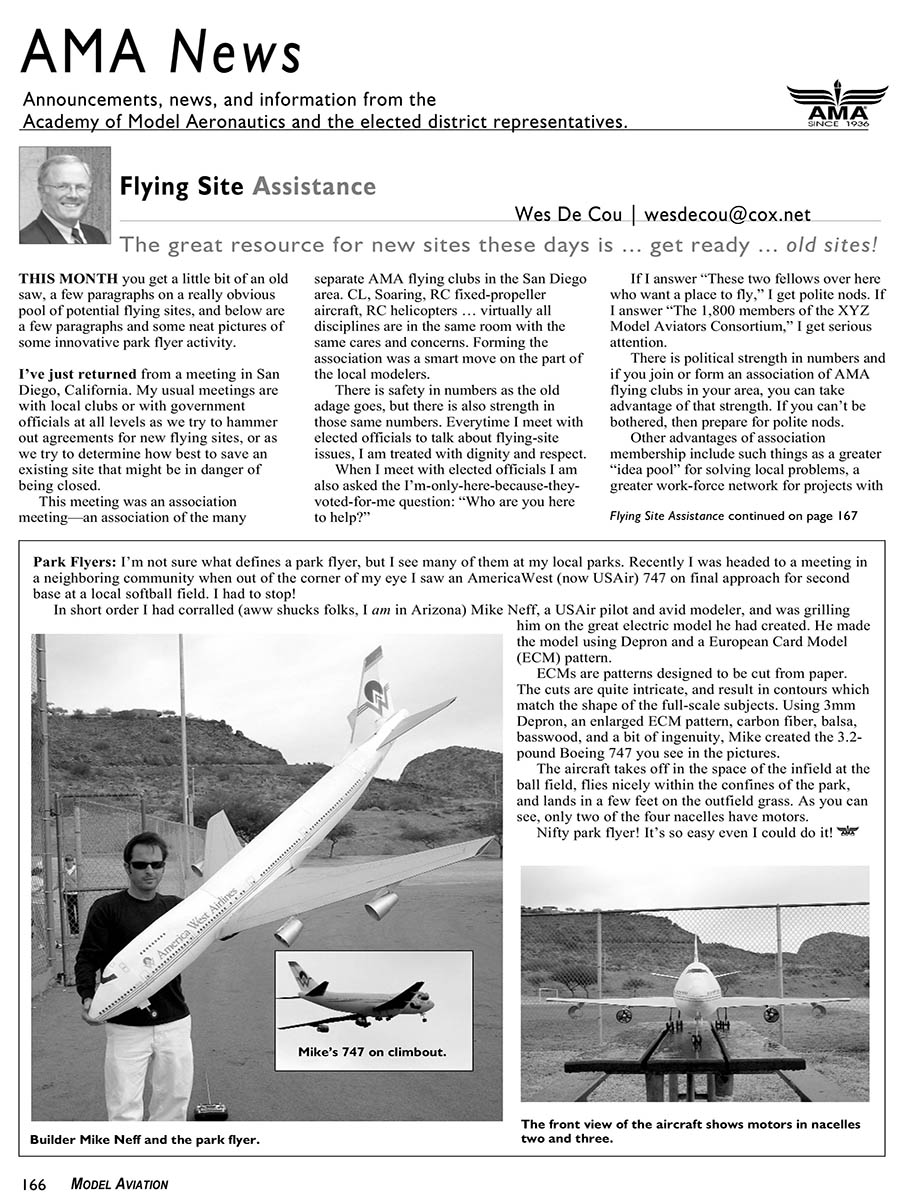
I'm not sure what defines a park flyer, but I see many of them at my local parks. Recently I was headed to a meeting in a neighboring community when out of the corner of my eye I saw an AmericaWest (now USAir) 747 on final approach for second base at a local softball field. I had to stop!
In short order I had corralled (aww shucks, folks — I am in Arizona) Mike Neff, a USAir pilot and avid modeler, and was grilling him on the great electric model he had created. He made the model using Depron and a European Card Model (ECM) pattern.
ECMs are patterns designed to be cut from paper. The cuts are quite intricate and result in contours which match the shape of the full-scale subjects. Using 3 mm Depron, an enlarged ECM pattern, carbon fiber, balsa, basswood, and a bit of ingenuity, Mike created the 3.2-pound Boeing 747 you see in the pictures.
The aircraft takes off in the space of the infield at the ball field, flies nicely within the confines of the park, and lands in a few feet on the outfield grass. As you can see, only two of the four nacelles have motors.
Nifty park flyer! It's so easy even I could do it!
Site Acquisition and Preservation
I have some reminders on site acquisition. If you don't have a Site Acquisition Committee in your club, get one—even if it's a committee of one.
Find some people who have a little time and who are willing to pound the pavement in search of likely sites. Use members who like to talk to people because those who own land you might be able to use for a flying site are only people.
If you have a secure flying site, put someone in charge of finding a second secure site. I get frequent calls from members who have just been booted from the site "we've had forever!"
If your club has lost a site in the past millennium primarily because of the noise issue, go after that site as an electric venue. E-fields are the current rage. When you make a compelling case for a nearly noiseless model aviation site and include the recreational and educational advantages of the sport, local recreation directors listen.
Near my home in Phoenix, Arizona, we've established a great E-field in the middle of high-density residential developments. Rather than having them complain, we see local residents getting involved in the sport.
Revisit flying site problems you've encountered in the past. If noise was the culprit, consider a new request with a "switch" to electric.
Coordinators
- Wes De Cou, Coordinator
Western Region — Districts VIII–XI 202 W. Desert Flower Ln., Phoenix, AZ 85045 Voice: (480) 460-9466; Cell: (480) 296-9515; Fax: (480) 460-9434 E-mail: [email protected]
- Joe Beshar, Coordinator
Eastern Region — Districts I–VII 198 Merritt Dr., Oradell, NJ 07649 Tel.: (201) 261-1281; Fax: (201) 261-0223 E-mail: [email protected]
Finding—Preserving—Maintaining
Transcribed from original scans by AI. Minor OCR errors may remain.

