
Reminiscing brings back the 1938 1/2A Berryloid
Background
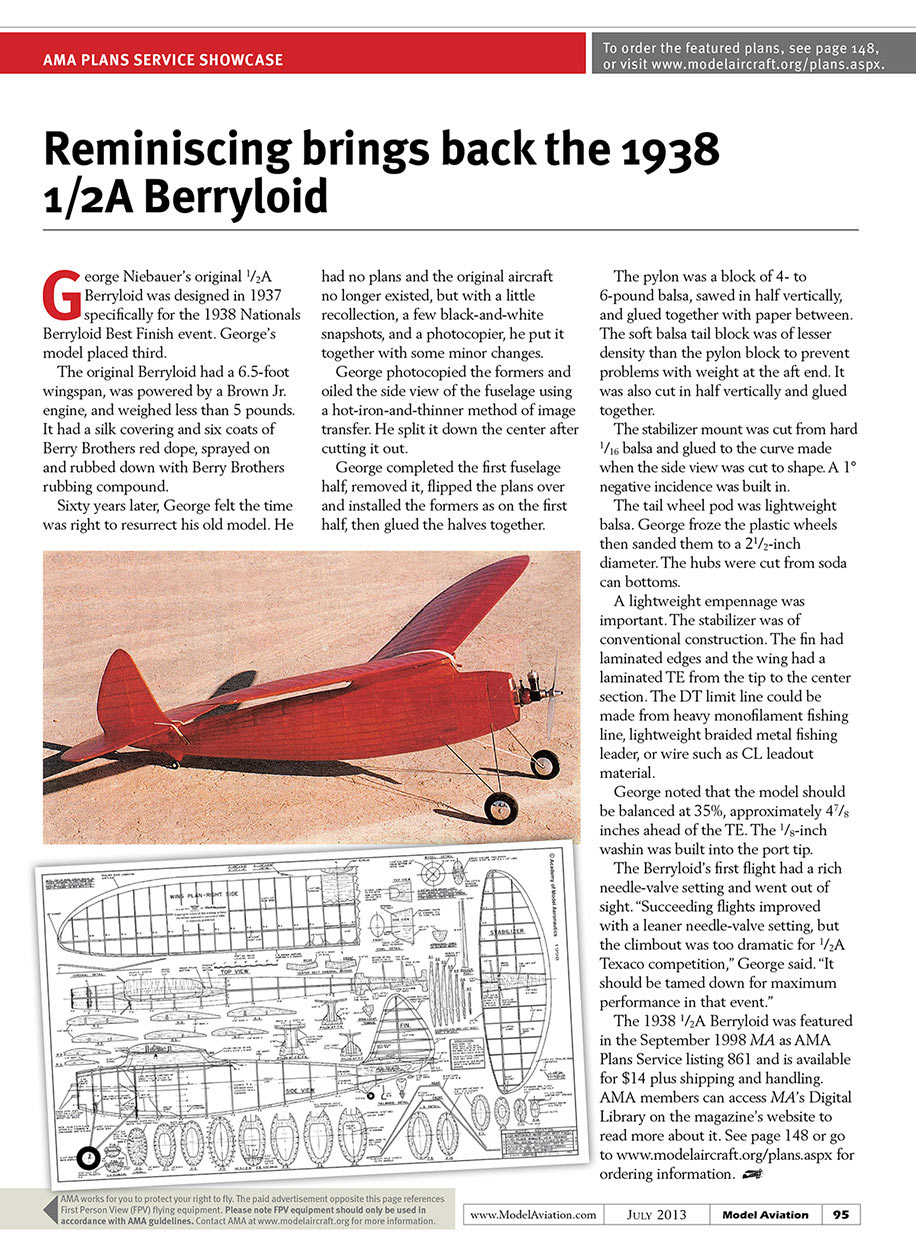
George Niebauer’s original 1/2A Berryloid was designed in 1937 specifically for the 1938 Nationals Berryloid Best Finish event. George’s model placed third.
The original Berryloid had a 6.5-foot wingspan, was powered by a Brown Jr. engine, and weighed less than 5 pounds. It featured a silk covering and six coats of Berry Brothers red dope, sprayed on and rubbed down with Berry Brothers rubbing compound.
Sixty years later, George felt the time was right to resurrect his old model. He had no plans and the original aircraft no longer existed, but with a little recollection, a few black-and-white snapshots, and a photocopier, he reproduced it with some minor changes.
Construction
George photocopied the formers and transferred the side view to wood using a hot-iron-and-thinner image-transfer method. He cut the side view out, split it down the center, and built the fuselage in two halves: he completed the first fuselage half, removed it, flipped the plans over, installed the formers as on the first half, then glued the halves together.
Highlights and materials:
- Pylon: a block of 4- to 6-pound balsa, sawed in half vertically and glued together with paper between the halves.
- Tail block: softer, lower-density balsa than the pylon block to avoid aft weight problems; also cut in half vertically and glued together.
- Stabilizer mount: cut from hard 1/16" balsa and glued to the curve formed when the side view was shaped; a 1° negative incidence was built in.
- Tail wheel pod: lightweight balsa. Plastic wheels were frozen, then sanded to a 2 1/2-inch diameter; hubs were cut from soda can bottoms.
- Empennage: kept lightweight. Stabilizer of conventional construction; fin with laminated edges.
- Wing: laminated trailing edge from the tip to the center section.
- DT (dethermalizer) limit line: can be made from heavy monofilament fishing line, lightweight braided metal fishing leader, or wire such as CL leadout material.
Balance and rigging:
- George recommended balancing the model at 35% of the mean aerodynamic chord—approximately 4 7/8 inches ahead of the trailing edge (TE).
- A built-in 1/8-inch wash-in was included at the port tip.
Flight characteristics
The Berryloid’s first flight had a rich needle-valve setting and climbed out of sight. Succeeding flights improved with a leaner needle-valve setting, but the climbout remained too dramatic for 1/2A Texaco competition. George noted the climb should be tamed for maximum performance in that event.
Plans and availability
The 1938 1/2A Berryloid was featured in the September 1998 Model Aviation (MA) as AMA Plans Service listing 861 and is available for $14 plus shipping and handling. AMA members can access MA’s Digital Library on the magazine’s website to read more. See page 148 of the September 1998 issue or go to www.modelaircraft.org/plans.aspx for ordering information.
Transcribed from original scans by AI. Minor OCR errors may remain.

