
AMA Plans Service Showcase
Fokker Universal
A rarely modeled 1920s bush plane
Robert Noorduyn designed the full-scale Fokker Universal. It became not only the first Fokker built in the U.S., but also the first to use wing struts.
This airplane was built around the 220-horsepower Wright Whirlwind engine and could carry five passengers: four in the cabin and one next to the pilot in the open cockpit. The Universal was also used as a bush plane and operated off both wheels and floats.
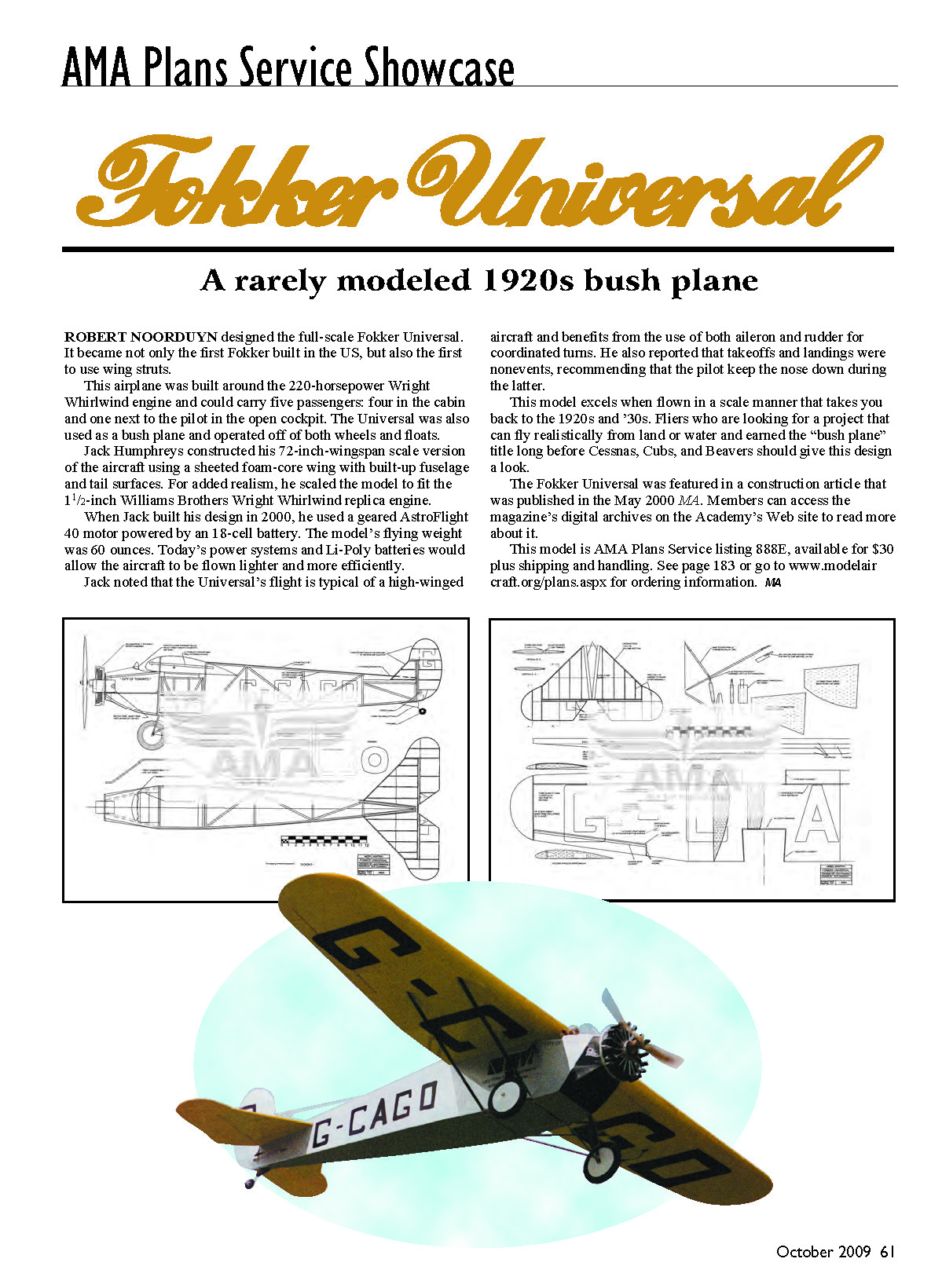
Jack Humphreys constructed his 72-inch-wingspan scale version of the aircraft, using a sheeted foam-core wing with built-up fuselage and tail surfaces. For added realism, he scaled the model to fit the 1-1/2-inch Williams Brothers Wright Whirlwind replica engine.
When Jack built his design in 2000, he used a geared AstroFlight 40 motor powered by an 18-cell battery. The model's flying weight was 60 ounces. Today's power systems and Li-Poly batteries would allow the aircraft to be flown lighter and more efficiently.
Jack noted that the Universal's flight is typical of a high-wing aircraft and benefits from the use of both aileron and rudder for coordinated turns. He also reported that takeoffs and landings were nonevents, recommending that the pilot keep the nose down during the latter.
This model excels when flown in a scale manner that takes you back to the 1920s and '30s. Fliers looking for a project that can fly realistically from land or water—and that earned the "bush plane" title long before Cessnas, Cubs, and Beavers—should give this design a look.
The Fokker Universal was featured in a construction article published in the May 2000 Model Aviation (MA). Members can access the magazine's digital archives on the Academy's website to read more about it.
This model is AMA Plans Service listing 888E, available for $30 plus shipping and handling. See page 183 or go to www.modelaircraft.org/plans.aspx for ordering information.
Transcribed from original scans by AI. Minor OCR errors may remain.

