
AMA Safety Code
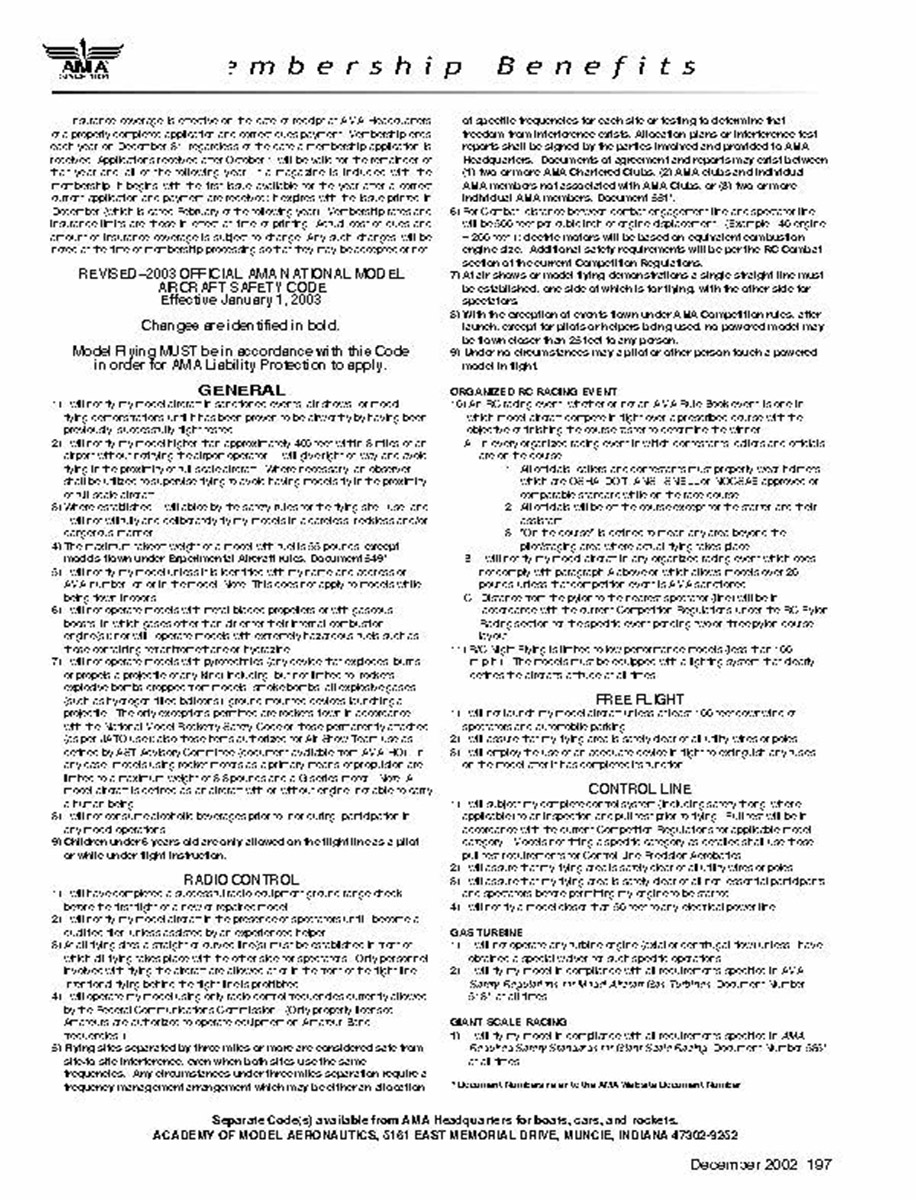
REVISION—2003 OFFICIAL AMA NATIONAL MODEL AIRCRAFT SAFETY CODE Effective January 1, 2003
Changes are identified in bold.
Model flying MUST be in accordance with this Code in order for AMA Liability Protection to apply.
GENERAL
- The safety of all participants and spectators is the primary concern in the operation of model aircraft. Modeling activities shall be conducted in a manner that avoids injury to persons or damage to property.
- Model aircraft shall be available for visual inspection by any duly authorized representative of the Academy upon request.
- Model aircraft must be maintained in a condition that ensures safe operation. Any model deemed unsafe by an official or by the field manager shall not be flown until deemed safe.
- Each model aircraft operation shall be conducted in accordance with the rules and regulations established by the local flying site, AMA chartered club, or event sponsor.
- Models shall not be flown in a reckless manner or in such a way as to endanger people or property. Intoxication of any participant is prohibited while flying or participating in model aircraft operations.
- Under no circumstances shall any person operate a model aircraft while the person is under the influence of alcohol or illegal drugs.
- The use of unmanned aircraft for surveillance or other activities that invade privacy is prohibited.
- All pilots should have current AMA membership as required by local club rules and site operators.
- Children under the age of 18 are allowed on the flight line only under the direct supervision of an adult pilot.
RADIO CONTROL
- All radio control model aircraft frequencies shall be in accordance with the Federal Communications Commission and the Academy-approved frequency allocations. Pilots are responsible for complying with applicable frequency control procedures.
- Only fully certified radio transmitters shall be used. Non-compliant or modified transmitters that may cause interference shall not be used.
- Transmitters shall be properly identified with the pilot's name and AMA number where required by the club or event.
- Any malfunctioning radio equipment shall be removed from service until repaired.
- All R/C operations shall take place on sites that provide a clear view of the aircraft and sufficient separation from non-participants. All aircraft shall yield to full-scale aircraft.
- Pilots shall avoid flying beyond visual line-of-sight under normal operating conditions.
- Pilots shall not fly in controlled airspace without proper authorization from the FAA and compliant with all applicable regulations.
- Models that operate on frequencies requiring frequency control shall comply with local club procedures. Frequency control devices or other arrangements are acceptable if they meet local requirements.
- Pilots shall respect other users of the site and follow the directions of the site manager or event director.
ORGANIZED R/C RACING EVENT
- On a recognized racing course at an organized R/C racing event, the event sponsor or director must provide a safety briefing that includes course layout, racing procedures, rescue procedures, and local emergency procedures.
- All models used in racing shall be of a type and condition that provide safe and predictable handling characteristics. The event director or designated official may require inspection of models prior to practice or competition.
- All pilots shall wear identification while on the pit or starting grid as required by the event director.
- Pit areas shall be located to minimize the possibility of accidents and shall be separated from the course.
- The event director may impose additional safety rules as necessary to ensure safe conduct of the event.
FREE FLIGHT
- Free flight operations shall be conducted in a manner that minimizes risk to persons and property. A launch area shall be clearly designated and a range safe for retrieval established.
- Free flight models shall not be flown in a manner that endangers full-scale aircraft or persons on the ground.
CONTROL LINE
- Control-line models shall be flown only on facilities that provide a proper circle and safety area. All lines, handle, and bellcrank attachments shall be inspected for safety prior to flight.
- The number of engines on a control-line model shall be limited by the safety standards of the club or event and shall not be operated in a manner that creates undue hazards.
- All pilots shall stand in the designated pilot area and shall ensure that spectators are kept well clear of the flying circle.
GAS TURBINE
- Gas turbine-powered models shall be operated in accordance with manufacturer's instructions and any additional safety measures required by the hosting club or site operator.
- Fuel handling and storage shall be conducted with recognized safety precautions to minimize the risk of fire or injury.
GIANT SCALE MODELS
- Giant scale models shall operate at sites and under conditions appropriate for their size and energy potential. Giant scale operations may require additional safety provisions as determined by the hosting club or event.
ORGANIZED FLIGHT EVENTS AND COMPETITIONS
- All organized events shall have an appointed contest director or event manager responsible for safety and rule compliance.
- Safety briefings are required prior to the commencement of flying activities. All participants shall attend the briefing or be briefed individually.
- Event officials shall have the authority to ground any model or pilot deemed unsafe or in violation of the rules.
- Emergency procedures and contact information shall be posted and communicated to all participants.
SEPARATE CODE(S) available from AMA Headquarters for boats, cars, and rockets.
ACADEMY OF MODEL AERONAUTICS, 5161 EAST MEMORIAL DRIVE, MUNCIE, INDIANA 47302-9252
Transcribed from original scans by AI. Minor OCR errors may remain.

