
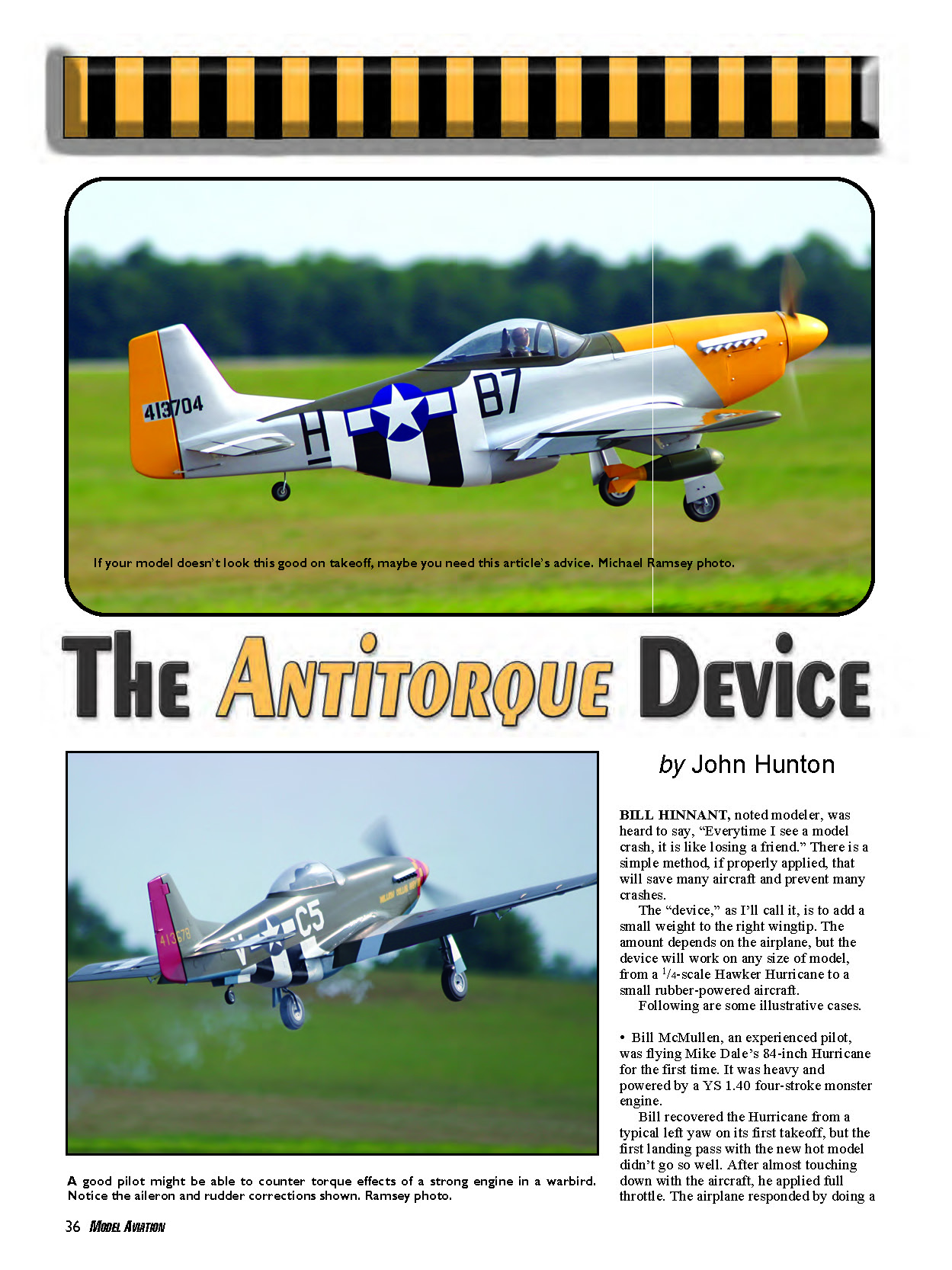
The Antitorque Device
by John Hunton
Bill Hinnant, noted modeler, was heard to say, “Every time I see a model crash, it is like losing a friend.” There is a simple method, if properly applied, that will save many aircraft and prevent many crashes.
The “device,” as I’ll call it, is to add a small weight to the right wingtip. The amount depends on the airplane, but the device will work on any size of model, from a 1/4-scale Hawker Hurricane to a small rubber-powered aircraft.
Illustrative cases
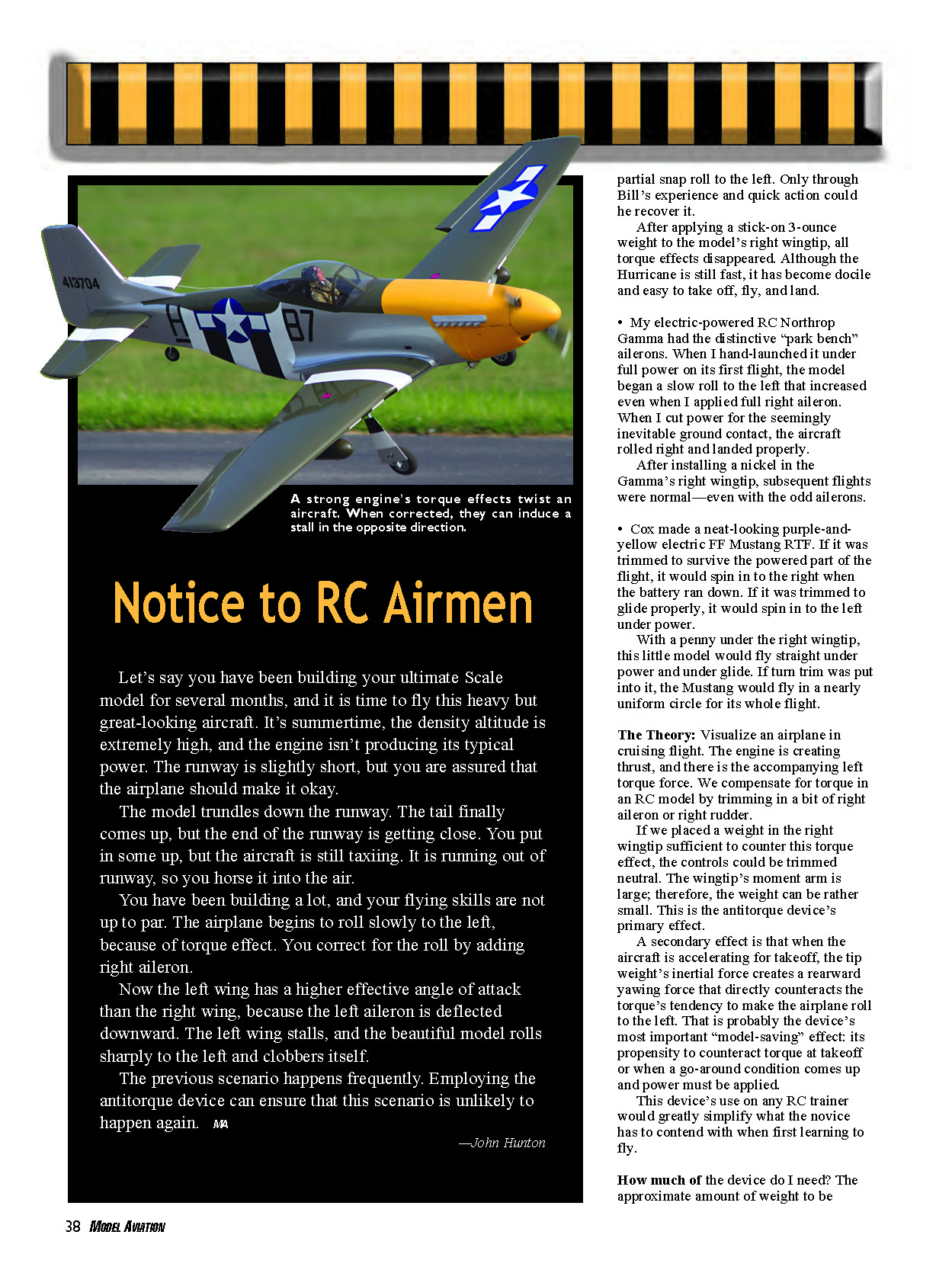
- Bill McMullen, an experienced pilot, was flying Mike Dale’s 84-inch Hurricane for the first time. It was heavy and powered by a YS 1.40 four-stroke monster engine. Bill recovered the Hurricane from a typical left yaw on its first takeoff, but the first landing pass with the new hot model didn’t go so well. After almost touching down, he applied full throttle. The airplane responded by doing a partial snap roll to the left. Only through Bill’s experience and quick action could he recover it. After applying a stick-on 3-ounce weight to the model’s right wingtip, all torque effects disappeared. Although the Hurricane is still fast, it has become docile and easy to take off, fly, and land.
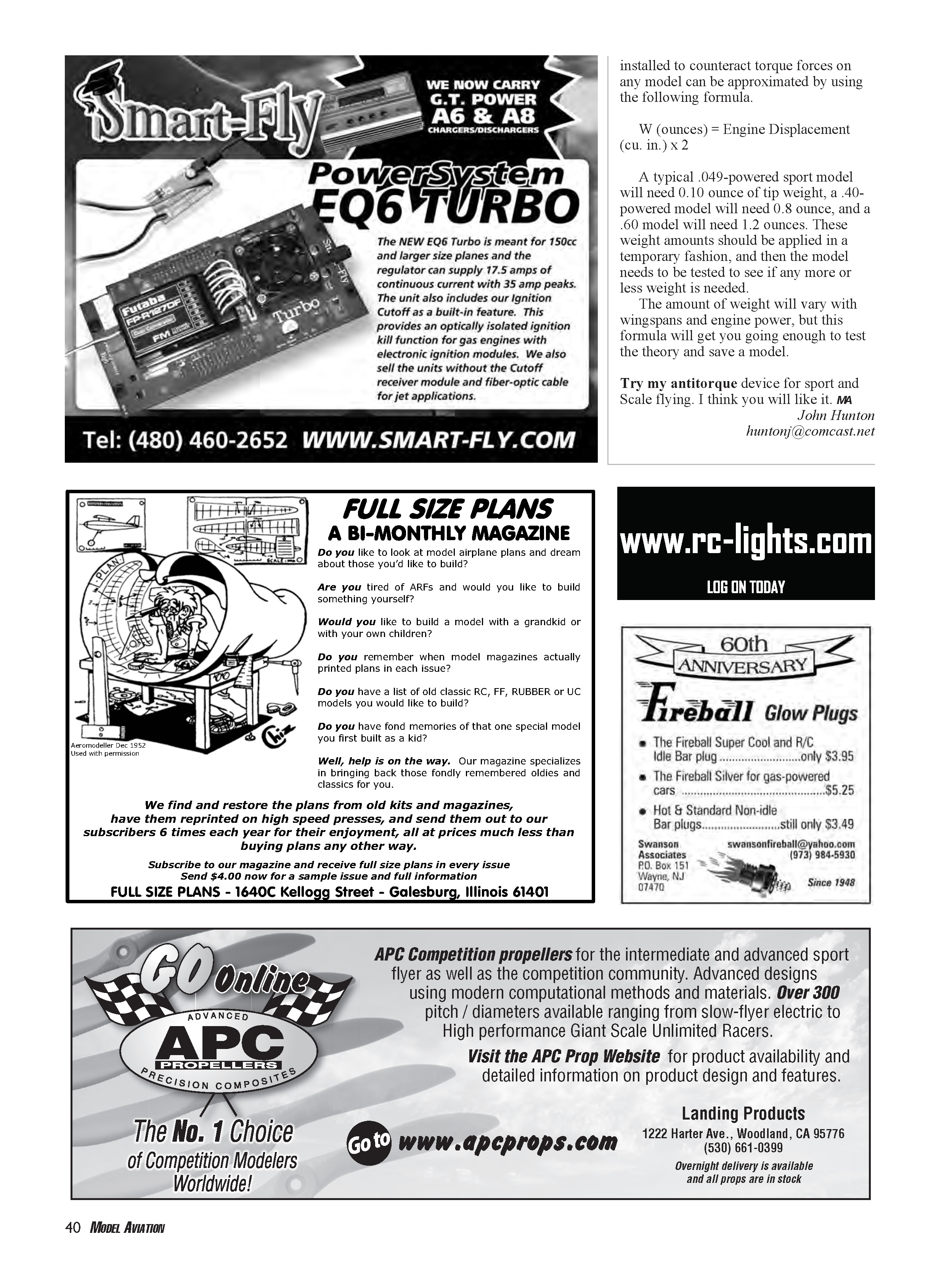
- My electric-powered RC Northrop Gamma had the distinctive “park-bench” ailerons. When I hand-launched it under full power on its first flight, the model began a slow roll to the left that increased even when I applied full right aileron. When I cut power for the seemingly inevitable ground contact, the aircraft rolled right and landed properly. After installing a nickel in the Gamma’s right wingtip, subsequent flights were normal—even with the odd ailerons.
- Cox made a neat-looking purple-and-yellow electric FF Mustang RTF. If it was trimmed to survive the powered part of the flight, it would spin into the right when the battery ran down. If it was trimmed to glide properly, it would spin into the left under power. With a penny under the right wingtip, this little model would fly straight under power and under glide. If turn trim was put into it, the Mustang would fly in a nearly uniform circle for its whole flight.
The Theory
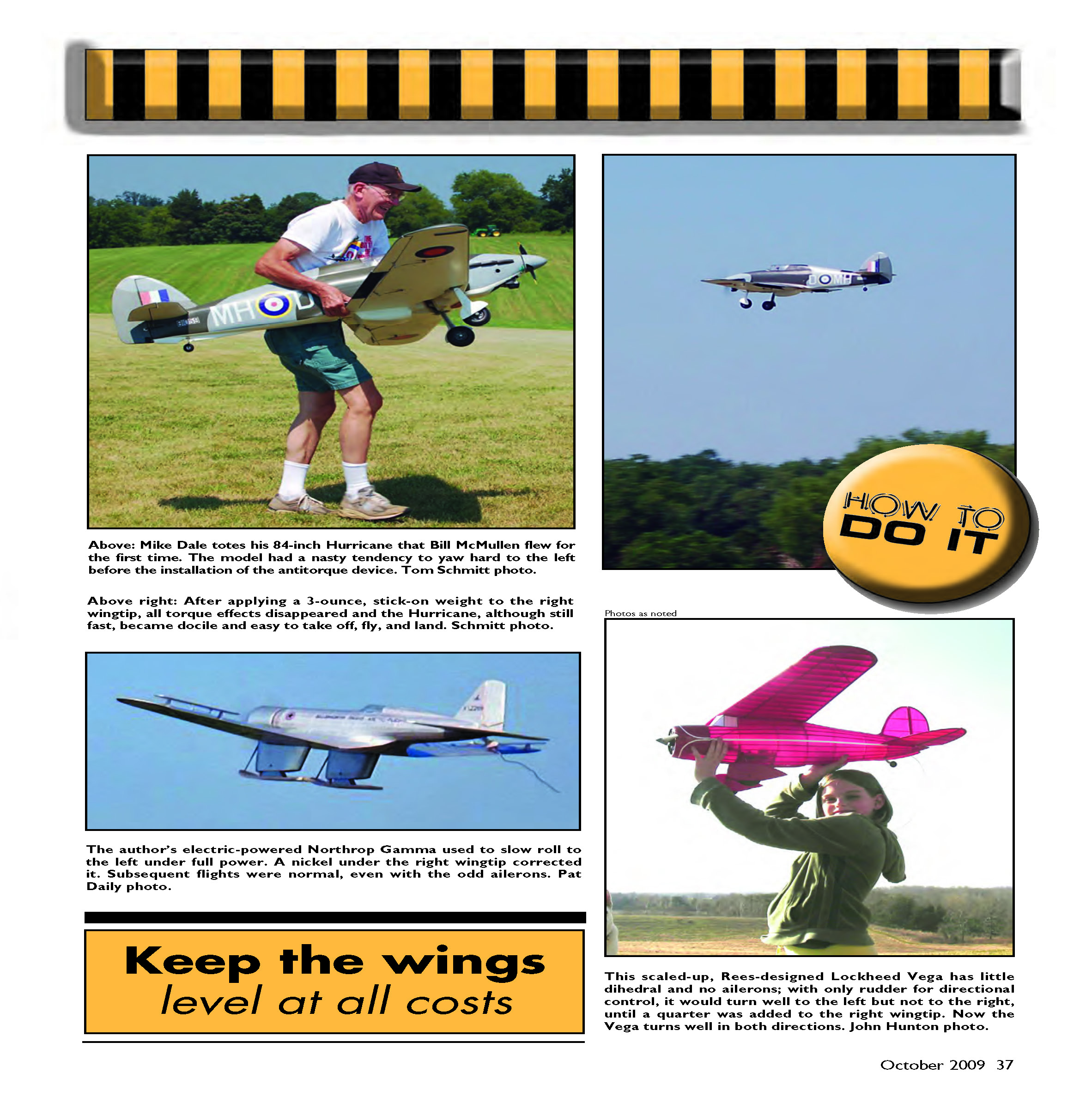
Visualize an airplane in cruising flight. The engine is creating thrust, and there is the accompanying left torque force. We compensate for torque in an RC model by trimming in a bit of right aileron or right rudder. If we placed a weight in the right wingtip sufficient to counter this torque effect, the controls could be trimmed neutral. The wingtip’s moment arm is large; therefore, the weight can be rather small. This is the antitorque device’s primary effect.
A secondary effect is that when the aircraft is accelerating for takeoff, the tip weight’s inertial force creates a rearward yawing force that directly counteracts the torque’s tendency to make the airplane roll to the left. That is probably the device’s most important “model-saving” effect: its propensity to counteract torque at takeoff or when a go-around condition comes up and power must be applied.
Keep the wings level at all costs
This device’s use on any RC trainer would greatly simplify what the novice has to contend with when first learning to fly.
How much of the device do I need?
The approximate amount of weight to be installed to counteract torque forces on any model can be approximated by using the following formula:
W (ounces) = Engine Displacement (cu. in.) x 2
Examples:
- A typical .049-powered sport model will need about 0.10 ounce of tip weight.
- A .40-powered model will need about 0.8 ounce.
- A .60 model will need about 1.2 ounces.
These weight amounts should be applied in a temporary fashion, and then the model needs to be tested to see if more or less weight is needed. The amount of weight will vary with wingspans and engine power, but this formula will get you started to test the theory and save a model.
Try my antitorque device for sport and scale flying. I think you will like it.
John Hunton [email protected]
Transcribed from original scans by AI. Minor OCR errors may remain.

