
Ares Tiger Moth 75 Nano-Micro RTF
Jay Smith
The de Havilland Tiger Moth, a classic biplane and RAF trainer during World War II, is often modeled as an RC aircraft. Typically available from a park-size model up to Giant Scale, I was excited to see the availability of an RTF micro version.
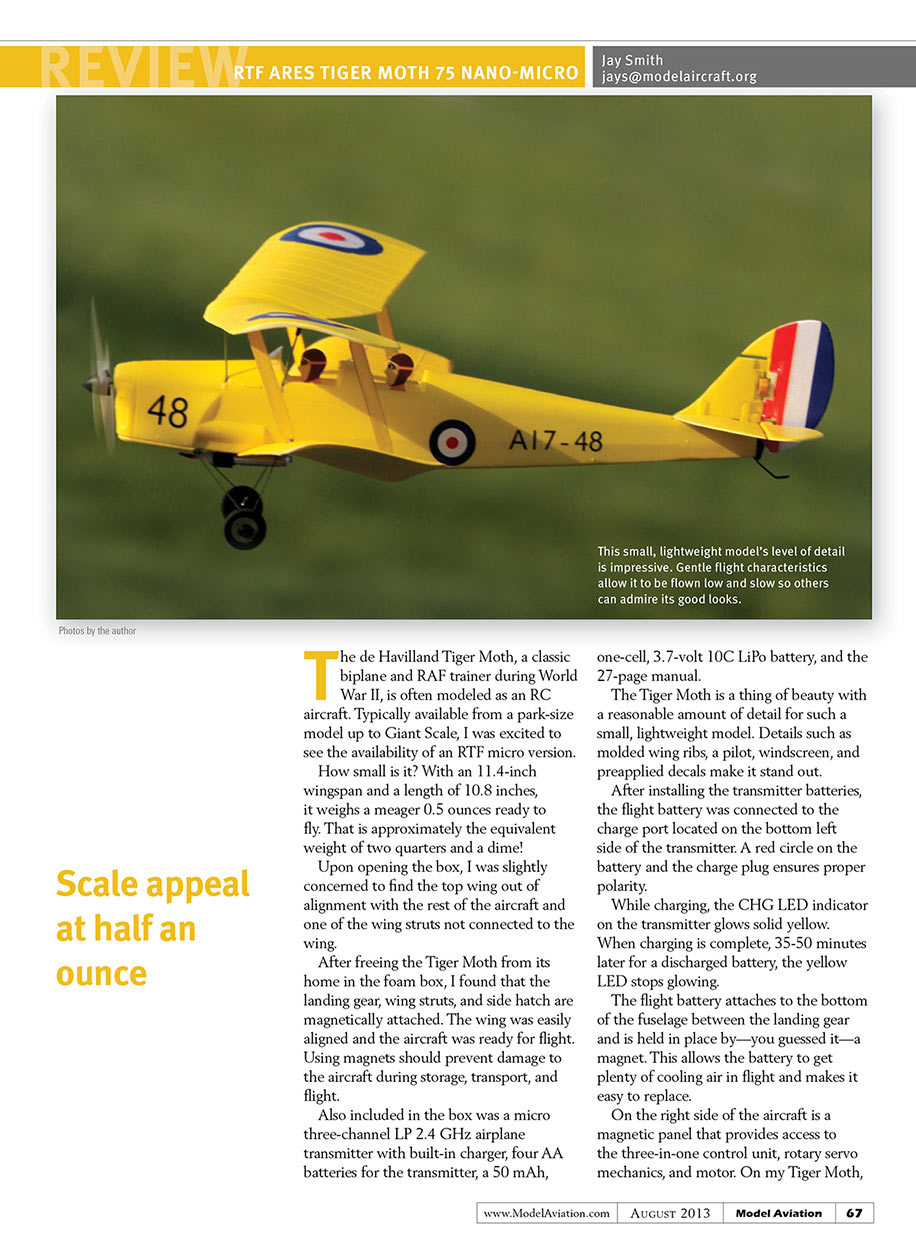
How small is it? With an 11.4-inch wingspan and a length of 10.8 inches, it weighs a meager 0.5 ounces ready to fly. That is approximately the equivalent weight of two quarters and a dime!
Upon opening the box, I was slightly concerned to find the top wing out of alignment with the rest of the aircraft and one of the wing struts not connected to the wing.
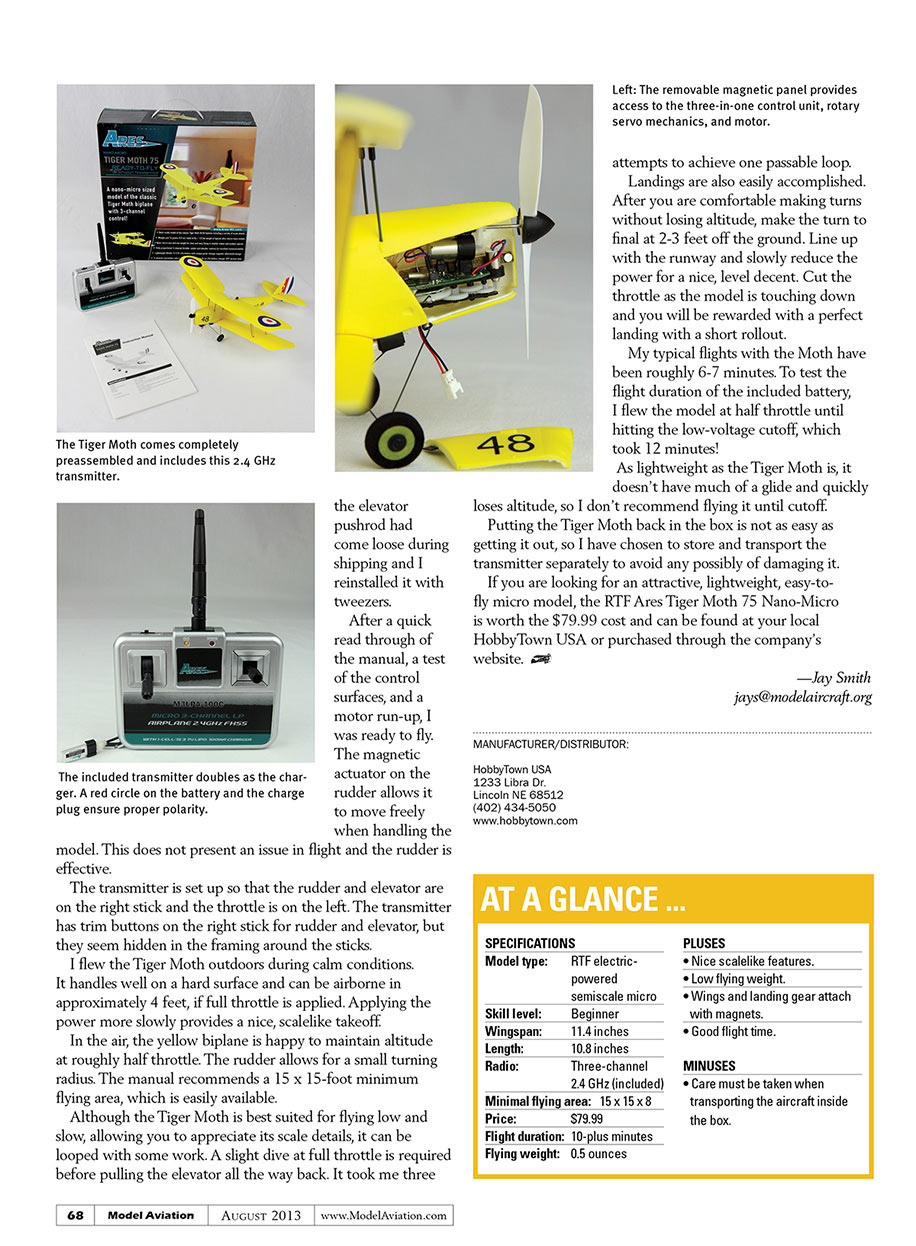
After freeing the Tiger Moth from its home in the foam box, I found that the landing gear, wing struts, and side hatch are magnetically attached. The wing was easily aligned and the aircraft was ready for flight. Using magnets should prevent damage to the aircraft during storage, transport, and flight.
Also included in the box was a micro three-channel LP 2.4 GHz airplane transmitter with built-in charger, four AA batteries for the transmitter, a 50 mAh, one-cell, 3.7-volt 10C LiPo battery, and the 27-page manual.
The Tiger Moth is a thing of beauty with a reasonable amount of detail for such a small, lightweight model. Details such as molded wing ribs, a pilot, windscreen, and preapplied decals make it stand out.
After installing the transmitter batteries, the flight battery was connected to the charge port located on the bottom left side of the transmitter. A red circle on the battery and the charge plug ensures proper polarity.
While charging, the CHG LED indicator on the transmitter glows solid yellow. When charging is complete, 35-50 minutes later for a discharged battery, the yellow LED stops glowing.
The flight battery attaches to the bottom of the fuselage between the landing gear and is held in place by—you guessed it—a magnet. This allows the battery to get plenty of cooling air in flight and makes it easy to replace.
On the right side of the aircraft is a magnetic panel that provides access to the three-in-one control unit, rotary servo mechanics, and motor. On my Tiger Moth, the elevator pushrod had come loose during shipping and I reinstalled it with tweezers.
After a quick read through of the manual, a test of the control surfaces, and a motor run-up, I was ready to fly. The magnetic actuator on the rudder allows it to move freely when handling the model. This does not present an issue in flight and the rudder is effective.
The transmitter is set up so that the rudder and elevator are on the right stick and the throttle is on the left. The transmitter has trim buttons on the right stick for rudder and elevator, but they seem hidden in the framing around the sticks.
I flew the Tiger Moth outdoors during calm conditions. It handles well on a hard surface and can be airborne in approximately 4 feet, if full throttle is applied. Applying the power more slowly provides a nice, scalelike takeoff.
In the air, the yellow biplane is happy to maintain altitude at roughly half throttle. The rudder allows for a small turning radius. The manual recommends a 15 x 15-foot minimum flying area, which is easily available.
Although the Tiger Moth is best suited for flying low and slow, allowing you to appreciate its scale details, it can be looped with some work. A slight dive at full throttle is required before pulling the elevator all the way back. It took me three attempts to achieve one passable loop. Landings are also easily accomplished. After you are comfortable making turns without losing altitude, make the turn to final at 2–3 feet off the ground. Line up with the runway and slowly reduce the power for a nice, level descent. Cut the throttle as the model is touching down and you will be rewarded with a perfect landing with a short rollout.
My typical flights with the Moth have been roughly 6–7 minutes. To test the flight duration of the included battery, I flew the model at half throttle until hitting the low-voltage cutoff, which took 12 minutes.
As lightweight as the Tiger Moth is, it doesn’t have much of a glide and quickly loses altitude, so I don’t recommend flying it until cutoff.
Putting the Tiger Moth back in the box is not as easy as getting it out, so I have chosen to store and transport the transmitter separately to avoid any possibility of damaging it.
If you are looking for an attractive, lightweight, easy-to-fly micro model, the RTF Ares Tiger Moth 75 Nano-Micro is worth the $79.99 cost and can be found at your local HobbyTown USA or purchased through the company’s website.
—Jay Smith [email protected]
MANUFACTURER/DISTRIBUTOR: HobbyTown USA 1233 Libra Dr Lincoln NE 68512 (402) 434-5050 www.hobbytown.com
AT A GLANCE ...
SPECIFICATIONS Model type: RTF electric-powered semiscale micro Skill level: Beginner Wingspan: 11.4 inches Length: 10.8 inches Radio: Three-channel 2.4 GHz (included) Minimal flying area: 15 x 15 x 8 Price: $79.99 Flight duration: 10-plus minutes Flying weight: 0.5 ounces
PLUSES
- Nice scalelike features.
- Low flying weight.
- Wings and landing gear attach with magnets.
- Good flight time.
MINUSES
- Care must be taken when transporting the aircraft inside the box.
Transcribed from original scans by AI. Minor OCR errors may remain.

