
Building inspiration and tips
Thayer Syme
Wow! The last two months have flown by! We are in the heart of our summer flying season, watching the sky for good days to get out to the field. I've been spending time in the workshop, working on a new Scale model that has been on my to-do list for many years. I plan to have it done for the Northeast Electric Aircraft Technology (NEAT) Fair, which is right around the corner.
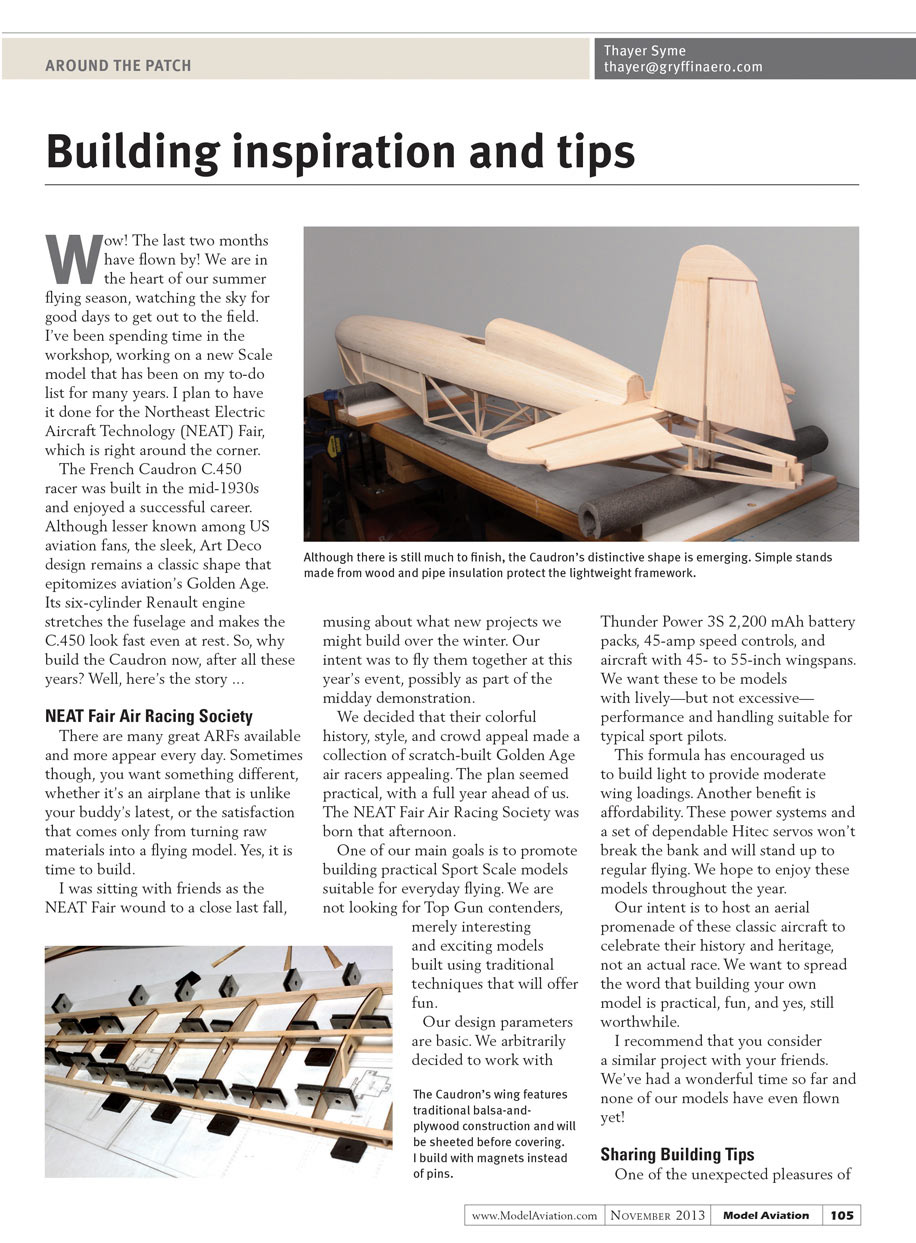
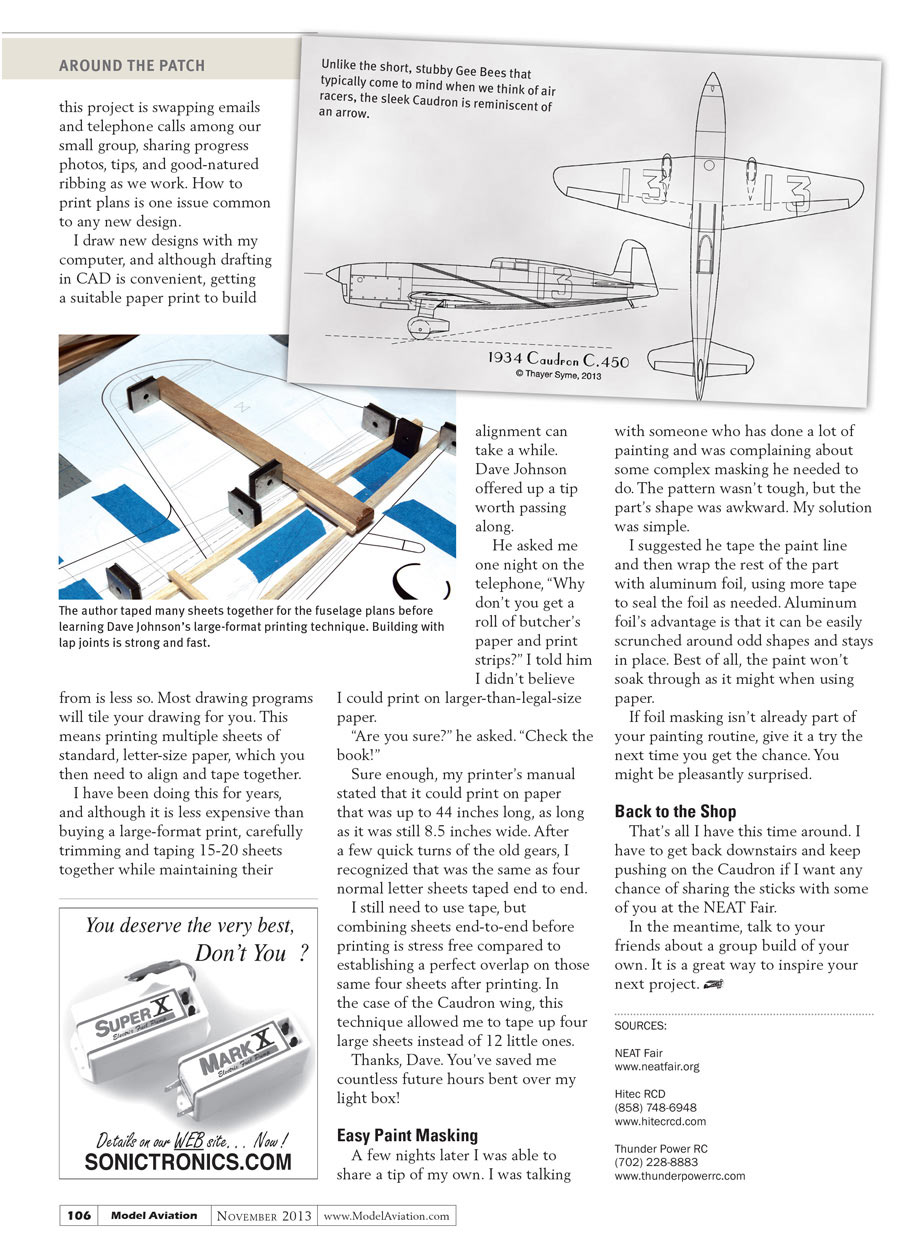
The French Caudron C.450 racer was built in the mid-1930s and enjoyed a successful career. Although lesser known among US aviation fans, the sleek, Art Deco design remains a classic shape that epitomizes aviation's Golden Age. Its six-cylinder Renault engine stretches the fuselage and makes the C.450 look fast even at rest. So, why build the Caudron now, after all these years? Well, here's the story ...
NEAT Fair Air Racing Society
There are many great ARFs available and more appear every day. Sometimes though, you want something different, whether it's an airplane that is unlike your buddy's latest, or the satisfaction that comes only from turning raw materials into a flying model. Yes, it is time to build.
I was sitting with friends as the NEAT Fair wound to a close last fall, musing about what new projects we might build over the winter. Our intent was to fly them together at this year's event, possibly as part of the midday demonstration.
We decided that their colorful history, style, and crowd appeal made a collection of scratch-built Golden Age air racers appealing. The plan seemed practical, with a full year ahead of us. The NEAT Fair Air Racing Society was born that afternoon.
One of our main goals is to promote building practical Sport Scale models suitable for everyday flying. We are not looking for Top Gun contenders, merely interesting and exciting models built using traditional techniques that will offer fun.
Our design parameters are basic. We arbitrarily decided to work with Thunder Power 3S 2,200 mAh battery packs, 45-amp speed controls, and aircraft with 45- to 55-inch wingspans. We want these to be models with lively—but not excessive—performance and handling suitable for typical sport pilots.
This formula has encouraged us to build light to provide moderate wing loadings. Another benefit is affordability. These power systems and a set of dependable Hitec servos won't break the bank and will stand up to regular flying. We hope to enjoy these models throughout the year.
Our intent is to host an aerial promenade of these classic aircraft to celebrate their history and heritage, not an actual race. We want to spread the word that building your own model is practical, fun, and yes, still worthwhile.
I recommend that you consider a similar project with your friends. We've had a wonderful time so far and none of our models have even flown yet!
Sharing Building Tips
Around the Patch
Thayer Syme
This project is swapping emails and telephone calls among our small group, sharing progress photos, tips, and good-natured ribbing as we work. How to print plans is one issue common to any new design.
I draw new designs with my computer, and although drafting in CAD is convenient, getting a suitable paper print to build alignment can take a while. Dave Johnson offered up a tip worth passing along.
He asked me one night on the telephone, "Why don't you get a roll of butcher's paper and print strips?" I told him I didn't believe I could print on larger-than-legal-size paper.
"Are you sure?" he asked. "Check the book!"
Sure enough, my printer's manual stated that it could print on paper that was up to 44 inches long, as long as it was still 8.5 inches wide. After a few quick turns of the old gears, I recognized that was the same as four normal letter sheets taped end to end.
I still need to use tape, but combining sheets end-to-end before printing is stress free compared to establishing a perfect overlap on those same four sheets after printing. In the case of the Caudron wing, this technique allowed me to tape up four large sheets instead of 12 little ones.
Thanks, Dave. You've saved me countless future hours bent over my light box!
Easy Paint Masking
A few nights later I was able to share a tip of my own. I was talking with someone who has done a lot of painting and was complaining about some complex masking he needed to do. The pattern wasn't tough, but the part's shape was awkward. My solution was simple.
I suggested he tape the paint line and then wrap the rest of the part with aluminum foil, using more tape to seal the foil as needed. Aluminum foil's advantage is that it can be easily scrunched around odd shapes and stays in place. Best of all, the paint won't soak through as it might when using paper.
If foil masking isn't already part of your painting routine, give it a try the next time you get the chance. You might be pleasantly surprised.
Back to the Shop
That's all I have this time around. I have to get back downstairs and keep pushing on the Caudron if I want any chance of sharing the sticks with some of you at the NEAT Fair.
In the meantime, talk to your friends about a group build of your own. It is a great way to inspire your next project.
SOURCES:
- NEAT Fair
- Hitec RCD
(858) 748-6948 www.hitecrcd.com
- Thunder Power RC
(702) 228-8883 www.thunderpowerrc.com
Transcribed from original scans by AI. Minor OCR errors may remain.

