
Building from kits
Thayer Syme — [email protected]
A successful first flight with a new model is one of the great pleasures in aeromodeling. From the moment a photo or drawing captures the imagination, the mind inevitably springs to some version of a warm spring day with a light breeze down the runway and the wheels tickling the grass as that airplane floats off into the blue for the first time.
To make that moment even sweeter, many enthusiasts still prefer building their own models and the increased emotional investment that process provides.
I have enjoyed assembling and flying countless models over the years, building my knowledge base and skills along the way. Yet when it comes time to clean out my workshop and make room for new projects, the models that I glued together, sanded smooth, and carefully covered myself are the ones most likely to stay while others are entrusted to a new owner.
Where Do We Get Them?
“But no one is making kits anymore.” Fortunately, that often-heard lament isn't true. Ignore the doom and gloom about building being a lost art—and hobby shop shelves full of the latest ARFs. There are actually quite a few balsa kits readily available.
Sure, the passage of time brings manufacturer changes and attrition. Despite this, some of the classic kit companies are still with us, along with a new generation of firms founded by younger designers to share their dreams.
I grew up poring over the Sig Manufacturing catalog like it was the Sears and Roebuck Christmas Wish Book, dreaming of next summer’s great adventures. While my 35-plus years in the hobby seem long to me, Sig is now well into its seventh decade of operation, alive and well under passionate new ownership. A quick visit to the company’s website reveals a large number of kits for Free Flight, Control Line, and RC builders.
Hobbico continues to offer a range of kits, including several large World War II warbirds and sport models under the Top Flite and Great Planes umbrellas. They should be available through your local hobby shop, even if they aren’t on its shelves.
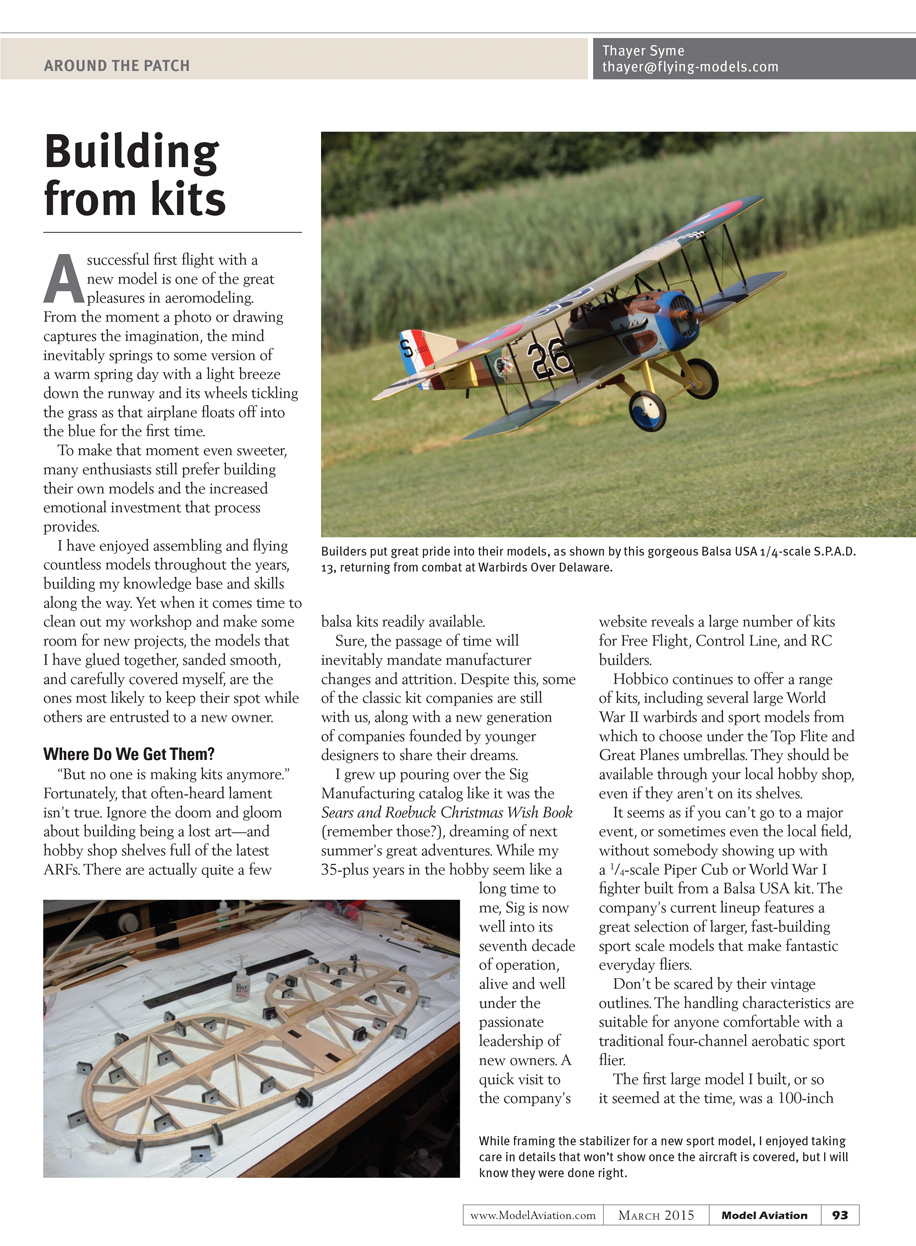
It seems you can’t go to a major event, or sometimes even the local field, without somebody showing up with a 1/4-scale Piper Cub or World War I fighter built from a Balsa USA kit. The company’s current lineup features a great selection of larger, fast-building sport-scale models that make fantastic everyday fliers. Don’t be scared by their vintage outlines—the handling characteristics are suitable for anyone comfortable with a traditional four-channel aerobatic sport flier.
The first large model I built, or so it seemed at the time, was a 100-inch-wingspan Balsa USA Nomad that now awaits restoration in my parents’ barn. If memory serves, it was delivered to my door for $19.95 when I was in high school, and I had a lot of fun flying it after it was built. Equally important were the lessons I learned as I carefully built the Nomad. I remember crawling out my bedroom window onto our flat kitchen roof one spring Saturday to profile the balsa block wingtips with my Dremel tool and keep the balsa “snow” out of my room. I later spent the better part of a day carefully aligning the wings of the fully assembled skeleton, using our Ping-Pong table as a reference surface. It may be my aging vision, but even today those wingtips still look pretty good to me.
For a more detailed scale kit of a classic vintage model, don’t overlook Proctor Enterprises. I have two of the company’s kits awaiting my attention. One, the Antic biplane, isn’t actually a scale model, but it seems as though it could be. Its traditional construction and appearance will make it a great warm-up for my Curtiss Jenny.
Perhaps you want something less ambitious? Several smaller kit companies offer a variety of smaller, easier-to-build kits:
- Manzano Laser Works
- Mountain Models
- Park Scale Models
- Stevens AeroModel
- Others catering to niche interests and scales
Building from kits remains a rewarding path for modelers who enjoy the craftsmanship, learning, and personal connection that come with assembling their own airplanes.
Transcribed from original scans by AI. Minor OCR errors may remain.

