

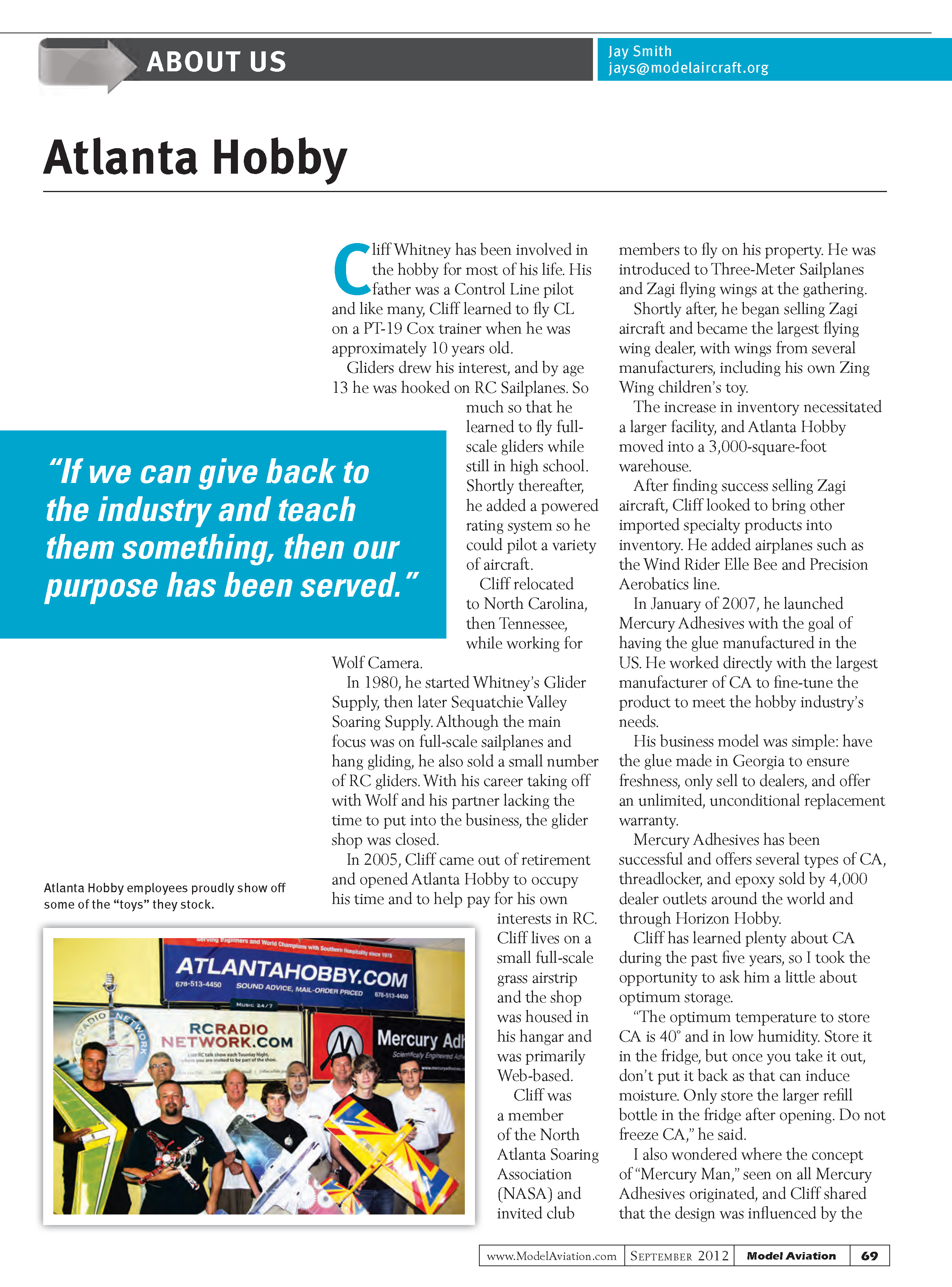
Atlanta Hobby - 201209
Early life and flying
Cliff Whitney has been involved in the hobby for most of his life. His father was a Control-Line pilot and, like many, Cliff learned to fly CL on a PT-19 Cox trainer when he was approximately 10 years old. Gliders drew his interest, and by age 13 he was hooked on RC sailplanes. So much so that he learned to fly full-scale gliders while still in high school. Shortly thereafter, he added a powered rating so he could pilot a variety of aircraft.
Cliff relocated to North Carolina, then Tennessee, while working for Wolf Camera. In 1980, he started Whitney’s Glider Supply, then later Sequatchie Valley Soaring Supply. Although the main focus was on full-scale sailplanes and hang gliding, he also sold a small number of RC gliders. With his career taking off with Wolf and his partner lacking the time to put into the business, the glider shop was closed.
Atlanta Hobby and retail growth
In 2005, Cliff came out of retirement and opened Atlanta Hobby to occupy his time and to help pay for his own interests in RC. Cliff lives on a small full-scale grass airstrip and the shop was housed in his hangar and was primarily web-based. Cliff was a member of the North Atlanta Soaring Association (NASA) and invited club members to fly on his property. He was introduced to three-meter sailplanes and Zagi flying wings at the gathering. Shortly after, he began selling Zagi aircraft and became the largest flying-wing dealer, with wings from several manufacturers, including his own Zing Wing children’s toy.
The increase in inventory necessitated a larger facility, and Atlanta Hobby moved into a 3,000-square-foot warehouse. After finding success selling Zagi aircraft, Cliff looked to bring other imported specialty products into inventory. He added airplanes such as the Wind Rider Elle Bee and the Precision Aerobatics line.
Mercury Adhesives
In January of 2007, he launched Mercury Adhesives with the goal of having the glue manufactured in the U.S. He worked directly with the largest manufacturer of CA to fine-tune the product to meet the hobby industry’s needs. His business model was simple: have the glue made in Georgia to ensure freshness, only sell to dealers, and offer an unlimited, unconditional replacement warranty. Mercury Adhesives has been successful and offers several types of CA, threadlocker, and epoxy sold by 4,000 dealer outlets around the world and through Horizon Hobby.
CA storage advice
Cliff has learned plenty about CA during the past five years, so I took the opportunity to ask him a little about optimum storage. “The optimum temperature to store CA is 40°F and in low humidity. Store it in the fridge, but once you take it out, don’t put it back as that can induce moisture. Only store the larger refill bottle in the fridge after opening. Do not freeze CA,” he said.
Mercury Man logo
I also wondered where the concept of “Mercury Man,” seen on all Mercury Adhesives, originated. Cliff shared that the design was influenced by the Thompson Air Race Trophy and an old Chinese cartoon.
RC Radio Network (RCRN)
Cliff’s next big undertaking began in 2009 with the RC Radio Network (RCRN). The plan was to have a live RC show that people could watch and listen to on the Internet. The idea came about after a friend did live podcasts and involved the audience via chat. Cliff had another friend who owned a radio station and he had the idea to combine them. Cliff wrote the application and invested in all the equipment required to produce the show. He acquired licensing to play music around the clock without annoying advertising, other than RC commercials and station IDs. RCRN currently has 10,000 songs in the playlist which is mixed by Cliff. Air Show can draw as many as 1,500 participants to the live interactive talk show. Listeners are part of the show via interactive chats, telephone calls, and multimedia visuals. It is broadcast every other week on the first and third Tuesday of the month.
Cliff was excited to discuss RCRN. He has recently invested in new equipment to continue improving the show and told me a little of what it takes to produce it:
Note: A small region of the original page is unreadable—the immediate text that follows the line ending with “told me a little of what it takes to produce it:” is too small/blurry in the supplied image for a confident, accurate transcription. Could you either
- upload a higher-resolution crop of the rightmost column near the top (the area right under the header where the RCRN production details continue), or
- confirm that you want me to start the continuation at the paragraph beginning “Cliff has learned plenty about CA during the past five years…” (which is clearly readable on this page)?
Once you send the clearer crop or confirm, I’ll extract and correct the primary article text exactly as requested.
Transcribed from original scans by AI. Minor OCR errors may remain.

