
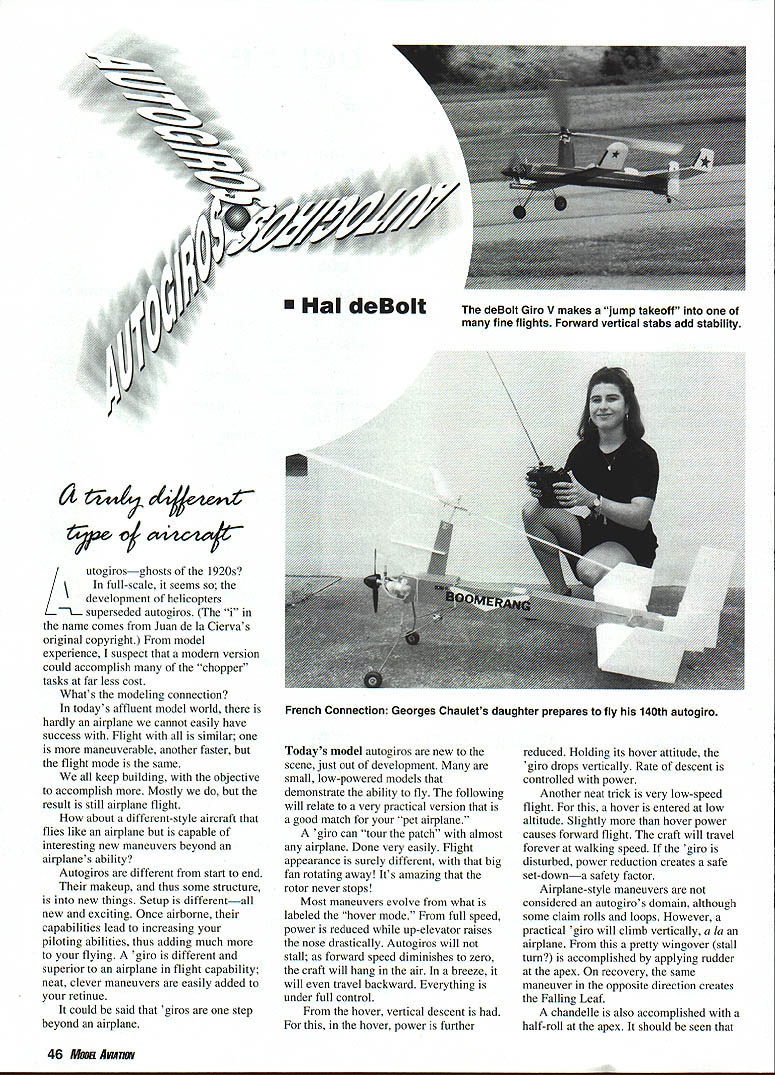
Autogiros
Hal deBolt
A truly different type of aircraft
Autogiros—ghosts of the 1920s? In full scale, it seems so; development of helicopters superseded autogiros. (The "i" in the name comes from Juan de la Cierva's original copyright.) From model experience, I suspect that a modern version could accomplish many of the "chopper" tasks at far less cost.
What's the modeling connection? In today's affluent model world, there is hardly an airplane we cannot easily have success with. Flight with all is similar; one is more maneuverable, another faster, but the flight mode is the same.
We all keep building with the objective to accomplish more. Mostly we do, but the result is still airplane flight.
How about a different-style aircraft that flies like an airplane but is capable of interesting new maneuvers beyond an airplane's ability?
Autogiros are different from start to end. Their makeup, and thus some structure, is into new things. Setup is different—all new and exciting. Once airborne, their capabilities lead to increasing your piloting abilities, thus adding much more to your flying. A giro is different and superior to an airplane in flight capability; neat, clever maneuvers are easily added to your routine.
It could be said that 'giros are one step beyond an airplane.
Today's model autogiros
Today's model autogiros are new to the scene, just out of development. Many are small, low-powered models that demonstrate the ability to fly. The following will relate to a very practical version that is a good match for your "pet airplane."
A giro can "tour the patch" with almost any airplane. Done very easily. Flight appearance is surely different, with that big fan rotating away! It's amazing that the rotor never stops.
Most maneuvers evolve from what is labeled the "hover mode." From full speed, power is reduced while up-elevator raises the nose drastically. Autogiros will not stall; as forward speed diminishes the craft will hang in the air. In a breeze, it will even travel backward. Everything is under full control.
From the hover, vertical descent is possible. For this, in the hover, power is further reduced. Holding its hover attitude, the giro drops vertically. Rate of descent is controlled with power.
Another neat trick is very low-speed flight. For this, a hover is entered at low altitude. Slightly more than hover power causes forward flight. The craft will travel forever at walking speed. If the giro is disturbed, proper reduction creates a safe set-down—a safety factor.
Maneuvers and performance
Airplane-style maneuvers are not considered an autogiro's domain, although some claim rolls and loops. However, a practical giro will climb vertically, a la an airplane. From this, a pretty wingover is accomplished by applying rudder at the apex. On recovery, the same maneuver in the opposite direction creates the Falling Leaf.
A chandelle is also accomplished with a half-roll at the apex. It should be seen that during that slow flyby, a touch-and-go can easily be added.
A giro's landing ability is outstanding. Of course, an airplane-style approach and touchdown, with rollout and all, is practical. More remarkable is a no-roll landing. At some altitude a hover is entered, relating to the desired landing spot, followed by a vertical descent to the spot. As the spot is neared, an added bit of power stops the descent, then full power reduction results in the no-roll landing. Then a taxi back to the "attaboys" may be in order.
Best of all, everything is done easily and under full control.
The message
At this time, autogiros are rare in modeling. Unless one has been involved with them, their goodness and difference is not apparent. I would hope with this description of their flight abilities, one can see new, interesting progress in RC flight. Hopefully it will entice more into the 'giro fraternity.
In the 1970s, helicopters were just appearing; they were attractive but complex, sophisticated, and expensive. I thought that an autogiro had some 'chopper abilities, and would be much simpler and not costly. So I spent a year developing a successful, usable 'giro. It found little interest, and so was shelved, but the published findings allowed whirlywing success.
Usable engineering data for autogiros is practically nonexistent, so in recent times it was a surprise to see widespread activity with them, even though not in great numbers. Several fly-ins and symposia have been held, with good attendance.
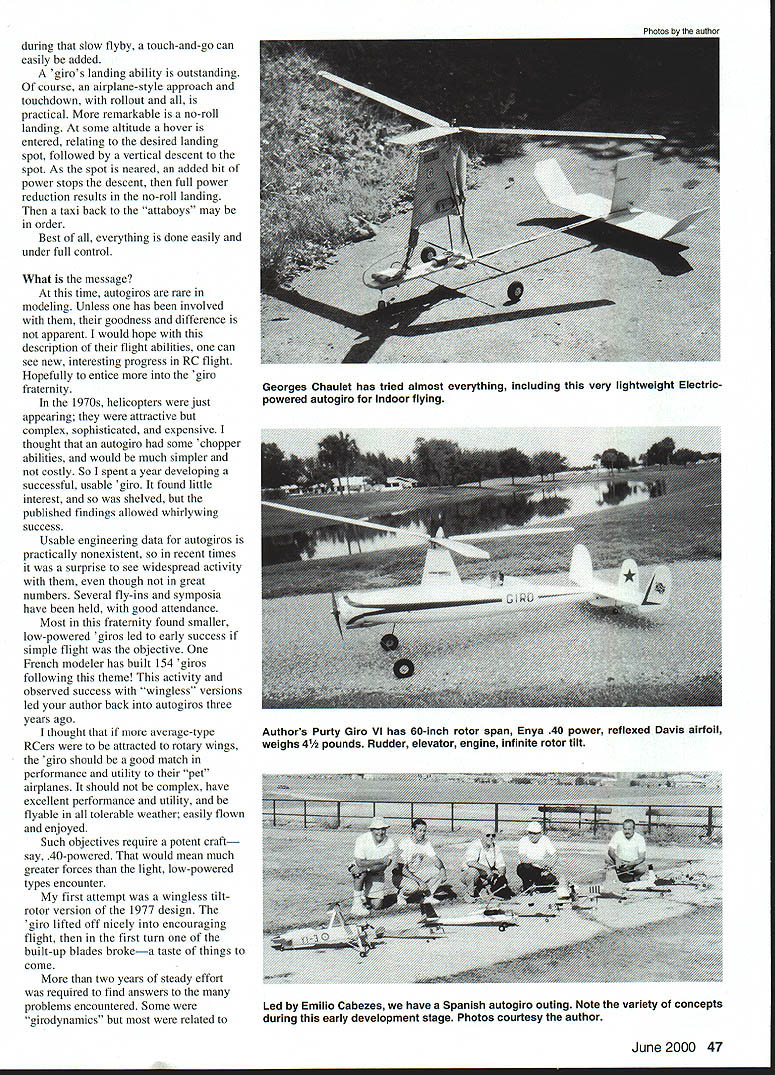
Most in this fraternity found smaller, low-powered 'giros led to early success if simple flight was the objective. One French modeler has built 154 'giros following this theme! This activity and observed success with "wingless" versions led your author back into autogiros three years ago.
I thought that if more average-type RCers were to be attracted to rotary wings, the 'giro should be a good match in performance and utility to their "pet" airplanes. It should not be complex, have excellent performance and utility, and be flyable in all tolerable weather; easily flown and enjoyed.
Development challenges and solutions
Such objectives require a potent craft—say, .40-powered. That would mean much greater forces than the light, low-powered types encounter.
My first attempt was a wingless tilt-rotor version of the 1977 design. The 'giro lifted off nicely into encouraging flight, then in the first turn one of the built-up blades broke—a taste of things to come.
More than two years of steady effort was required to find answers to the many problems encountered. Some were "girodynamics" but most were related to lack of understanding the magnitude of the forces prevailing; how strong is enough? Finding the answers required flight tests, and with the unknowns, crashes. Very time-consuming! Finally, substituting the car for a wind tunnel, much was solved before flight.
The best part was that putting all of the solutions into one package created an excellent autogiro—a joy to fly and perform with, and the effort was repaid many fold. It fills all of the objectives nicely, and any R/Cer should appreciate it. Any and all of the info will be published; hopefully leading many more of you to the enjoyment of rotating wings!
Getting started
"So, you got my attention! Question is, how do I get started?" Unfortunately, with 'giros new on the scene, there is not a predominance of useful things available to the newcomer. However, what there is is very trustworthy.
From your author's experience, an R/Cer's entry into rotary wings would come easily via the MAN autogiro of 1977, even though today's 'giros consider it antique. The advantage is that it is extremely simple, flies like an airplane, yet is capable of all 'giro maneuvers. And the basics are there to convert it to the modern style.
I am always willing to assist in any way possible. You have interest and/or questions? I would be pleased to help if I can. Mail or phone okay. Please include a stamped, self-addressed return envelope.
Hal deBolt 2206 Greenwich Dr. Sun City Center, FL 33573 (813) 634-7668
References & Sources
Data:
- deBolt, Model Aviation 4/77
Contacts and plans:
- Bill Young — Model Autogiro Design, 4403 Rustic Knolls Ln., Flagstaff, AZ 86004
- Plans: deBolt, MAN 9/77, Plan #296
- Emilio Cabezas, RCM 1/98, Plan #1244
- Whistler Giro, RCM 5/92, Plan #1116
Kits:
- Autogyro Company of Arizona, 3307 W. Renee Dr., Phoenix, AZ 85027
Transcribed from original scans by AI. Minor OCR errors may remain.

