
Balsa USA - 2011/01
By Jay Smith
ALMOST ANYONE who is interested in RC kits of World War I aircraft is probably familiar with Balsa USA. The company has been producing an expanded line of WW I models since the 1990s, but its story starts much longer ago.
History
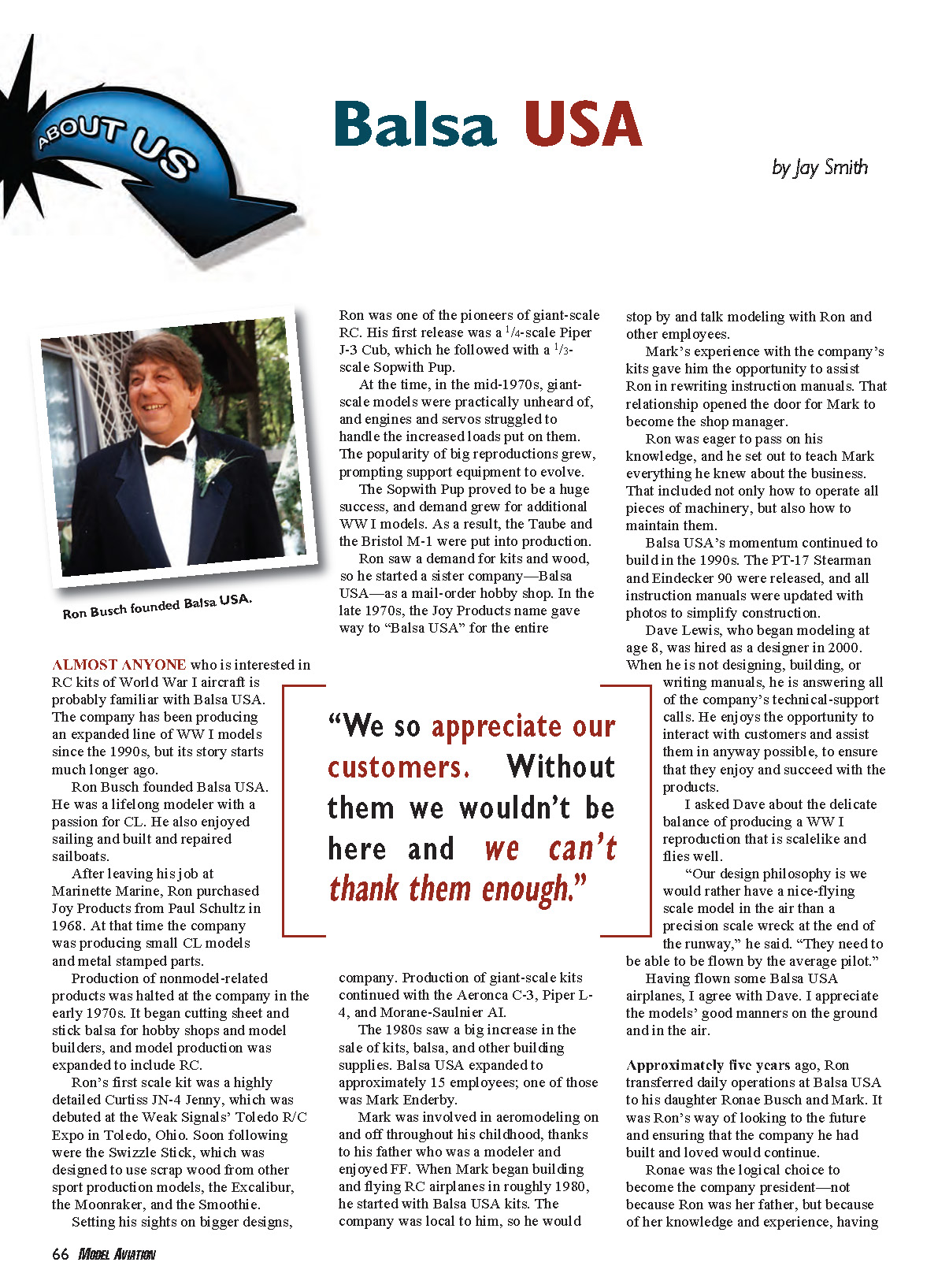
Ron Busch founded Balsa USA. He was a lifelong modeler with a passion for control-line (CL) flying. He also enjoyed sailing and built and repaired sailboats.
After leaving his job at Marinette Marine, Ron purchased Joy Products from Paul Schultz in 1968. At that time the company was producing small CL models and metal-stamped parts. Production of non-model-related products was halted in the early 1970s. The company began cutting sheet and stick balsa for hobby shops and model builders, and model production was expanded to include radio control (RC).
Ron’s first scale kit was a highly detailed Curtiss JN-4 Jenny, which debuted at the Weak Signals Toledo R/C Expo in Toledo, Ohio.
Early kits
- Curtiss JN-4 Jenny
- Swizzle Stick (designed to make use of scrap wood from other sport production models)
- Excalibur
- Moonraker
- Smoothie
Giant-scale pioneer
Setting his sights on bigger designs, Ron was one of the pioneers of giant-scale RC. His first release was a 1/4-scale Piper J-3 Cub, which he followed with a 1/3-scale Sopwith Pup. In the mid-1970s, giant-scale models were practically unheard of; engines and servos struggled with the increased loads. The popularity of big reproductions grew, prompting support equipment to evolve.
The Sopwith Pup proved to be a huge success, and demand grew for additional WW I models. As a result, the Taube and the Bristol M-1 were put into production.
Seeing demand for kits and wood, Ron started a sister company—Balsa USA—as a mail-order hobby shop. In the late 1970s, the Joy Products name gave way to Balsa USA for the entire company. Production of giant-scale kits continued with the Aeronca C-3, Piper L-4, and Morane-Saulnier AI.
1980s and 1990s
The 1980s brought a big increase in the sale of kits, balsa, and other building supplies. Balsa USA expanded to approximately 15 employees, one of whom was Mark Enderby.
Mark was involved in aeromodeling on and off throughout his childhood, thanks to his modeler father who enjoyed free flight (FF). When Mark began building and flying RC airplanes around 1980, he started with Balsa USA kits. The company was local to him, so he would stop by and talk modeling with Ron and other employees.
Mark’s experience with the company’s kits gave him the opportunity to assist Ron in rewriting instruction manuals. That relationship opened the door for Mark to become the shop manager. Ron was eager to pass on his knowledge and taught Mark everything he knew about the business, including how to operate and maintain all pieces of machinery.
Balsa USA’s momentum continued in the 1990s. The PT-17 Stearman and Eindecker 90 were released, and all instruction manuals were updated with photographs to simplify construction.
Design and support
Dave Lewis, who began modeling at age eight, was hired as a designer in 2000. When he is not designing, building, or writing manuals, he answers the company’s technical-support calls. He enjoys interacting with customers and assisting them to ensure they enjoy and succeed with the products.
I asked Dave about the delicate balance of producing a WW I reproduction that is scale-like and flies well. He responded: "Our design philosophy is we would rather have a nice-flying scale model in the air than a precision-scale wreck at the end of the runway. They need to be able to be flown by the average pilot."
Having flown some Balsa USA airplanes, I agree with Dave. I appreciate the models' good manners on the ground and in the air.
Leadership and legacy
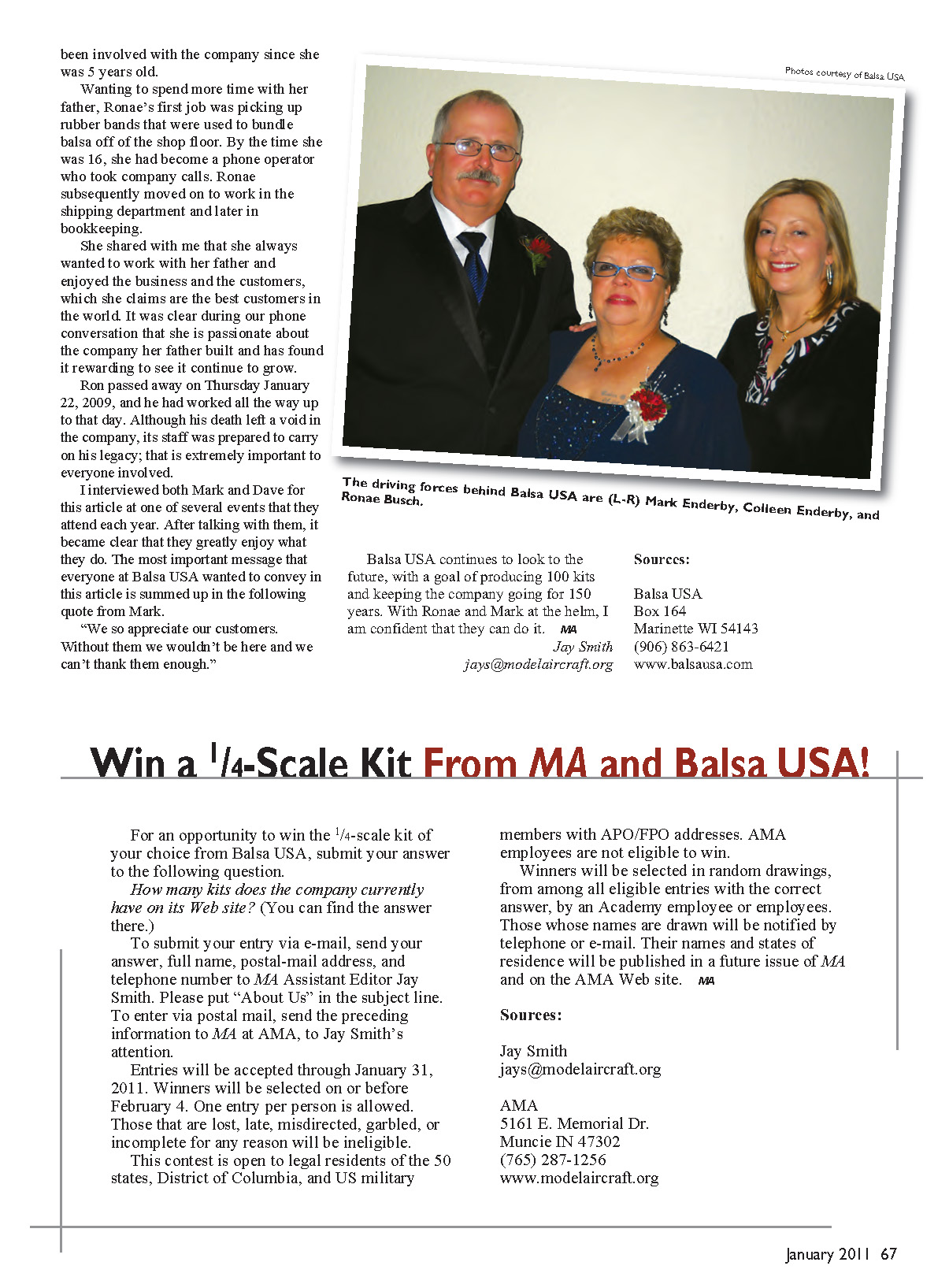
Approximately five years before Ron’s death, he transferred daily operations at Balsa USA to his daughter Ronae Busch and to Mark. It was Ron’s way of looking to the future and ensuring that the company he had built and loved would continue.
Ronae was the logical choice to become company president—not because Ron was her father, but because of her knowledge and experience, having been involved with the company since she was five years old. Wanting to spend more time with her father, Ronae's first job was picking up rubber bands used to bundle balsa off the shop floor. By the time she was 16, she had become a phone operator who took company calls. Ronae subsequently moved on to work in the shipping department and later in bookkeeping.
She shared that she always wanted to work with her father and enjoyed the business and the customers, whom she calls the best customers in the world. It was clear during our conversation that she is passionate about the company her father built and has found it rewarding to see it continue to grow.
Ron passed away on Thursday, January 22, 2009, and he had worked all the way up to that day. Although his death left a void, the staff was prepared to carry on his legacy, which is extremely important to everyone involved.
I interviewed both Mark and Dave at one of several events they attend each year. After talking with them, it became clear they greatly enjoy what they do. The most important message everyone at Balsa USA wanted to convey is summed up in Mark’s quote: "We so appreciate our customers. Without them we wouldn't be here and we can't thank them enough."
Balsa USA continues to look to the future, with a goal of producing 100 kits and keeping the company going for 150 years. With Ronae and Mark at the helm, I am confident they can do it.
MA Jay Smith [email protected]
Sources
- Balsa USA
- Box 164, Marinette, WI 54143
- (906) 863-6421
- www.balsausa.com
Transcribed from original scans by AI. Minor OCR errors may remain.

