
Battery Basics
Bob Aberle
My apologies. I had every intention this month of publishing my new Radio Control (RC) electric sailplane model that I hope beginners will build from scratch. (It's not a kit or an Almost Ready-to-Fly [ARF]/Ready-to-Fly [RTF] model!) As I learned, designing, building, flying, photographing, and writing about it takes more than four weeks. I promise to publish my "Scratch-One" design next month.
This month (the eighth installment I've written) will be devoted to the all-important battery basics. In the previous seven chapters I've referred to the RC-system batteries and the electric-motor batteries on many occasions. I will probably repeat some of those points to emphasize their importance.
The battery power to your RC system is like putting gas in your car; if you run out of gas, the car doesn't run. If your RC system runs out of electrical power, it doesn't work (fly)! During this presentation I will concentrate mostly on the RC-system batteries, but I will get into some aspects of the electric-motor batteries as they are used in electric-powered flight.
Types of Batteries
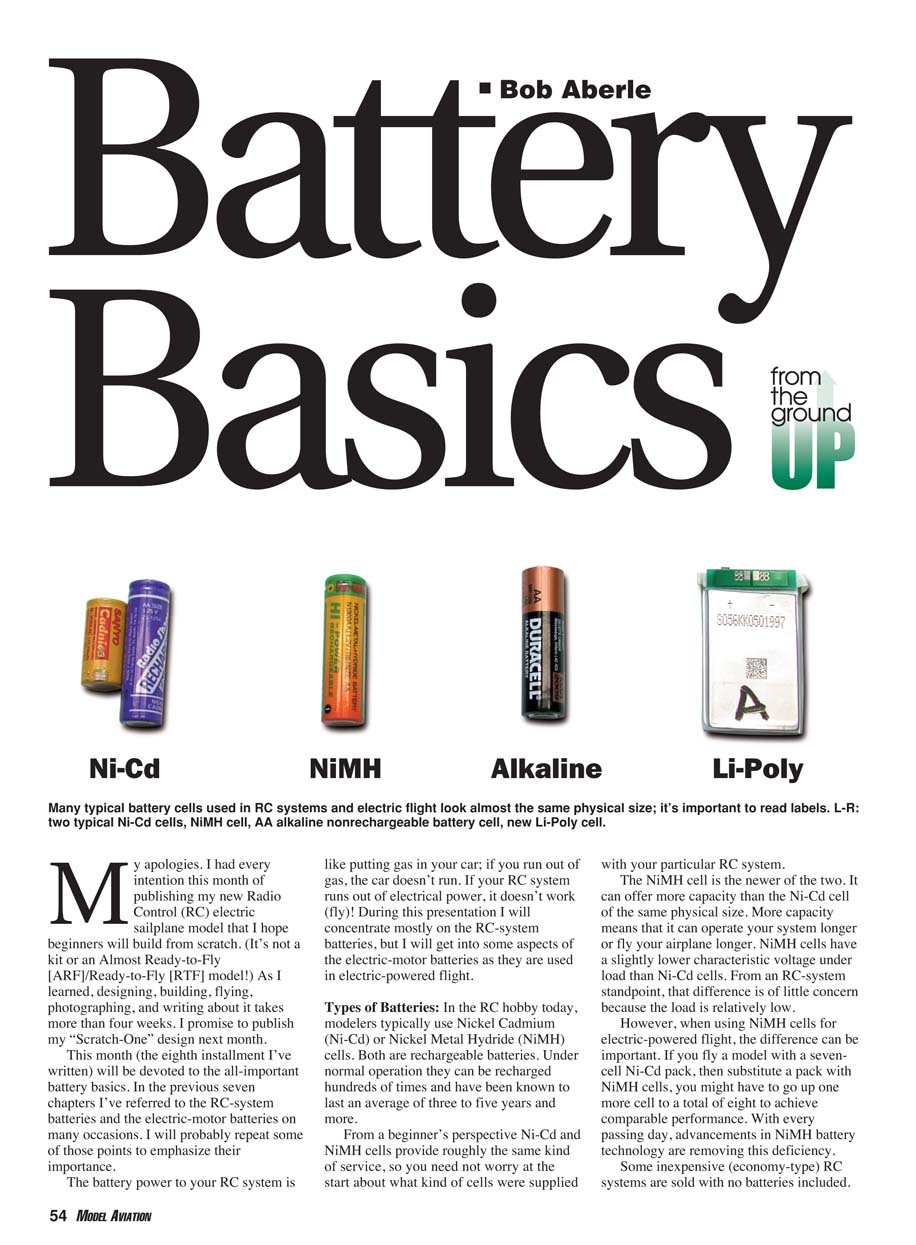
In the RC hobby today, modelers typically use Nickel Cadmium (Ni-Cd) or Nickel Metal Hydride (NiMH) cells. Both are rechargeable batteries. Under normal operation they can be recharged hundreds of times and have been known to last an average of three to five years or more.
From a beginner's perspective Ni-Cd and NiMH cells provide roughly the same kind of service, so you need not worry at the start about what kind of cells were supplied with your particular RC system.
The NiMH cell is the newer of the two. It can offer more capacity than the Ni-Cd cell of the same physical size. More capacity means that it can operate your system longer or fly your airplane longer. NiMH cells have a slightly lower characteristic voltage under load than Ni-Cd cells. From an RC-system standpoint, that difference is of little concern because the load is relatively low. However, when using NiMH cells for electric-powered flight, the difference can be important. If you fly a model with a seven-cell Ni-Cd pack, then substitute a pack with NiMH cells, you might have to go up one more cell to a total of eight to achieve comparable performance. With every passing day, advancements in NiMH battery technology are removing this deficiency.
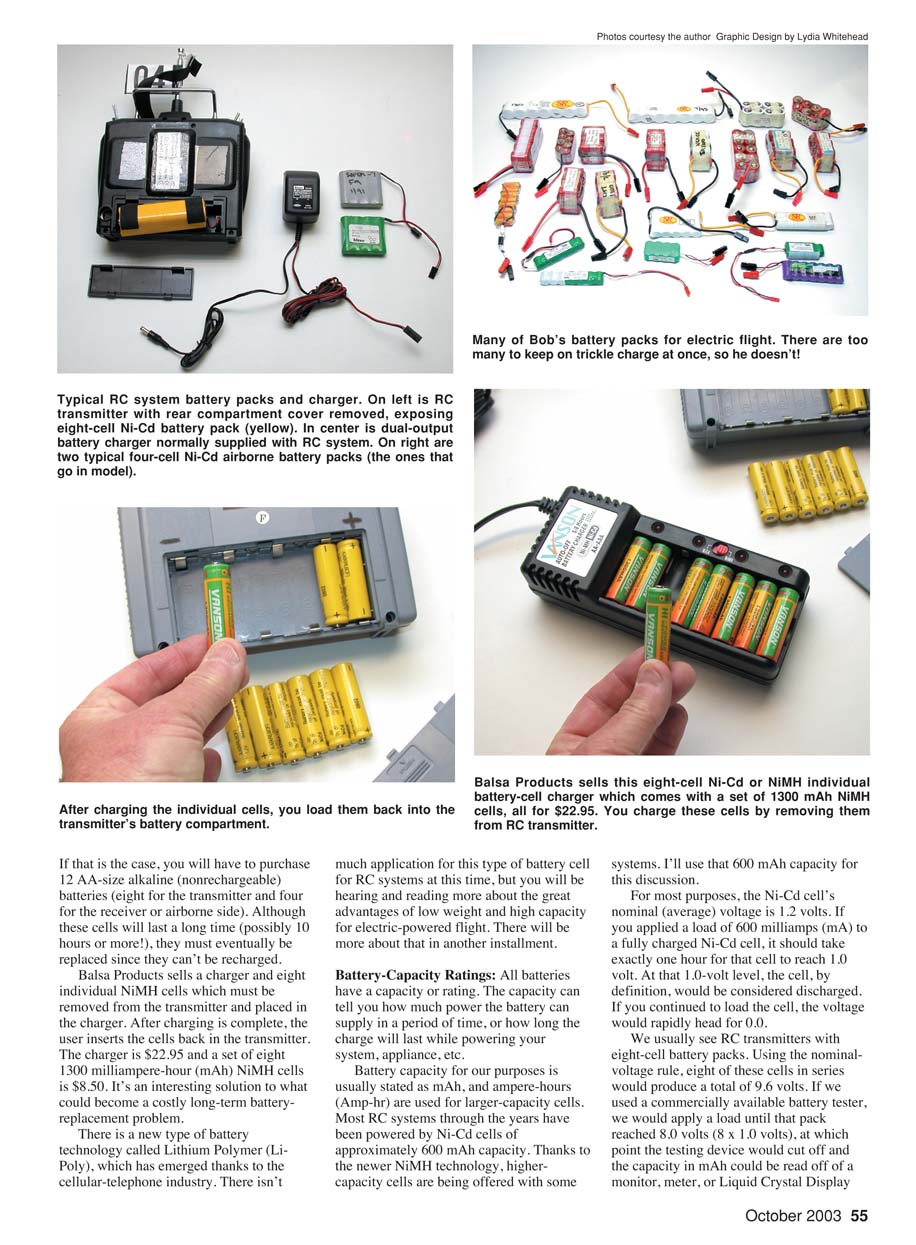
Some inexpensive (economy-type) RC systems are sold with no batteries included. If that is the case, you will have to purchase 12 AA-size alkaline (nonrechargeable) batteries (eight for the transmitter and four for the receiver or airborne side). Although these cells will last a long time (possibly 10 hours or more!), they must eventually be replaced since they can't be recharged. Balsa Products sells a charger and eight individual NiMH cells which must be removed from the transmitter and placed in the charger. After charging is complete, the user inserts the cells back in the transmitter. The charger is $22.95 and a set of eight 1300 milliampere-hour (mAh) NiMH cells is $8.50. It's an interesting solution to what could become a costly long-term battery-replacement problem.
There is a new type of battery technology called Lithium Polymer (Li-Poly), which has emerged thanks to the cellular-telephone industry. There isn't much application for this type of battery cell for RC systems at this time, but you will be hearing and reading more about the great advantages of low weight and high capacity for electric-powered flight. There will be more about that in another installment.
Battery-Capacity Ratings
All batteries have a capacity or rating. The capacity can tell you how much power the battery can supply in a period of time, or how long the charge will last while powering your system, appliance, etc.
Battery capacity for our purposes is usually stated as mAh (milliampere-hours), and ampere-hours (Amp-hr) are used for larger-capacity cells. Most RC systems through the years have been powered by Ni-Cd cells of approximately 600 mAh capacity. Thanks to the newer NiMH technology, higher-capacity cells are being offered with some systems. I'll use that 600 mAh capacity for this discussion.
For most purposes, the Ni-Cd cell's nominal (average) voltage is 1.2 volts. If you applied a load of 600 milliamps (mA) to a fully charged Ni-Cd cell, it should take exactly one hour for that cell to reach 1.0 volt. At that 1.0-volt level, the cell, by definition, would be considered discharged. If you continued to load the cell, the voltage would rapidly head for 0.0.
We usually see RC transmitters with eight-cell battery packs. Using the nominal-voltage rule, eight of these cells in series would produce a total of 9.6 volts. If we used a commercially available battery tester, we would apply a load until that pack reached 8.0 volts (8 x 1.0 volts), at which point the testing device would cut off and the capacity in mAh could be read off a monitor, meter, or Liquid Crystal Display (LCD).
Charging
With respect to charging, you will hear the following terms:
- Overnight charging (C/10)
- Field fast charging (high-rate charging: ~3C for Ni-Cd, ~2C for NiMH)
- Trickle charging (very low rate, e.g., C/50)
All battery charging, regardless of the type, is done as a function of the battery's rated capacity. You want to know what a battery's capacity is before you put it on a charger because too small a battery charged at too high a charge rate will be "cooked." On the other end of the scale, too big a battery charged at too low a rate will never get to full charge.
The overnight charging rate has been established for many years as the capacity of the battery divided by 10 (usually written C/10). This is the rate most RC-system dual chargers use. When employing a C/10 overnight rate, you are instructed to leave the batteries on charge for at least 10 hours. You could let them go for 16 or even 24 hours, and you would never hurt the batteries. This rule applies to Ni-Cd and NiMH cells.
As a beginner in the hobby, you shouldn't experience any problems if you use the unit that came with your new RC system to overnight-charge (the night before you intend to fly) the transmitter and airborne battery. As you progress in the hobby, you will learn the rest of what is necessary to maintain your battery packs.
Important charging reminders:
- When plugging your charger into a household 115VAC outlet, make sure that the outlet remains "live" during the overnight-charge period. If you plug your charger into an outlet that is connected to your shop lighting, you'll turn off your charger when you turn out the lights, and nothing will be charged.
- Don't be tempted to restore only enough charge to cover what you took out at the flying field. When you return home, don't put the batteries on charge for only two hours if you flew for two hours that day. Ni-Cd and NiMH battery chemistry is such that it needs the C/10 charge current and a minimum of 10 hours of charging. Anything less than 10 hours can cause problems.
- Never charge a relatively high-capacity battery at a lower rate, then leave it on for a much longer period of time to compensate. For example, if you replace your original RC-system batteries with 1600 mAh AA cells, the correct C/10 charge rate would be 160 mA. If your RC-system charger only produces 50–60 mA and you try to compensate by extending the charge duration, the battery will never achieve full capacity. Purchase a charger with the proper output for higher-capacity cells.
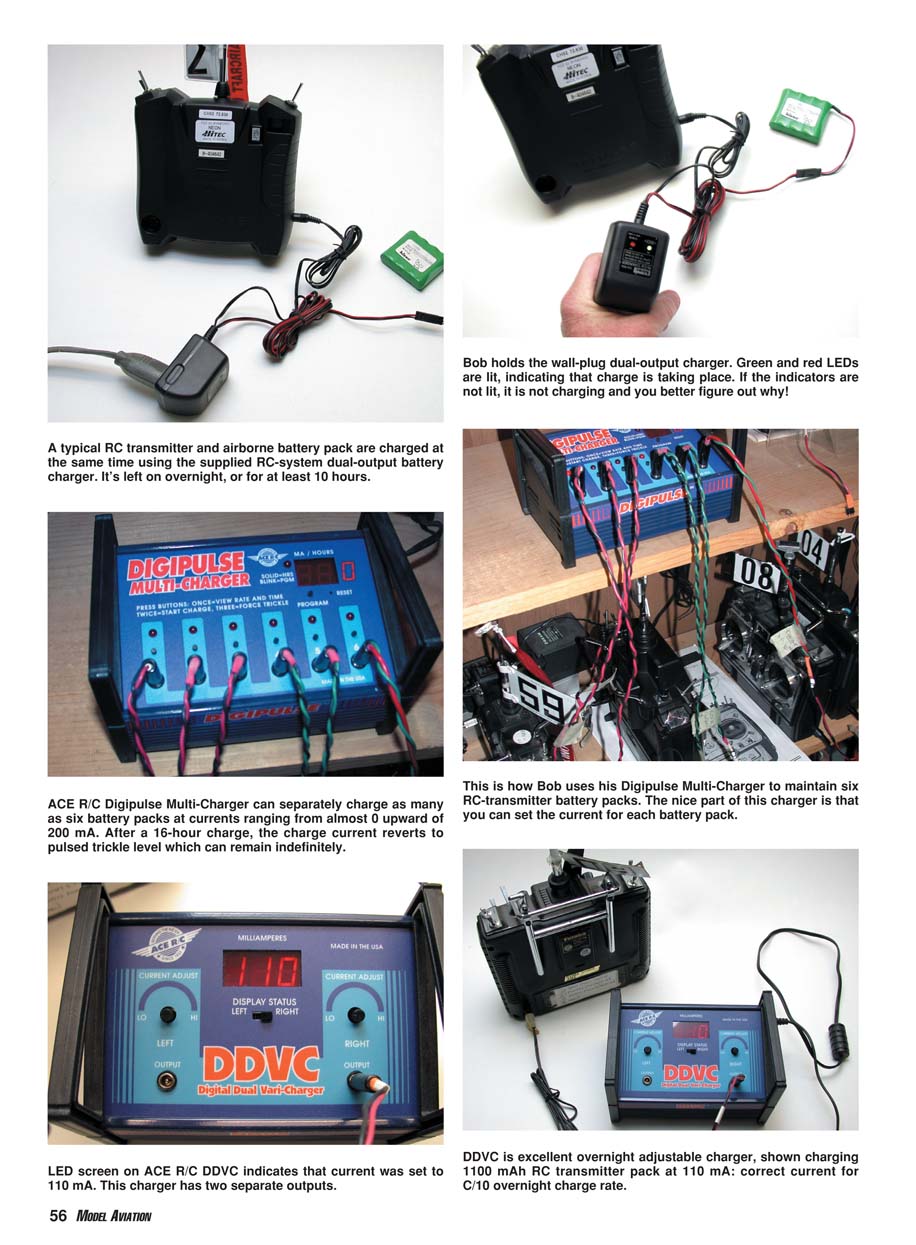
One recommended charger for variable output is the ACE R/C Digital Dual Variable Charger (DDVC). It has two outputs adjustable from 0 up to approximately 300 mA and can handle as many as 10–12 battery cells. Dial up the correct C/10 current for your pack and let it run overnight.
You can leave batteries on C/10 indefinitely without degradation. Many times I have left batteries on C/10 for 24–48 hours with no problem. I generally put my battery packs on C/10 the night before I plan on flying. If it rains and several days go by before I fly again, I charge the batteries overnight again.
Trickle charging is done at a rate considerably lower than C/10. We generally refer to a trickle charge as C/50, so a typical 500 mAh battery would be charged at only 10 mA (500/50 = 10). At that rate the battery can be left on trickle for an indefinite period. All of my RC transmitters are left on constant trickle charge following overnight charging. I have four transmitters that have been on trickle charge for more than five years and still have close to their full rated capacity.
One shelf-mounted charger I use is the ACE R/C DigiPlus Multi-Charger. It has six individual outputs, each adjustable roughly 5 to 200 mA. After a timed 16-hour period, each output reverts back to a pulsed trickle charge that will keep the batteries at peak performance. There's even a backup battery to protect the charger's memory in case of a power failure.
Field fast charging is a high charge rate that allows Ni-Cd cells to be completely recharged in approximately 20 minutes and NiMH cells in about 30 minutes. The typical specific rates are 3C for Ni-Cd and 2C for NiMH. For example, a 300 mAh Ni-Cd pack fast-charged at 3C would use a 900 mA current and could be fully charged in roughly 20 minutes. Field chargers operate from 12V DC so they can be connected to a car battery.
Why field fast charge? You might want to extend flying time at the field. I get approximately two solid hours of operating time from a single RC transmitter, so I seldom need to field-fast-charge transmitters. There are reasons to avoid it:
- Many transmitters have a protective fuse in the primary power lead, sometimes rated only 0.5 amp (500 mA). A fast charge at 1.5 amps could blow that fuse and require factory service.
- Some RC-system batteries were not intended to be fast charged repeatedly.
For receiver (airborne) packs (four- and five-cell), which tend to run out faster, many modelers prefer swapping in a fresh pack rather than fast-charging at the field. If you are into electric-powered flight, field fast charging becomes essential for recharging the pack used to run the motor so it can be used again in 20–30 minutes.
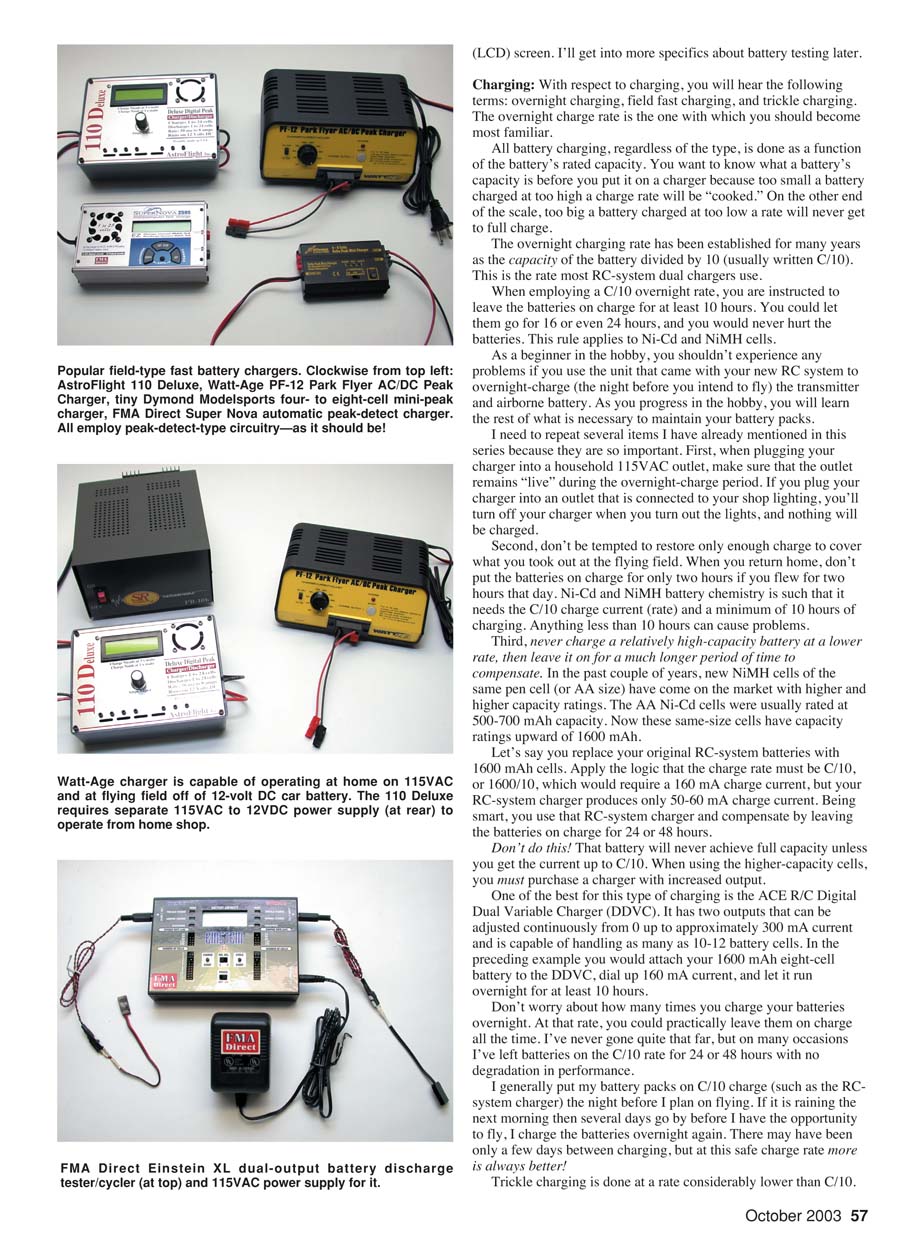
The only "fast" charger of choice for Ni-Cd and NiMH is a peak-detect charger. A peak-detect circuit permits fast charging up to the moment of full charge and then senses the peak and turns off the charger, providing full charge without overcharging. Some inexpensive chargers use fixed timers (e.g., 15–20 minutes) and cannot sense state of charge; these can undercharge or overcharge the battery.
Some automatic peak-detect chargers (e.g., FMA Direct Super Nova and Dymond Modelsports Super Turbo) sense cell count and capacity and automatically set proper charging parameters; they are useful if you become serious about electric-powered flight.
Safety notes:
- Only use peak-detect chargers to fast-charge Ni-Cd or NiMH cells and only if the cells are rated for fast charging.
- Never fast-charge a hot battery pack; only charge when the pack is cool or at most warm to the touch.
- Never use a peak-detect charger to charge any Lithium-type battery (Li-Ion, Li-Poly, etc.). Use chargers specifically designed for Lithium chemistry.
Testing
You know what capacity is and how to charge a battery; now you must learn how to monitor or test your batteries to determine when they are running out of power and when they must be replaced. Batteries can fail in months, not necessarily years.
There are two places where you will want to test batteries:
- At home (workbench testing) — to determine ongoing capacity and when replacement is needed.
- At the flying field — to know when to stop flying and when to swap or recharge.
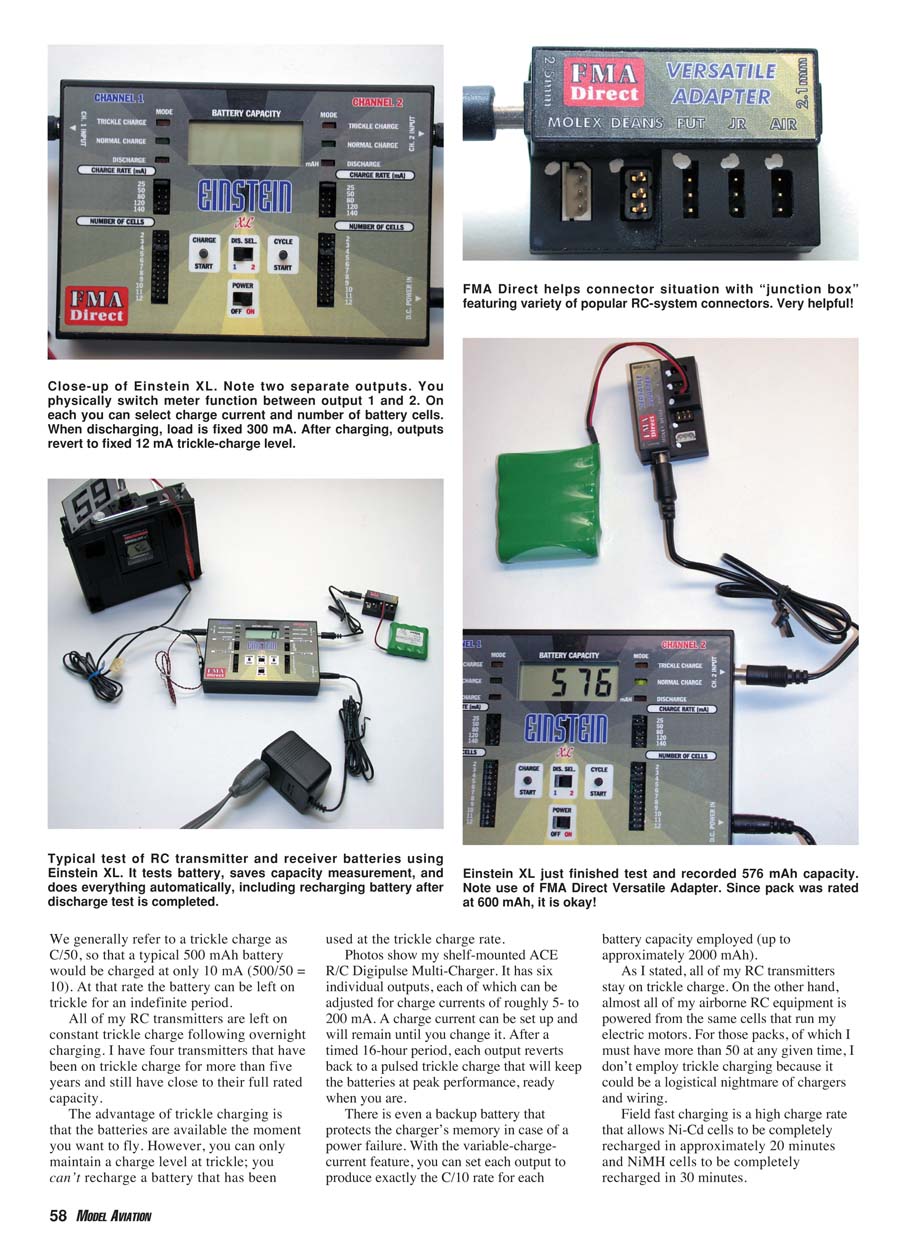
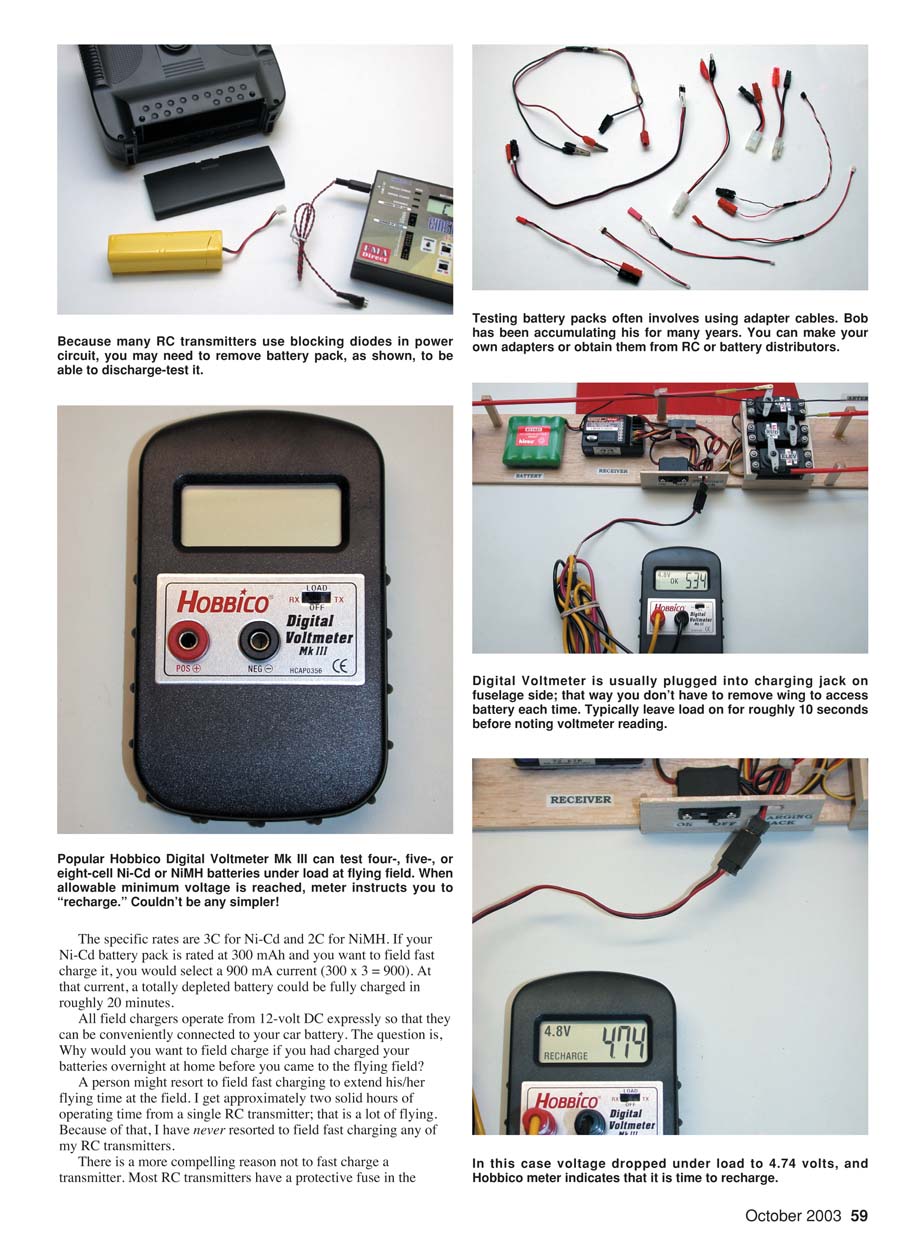
At-home testers: There are several battery discharge testers on the market. I use the FMA Direct Einstein XL (costs just under $100 with power supply). The Einstein has two separate outputs, lets you select discrete charging currents (25, 50, 80, 120, 140 mA), and supports packs from 2 up to 12 cells (Ni-Cd and NiMH). It can overnight-charge packs up to 140 mA and then revert to a trickle after a timed 16-hour period.
Basic use of any discharge tester:
- Fully charge the battery at the overnight (C/10) rate.
- Initiate the discharge test. The tester places a fixed load on the battery and measures the capacity in mAh.
- When a minimum voltage of 1.0 volt per cell is reached, the tester stops the discharge and typically recharges the battery at a selected rate.
- The last mAh reading is saved until you disconnect the battery.
Interpreting results: I generally discard a battery when capacity drops 20% from its rated value. For a 600 mAh pack, I would use it until it measures about 480 mAh. Keep a logbook of capacity measurements for each identified pack. Usually a pack maintains capacity for two or three years and then drops off rapidly. When that happens, discard the entire pack rather than attempt to replace individual cells.
When discarding batteries, follow manufacturer recommendations and return them to certified disposal organizations.
Other recommended testers and sources:
- Hobbico Accu-Cycle (sold by Tower Hobbies and Great Planes) — has two separate monitoring meters; roughly $80. Info: www.hobbico.com/chargers/hcap0260.html
- Hangar 9 Sure Cycle Battery Cycler (Horizon Hobby) — single output meter; about $60. Info on Horizon site.
Field testers: At the field you need loaded testing (applying a realistic load). Transmitters typically draw 100–200 mA, which provides a meaningful test. Never test a transmitter battery with only a simple voltmeter; without load, batteries can appear okay when they will fail under load.
For receiver (airborne) batteries (usually 4 or 5 cells), use a "loaded" voltmeter (historically called an ESV — expanded scale voltmeter). Modern digital loaded voltmeters impose a load of about 250–500 mA.
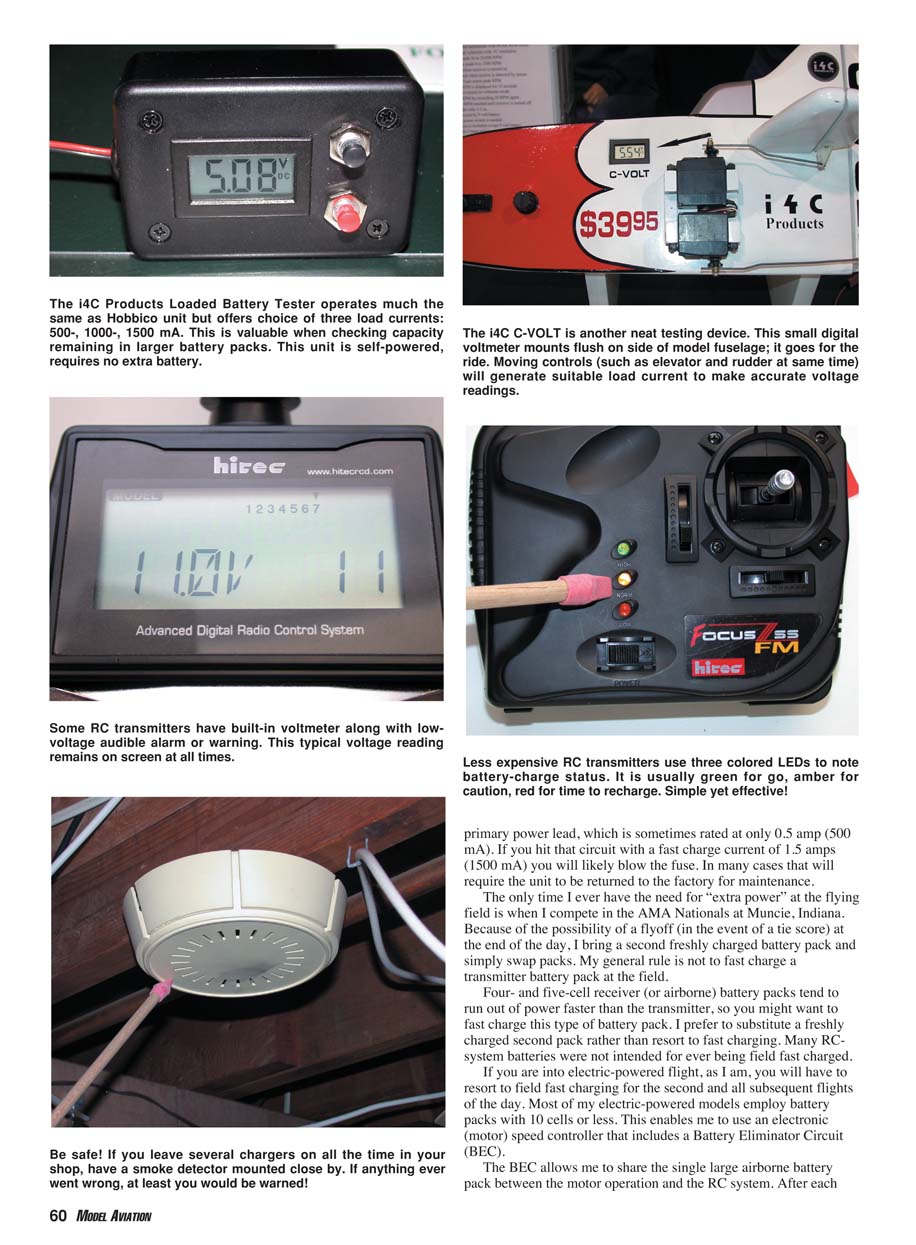
I like the Hobbico Digital Voltmeter Mk III (HCAP0356) from Tower Hobbies. The unit is set up to indicate when recharging is needed; for a four-cell pack it indicates when the voltage is roughly 4.8 volts under load — a conservative and safe cutoff.
Use a charging jack on the fuselage side so you can plug the tester in without removing the wing. After every flight, plug in the tester, select the correct cell count, wait about 10 seconds, and read the LCD.
More sophisticated field equipment:
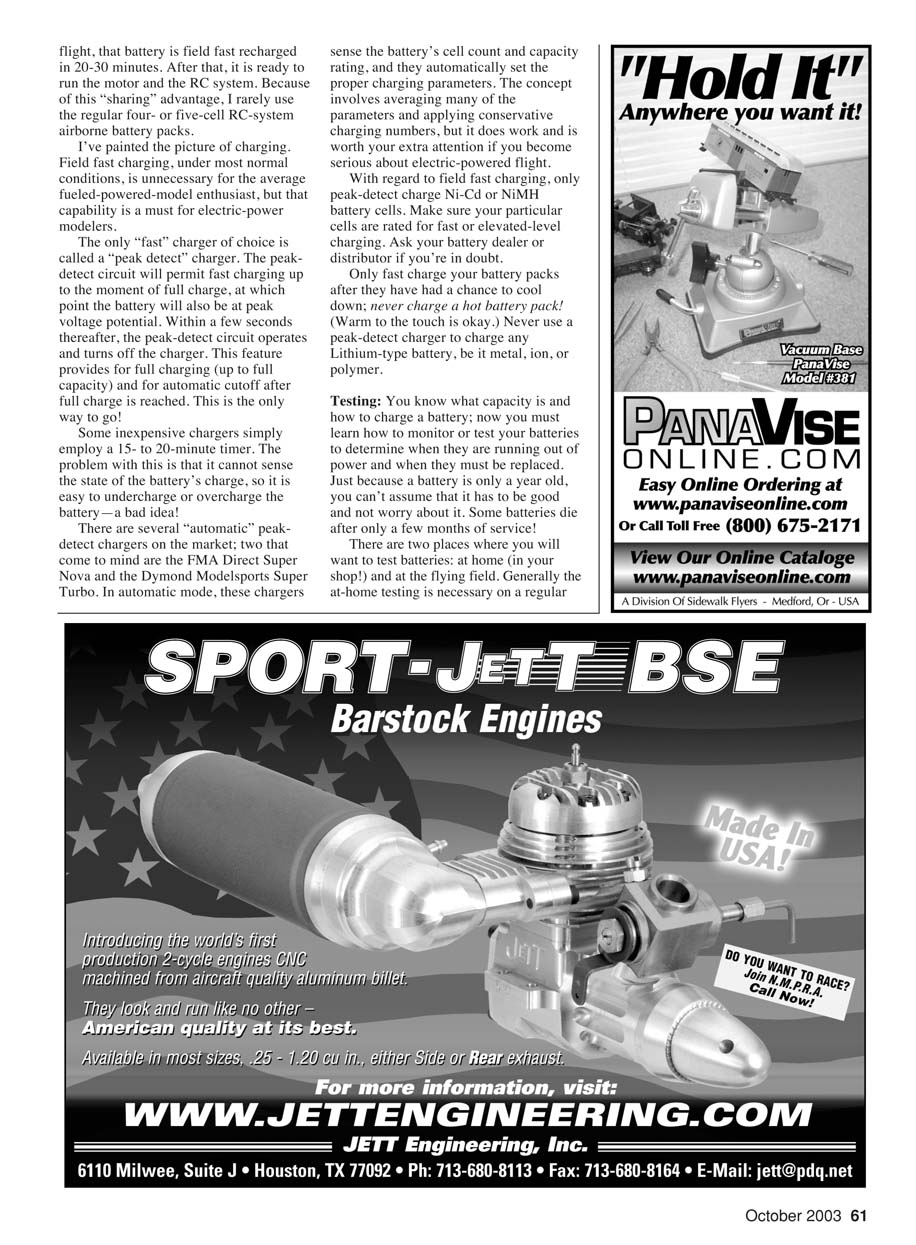
- i4C Products Loaded Battery Tester (selectable loads of 500, 1000, and 1500 mA) — appropriate for larger packs; powered by the battery under test.
- i4C C-Volt — a small LCD voltmeter mounted on the fuselage that powers up with the model. It has no load, so observe the readout while operating several controls to produce a realistic load. For a four-cell pack, 4.7–4.8 volts is the time to recharge or replace.
Testing batteries used for electric power is different. If you use a Battery Eliminator Circuit (BEC) and share power between radio and motor, the radio draws only a fraction of the battery's power while the motor may draw many amps. Because you typically recharge the motor battery after each flight, you start each flight at full charge. If the model is sluggish or won't sustain flight, the pack may have a bad cell; the flight behavior is your cue to investigate.
Note about transmitter testing: Almost all RC transmitters manufactured in the Far East have a diode in the charging-jack circuit that blocks discharge-test access. To test the pack, remove the battery pack from the transmitter and connect it directly to the tester using adapter cables (usually sold by the RC manufacturers). Do not short out the diode inside the transmitter — that voids the warranty and risks damaging circuitry.
Replacing Batteries
When capacity drops to the replacement threshold (I use 20% below rated capacity), you must decide to buy a replacement pack from the RC manufacturer or from aftermarket suppliers. Many RC manufacturers supply only 500–700 mAh packs, so aftermarket suppliers often offer higher-capacity cells in the same physical size.
Keep in mind the charger compatibility issue: upgrading from a 500 mAh pack to a 1600 mAh pack requires a charger capable of delivering the appropriate C/10 current. Consider chargers like the ACE DDVC or DigiPulse Multi-Charger for higher-capacity cells.
When you have some experience, you may want to assemble your own packs from individual cells. Aftermarket suppliers sell cells with solder tabs. For high-current packs you will need copper bars or copper braid for intercell connections — a topic for a later article.
Charge Retention
If several days or a week goes by before you fly again, recharge the night before. Ni-Cd batteries lose charge over time; retention depends strongly on storage temperature:
- Stored at 32°F: ~10% charge loss in 30 days
- Stored at 68°F: ~30% charge loss in 30 days
- Stored at 104°F: ~70% charge loss in 30 days
NiMH cells tend to lose charge even faster. By contrast, Li-Poly cells show excellent retention, losing only about 1–2% over six months. From this, recharge at the C/10 overnight rate if a week goes by.
Battery Storage
There are two schools of thought: store Ni-Cd/NiMH cells fully charged or store them fully discharged. Either is acceptable, but experts advise against storing cells at a partial charge. I find it easiest to return from the field and put the cells on overnight charge and return them to the shelf fully charged. If I don't use a battery in a month or two, I recharge it again.
Memory
Ni-Cd cells have historically been said to develop a "memory" where repeated similar discharge cycles reduce available capacity for higher demands. This has been debated. Newer NiMH cells seem less affected and Li-Poly cells are not affected.
Regular discharge testing/cycling would eliminate any potential issue. Batteries for electric-powered flight are typically fully cycled every flight, so additional cycling isn't necessary. If an electric model refuses to take off or sustain flight, investigate the battery; but don't bother to cycle these motor packs routinely.
Li-Poly Cells
Li-Poly cells will be the subject of a separate article. Progress is rapid and measured in weeks. Development is producing cells with increasing capacity at higher currents and decreasing weight, while costs are falling.
Current Li-Poly use is limited for high loads (roughly up to 10 amps for the time being), but limits are improving. Li-Poly cells may eventually be used to power RC systems as well.
Do not attempt to charge Li-Poly batteries with peak-detect chargers intended for Ni-Cd/NiMH. Use chargers designed for Li-Poly chemistry. Some modern chargers (e.g., the Great Planes Triton) include separate modes for Ni-Cd/NiMH and Li-Poly; ensure the correct mode is selected.
I've written many articles about batteries through the years. No matter how basic and thorough I am, these articles generate the most inquiries. Now is your chance! Please write in and let us know how we can continue to help you. What else would you like to see in this series? Address suggestions to Bob Hunt at Box 68, Stockertown PA 18083, or to [email protected].
Next month look for the Pogo follow-up: a new design which I hope you can build from basic materials without a kit. This will be your first scratch-built RC model. I think you can do it!
Bob Aberle
Manufacturers/distributors
- ACE Hobby Distributors Inc. (chargers, testers)
2055 Main St., Irvine CA 92614 (949) 833-0088 | Fax: (949) 833-0003 www.acehobby.com
- Airtronics Inc. (RC systems, batteries, cables, connectors, adapters)
1185 Stanford Ct., Anaheim CA 92805 (714) 978-1895 | [email protected] www.airtronics.net
- Balsa Products (RC systems, batteries and alkaline-battery replacement (charger/cells))
122 Jansen Ave., Iselin NJ 08830 (732) 634-6131 | www.balsapr.com
- Batteries America (batteries, cables, connectors, adapters)
2211-D Parview Rd., Middleton WI 53562 (800) 308-4805 | [email protected] www.batteriesamerica.com
- Dymond Modelsports (batteries, chargers, testers, cables, connectors, adapters)
3904 Convoy St., San Diego CA 92111 (858) 495-0092 | www.rc-dymond.com
- FMA Direct (RC systems, batteries, cables, connectors, adapters, testers)
5716A Industry Ln., Frederick MD 21704 (800) 343-2934 | Fax: (301) 668-7619 | [email protected] www.fmadirect.com
- Futaba Corporation of America and Great Planes Model Distributors (RC systems, batteries, cables, connectors, adapters)
Box 9021, Champaign IL 61826 (800) 637-7660 or (217) 398-6300 | [email protected] www.futaba-rc.com
- Hitec RCD (includes Multiplex RC systems) (RC systems, batteries, cables, connectors, adapters)
12115 Paine St., Poway CA 92064 (858) 748-6948 | www.hitecrcd.com
- Hobby Lobby International (batteries, cables, connectors, adapters)
5614 Franklin Pike Cir., Brentwood TN 37027 (615) 373-1444 | [email protected] www.hobby-lobby.com
- Horizon Hobby Inc. and JR Remote Control (batteries, chargers, cables, connectors, adapters, testers)
4105 Fieldstone Rd., Champaign IL 61822 (217) 403-3279 | Fax: (217) 352-2010 www.horizonhobby.com
- i4C Products Inc. (testers)
6924 E. 92nd, Tulsa OK 74133 (918) 492-9435 | [email protected] www.i4cproducts.com
- Maxx Products International (batteries, cables, connectors, adapters)
815 Oakwood Rd. Unit D, Lake Zurich IL 60047 (847) 438-2233 | [email protected] www.maxxprod.com
- New Creations R/C (batteries, chargers, testers, cables, connectors, adapters)
Box 497, Willis TX 77378 (936) 856-4630 (calls preferred)
- Peak Electronics Inc. (chargers, testers)
12520 Kirkham Ct. #8, Poway CA 92064 (858) 679-4952 | [email protected] www.siriuselectronics.com
- Radical R/C (batteries, cables, connectors, adapters, chargers, testers)
5339 Huberville Rd., Dayton OH 45431 (937) 256-7727 | [email protected] www.radicalrc.com
- SR Batteries Inc. and Techniques technical journal (batteries)
Box 287, Bellport NY 11713 (631) 286-0079 | Fax: (631) 286-0901 | [email protected] www.srbatteries.com
- Tower Hobbies (includes Great Planes and Hobbico items) (RC systems, batteries, cables, connectors, adapters, testers)
Box 9078, Champaign IL 61826-9078 (800) 637-6050 | www.towerhobbies.com
Transcribed from original scans by AI. Minor OCR errors may remain.

