
The "skinny" on the new A123 batteries
A123 LITHIUM CELLS
Lacking any meaningful way to purchase these breakthrough cells directly at a reasonable price, modelers are eagerly grabbing up DeWALT 36-volt drill packs (model DC9360) that are being offered on eBay for roughly $100 including shipping. Salvaging the 10 cells they contain enables the modelers to build a 4S pack for approximately $40.
This must be driving the DeWALT marketing department crazy because far more "replacement" packs are disappearing off the shelves, yet no complaints of short service life are coming in.
In tearing down three of these packs I found that if you fold the four end cells over using the existing tabs, they form a nice pack of two sticks side by side. I put a 1/8-inch spacer of hard balsa between the ends of the cells as they are folded over. This helps keep the packs straight. Then I tack the balance connector leads to the edge of the folded tabs that were flush with the edge of the cells.
If you want to use the two cells that are left over, you need to buy another DeWALT pack and build up the four-cell pack using the two center cells. I found the Model Electronics Corporation power tube kit handy for this, eliminating any need to solder connections between the cells.
Flight-testing these packs so far has given excellent results. Replacing Li-Polys on a 4:3 basis, they represent an economical power system. Even more encouraging is that there have been no reported incidents of bursting or fires.
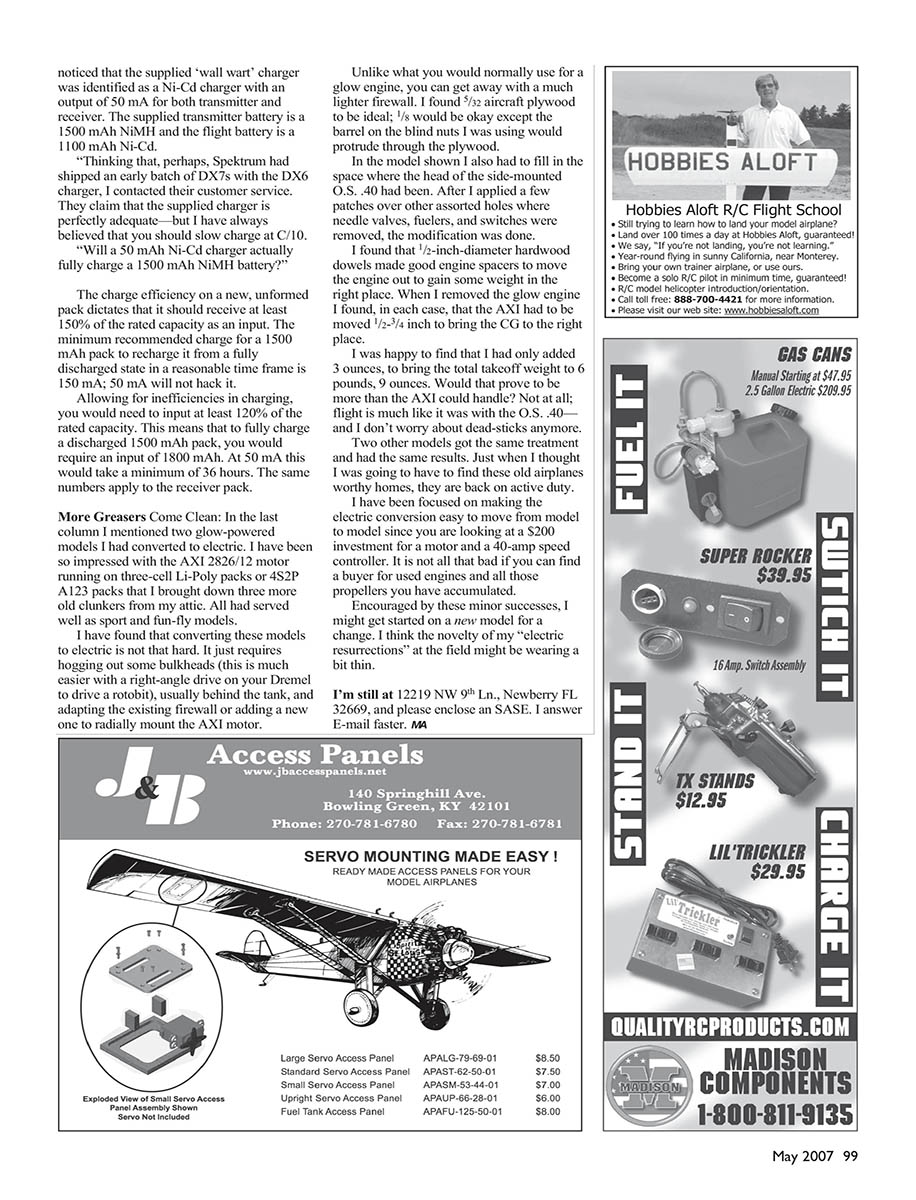
Charging these A123 packs presented a problem since the only charger was the one offered by A123Racing, and the company did not address pack configurations we find useful in electric-powered flight. Fortunately at least three charger vendors have stepped forward to provide the charge algorithm needed for the A123 packs.
- Tejera Microsystems Engineering's Xtrema is the first to address these cells, providing the programming capability to set the end-of-charge voltage to the required level.
- FMA Direct has modified its popular Cellpro balancing charger for the 3.6-volt/cell cutoff required and will update your Cellpro for a modest amount.
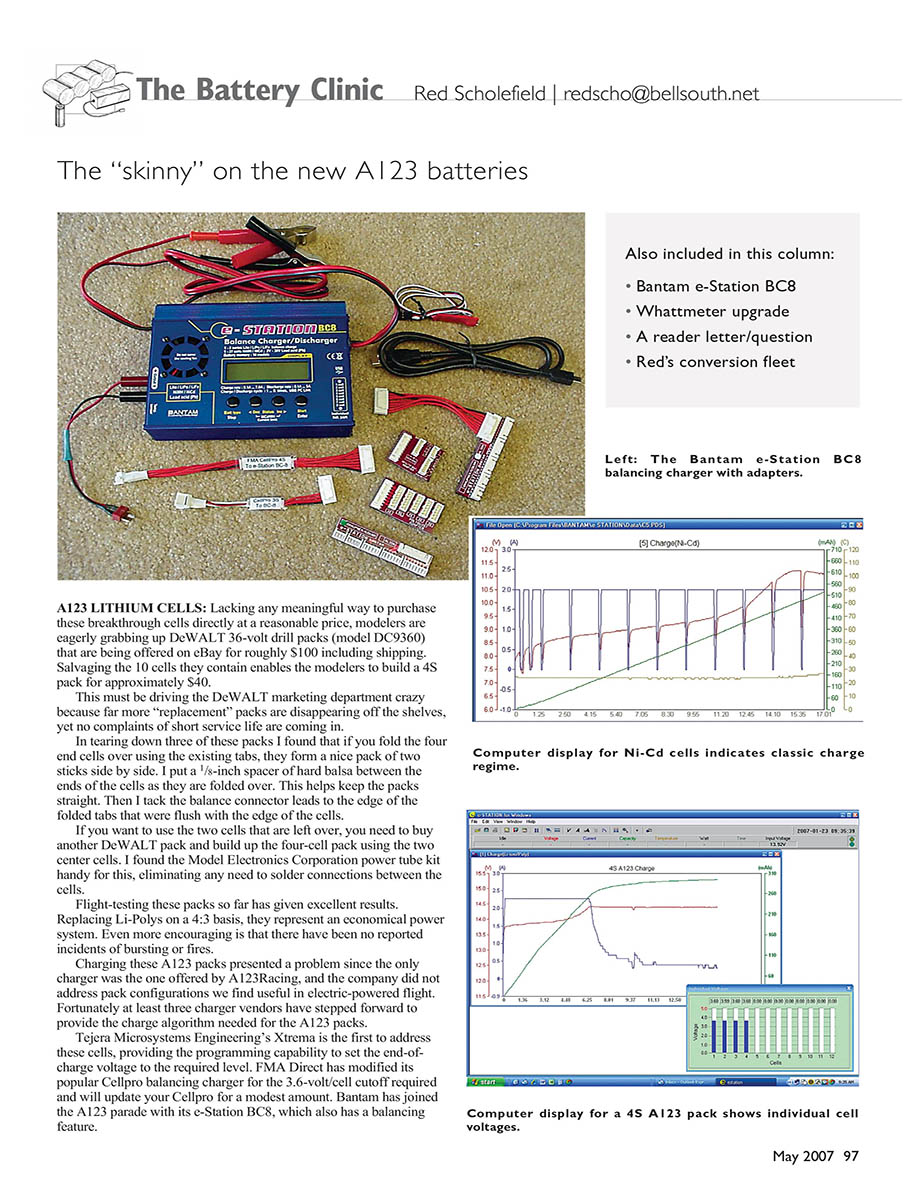
- Bantam has joined the A123 parade with its e-Station BC8, which also has a balancing feature.
Sid Kauffman of SLK Electronics (originator of the LiPoDapter, which is now available for A123 packs) wrote the following about A123 (M1) vs. eMoli cells:
"I see the eMoli as Li-Poly in a steel can. They don't have the discharge capability of good Li-Poly and with a significant weight penalty. I have also done enough stupid things to the M1 (as well as Li-Poly) to know that the M1 are way more tolerant of abuse.
"The eMoli weighs 3.5 ounces vs. 2.5 ounces for the M1. Agreed there's more energy there, but the discharge is limited.
"Can the eMoli be charged in less than an hour? The M1 can be charged in 15 minutes or less.
"Extracting eMoli cells from Milwaukee power packs is a real pain; sticky junk all over. The DeWALT packs come apart cleanly."
I have passed 75 charge/discharge cycles on my 4S A123 packs, and there is no sign of performance degradation.
Bantam e-Station BC8
Responding to the need for balancing packs along with addressing the A123 Lithium cells, Bantam is offering its BC8. At a price of $269.95 it covers the popular Li-Poly packs and A123 packs up to eight cells, Ni-Cd/NiMH to 27 cells, and Lead Acid up to 36 volts. The charge-power limit is 150 watts, and the cycling (one to five cycles) and discharge capability is up to 25 watts.
The BC8 unit is housed in a substantial aluminum case with rubber standoff feet. As are most chargers, it is operated from any 10- to 15-volt DC source. Charge leads connect by way of banana jacks, and there is a nine-pin socket for the balancing function. Adapters are available to interface with nearly all the popular Li-Poly pack offerings.
Supported packs/brands I verified include:
- Align
- E-flite
- Kokam
- Graupner
- MPX
- Thunder Power
- Poly-Quest
- Electric Power
- EVO
Watch the polarity on some adapters — I had to make my own adapters for the Cellpro balancing plug. If your particular pack is not covered, Bantam provides an open-ended wiring harness to enable you to make your own adapter.
Features:
- Stores up to 10 battery programs for retrieval
- Simple four-button programming and operating system with variable-brilliance backlit display
- Can monitor and balance individual cells of the Lithium battery pack during discharge and charge
- 20-page instruction manual supported by a flowchart; downloadable PDF available from RC Accessory
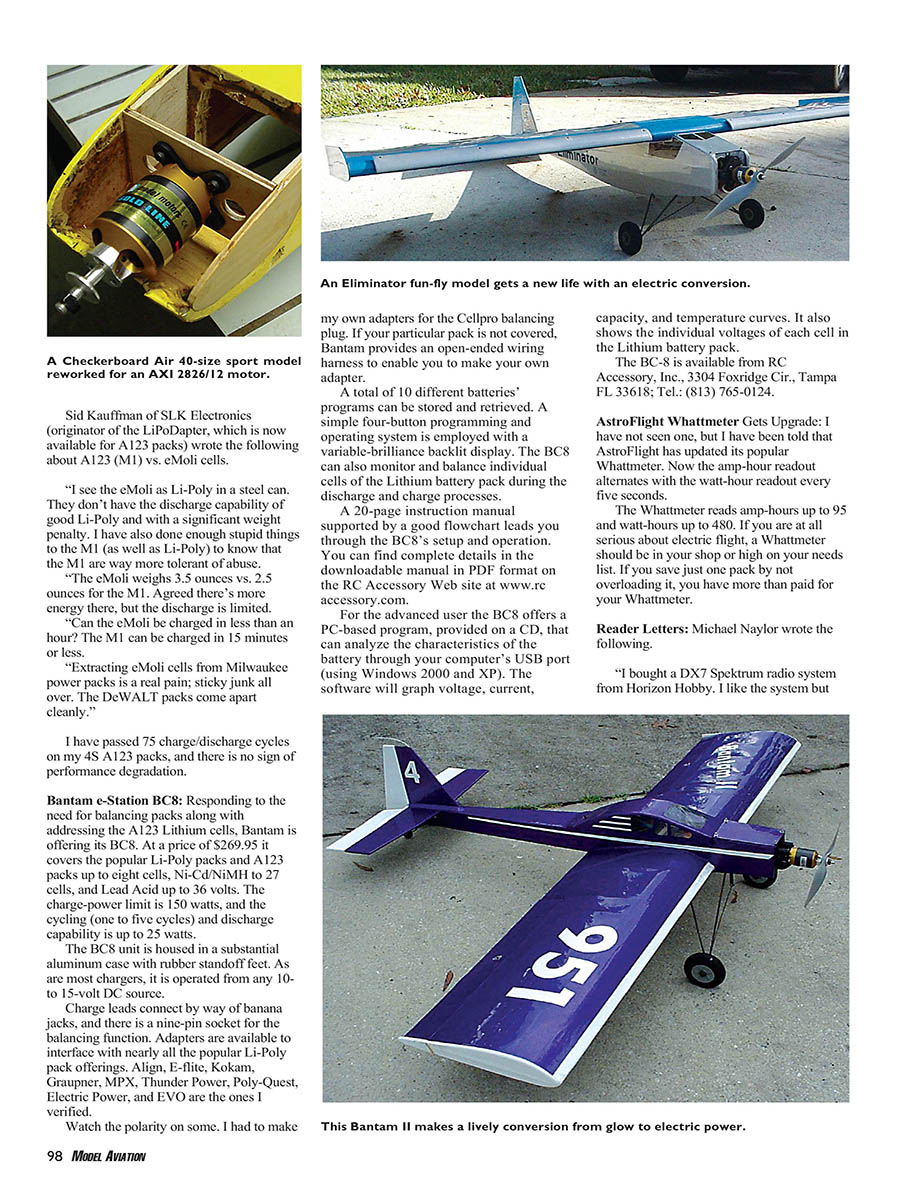
- PC-based program (on CD) for Windows 2000/XP that analyzes battery characteristics via USB, graphs voltage/current/capacity/temperature, and shows individual cell voltages during discharge/charge
The BC8 is available from RC Accessory, Inc., 3304 Foxridge Cir., Tampa FL 33618; Tel.: (813) 765-0124.
AstroFlight Whattmeter Gets Upgrade
I have not seen one, but I have been told that AstroFlight has updated its popular Whattmeter. Now the amp-hour readout alternates with the watt-hour readout every five seconds.
The Whattmeter reads amp-hours up to 95 and watt-hours up to 480. If you are at all serious about electric flight, a Whattmeter should be in your shop or high on your needs list. If you save just one pack by not overloading it, you have more than paid for your Whattmeter.
Reader Letters
Michael Naylor wrote the following:
"I bought a DX7 Spektrum radio system from Horizon Hobby. I like the system but noticed that the supplied 'wall wart' charger was identified as a Ni-Cd charger with an output of 50 mA for both transmitter and receiver. The supplied transmitter battery is a 1500 mAh NiMH and the flight battery is a 1100 mAh Ni-Cd.
"Thinking that, perhaps, Spektrum had shipped an early batch of DX7s with the DX6 charger, I contacted their customer service. They claim that the supplied charger is perfectly adequate — but I have always believed that you should slow charge at C/10.
"Will a 50 mA Ni-Cd charger actually fully charge a 1500 mAh NiMH battery?"
Response:
The charge efficiency on a new, unformed pack dictates that the full charge be at least 150% of the rated capacity as an input. The minimum recommended charge for a 1500 mAh pack to recharge it from a fully discharged state in a reasonable time frame is 150 mA; 50 mA will not hack it.
Allowing for inefficiencies in charging, you would need to input at least 120% of the rated capacity. This means that to fully charge a discharged 1500 mAh pack, you would require an input of 1800 mA. At 50 mA this would take a minimum of 36 hours. The same numbers apply to the receiver pack.
More Greasers Come Clean
In the last column I mentioned two glow-powered models I had converted to electric. I have been so impressed with the AXI 2826/12 motor running on three-cell Li-Poly packs or 4S2P A123 packs that I brought down three more old clunkers from my attic. All had served well as sport and fun-fly models.
I have found that converting these models to electric is not that hard. It just requires hogging out some bulkheads (this is much easier with a right-angle drive on your Dremel to drive a router), usually behind the tank, and adapting the existing firewall or adding a new one to radially mount the AXI motor.
Unlike what you would normally use for a glow engine, you can get away with a much lighter firewall. I found 5/32 aircraft plywood to be ideal; 1/8 would be okay except the barrel on the blind nuts I was using would protrude through the plywood.
In the model shown I also had to fill in the space where the head of the side-mounted O.S. .40 had been. After I applied a few patches over other assorted holes where needle valves, fuelers, and switches were removed, the modification was done.
I found that 1/2-inch-diameter hardwood dowels made good engine spacers to move the engine out to gain some weight in the right place. When I removed the glow engine I found, in one case, that the AXI had to be moved 1/2–3/4 inch to bring the CG to the right place.
I was happy to find that I had only added 3 ounces, to bring the total takeoff weight to 6 pounds, 3 ounces. Would that prove to be more than the AXI could handle? Not at all; flight is much like it was with the O.S. .40 — and I don't worry about dead-sticks anymore. Two other models got the same treatment and had the same results. Just when I thought I was going to have to find these old airplanes worthy homes, they are back on active duty.
I have been focused on making the electric conversion easy to move from model to model since you are looking at a $200 investment for a motor and a 40-amp speed controller. It is not all that bad if you can find a buyer for used engines and all those propellers you have accumulated.
Encouraged by these minor successes, I might get started on a new model for a change. I think the novelty of my "electric resurrections" at the field might be wearing a bit thin.
I'm still at 12219 NW 9th Ln., Newberry FL 32669, and please enclose an SASE. I answer E-mail faster.
RS
Transcribed from original scans by AI. Minor OCR errors may remain.

