


The Battery Clinic
Red Scholefield
Red answers a reader's letter about Li-Poly shelf life
Also included in this column is information about:
- Required battery capacity for your model
- Why commercial Li-Poly applications have fewer problems
- Answers to other reader questions
- How to make your Ni-Cd charger compatible with Li-Polys (really!)
- The scene at the Southeast Electric Flight Festival (SEFF)
THIS STARTS my second month of writing this column, and I thought I wouldn't have any input from readers yet—generally a source of "inspiration" for many columnists. Much to my surprise, I received a letter forwarded from the MA staff. Since the question is rather general in nature—and the sender neglected to enclose an SASE—I'll answer it here.
Do Li-Polys get moldy? Mort B. asked about Li-Poly shelf life. He noticed a problem after roughly 18 months of use, and having inventoried more batteries of the same vintage, he found them also lacking in performance. Some leaked, and there was some swelling and reduced capacity.
He related that his average discharge was 2 amps or less (using 400 mAh cells) and that he had charged them properly. This equates to a 5C discharge for a 400 mAh pack—more than some of the older Li-Poly designs were happy with.
Mort, you are facing a plethora of problems. Lithium technology is changing so fast that you have put yourself way behind the curve by trying to inventory cells for more than a year.
According to manufacturers, Li-Poly packs should be stored roughly 50%-70% charged. They should be stored in the refrigerator (not the freezer).
The packs should be looked at every six months to see if the voltages are up to 3.4–3.7 volts. If not, give them a little charge to bring them up to this level. They have excellent charge retention but can still lose capacity just sitting for long periods. That might account for the leaking and swelling you noted as the cells dropped to less than the minimum 2.5 volts.
It would have been nice to know what voltage these did read when you took them out of storage. You wrote that you had approximately 18 months of service on the other packs. This could add up to a large number of cycles or very few.
Whenever you are trying to define a problem, try to give more detail. It really helps the diagnostics.
Did you, at any time during the 18 months of use, look at the individual cell voltages in the pack? If cells get out of balance (differ in voltage by more than 10 millivolts) during use, subsequent charge/discharge cycles can wreak havoc on the pack if the pack is used and recharged regularly. The pack will tend to self-balance during repeated use. Trouble comes when one cell is weak and the others are strong; the weak cell will be driven into deep discharge repeatedly and will fail prematurely.
How much battery do I need for my model? This question comes up repeatedly.
The answer becomes obvious for electric flight. If your flights are too short or lackluster, you need more capacity or more cells or both. Learning the limits your battery imposes upon your radio-system flight time demands a bit more exacting answer. Essentially you want to know your battery’s “miles/gallon”—or in more precise battery terms, “minutes/ampere hours.”
With glow or gas, this is a matter of seeing how much you have remaining in the tank after flying so many minutes. The same holds true for your “ampere-hour tank”—except you need some means for looking at it.
Those who have been involved in RC long enough to have consumed a gallon of fuel should have some means of looking at what’s left in the tank—a cycler—which usually costs less than one wipeout from outlying your battery capacity.
Once you can check the remaining capacity and you note how long the transmitter/receiver were on, some deft arithmetic will answer the question of how much battery you need for that specific setup. Details are addressed at “The R/C Battery Clinic” at www.rcbatteryclinic.com. If you want a hard copy, send me an SASE at 12219 NW 9th Ln., Newberry FL 32669.
Of course you can cheat a bit and observe what your flying buddies are using with a similar setup. It might be prudent not to follow too closely those with such nicknames as “Crash,” “Lucky,” “Smoking Crater,” or something similar.
How do they get away with it? With all the horror stories about Li-Poly conflagrations of the worse sort, some have asked how these cells can be used so widely in cell phones, laptops, and other consumer devices. Why aren’t there more incidents?
I’ve torn open a laptop pack to answer your question. A photo shows a 14.4-volt, 2600 mAh Sanyo pack. Look at the circuitry employed to control the charge/discharge of the pack. Also shown is even more on the end of the pack. This is complex circuitry that will not allow any abuse of the pack. If you have priced a laptop battery pack lately, you can see what safety costs.
When charged (sans all the electronic gadgetry), these cells (the pack had been discarded because it would no longer operate the laptop for a reasonable amount of time) gave a respectable amount of capacity: 85% or more. I wonder if the consumer devices are designed to sell replacement batteries at exorbitant prices.
Our Li-Poly hobby-market suppliers are doing everything they can to make the packs as safe as possible, yet not compromise their performance or your pocketbook. Look for more improvements in the coming months.
More Good Questions: The following are answers to inquiries posted to The R/C Battery Clinic online forums.
Al R. wanted a way to charge the two Ni-Cd 7.2-volt car packs he was going to use with his Sullivan starter. (This makes for a great combination by the way, giving you peppy starts with the inherent safety of being cordless; there is no cord to snag a propeller.) He wrote:
“I have several DeWALT 14.4 drill pack chargers (unfortunately I don’t have any spec for the charger). Can I connect the series packs to the DeWALT charger and have it work properly and safely? (It charges the DeWALT drill batteries in about 15 to 20 minutes and then goes to a trickle charge.)”
Using your old charger depends on what kind of charge termination it employed. Some used a thermal sensor, either as a primary termination or a backup in case the primary (peak detection) failed to terminate the charge. Twenty minutes is an aggressive charge rate, and things could get messy if the charge termination were to fail.
Some power-tool chargers had the thermal sensor in the charge socket and others depended on a thermal device in the battery pack itself or were simply peak-detection chargers. A thermal sensor internal to the battery pack is usually indicated if there are three terminals on the pack.
I would connect the packs (making sure both are fully discharged down to at least 6 volts at a fairly low discharge rate) in series and then to the charger. I would watch the packs during the charge period, monitoring their temperature. They should get quite warm as the charge is completed, but not hot, if everything is working okay. If the charge terminates normally, it is a voltage-sensing termination scheme rather than thermal, and you are in business.
If you have any of your old drill packs around, tear one down to see if there is a thermal sensor in it. This could be used with your two six-cell packs, placing it between the packs if they are configured that way.
Try to position the sensor so that it is actually touching the cells somewhere in the middle of the pack (what you would think of as the center of thermal mass). You should end up then with a three-wire charge cord.
Check your local electronic surplus store. Look for a wall-wart charger with a 12- to 15-volt DC, 100-180 mA output. (This is usually indicated someplace on the charger.) This will provide you with a usable slow charger and won’t be nearly as hard on the battery packs.
No matter what you come up with, keep your eyes open at swap shops, etc. for one of the old Ace HD500 Verichargers. These are wonderful little units that allow you to set a charge rate up to 500 mA, enabling you to charge anything up to a 5 Ah Ni-Cd/NiMH pack of roughly 16 cells.
The Battery Clinic
Red Scholefield
An adapter to make your trusty Ni-Cd charger compatible with Li-Polys? You jest! Not really. A prototype device from Sid Kaufman (of SLK Electronics, makers of the ElectriCalc) that found its way to the battery lab does just that.
The LiPoDapter connects between your Li-Poly pack and almost any charger with output voltage and current needed for the cells you want to charge. It conservatively counts the number of cells (it's good for two to six cells and can handle as many as 5 amps but will not accommodate a single cell for balance charging if needed), allowing you to bump it up if it counts low (never counts high).
While you are setting it up, a green LED blinks the number of cells. If this is correct, you hold down the program button for five seconds until the red LED comes on, blinking the number of cells to confirm your setting and indicating that it is connected to the charger. Then you set your charger to the desired charge current. When the red LED stops blinking and the green LED comes on, the charge is complete and the charger is disconnected.
The device worked on any charger I had in my collection—even the Alpha 4 (on N function). The test version was packaged in 6-mil clear heat shrink.
The units tested do have a drawback. The LiPoDapter has what would be called a hard cutoff once it reaches the cutoff voltage. If you are charging at higher rates, such as the 1C recommended by most manufacturers, the LiPoDapter charges the pack only approximately 70%.
Most Li-Poly chargers employ a tapering current as they approach cutoff—what would be termed a soft cutoff. You will get to a higher level of charge if you use a lower charge current, but that will take some time.
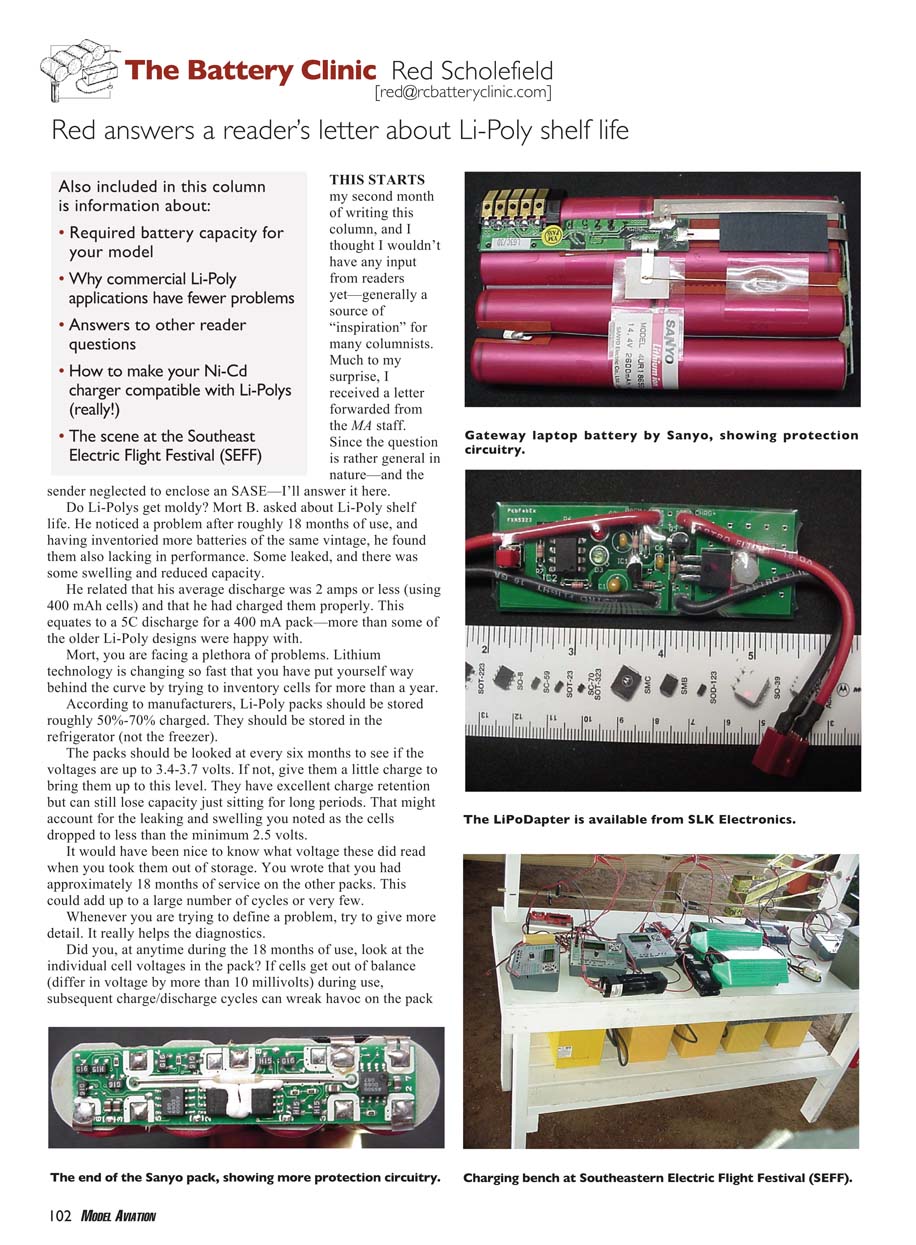
The SEFF Event: At this event, held in Americus, Georgia, April 21-24, AstroFlight 109s dominated the Li-Poly charger scene, with a fair showing of Tritons and Orbit Microdals. Shown is a bench full of chargers fed by forklift batteries connected in parallel to 1/2-inch-diameter copper buss bars.
I know it’s RC Electrics columnist Greg Gimlick’s territory, but I have to share a couple of models with you from SEFF. Shown is a Spruce Goose with eight motors. As I recall, it spanned 52 inches. What’s next, a Dornier Do X with six motors pulling and six pushing?
The Sikorsky S-39 (from Classic Aero) was beautiful. There was no ugly cylinder or muffler to hide.
I’m sorry, but I didn’t get the builders’ names or the details. There were more than 300 modelers at this event, and I had to talk with them all.
I Won’t Ignore Old Friends: Although we have had nearly 50 years of RC (egads, has it been that long?) during which to get comfortable with the care and feeding of Ni-Cds and more than a decade with NiMH cells, there are still those who could be charged with criminal abuse of batteries if it were a felony. I’ll try not to let Lithium technology push these old standbys off the pages, so you can expect occasional sermons addressing old sins committed by newer modelers.
Confessions are welcome, regardless of the technology sinned against. If you want a personal, behind-the-curtain answer, please E-mail me. If you must snail-mail, send an SASE. (With the price of postage, that’s enough electricity to run a charger for 500 hours or more. There’s an exercise for the student; you might want to check my math on this one.)
I’ll be here in alternating months. Keep those cards and letters coming. I’ll answer them personally or here if they are of general interest (or if I get desperate for filler). Send an SASE for snail-mail answers; E-mail is free! MA
Transcribed from original scans by AI. Minor OCR errors may remain.

