

The Battery Clinic
Red Scholefield | [email protected]
A reader asks how to convert his Sullivan starter to a cordless unit
I can't believe this is the start of my second year writing this column, but thanks to you readers I'm still here. I figured by now every modeler in the free world would have had his or her fill of battery lore.
Although our AMA membership has not reflected it yet, there seem to be many new modelers on the block who are anxious to learn how to care for their batteries. I hope my contribution here and those of other MA writers will be the motivation necessary to bring these new modelers into the fold.
A reader wrote:
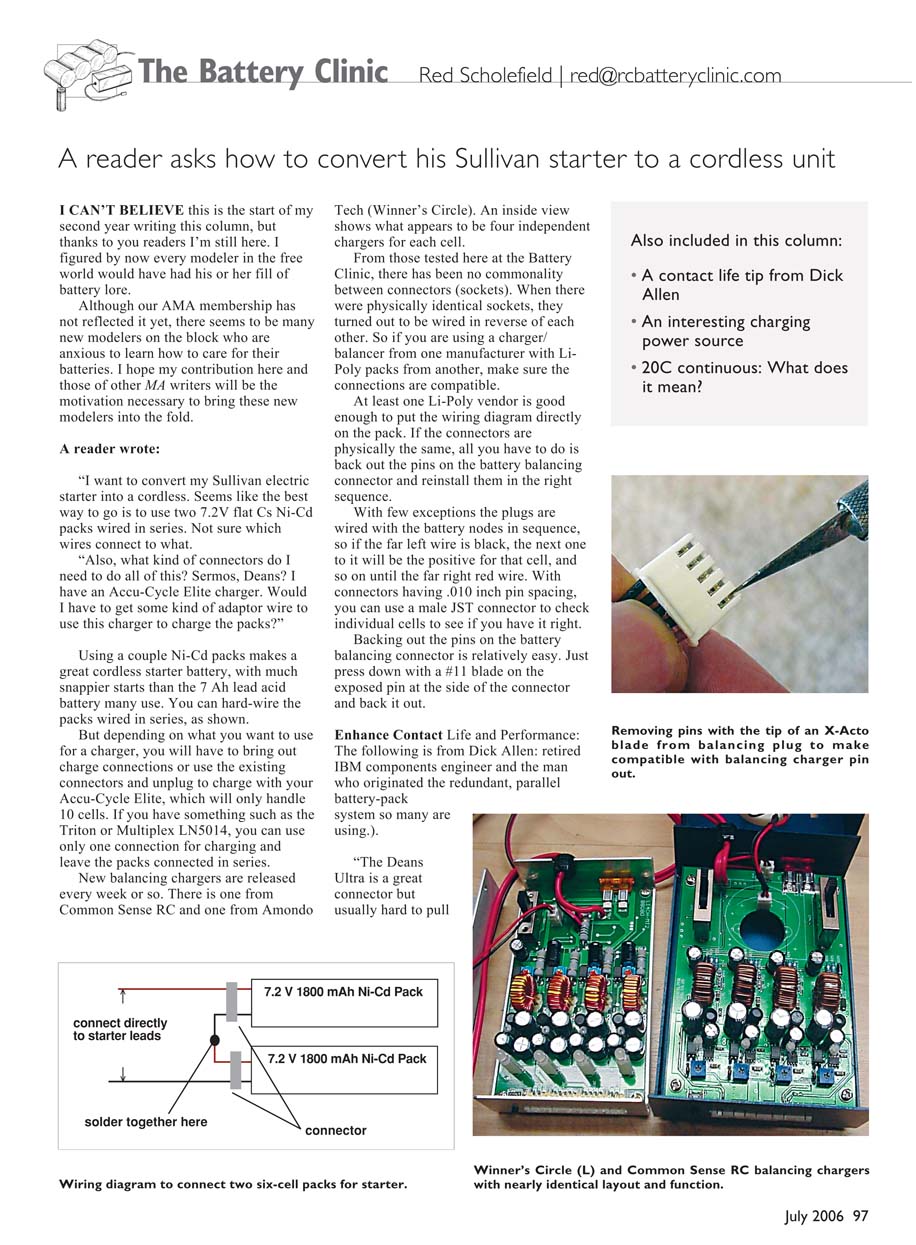
"I want to convert my Sullivan electric starter into a cordless. Seems like the best way to go is to use two 7.2V flat C's Ni-Cd packs wired in series. Not sure which wires connect to what.
"Also, what kind of connectors do I need to do all of this? Sermos, Deans? I have an Accu-Cycle Elite charger. Would I have to get some kind of adaptor wire to use this charger to charge the packs?"
Using a couple of Ni-Cd packs makes a great cordless starter battery, with much snappier starts than the 7 Ah lead-acid battery many use. You can hard-wire the packs in series.
But depending on what you want to use for a charger, you will have to bring out charge connections or use the existing connectors and unplug to charge with your Accu-Cycle Elite, which will only handle 10 cells. If you have something such as the Triton or Multiplex LN5014, you can use only one connection for charging and leave the packs connected in series.
New balancing chargers are released every week or so. There is one from Common Sense RC and one from Amondo Tech (Winner's Circle). An inside view shows what appears to be four independent chargers for each cell.
From those tested here at the Battery Clinic, there has been no commonality between connectors (sockets). When there were physically identical sockets, they turned out to be wired in reverse of each other. So if you are using a charger/balancer from one manufacturer with Li-Poly packs from another, make sure the connections are compatible. At least one Li-Poly vendor is good enough to put the wiring diagram directly on the pack. If the connectors are physically the same, all you have to do is back out the pins on the battery balancing connector and reinstall them in the right sequence.
With few exceptions the plugs are wired with the battery nodes in sequence, so if the far-left wire is black, the next one to it will be the positive for that cell, and so on until the far-right red wire. With connectors having .010 inch pin spacing, you can use a male JST connector to check individual cells to see if you have it right. Backing out the pins on the battery balancing connector is relatively easy. Just press down with a #11 blade on the exposed pin at the side of the connector and back it out.
Enhance contact life and performance
The following is from Dick Allen: retired IBM components engineer and the man who originated the redundant, parallel battery-pack system so many are using.
"The Deans Ultra is a great connector but usually hard to pull apart. This can be cured by putting a small amount of petrolatum ('Vaseline'—petroleum jelly) on the male contacts, then wiping it off with a clean, lint-free cloth. The amount left will be just right.
"This will not affect the contact resistance at all but will greatly reduce the insertion/retraction force. It will also substantially reduce gold plating wear.
"Incidentally, I ran tests at IBM years ago in which petrolatum performed much better than other more expensive contact lubricants and was subsequently used on millions (probably billions) of critical IBM connector contacts."
Automotive jump-starter units as a charging source
Automotive jump-starter units make a good charging source. Some modelers have been using the automotive jump starters from auto-supply stores (that cost roughly $35) to power their Li-Poly chargers. They weigh approximately 12 pounds and have a built-in self charger, handle, and a 12-volt outlet.
The one I looked at (and bought at The Home Depot) had a 17 Ah lead-acid gel cell in it. The price of one of these cells is nearly as much as the whole jump-starter unit.
When using these at home in the workshop as a power supply, is it okay to charge it while using it to power a charger such as the Triton? Yes; the battery smoothes out all the pulses from the charger.
20C continuous: What does it mean?
And now to open Pandora's Box; in this case Pandora is the way Li-Poly vendors are rating their packs. It seems that nearly all are specifying some continuous discharge rate along with a burst rate.
I suspected these a little, particularly when they state 20C continuous. So far I have not found a single one (of the half-dozen different vendors) that can give 20C continuous without seriously compromising performance and cycle life.
If the pack temperature goes much above 140 degrees Fahrenheit, salting starts internal to the pack and capacity on subsequent discharges is significantly compromised. If the pack exceeds 160 degrees Fahrenheit, you are in a danger zone.
Coincident with these high temperatures, we see a dip in the discharge curve as the pack heats up. This dip is also coincident with deterioration of the pack, so you know from the discharge curve when you are approaching the danger zone.
After discussing this with several vendors, it became clear that they had no idea what 20C continuous would do to the pack—only that their supplier had shown them a curve at 20C. This was for one cycle—nothing about subsequent cycles at that rate. Few had actually tested them in this range, much less run any cycle life testing.
When questioned about what exactly defined the burst rate—how long a duration—again, the deer-in-the-headlights look. Isn't it strange that the 20C continuous and 30C burst happens to be on nearly all the packs offered when they come from a variety of cell manufacturers, mostly in China?
While working in that part of the world I discovered that when I asked a technical question I would usually get a "yes" in response. What you soon discover is that "yes" means they heard the question. It does not mean they agree with you. So if you like soft-shoe routines, your Li-Poly supplier will give you one that will rival the best vaudeville act ever when you start probing its Li-Poly claims.
There may be light at the end of the tunnel; at least one Li-Poly vendor is trying to make sense of this wild rating system. That will have some meaning and give us an indication of what we can expect in the way of cycle life from these products.
When you consider that we have been rating (and derating) rechargeable batteries for a half century, you have to wonder why the Li-Poly gang has taken such an off-the-wall approach when simply stating the internal resistance and cycle life as a function of discharge rate would make things easier for all.
If running your packs at 8–10C and balancing them occasionally meets your needs, you should enjoy a fairly good cycle life. If, on the other hand, you are into F5B "rocketry" with a 45-second run time for a complete capacity dump and you can live with four or five cycles of life, so be it. But you should know going in what the consequences are.
So how do you determine a pack's internal resistance? The same way it has been done for years in the battery industry. You measure current and voltage at two different levels, and the change in voltage divided by the corresponding change in current gives you the internal resistance.
From this you will have a good idea of how your performance suffers as you push the packs at higher rates. And the current multiplied by the internal resistance gives you the watts the pack will have to dissipate in heat.
Once I get the new 500-watt discharge unit promised by West Mountain Radio, I should be able to run high-rate discharge cycles and provide some meaningful data on lithium packs.
Vintage Radio Control Society (VR/CS)
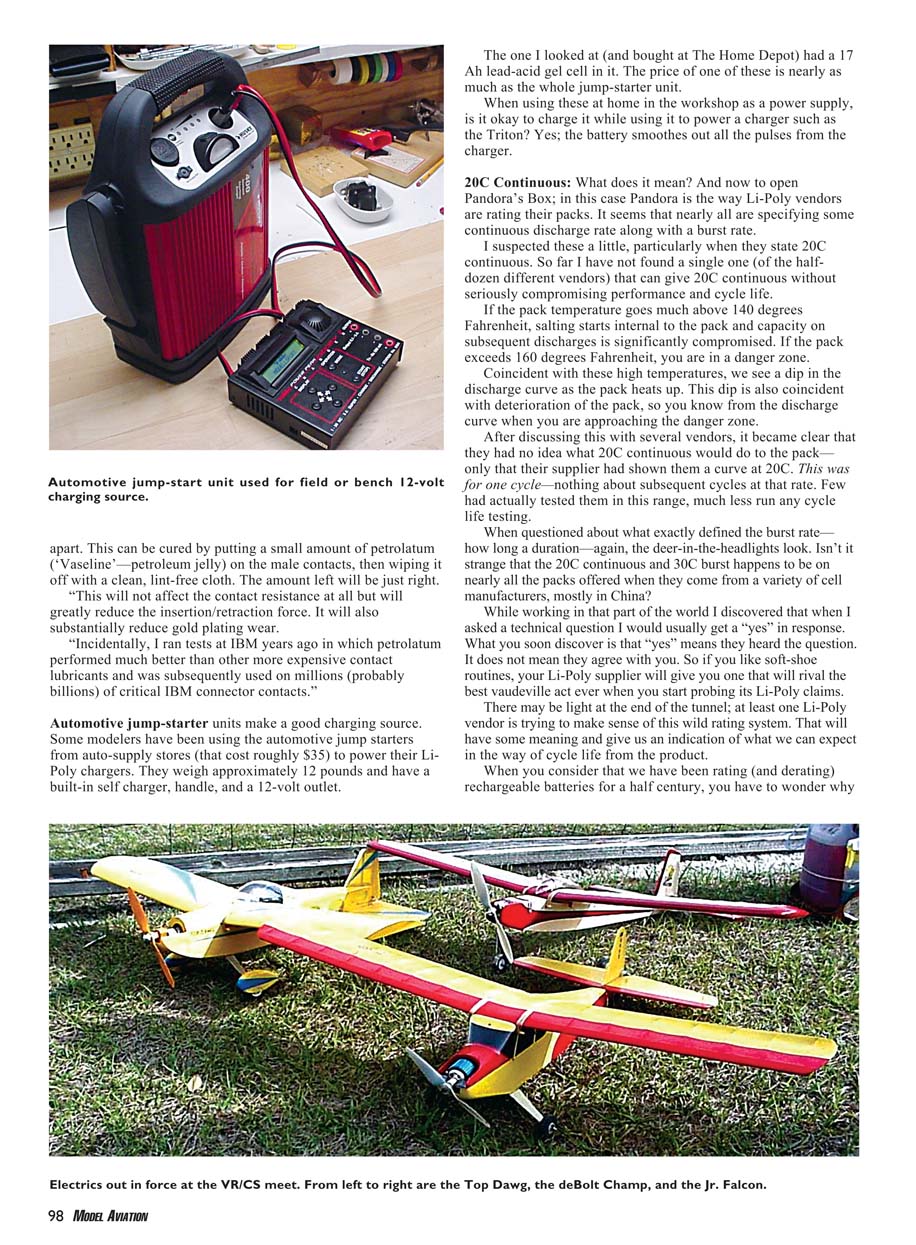
To give more weight to Dave Brown's statement (in the April 2006 MA) regarding the growth of electrics, the VR/CS meet I attended in Spring Hill, Florida, in March had a record number of vintage models flying with electric power. I would guess that at least half of the entries were electric powered. Old dogs do learn new tricks.
I've got some battery testing to do at the field. Fly safe. I'll be back to you in the September issue, hopefully with some hands-on information about the FMA Direct Cellpro lithium charge/balancing system that is replacing the BalancePro.
You can send mail to me at 12219 NW 9th Ln., Newberry FL 32669. Please include an SASE if you want a reply. MA
Transcribed from original scans by AI. Minor OCR errors may remain.

