

Strip, solder, insulate; strip, solder, insulate
Red Scholefield | [email protected]
Also included in this column:
- Your wattmeter lies!
- FMA Direct Cellpro 4s Charger
- LipoSack fire‑retardant fabric charging pouch
Safety: one lead at a time
I get many questions from people who want to build or rebuild their own battery packs. The fact that they are asking basic questions that anyone delving into this should already know is kind of scary.
When you are working with a battery, be it Ni‑Cd, NiMH, or Li‑Poly, there is a finite amount of energy you have to deal with. Although you might only get a small burn, shorting any lithium battery even for a few seconds can heat the tabs enough to ruin a pack or start a fire.
If you are going to do battery‑pack surgery, connect only one battery lead at a time to prevent a short. Strip one lead, solder it to the connector and battery, and insulate. Repeat with the remaining battery leads. It will save you considerable heartburn, not to mention more serious kinds of burns.
Your wattmeter lies!
From time to time I run into people who overprop their electric‑powered aircraft, thinking that if they never use full throttle they will not exceed the system's limits. If you understand how an ESC works, you'll quickly see the fallacy.
An ESC switches the power on and off at a high rate, varying the width of the pulses to achieve speed control. The on time can vary from 100% on to full off. An intermediate throttle setting is some percentage of this pulse width, but the peak current during the on pulses remains the same as at full throttle.
If your wattmeter reads 20 amps at full throttle, it will indicate something less at an intermediate setting, lulling you into thinking you are not overstressing the battery. The wattmeter is averaging the current while the peaks remain at 20 amps. Regardless of the duration of these pulses, they are always at the maximum full‑throttle current, essentially hitting your battery, ESC, and motor with potentially destructive over‑spec current pulses, regardless of the throttle setting.
If you persist with this setup you can seriously reduce the life span of the pack, ESC, and motor. One solution is to propeller down so that the maximum current does not exceed the rating of the battery or ESC. This will make your whole system much happier: the motor will run at higher efficiency and cooler, deliver more rpm because you are not loading the pack as heavily, and the ESC will have longer life from not being overstressed.
Fortunately, the days when you have to wring every last bit out of the system to get acceptable performance are coming to an end. Off‑the‑shelf electric‑flight components operated within their spec limits now give you all the adrenalin rush you need.
FMA Direct Cellpro 4s Charger
Balance, balance, balance is all we hear. A real lithium pain reliever is ready: FMA Direct has one heck of a product in the Cellpro 4s Charger. I was lucky enough to evaluate a preproduction unit.
With the Cellpro there is no more remembering blinking and beeping or just taking a black box's word for it. I added banana plugs to the power lead as soon as I got the unit since I'll probably use it more in the shop where there are several 12‑volt outlets (banana jacks). You can rig a cigarette‑lighter plug to match the banana plugs by using a 7/8‑inch section of 3/16‑inch outside‑diameter thin‑wall brass tubing and insulating with heat shrink (red + and black − please). It's a good idea to take a banana plug to the hobby shop to make sure you get the right size.
To quote a popular TV commercial, the operation is so simple that even a caveman could do it. There is polarity protection when needed. There are no knobs to turn or buttons to push—only one button to manually set the charge rate if you don't use Auto mode. This same button lets you scroll through displays showing percentage charged, charge rate, capacity input, source voltage, and individual cell voltages during charging and balancing. It brings lithium charging for the modeler to the same safe level enjoyed by cell phone and laptop users.
I was so impressed with the simplicity that I modified every lithium pack I have to take advantage of the Cellpro, either adding the appropriate connector or making adapters.
The eight‑page instruction manual, apparently written by someone who has actually used the charger, is a gold mine of information—particularly the section on estimating performance factors. Charger viewer software is a free download from FMA Direct (www.fmadirect.com), though you don't need to hook the unit to a computer to use it. The option is nice for techies who want to view charge graphs and store data.
Adapters and connectors
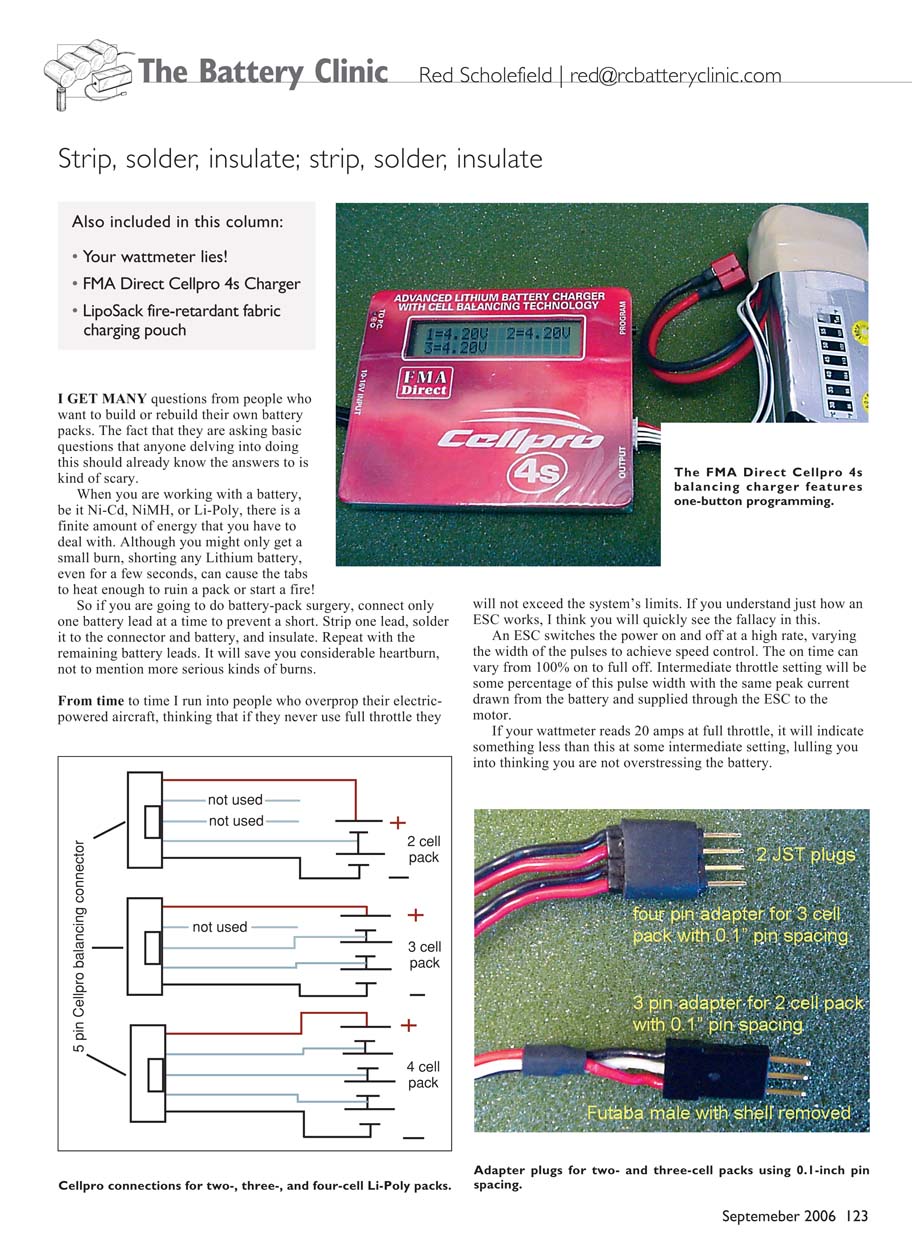
Making the adapters you might need requires understanding the pin arrangement FMA Direct uses in the Cellpro. It starts at the left side of the connector with the most negative lead, adding nodes with the next pin being the connection between the most negative cell and its neighbor. It moves along until the positive of the most positive cell in the string is the red lead.
All the nodes are connected for a four‑cell pack. For a three‑cell pack the node next to the most positive is omitted; a two‑cell pack eliminates that node and the one next to it. (See the photo in the manual.)
Many other brands use only three‑ or four‑pin connectors—no pins omitted—so if you are trying to connect to the Cellpro you have to pick up the right nodes. If that isn't complicated enough, there are at least two different pin spacings: some packs use 0.1‑inch centers and others use 2 mm.
On the ones with 0.1‑inch spacing you can make a matching plug for two‑cell packs using the inner part of a Futaba male connector (without the outer shell). This gives you the three pins you need and fits perfectly in the battery connector. A pair of JST connectors cemented together edgewise gets you a compatible four‑pin connector—slip a piece of heat shrink over it to make it neat. I made this using one Cellpro connector Y'd into three‑ and four‑pin connectors. (For the cavemen: don't hook up two packs at once.)
FMA Direct simplifies this by offering the Cellpro to Thunder Power/Poly‑Quest Adapter (item CP‑TP/PQ, $14.95), which has six sockets to accept other brands of two‑, three‑, and four‑cell packs. The company also sells the female balancing connector used on its packs so you can retrofit your existing packs.
You can find Jim Young's in‑depth review of the Cellpro at www.rcgroups.com/links/index.php?id=4994. My prediction is that the Cellpro will blow away the lithium‑charger market. Make sure you order the adapter box if you are using packs with balance connectors other than the Cellpro.
Other balancing devices
For those who already have a healthy investment in lithium charging devices, a number of balancing gizmos are being offered. I had the opportunity to look at the AstroFlight Blinky and found that it performed as advertised.
Aptly named, the Blinky works individually to take all the cells to the same level or in conjunction with any non‑balancing charger. An adapter for 2 mm pin spacing is available. Plug the Blinky into the balance plug and connect the charger through the power plug.
I use it with the AstroFlight 109, which Astro Bob updated to eliminate a rare cell‑miscount problem (starting with a fully charged pack it could jump the count). An easy‑to‑install chip to take your 109 to version 1.7 is available from AstroFlight for $10. Bob also has upgrade chips for the 110 and 112 digital chargers.
LipoSack charging pouch
So you're not allowed to use the family Crock‑Pot as a lithium charging chamber? I noticed another take on Li‑Poly charging containers at the Southeast Electric Flight Festival.
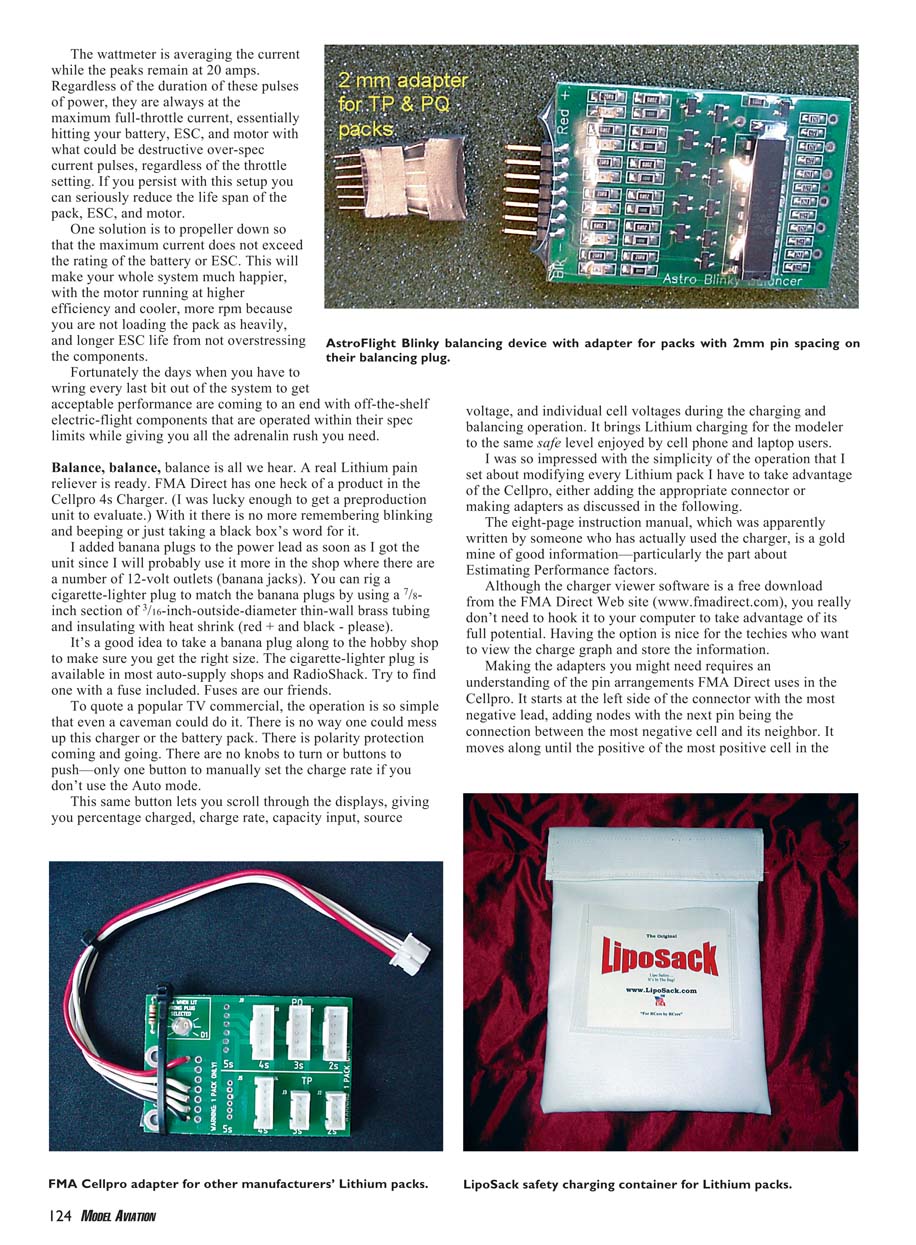
The LipoSack is a fire‑retardant, 9 x 12‑inch fabric pouch with a Velcro flap to seal it. This product retails for $29.95. Just pop in your Li‑Poly pack while it's charging. You can learn more and watch a demonstration video at www.liposack.com/index.html.
Closing and contact
I was going to give you a tour of The Battery Clinic lab, but I'm out of space already. Maybe I'll give it to you in the November issue, which you'll have time on a cold, blustery evening to digest.
I answer e‑mail fast. Mail to Newberry, Florida, is slower, but you can write me at:
12219 NW 9th Ln. Newberry, FL 32669
Please send an SASE if you want a personalized, autographed reply.
MA
Transcribed from original scans by AI. Minor OCR errors may remain.

