

A close look at some new Li-Poly balancing chargers
The Battery Clinic Red Scholefield | [email protected]
It seems that battery and charger items are landing at "The Battery Clinic" nearly every time the brown UPS truck passes. This month brings two more offerings with balancing capability and an exciting new battery that may tip the scales in electric vs. glow power.
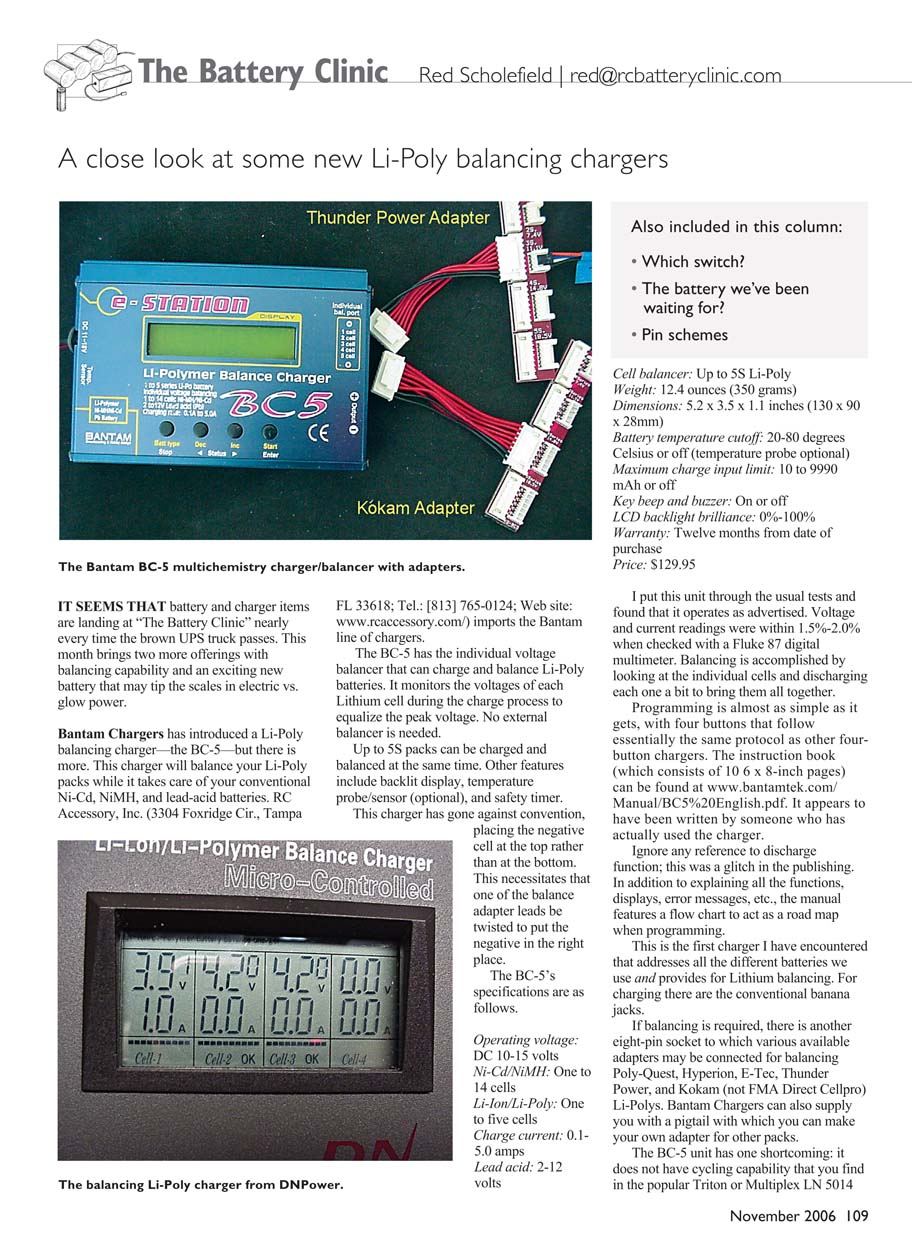
Bantam Chargers has introduced a Li-Poly balancing charger—the BC-5—but there is more. This charger will balance your Li-Poly packs while it takes care of your conventional Ni-Cd, NiMH, and lead-acid batteries. RC Accessory, Inc. (3304 Foxridge Cir., Tampa, FL 33618; Tel.: 813-765-0124; Web: www.rcaccessory.com) imports the Bantam line of chargers.
The BC-5 has an individual-voltage balancer that can charge and balance Li-Poly batteries. It monitors the voltages of each lithium cell during the charge process to equalize peak voltages. No external balancer is needed.
Up to 5S packs can be charged and balanced at the same time. Other features include a backlit display, optional temperature probe/sensor, and a safety timer. This charger has gone against convention, placing the negative cell at the top rather than at the bottom; this necessitates that one of the balance adapter leads be twisted to put the negative in the right place.
The BC-5’s specifications are as follows:
- Operating voltage: DC 10–15 volts
- Ni-Cd/NiMH: 1–14 cells
- Li-Ion/Li-Poly: 1–5 cells
- Charge current: 0.1–5.0 amps
- Lead acid: 2–12 volts
I put this unit through the usual tests and found that it operates as advertised. Voltage and current readings were within 1.5%–2.0% when checked with a Fluke 87 digital multimeter. Balancing is accomplished by monitoring the individual cells and discharging each one slightly to bring them all together. Programming is almost as simple as it gets, with four buttons that follow essentially the same protocol as other four-button chargers. The instruction book (10 pages, 6 x 8 inches) can be found at www.bantamtek.com/Manual/BC5%20English.pdf. It appears to have been written by someone who has actually used the charger. Ignore any reference to a discharge function; that was a publishing glitch. In addition to explaining all the functions, displays, and error messages, the manual features a flow chart to act as a road map when programming.
This is the first charger I have encountered that addresses all the different batteries we use and provides for lithium balancing. For charging there are conventional banana jacks. If balancing is required, there is another eight-pin socket to which various available adapters may be connected for balancing Poly-Quest, Hyperion, E-Tec, Thunder Power, and Kokam (not FMA Direct/Cellpro) Li-Polys. Bantam Chargers can also supply a pigtail so you can make your own adapter for other packs.
The BC-5 unit has one shortcoming: it does not have the cycling capability found in popular chargers such as the Triton or Multiplex LN 5014. If you feel you need a charger dedicated to a specific battery chemistry, XUS Hobby offers an alternative. XUS Hobby (www.xushobby.com) sent me one of its new Li-Poly balancing chargers by DNPower. The price is $85.95. You will find the same charger under at least two other labels: Common Sense R/C and Tenergy.
I was immediately impressed by the instrument's quality metal case and large display. This charger is almost as simple to use as you can get, which is fortunate because the instructions confused even me. The unit is essentially four individual chargers with currents adjustable from 200 mA to 2 A in 200 mA steps. Connect to your 12-volt source, set the charge rate, and hit the start button.
There are charge ports for one-, two-, three-, or four-cell packs, plus a screw-terminal five-pin connector block you can connect to your own adapter. Adapter cables are supplied for Thunder Power and Electric Power packs. The display gives you individual charge voltages and the status of each cell. You get cell-voltage readings, the charge current, and an "OK" indication when that cell is charged. Testing verified the current readings for each cell in a deliberately unbalanced pack.
Input and output have reversal protection. Considering the number of different balance-connector pinouts, this is essential. I let the smoke out of one balancing charger I was testing where the balance connector was physically compatible but wired in reverse.
I'm sure I'll get a number of questions, such as "How does this charger compare with the FMA Cellpro reviewed in the September column?" I found the cosmetics of the Cellpro's packaging, with overall clear heat shrink rather than a case, a bit on the cheesy side. It has many features including charge input with 1% accuracy, state-of-charge (fuel gauge) accurate to 5%, charge time, 10 mV voltage display accuracy, and PC viewer software, all at a slightly lower price. On a strictly technical basis I would give the nod to the Cellpro.
Which Switch?
As more venture into electric power and learn that propellers on electrics are as dangerous as those on wet-powered models, manufacturers have come to the conclusion that there should be some safe way to prevent random start-ups.
Those little switches that come on some ESCs only switch the signal lead to the receiver; the battery is still connected. I like to put a switch in the red lead of the battery circuit that completely disconnects the battery. Contrary to what you might think about the switch rating, you don't need a switch rated for switching the full 30 amps your motor might draw. One with a 6-amp switching rating will be okay since you are not actually switching that much unless the motor happens to be on, which it shouldn't be.
Switches can carry much more current than they can switch and are rated at their switching capability—not how much current they can carry after the switch action. I have been using miniature toggle switches with 6-amp ratings with no problem on models that draw as many as 35 amps.
There are some other, even more foolproof methods that employ a shorting plug accessible from outside the model to connect the battery. An elegant setup was presented on WattFlyer (www.wattflyer.com/forums).
Is This the Battery We've Been Waiting For?
A thousand charge/discharge cycles, 30C continuous discharge capability, 15-minute charge, and safe! That is quite an order, but it is what A123Systems (www.a123systems.com) is claiming.
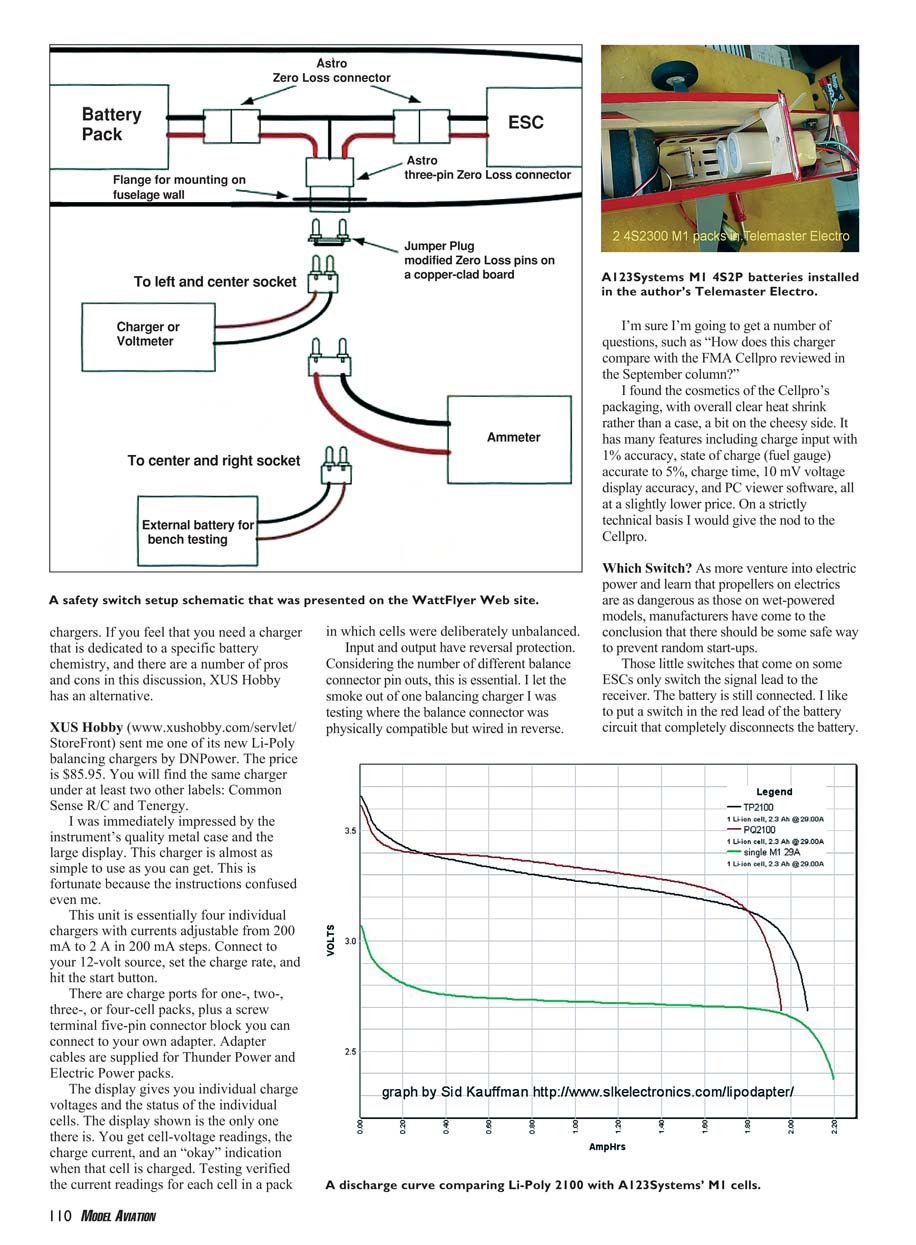
The company is interested in the hobby market and sent me a couple of four-cell, 2300 mAh packs for testing. The voltage delivery is lower than with Li-Polys and they require a different charge regime (constant-current to 3.6 volts vs. the normal 4.2 volts).
With the lower voltage I used the four-cell packs running in parallel to replace the 3S2P 3200 Li-Polys I had been using in a Telemaster Electro. A bench run of 29 amps (13C), the limit of my CBA II, gives a comparison with regular Li-Polys. Although the voltage is approximately 0.5 volt lower, the discharge is flatter than either of the Li-Poly cells.
A123Systems has established a123racing (www.a123racing.com), which focuses primarily on the car market—at least for now. Batteries and chargers are available from the company if 2S and 3S is all you require. I hope higher-cell-count packages will be added. These packs' size and weight do not lend them well to lower-capacity flight applications.
I am using a Vencon (www.vencon.com) UBA4 programmable system, checking for balance on a Cellpro and then charging individual cells as necessary for 3.6 volts constant voltage with a 50 mA current cutoff. So far the pack seems to stay well balanced. If you have access to a power supply that has voltage- and current-limit settings, that should work also.
Sid Kauffman of SLK Electronics (the ElectriCalc guy) is offering a modified LiPoDapter that enables you to charge up to 6S M1 cells (this appears to be the designation given to these cells) with your Ni-Cd charger. I have tried the modified version, and it does the job on the 3S and 4S packs I'm testing. Visit Sid's website at www.slkelectronics.com; some excellent Li-Poly information is presented there—particularly in the LiPoDapter section.
I look forward to any input from others who are using these cells. Accumulating 1,000 cycles is going to take me a very long time.
Regarding the proliferation of connection schemes—contradictory pinout arrangements with the same physical connectors reversed from one vendor to the next, and every conceivable connector ever listed in Digi-Key and some that are not—heaven help the poor guy (such as myself) who has packs from more than one source until the industry standardizes balancing connectors and pinout conventions.
Although it is obvious that battery vendors are copying each other's marketing hype, they cannot be accused of copying anyone else's balancing-connector protocol. We are going to have to adapt, sorting out pinouts, connections, pin spacing, and all the other variables thrown at us to make our own adapters to adapt the other adapters.
Last month I mentioned a tour of The Battery Clinic lab. I have not forgotten that, but with all the important stuff hitting us I'll save it for when I run out of important things to bring you.
If e-mail doesn't do it for you, the mail to Newberry is slower, but you can write to me at: 12219 NW 9th Ln., Newberry, FL 32669. Please enclose an SASE if you want a personalized, autographed reply.
MA
Transcribed from original scans by AI. Minor OCR errors may remain.

