

The Battery Clinic
Red Scholefield | [email protected]
The McLeod Balsa Stripper is great for scratch builders
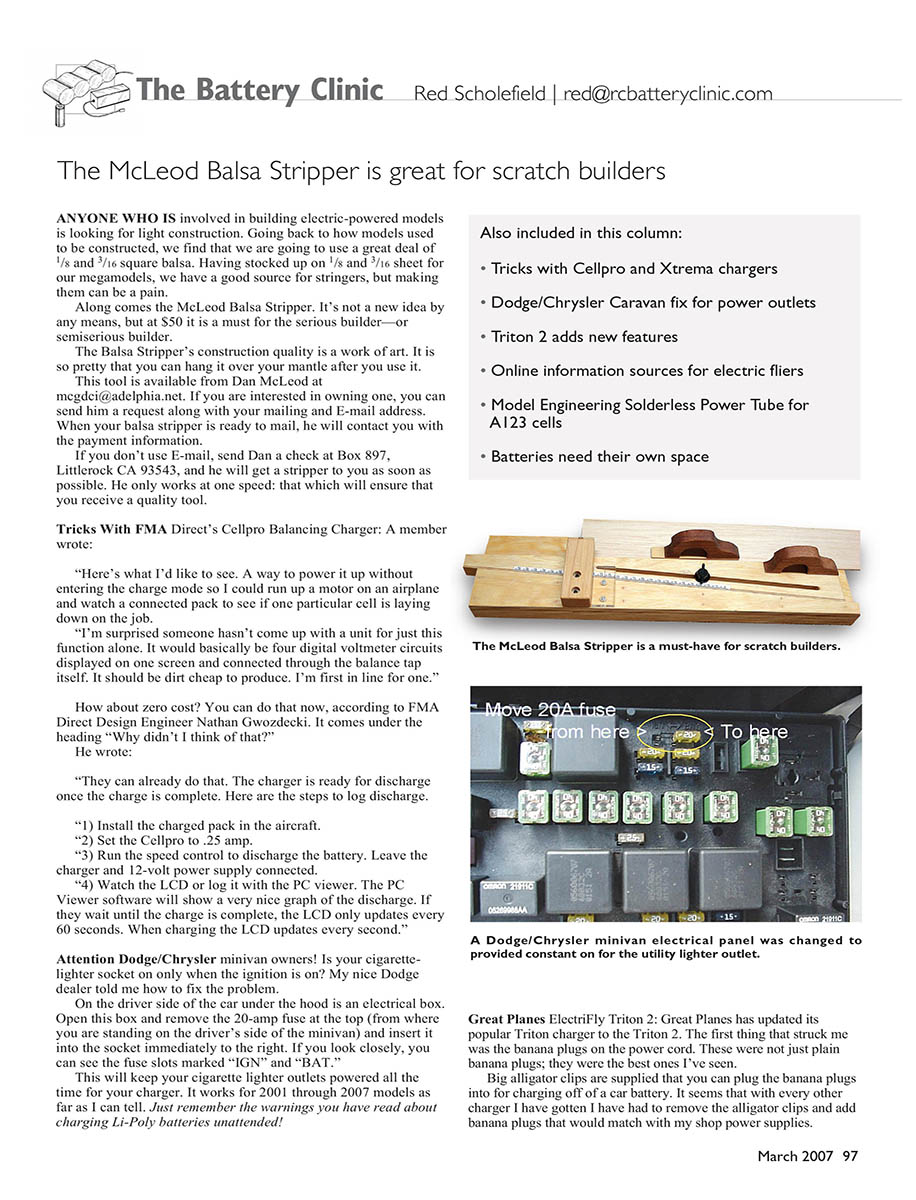
Anyone who is involved in building electric-powered models is looking for light construction. Going back to how models used to be constructed, we find that we are going to use a great deal of 1/8 and 3/16 square balsa. Having stocked up on 1/8 and 3/16 sheet for our megamodels, we have a good source for stringers, but making them can be a pain.
Along comes the McLeod Balsa Stripper. It's not a new idea by any means, but at $50 it is a must for the serious builder—or semi-serious builder.
The Balsa Stripper's construction quality is a work of art. It is so pretty that you can hang it over your mantle after you use it.
This tool is available from Dan McLeod at [email protected]. If you are interested in owning one, send him a request along with your mailing and email address. When your balsa stripper is ready to mail, he will contact you with payment information.
If you don't use email, send Dan a check to Box 897, Littlerock, CA 93543, and he will get a stripper to you as soon as possible. He only works at one speed: that which will ensure that you receive a quality tool.
Tricks With FMA Direct's Cellpro Balancing Charger
A member wrote: "Here's what I'd like to see. A way to power it up without entering the charge mode so I could run up a motor on an airplane and watch a connected pack to see if one particular cell is laying down on the job.
"I'm surprised someone hasn't come up with a unit for just this function alone. It would basically be four digital voltmeter circuits displayed on one screen and connected through the balance tap itself. It should be dirt cheap to produce. I'm first in line for one."
Good news: you can do this now, according to FMA Direct Design Engineer Nathan Gwozdecki. It comes under the heading "Why didn't I think of that?"
He wrote:
They can already do that. The charger is ready for discharge once the charge is complete. Here are the steps to log discharge:
- Install the charged pack in the aircraft.
- Set the Cellpro to 0.25 amp.
- Run the speed control to discharge the battery. Leave the charger and 12-volt power supply connected.
- Watch the LCD or log it with the PC Viewer. The PC Viewer software will show a very nice graph of the discharge. If you wait until the charge is complete, the LCD only updates every 60 seconds. When charging, the LCD updates every second.
Attention Dodge/Chrysler minivan owners!
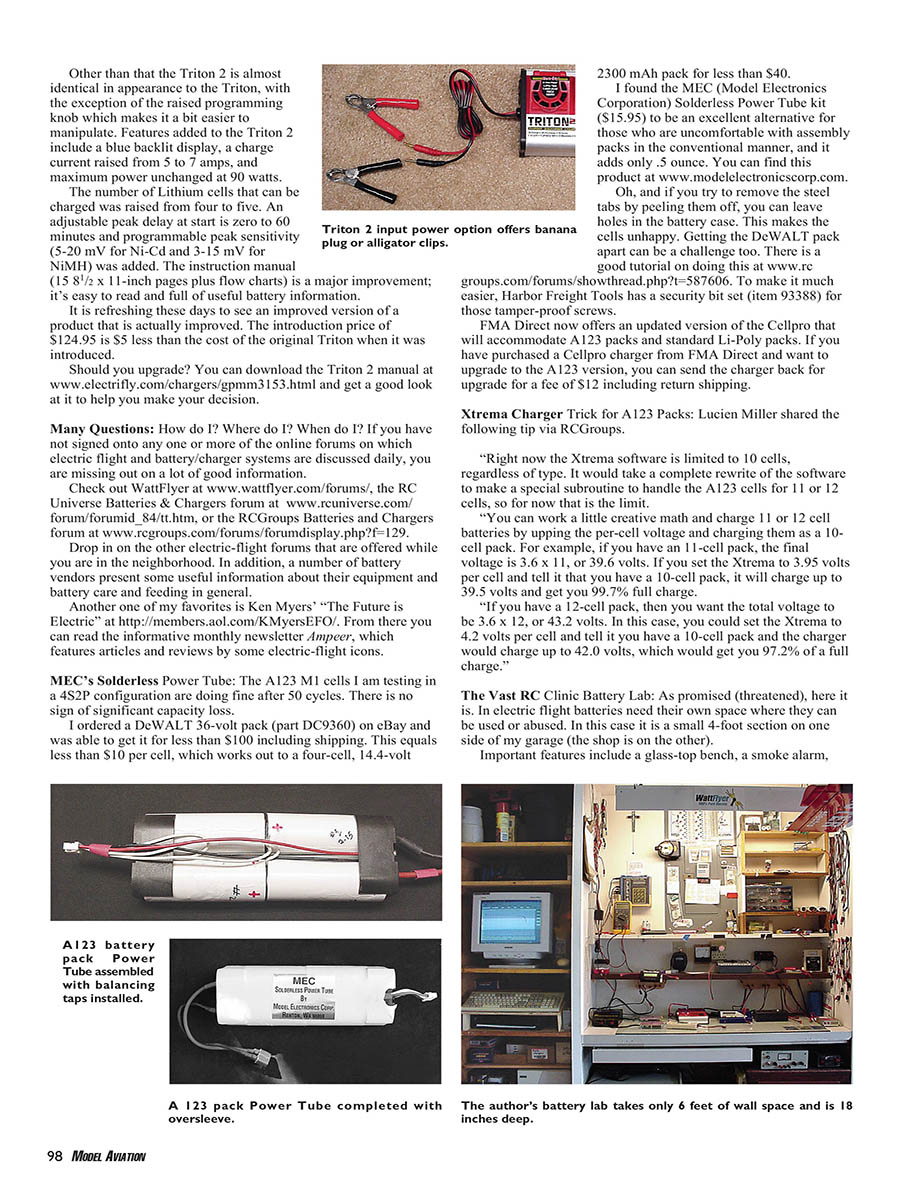
Is your cigarette-lighter socket on only when the ignition is on? A Dodge dealer shared a simple fix.
On the driver's side of the car under the hood is an electrical box. Open this box and remove the 20-amp fuse at the top (from where you are standing on the driver's side of the minivan) and insert it into the socket immediately to the right. If you look closely, you can see the fuse slots marked "IGN" and "BAT." This will keep your cigarette lighter outlets powered all the time for your charger. It works for 2001 through 2007 models as far as I can tell. Just remember the warnings you have read about charging Li-Poly batteries unattended!
Great Planes ElectriFly Triton 2
Great Planes has updated its popular Triton charger to the Triton 2. The first thing that struck me was the banana plugs on the power cord. These aren't just plain banana plugs; they are the best ones I've seen. Big alligator clips are supplied that you can plug the banana plugs into for charging off a car battery. With many other chargers I've had to remove the alligator clips and add banana plugs to match my shop power supplies.
Other than that, the Triton 2 is almost identical in appearance to the Triton, with the exception of the raised programming knob which makes it easier to manipulate. Features added to the Triton 2 include a blue backlit display, charge current raised from 5 to 7 amps, and maximum power unchanged at 90 watts.
The number of lithium cells that can be charged was raised from four to five. An adjustable peak delay at start is zero to 60 minutes and programmable peak sensitivity was added (5–20 mV for Ni-Cd and 3–15 mV for NiMH). The instruction manual (15 pages plus flow charts) is a major improvement; it’s easy to read and full of useful battery information.
It’s refreshing these days to see an improved version of a product that is actually improved. The introduction price of $124.95 is $5 less than the cost of the original Triton when it was introduced.
Should you upgrade? You can download the Triton 2 manual at www.electrifly.com/chargers/gpmm3513.html to help you make your decision.
Many Questions
How do I? Where do I? When do I? If you have not signed onto any one or more of the online forums on which electric flight and battery/charger systems are discussed daily, you are missing out on a lot of good information.
Check out:
- WattFlyer: www.wattflyer.com/forums/
- RC Universe Batteries & Chargers forum: www.rcuniverse.com/forum/forumid_84/tt.html
- RCGroups Batteries and Chargers forum: www.rcgroups.com/forums/forumdisplay.php?f=129
Drop in on the other electric-flight forums that are offered while you are in the neighborhood. In addition, a number of battery vendors present useful information about their equipment and battery care and feeding in general.
Another favorite is Ken Myers’ "The Future is Electric" at http://members.aol.com/KMyersEFO/. From there you can read the informative monthly newsletter Ampere, which features articles and reviews by electric-flight experts.
MEC’s Solderless Power Tube
The A123 M1 cells I am testing in a 4S2P configuration are doing fine after 50 cycles. There is no sign of significant capacity loss.
I ordered a DeWALT 36-volt pack (part DC9360) on eBay and was able to get it for less than $100 including shipping. This equals less than $10 per cell, which works out to a four-cell, 14.4-volt, 2300 mAh pack for less than $40.
I found the MEC (Model Electronics Corporation) Solderless Power Tube kit ($15.95) to be an excellent alternative for those who are uncomfortable with assembling packs in the conventional manner; it adds only 0.5 ounce. You can find this product at www.modelelectronicscorp.com.
If you try to remove the steel tabs by peeling them off, you can leave holes in the battery case. This makes the cells unhappy. Getting the DeWALT pack apart can be a challenge too. There is a good tutorial on doing this at www.rcgroups.com/forums/showthread.php?t=587606. To make it much easier, Harbor Freight Tools carries a security bit set (item 93388) for those tamper-proof screws.
FMA Direct now offers an updated version of the Cellpro that will accommodate A123 packs and standard Li-Poly packs. If you have purchased a Cellpro charger from FMA Direct and want to upgrade to the A123 version, you can send the charger back for upgrade for a fee of $12 including return shipping.
Xtrema Charger Trick for A123 Packs
Lucien Miller shared the following tip via RCGroups.
Right now the Xtrema software is limited to 10 cells, regardless of type. It would take a complete rewrite of the software to make a special subroutine to handle the A123 cells for 11 or 12 cells, so for now that is the limit.
You can work a little creative math and charge 11- or 12-cell batteries by upping the per-cell voltage and charging them as a 10-cell pack. Examples:
- For an 11-cell pack, final voltage = 3.6 × 11 = 39.6 V. If you set the Xtrema to 3.95 V per "cell" and tell it you have a 10-cell pack, it will charge up to 39.5 V and get you about 99.7% of a full charge.
- For a 12-cell pack, final voltage = 3.6 × 12 = 43.2 V. If you set the Xtrema to 4.20 V per "cell" and tell it you have a 10-cell pack, it will charge up to 42.0 V and get you about 97.2% of a full charge.
The Vast RC Clinic Battery Lab
As promised (threatened), here it is. In electric flight, batteries need their own space where they can be used or abused. In this case it is a small 4-foot section on one side of my garage (the shop is on the other).
Important features include a glass-top bench, a smoke alarm, and lots of outlets. It gives me something to do with that old computer and a place to keep a gazillion adapter cables and plugs at hand. In a shallow drawer under the bench is room for various battery manuals, a logbook, and more adapters/cables/plugs.
Devices currently served by the old computer:
- Orbit Microlader charger/cycler
- West Mountain Radio CBA II
- RadioShack recording digital voltmeter
- Xtrema charger
- Old and new versions of the Cellpro charger/balancer
- Vencon Technologies UBA4 battery analyzer
Under the bench are a 12-volt, 10-amp supply that serves seven banana-jack pairs above the bench; an ancient HP variable current/voltage power supply (when all else fails); and the computer CPU. There are multi-drawer storage boxes for battery connectors, balance leads, and terminals, etc., along with the obligatory pencil holder my kid made for me in first grade.
It so happens that my circuit-breaker panel is in the middle of all this, but it serves as a good magnetic bulletin board for important scraps I should have thrown away in the first place. The vintage ACE R/C Dual Verifiercharger has a well-deserved prominent place in this shrine to battery/charger technology. The crucifix hanging in the upper left seems prudent.
Until next time, you can contact me at: 12219 NW 9th Ln., Newberry, FL 32669. I can be reached much faster by email. — Red Scholefield
Transcribed from original scans by AI. Minor OCR errors may remain.

