
Using lead-acid batteries as a DC charger power source
Red Scholefield | [email protected]
Also included in this column:
- A123 as a starter battery
- A123 now in a smaller size
- Electric racing
- The CG blues
- Florida electric fly-ins
I get many questions about how many charges someone can get out of a lead-acid battery. It comes down to the simple matter of how many watt-hours are available from the battery.
A standard field-box battery that many use for starting and fuel pumps is 12 volts, 7 Ah. Thus 12 multiplied by 7 gives us 84 watt-hours. To charge, say, a 3S 2100 mAh Li-Poly pack would take the nominal 11.1 volts multiplied by the capacity of 2.1 Ah, to come up with 23.3 watt-hours.
However, since charging is not 100% efficient, nor are the chargers we use, we assume roughly 60–70% efficiency. Using a mid value of 65% gives about 55 watt-hours available from the lead-acid battery. Divide that 55 watt-hours by the 23.3 watt-hours needed to charge the 3S pack and you come up with roughly 2.4 charges. Your mileage may vary, but this gives you an approximation of how many charges you can get.
You will get more charges if you don't discharge the Li-Poly pack all the way. The number of charges you get will also increase somewhat as the charge rate is reduced. Did I claim it was simple?
A123 Does Duty as a Starter Battery
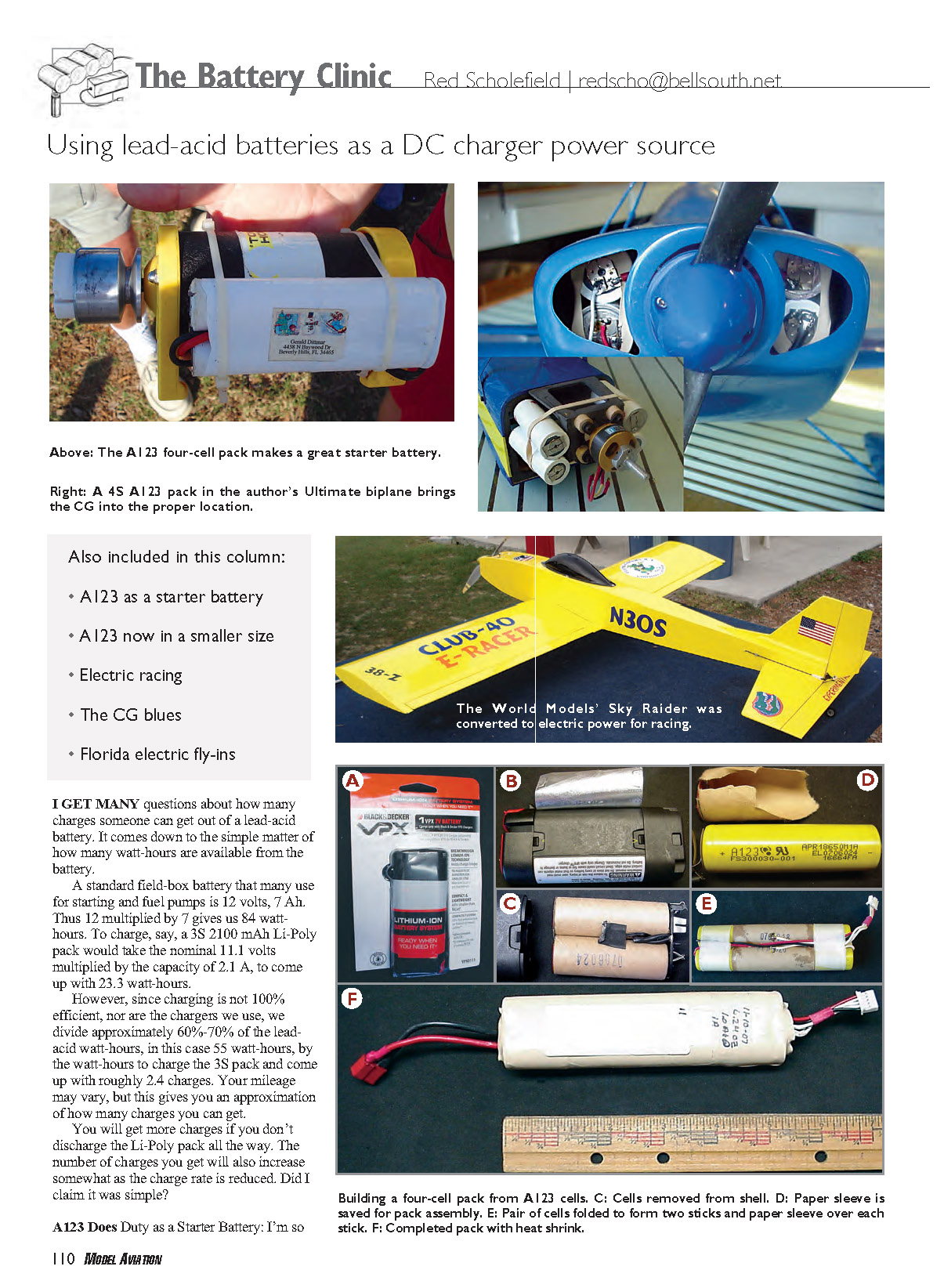
I'm so wrapped up in electric flying that something escaped me. A flying friend, Jerry Dittmar, came up with a neat power pack for his Sullivan starter (one of those bulky things you jam into the spinner on your glow-powered model to start it). Jerry made a 4S pack using A123 cells. It gives his starter lots of zip and nicely handled much of the starting at one of our recent Club 40 races.
A Smaller A123
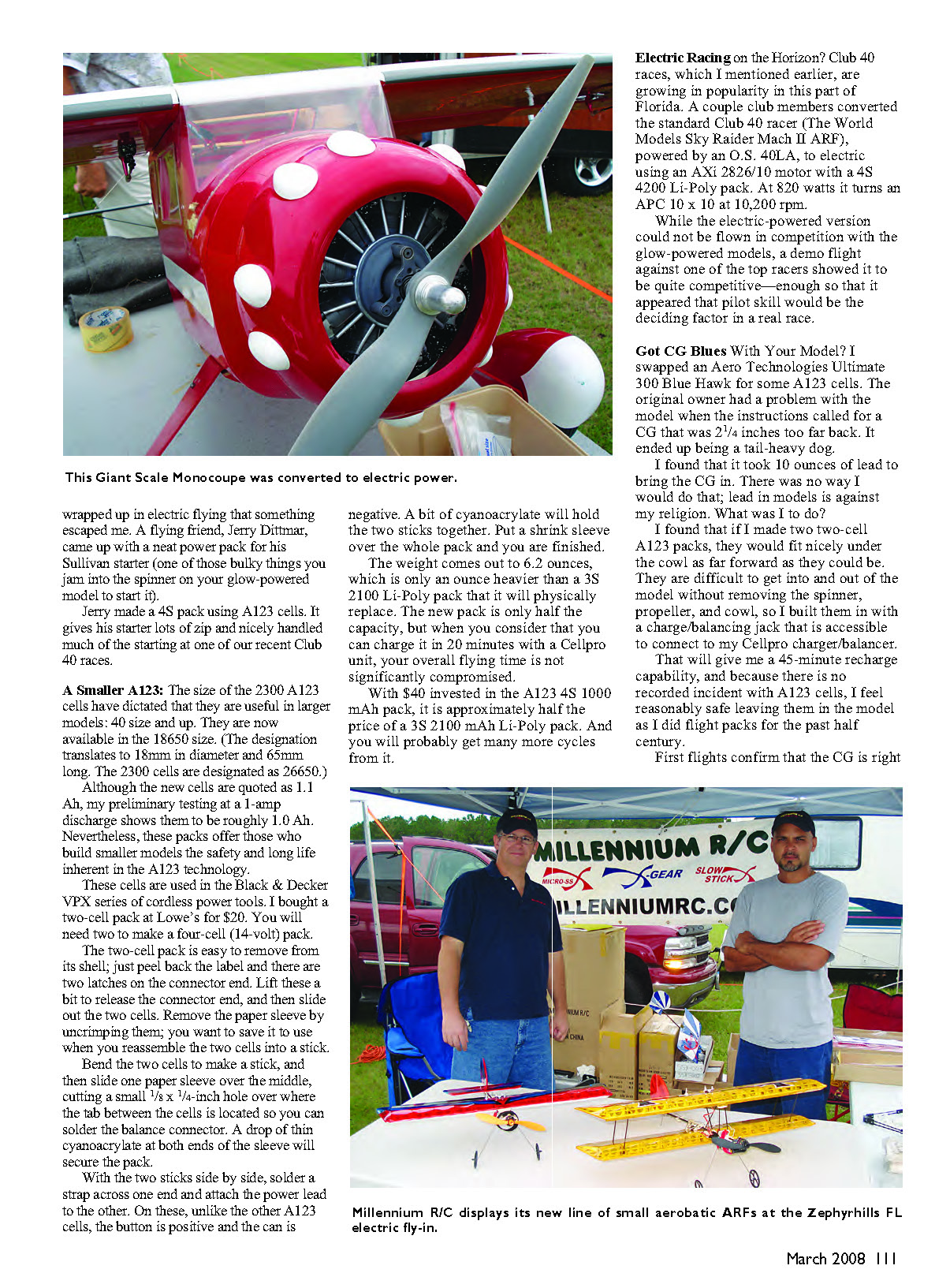
The size of the 2300 A123 cells has dictated that they are useful in larger models: 40-size and up. They are now available in the 18650 size (the designation translates to 18 mm in diameter and 65 mm long; the 2300 cells are designated as 26650). Although the new cells are quoted as 1.1 Ah, my preliminary testing at a 1-amp discharge shows them to be roughly 1.0 Ah. Nevertheless, these packs offer those who build smaller models the safety and long life inherent in A123 technology. These cells are used in the Black & Decker VPX series of cordless power tools. I bought a two-cell pack at Lowe's for $20. You will need two to make a four-cell (14-volt) pack.
The two-cell pack is easy to remove from its shell; just peel back the label and there are two latches on the connector end. Lift these a bit to release the connector end, and then slide out the two cells. Remove the paper sleeve by uncrimping it; you want to save it to use when you reassemble the two cells into a stick. Bend the two cells to make a stick, and then slide one paper sleeve over the middle, cutting a small 1/8 x 1/4-inch hole over where the tab between the cells is located so you can solder the balance connector. A drop of thin cyanoacrylate at both ends of the sleeve will secure the pack. With the two sticks side by side, solder a strap across one end and attach the power lead to the other. On these, unlike the other A123 cells, the button is positive and the can is negative. A bit of cyanoacrylate will hold the two sticks together. Put a shrink sleeve over the whole pack and you are finished.
The weight comes out to 6.2 ounces, which is only an ounce heavier than a 3S 2100 Li-Poly pack that it will physically replace. The new pack is only about half the capacity, but when you consider that you can charge it in 20 minutes with a Cellpro unit, your overall flying time is not significantly compromised.
With $40 invested in the A123 4S 1000 mAh pack, it is approximately half the price of a 3S 2100 mAh Li-Poly pack. And you will probably get many more cycles from it.
Electric Racing on the Horizon?
Club 40 races, which I mentioned earlier, are growing in popularity in this part of Florida. A couple club members converted the standard Club 40 racer (the World Models Sky Raider Mach II ARF), powered by an O.S. 40LA, to electric using an AXi 2826/10 motor with a 4S 4200 Li-Poly pack. At 820 watts it turns an APC 10 x 10 at 10,200 rpm.
While the electric-powered version could not be flown in competition with the glow-powered models, a demo flight against one of the top racers showed it to be quite competitive—enough so that it appeared pilot skill would be the deciding factor in a real race.
Got CG Blues With Your Model?
I swapped an Aero Technologies Ultimate 300 Blue Hawk for some A123 cells. The original owner had a problem with the model when the instructions called for a CG that was 2 1/4 inches too far back. It ended up being a tail-heavy dog.
I found that it took 10 ounces of lead to bring the CG in. There was no way I would do that; lead in models is against my religion. What was I to do?
I found that if I made two two-cell A123 packs, they would fit nicely under the cowl as far forward as they could be. They are difficult to get into and out of the model without removing the spinner, propeller, and cowl, so I built them in with a charge/balancing jack that is accessible to connect to my Cellpro charger/balancer.
That will give me a 45-minute recharge capability, and because there is no recorded incident with A123 cells, I feel reasonably safe leaving them in the model as I did flight packs for the past half century. First flights confirm that the CG is right where it belongs. The Blue Hawk is powered by an AXI 2808/24 motor and a Graupner 9 x 6 propeller.
Florida Electric Fly-Ins Grow
Electric fly-ins are growing at a rapid rate here in Florida. One in late October at Zephyrhills, hosted by the Can-Am Flyers Inc., had many fliers and well more than 100 models. The variety was awesome, including everything from park flyers to Giant Scale, International Miniature Aerobatic Club and 3-D aircraft.
I love what can be done with scale models by tucking a motor in them where you have no cylinder heads or mufflers with which to contend. In one of the photos is a beautiful Monocoupe by John Uhle that hides a Hacker B50-7XL motor with a 6.7:1 gearbox to swing an 18 x 8 APC-E propeller.
At the Zephyrhills meet I saw a new company in the vendor’s area. Millennium R/C, based in Orlando, Florida, features a line of kits and ARFs of some neat little (don’t leave home without one) aerobatic models. They are offered as laser-cut kits, employing a lot of carbon fiber, PARFs (Partially Almost Ready to Flys), and ARFs.
But there is more. Those models are offered as full-house packages, complete with a DNC Power 20C 1350 mAh, 11.1-volt Li-Poly battery; a Himax 2025-4200 brushless motor; an aluminum gearbox, 10T, and 12T/2.0mm pinion gears; 70-spur gear; three servos; a Castle Creations Thunderbird-18 ESC; a Deans connector set; and heat-shrink tubing. I saw some talented pilots fly these models, and they will do everything you want in a restricted area.
In another vendor booth I found a great supplier of Velcro that has become the fastener of choice in many electric-powered models. Lu Mahoney, the wife of an active modeler, has handy items such as ONE-WRAP back-to-back hook-and-loop straps that are ideal for holding down components and battery packs.
Along with this is a commercial-grade 875 hook material that—when attached to the airframe with slow cyanoacrylate, Cyberbond medium epoxy, or Goop—will hold everything in place. Lu offers an installation kit, which includes a 24 x 2-inch 875 hook, 36 x 2-inch ONE-WRAP, 36 x 1-inch ONE-WRAP, and 36 x 1/2-inch ONE-WRAP.
Bloody Hands and Ugly Planes
I got some pithy comments from a couple readers, one of whom was offended by the “blood and gore” shown in my November column. That message read, “Isn’t it common knowledge that if you stick your hand in a rotating propeller that you will get cut?”
The other in the same thread read:
“Seems everything is an ugly sight in Red’s write-ups, just check out that bird in the pix next to the hand. And that’s not the first ugly plane Red has shown, those planes just don’t deserve magazine page attention!”
There were only two negative comments about the blood-and-gore issue. It was overwhelmingly known that it was a good object lesson in safety.
To address the ugly models, much of what goes into a column of this type is driven by letters and questions from readers or from questions on forums regarding electric flight. One of the more popular questions is how to modify (the name of your favorite glow-powered airplane here) for electric. The simplest answer is to show how someone modified theirs with good results.
Send in those pictures (with details) of your electric-flight conversions, and maybe you too can have an ugly airplane published in MA.
That’s it for this month. Keep smiling and maybe the snow will melt soon. Better yet, take a vacation and visit the Sunshine State, where flying is at its best this time of the year.
Support your US Postal Service and send an SASE if you want a personalized answer. The Battery Clinic is located at 12219 NW 9th Ln., Newberry FL 32669. But E-mail is faster and saves a tree. (Oh, sorry, we hate trees; they eat airplanes.) MA
Sources:
- Lu Mahoney — [email protected]
- Millennium R/C — (407) 208-9745 — www.millenniumrc.com
Transcribed from original scans by AI. Minor OCR errors may remain.

