
The Battery Clinic
Red Scholefield | [email protected]
Has your favorite cordless power tool taken a dive?
A modeling buddy lamented that his little Makita drill would no longer do its tasks. We found that NoBS Batteries will make a replacement pack for your tired tool that you can drop in and reconnect with little effort besides taking out the screws, unsoldering the old pack, and soldering in the new one.
You will need a Torx T-8 driver for some tools; you should already have one in your toolbox. Sears has some good ones. The packs are supplied with solder tabs. These tools are frequently supplied with hard-to-find 4/5C cells, and there is little tolerance in the tool to allow for your own assembly, even if you can find the cells. I have since re-batteried my cordless screwdriver with a NoBS custom pack. Get in touch with Steve Anthony at NoBS Batteries and tell him what you need; it's best to e-mail him the description and dimensions of your battery because he is busy and hates to waste time answering phone calls.
A buddy gave me a Skil screwdriver, saying that the replacement packs (if he could even find them) cost more than the tool. The screwdriver has a removable, three-cell Ni-Cd pack. I found that its outside dimensions are the same as an A123 cell. Could I use one to replace the Ni-Cd pack at the same voltage? When I opened the screwdriver I found that I could bend the contacts so they fit the A123 nicely, making contact with the negative end and the positive can (after removing a section of insulation). Cutting off the end of the Ni-Cd battery case enabled me to reinsert it to hold the A123 firmly in place. It's easy to remove for recharging, which is done with one of my lithium chargers. Now I have a field screwdriver for putting in wing bolts that won't need charging for several months.
Sometimes figuring out how to get the tool apart is the biggest problem. Look for screws hidden under labels. You can feel around on the label, looking for a soft spot where the screw might be. The joint where the Skil driver could be bent to form a sort of pistol grip had a cap (labeled "3.6V") that I was able to remove to get to a screw that held it all together. Two easy-to-remove, metal, U-shaped clips held the other end of the handle together.
Ryobi has just come out with a 12-volt lithium drill (with two packs) that a club member found made a great pack for his Kavan starter. He made an adapter so the pack could plug directly into the starter without modification. The charger that comes with the drill takes care of recharging.
Messy Charger Cords?
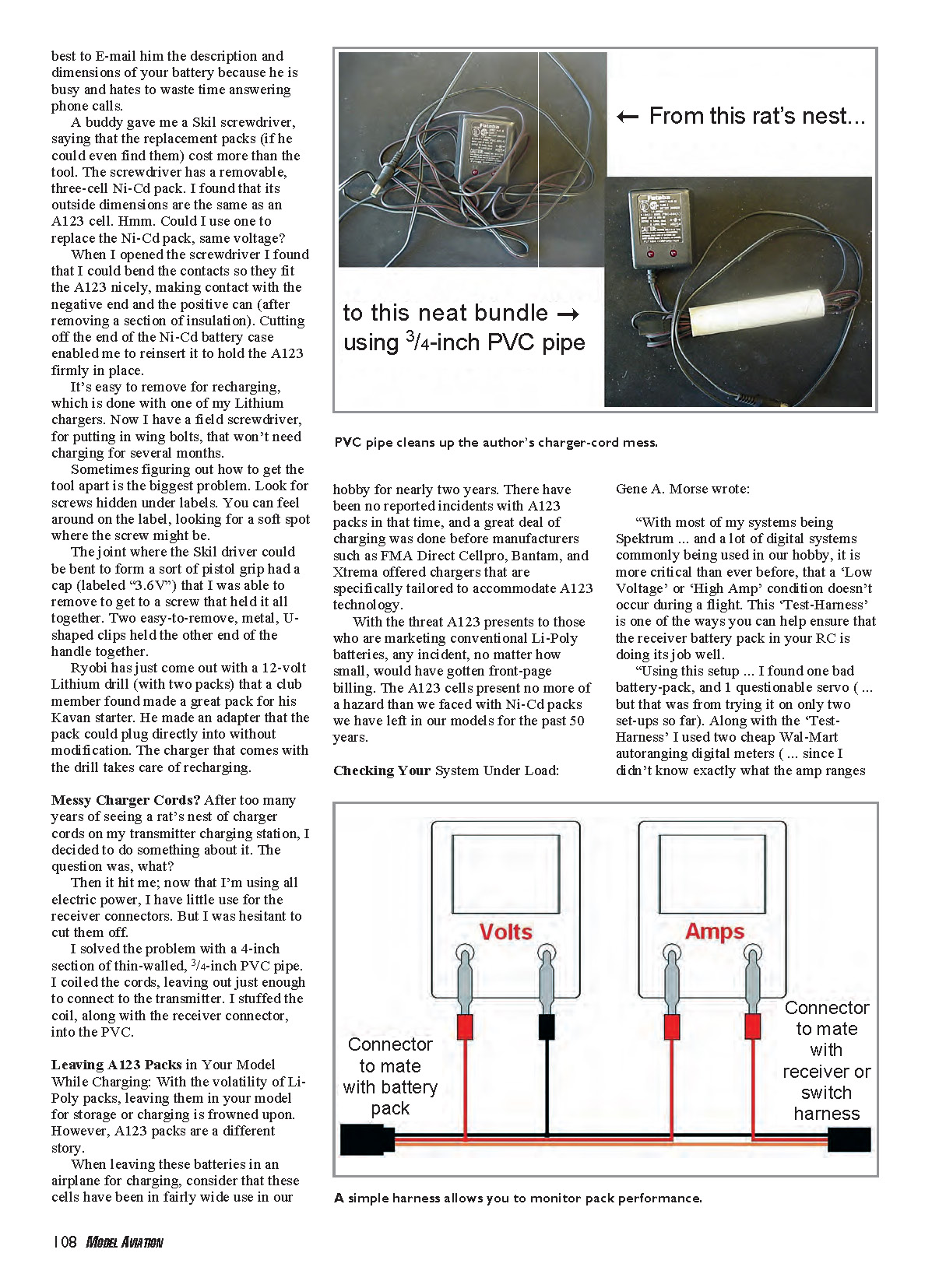
After too many years of seeing a rat's nest of charger cords on my transmitter charging station, I decided to do something about it. The question was, what? Now that I'm using all electric power, I have little use for the receiver connectors, but I was hesitant to cut them off. I solved the problem with a 4-inch section of thin-walled, 3/4-inch PVC pipe. I coiled the cords, leaving out just enough to connect to the transmitter. I stuffed the coil, along with the receiver connector, into the PVC.
Leaving A123 Packs in Your Model While Charging
With the volatility of Li-Poly packs, leaving them in your model for storage or charging is frowned upon. However, A123 packs are a different story. These cells have been in fairly wide use in our hobby for nearly two years. There have been no reported incidents with A123 packs in that time, and a great deal of charging was done before manufacturers such as FMA Direct, Cellpro, Bantam, and Xtreme offered chargers that are specifically tailored to accommodate A123 technology.
With the threat A123 presents to those who are marketing conventional Li-Poly batteries, any incident, no matter how small, would have gotten front-page billing. The A123 cells present no more of a hazard than we faced with Ni-Cd packs we have left in our models for the past 50 years.
Checking Your System Under Load
Gene A. Morse wrote:
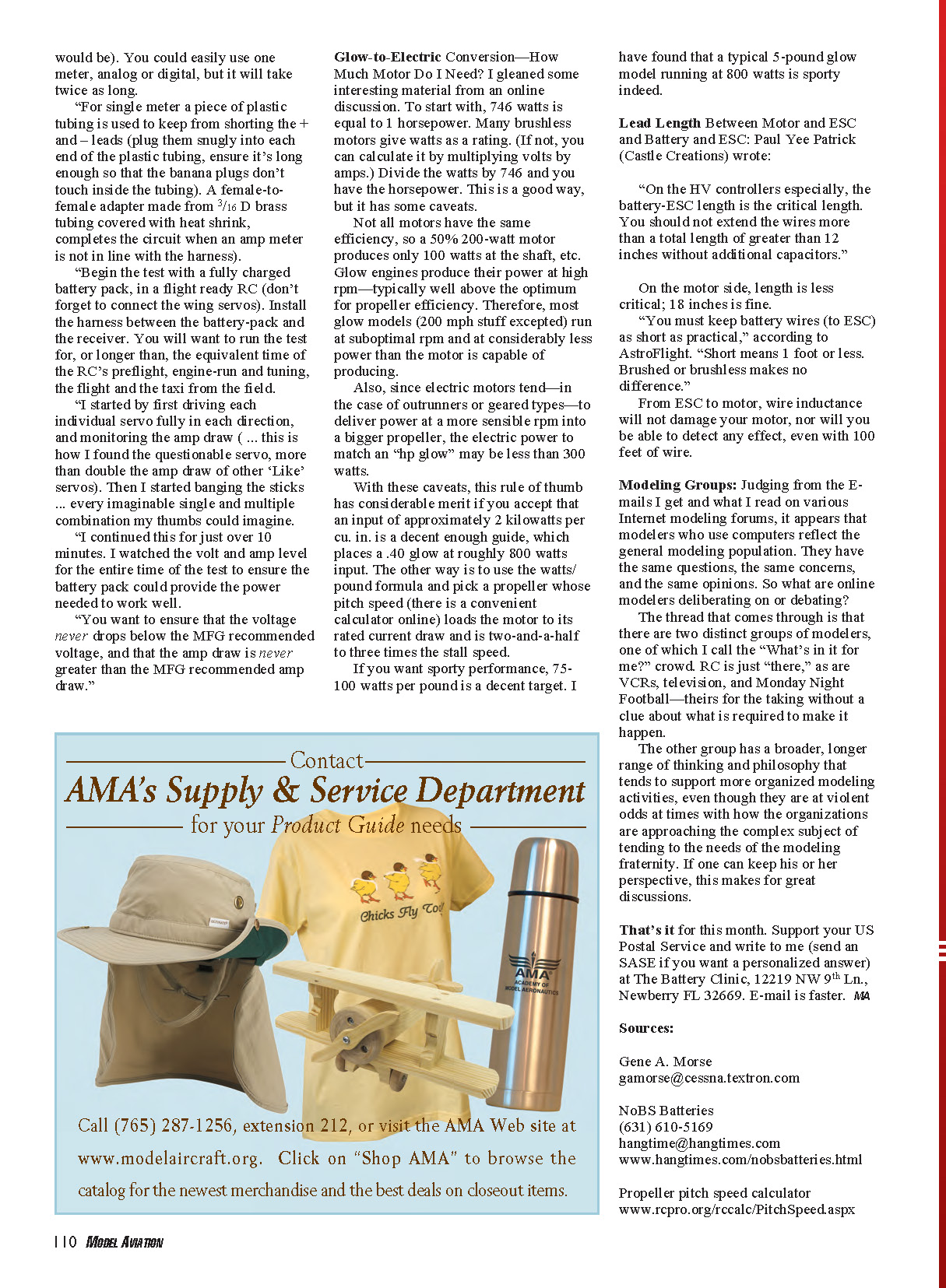
"With most of my systems being Spektrum and a lot of digital systems commonly being used in our hobby, it is more critical than ever before that a 'low voltage' or 'high amp' condition doesn't occur during a flight. This 'test-harness' is one of the ways you can help ensure that the receiver battery pack in your RC is doing its job well.
"Using this setup I found one bad battery pack and one questionable servo. Along with the test-harness I used two cheap Wal-Mart autoranging digital meters since I didn't know exactly what the amp ranges would be. You could easily use one meter, analog or digital, but it will take twice as long.
"For a single meter, a piece of plastic tubing is used to keep from shorting the + and – leads (plug them snugly into each end of the plastic tubing; ensure it's long enough so that the banana plugs don't touch inside the tubing). A female-to-female adapter made from 3/16" D brass tubing covered with heat shrink completes the circuit when an amp meter is not in line with the harness.
"Begin the test with a fully charged battery pack in a flight-ready RC (don't forget to connect the wing servos). Install the harness between the battery pack and the receiver. You will want to run the test for, or longer than, the equivalent time of the RC's preflight, engine-run and tuning, the flight, and the taxi from the field.
"I started by first driving each individual servo fully in each direction and monitoring the amp draw. This is how I found the questionable servo — it drew more than double the amps of other like servos. Then I started banging the sticks — every imaginable single and multiple combination my thumbs could conceive.
"I continued this for just over 10 minutes. I watched the volt and amp level for the entire time of the test to ensure the battery pack could provide the power needed to work well.
"You want to ensure that the voltage never drops below the manufacturer's recommended voltage, and that the amp draw is never greater than the manufacturer's recommended amp draw."
Glow-to-Electric Conversion—How Much Motor Do I Need?
I gleaned some interesting material from an online discussion. To start with, 746 watts equals 1 horsepower. Many brushless motors give watts as a rating (if not, you can calculate it by multiplying volts by amps). Divide the watts by 746 and you have the horsepower. This is a good way, but it has some caveats.
Not all motors have the same efficiency, so a 50% efficient 200-watt motor produces only 100 watts at the shaft. Glow engines produce their power at high rpm—typically well above the optimum for propeller efficiency. Therefore, most glow models (200 mph stuff excepted) run at suboptimal rpm and at considerably less power than the engine is capable of producing.
Also, since electric motors tend—in the case of outrunners or geared types—to deliver power at a more sensible rpm into a bigger propeller, the electric power to match a "hp glow" may be less than 300 watts.
With these caveats, this rule of thumb has considerable merit if you accept that an input of approximately 2 kilowatts per cu. in. is a decent enough guide, which places a .40 glow at roughly 800 watts input. The other way is to use the watts-per-pound formula and pick a propeller whose pitch speed (there is a convenient calculator online) loads the motor to its rated current draw and is two-and-a-half to three times the stall speed.
If you want sporty performance, 75–100 watts per pound is a decent target. I have found that a typical 5-pound glow model running at 800 watts is sporty indeed.
Lead Length Between Motor and ESC and Battery and ESC
Paul Yee (Castle Creations) wrote:
"On the HV controllers especially, the battery-to-ESC length is the critical length. You should not extend the wires more than a total length greater than 12 inches without additional capacitors."
On the motor side, length is less critical; 18 inches is fine.
AstroFlight advises: "You must keep battery wires (to ESC) as short as practical. Short means 1 foot or less. Brushed or brushless makes no difference."
From ESC to motor, wire inductance will not damage your motor, nor will you be able to detect any effect, even with 100 feet of wire.
Modeling Groups
Judging from the e-mails I get and what I read on various Internet modeling forums, it appears that modelers who use computers reflect the general modeling population. They have the same questions, the same concerns, and the same opinions. So what are online modelers deliberating on or debating?
The thread that comes through is that there are two distinct groups of modelers. One I call the "What's in it for me?" crowd. RC is just "there," as are VCRs, television, and Monday Night Football—theirs for the taking without a clue about what is required to make it happen.
The other group has a broader, longer-range way of thinking and a philosophy that tends to support more organized modeling activities, even though they are at violent odds at times with how the organizations approach the complex subject of tending to the needs of the modeling fraternity. If one can keep his or her perspective, this makes for great discussions.
That's it for this month. Support your U.S. Postal Service and write to me (send an SASE if you want a personalized answer) at:
The Battery Clinic 12219 NW 9th Ln. Newberry FL 32669
E-mail is faster.
MA
Sources:
- Gene A. Morse — [email protected]
- NoBS Batteries — (631) 610-5169, [email protected], www.hangtimes.com/nobsbatteries.html
- Propeller pitch speed calculator — www.rcpro.org/rccalc/PitchSpeed.aspx
Transcribed from original scans by AI. Minor OCR errors may remain.

