

The Battery Clinic - 2008/07
Red Scholefield | [email protected]
One big pack or individual packs harnessed together?
HOW TIME fritters away. I can't believe I'm starting my fourth year of this column and there are still unanswered battery questions. Since this is only my 78th orbit of the sun, hopefully I will be around to answer a few more.
Do you need more capacity or higher voltage? Consider individual packs harnessed together, in series or parallel. Compared to a single "unit" pack, harnessed packs have the following advantages.
- They are easy to check, easy to balance, and easy and safe to charge. Two packs harnessed in parallel, such as 2200 mAh 3S packs to achieve a 3S2P, 11.1-volt, 4400 mAh pack, can be disconnected at any time, so you retain the ability to check each cell through the balance connectors and charge safely by separating the packs. If you have a "hardwired" parallel pack in a single unit, you can't clearly diagnose a single weak cell. Charging a pack with a weak cell or cells can easily cause a fire during charging—and the danger is compounded by having so many cells in the pack for "fuel" on that fire.
- There is versatility in using packs. If you decide to retire that big model, you can instantly break your 3S2P pack to a pair of 3S packs for use in a smaller model.
- They are easy to rewire. Do you need to convert that 3S2P pack into 6S? It's a snap with a harness. A hardwired pack would likely be damaged in the arduous job of resoldering the individual cells, as is required in such a conversion.
- They are easy to arrange. Different pack shapes are required to fit and balance different models. Harnessed packs allow you to choose the optimal arrangement—front to back (in-line), side by side, or whatever you need.
Harnessing two packs is easy. Choose appropriate connectors for the expected amperage, and wire them for series or parallel operation. When running in series, the packs must be the same capacity, from the same manufacturer, and, if possible, the same age. They do not have to be the same number of cells. For parallel operation, they must be the same number of cells, but they can be a different capacity.
Bantam Upgrades Its BC6
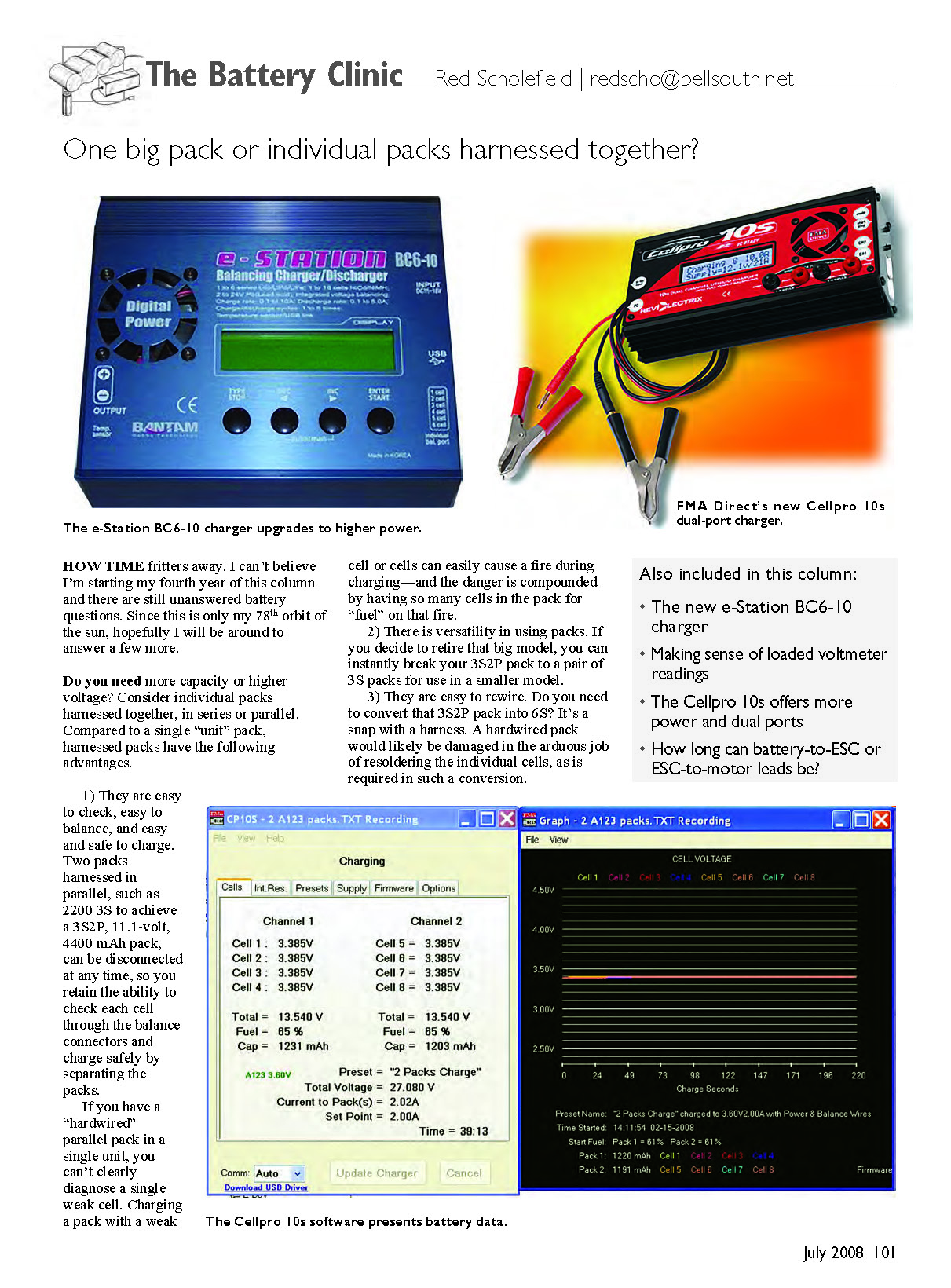
The latest addition to the Bantam e-Station BC series of chargers is the BC6-10, which ups the charge rate to 10 amps. As is its brother, the e-Station BC6, the BC6-10 is a 6S unit with a built-in 6S balancer. The BC6-10 supports Li-Ion, Li-Poly, and Li-Fe (A123). It's available for $179.95 through RC Accessory Inc.; see the end of the column for contact info.
The BC6-10's specifications are: input voltage 10–18 V; power 200 watts for charging and 25 watts for discharge; charge current 100 mA–10 amps; discharge current 100 mA–5 amps; balancer drain 200 mA per cell; Li-xx cell count 1S–6S; Ni-xx cell count 1–18; Pb cell count 1–12 (2–24 volts); weight 680 grams; dimensions 140 x 120 x 36 mm.
Loaded Voltmeter Readings
This still seems to confuse a lot of people, so it deserves another shot. Mike Oberst wrote:
"I would like your opinion if you don't mind. I have been using the Sanyo 2400 sub-C 4.8V Ni-Cd packs in several different scale models for quite a while. These models typically have 8–10 servos, mostly digitals.
"I charge at 240 mA for 12–14 hours with an Ace DMVC (the old analog one). I also have an Ace ESV. It's the analog unit with either 200 or 500 mA load. For years, I have been using the 200 mA load to test all my planes during the flying day. Using that load, I have always gotten four flights before I go into the red.
"Recently, I have come to believe that the 200 mA load is not a realistic representation of the load the battery is seeing in flight in most of my models. I base this assumption on the number of servos (8–10) that I am using in most of my models.
"Therefore, I have started using the 500 mA load on the Ace ESV. In using this load, I can only get two flights in before my ESV shows in the red. I have checked the Ace ESV with a digital meter to be sure it is not overloading, and it is very accurate.
"I want to be safe, but I flew these same models for 3–4 years, testing with the 200 mA load, and always got 4 flights with no problems. Should I continue loading at 500 mA and only get two flights before fast field charging, or is that being a bit too conservative? Should I go back to using the 200 mA load? I am a bit confused as to how I should proceed.
"If it helps any, my Graupner Ultra Duo field charger shows that I typically use 350–400 mAh per flight. Thanks in advance for your help."
Mike, it sounds like your 200 mA test load is doing okay.
Remember that your system is drawing maximum current only when the servos are moving. Your average drain, as you have demonstrated, is not 500 mA. Drawing 400 mAh per flight indicates that you should be comfortable with five flights and have a decent capacity reserve.
I like to use a voltwatch so I can see the actual state of the battery. With this, while the battery is well into the green, rapid movement of the sticks will get the orange or red to flicker. The best method is to know what your system takes in the way of mAh per minute of flight.
This is discussed in detail on The Battery Clinic's Web site. You seem to have a handle on this, so you are in good shape.
Cellpro 10s Raises the Bar
After nearly three months of beta testing by experienced modelers, FMA Direct's Cellpro 10s has been released for production at $189.95. Following the success of the Cellpro 4s with both Li-Poly and A123 capability, the 10s employs the same simple-to-operate philosophy of one-button programming.
Testing here at The Battery Clinic went through a half-dozen firmware updates as improvements and suggestions came in to FMA Direct from the beta-test team. One of the 10s's features is that the user will be notified of any firmware updates as soon as he or she connects to a computer with the USB cable (item FUM2), which can be ordered as an option for the 10s. These updates will be loaded into that user's 10s.
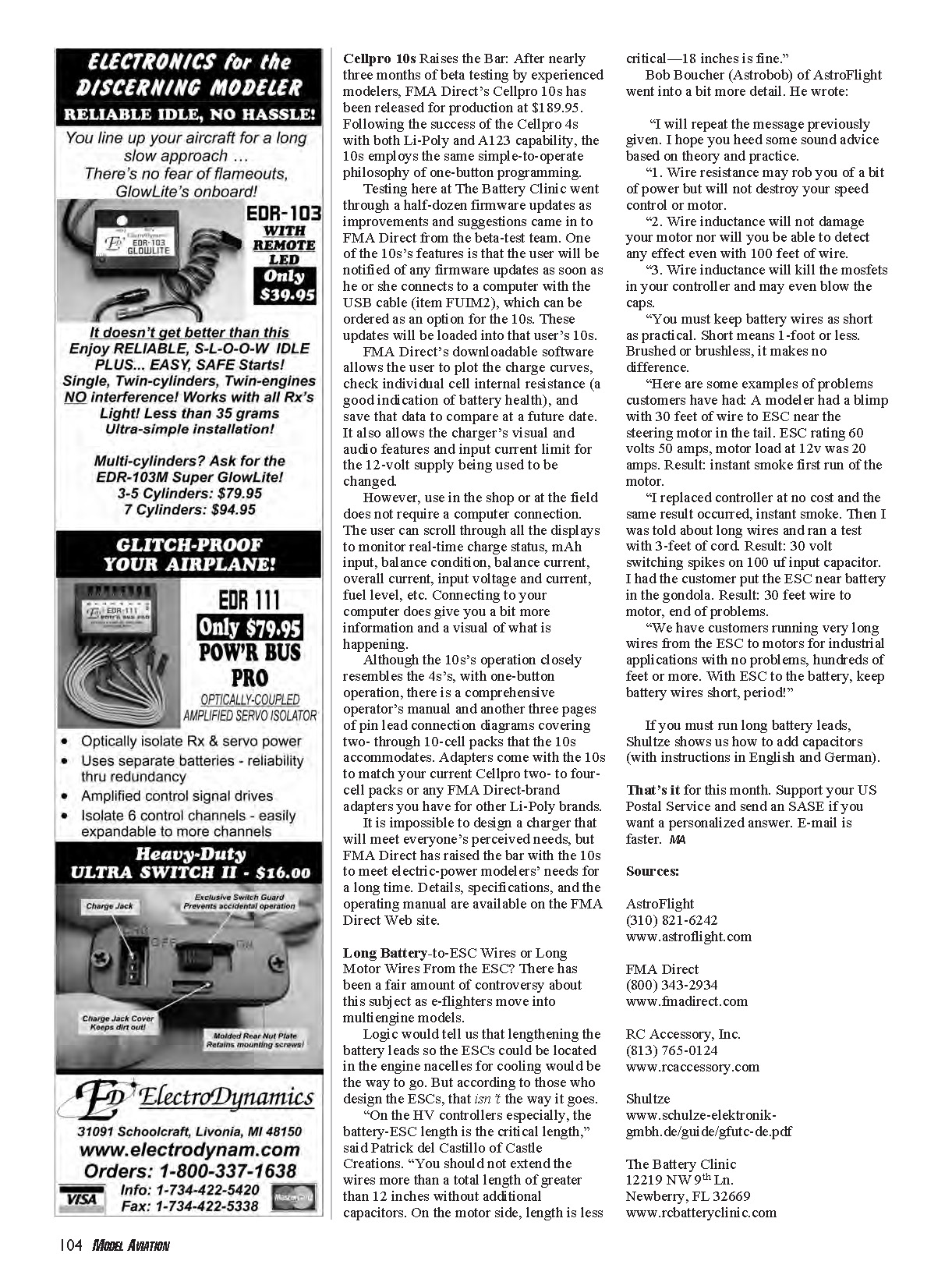
FMA Direct's downloadable software allows the user to plot the charge curves, check individual cell internal resistance (a good indication of battery health), and save that data to compare at a future date. It also allows the charger's visual and audio features and input current limit for the 12-volt supply being used to be changed.
However, use in the shop or at the field does not require a computer connection. The user can scroll through all the displays to monitor real-time charge status, mAh input, balance condition, balance current, overall current, input voltage and current, fuel level, etc. Connecting to your computer does give you a bit more information and a visual of what is happening.
Although the 10s's operation closely resembles the 4s's, with one-button operation, there is a comprehensive operator's manual and another three pages of pin lead connection diagrams covering two- through 10-cell packs that the 10s accommodates. Adapters come with the 10s to match your current Cellpro two- to four-cell packs or any FMA Direct-brand adapters you have for other Li-Poly brands.
It is impossible to design a charger that will meet everyone's perceived needs, but FMA Direct has raised the bar with the 10s to meet electric-power modelers' needs for a long time. Details, specifications, and the operating manual are available on the FMA Direct Web site.
Long Battery-to-ESC Wires or Long Motor Wires From the ESC?
There has been a fair amount of controversy about this subject as e-flighters move into multiengine models.
Logic would tell us that lengthening the battery leads so the ESCs could be located in the engine nacelles for cooling would be the way to go. But according to those who design the ESCs, that isn't the way it goes.
"On the HV controllers especially, the battery-ESC length is the critical length," said Patrick del Castillo of Castle Creations. "You should not extend the wires more than a total length of greater than 12 inches without additional capacitors. On the motor side, length is less critical—18 inches is fine."
Bob Boucher (AstroFlight) of AstroFlight went into a bit more detail. He wrote:
- Wire resistance may rob you of a bit of power but will not destroy your speed control or motor.
- Wire inductance will not damage your motor nor will you be able to detect any effect even with 100 feet of wire.
- Wire inductance will kill the MOSFETs in your controller and may even blow the caps.
You must keep battery wires as short as practical. Short means 1 foot or less. Brushed or brushless, it makes no difference.
Here are some examples of problems customers have had: A modeler had a blimp with 30 feet of wire to an ESC near the steering motor in the tail. ESC rating 60 volts 50 amps, motor load at 12 V was 20 amps. Result: instant smoke first run of the motor.
I replaced the controller at no cost and the same result occurred—instant smoke. Then I was told about long wires and ran a test with 3 feet of cord. Result: 30 volt switching spikes on 100 µF input capacitor. I had the customer put the ESC near the battery in the gondola. Result: 30 feet wire to motor, end of problems.
We have customers running very long wires from the ESC to motors for industrial applications with no problems, hundreds of feet or more. With ESC to the battery, keep battery wires short, period!
If you must run long battery leads, Schultze shows us how to add capacitors (with instructions in English and German).
That's it for this month. Support your US Postal Service and send an SASE if you want a personalized answer. E-mail is faster. RS
Sources
- AstroFlight
(310) 821-6242 www.astroflight.com
- FMA Direct
(800) 343-2934 www.fmadirect.com
- RC Accessory, Inc.
(813) 765-0124 www.rcaccessory.com
- Schultze
www.schultze-elektronik-gmbh.de
- The Battery Clinic
12219 NW 9th Ln. Newberry, FL 32669 www.rcbatteryclinic.com
Transcribed from original scans by AI. Minor OCR errors may remain.

