

Florida aeromodeling activities
Leader Members (LMs)
LEADER MEMBERS (LMs), please contact your district vice president or AMA Headquarters via e-mail, U.S. Postal Service, or telephone for important information regarding your LM status. According to Frank Geisler, head of the program:
“This is one part of a multi‑pronged approach to reaching out and contacting all LMs in the AMA. Based on the results of the latest LM survey, we have a big problem with not being able to contact all our LMs and we need them to update their contact info, especially their e‑mail address which is the most convenient method of communication for both the sender and receiver.”
Electric scale models and the OWLS meet
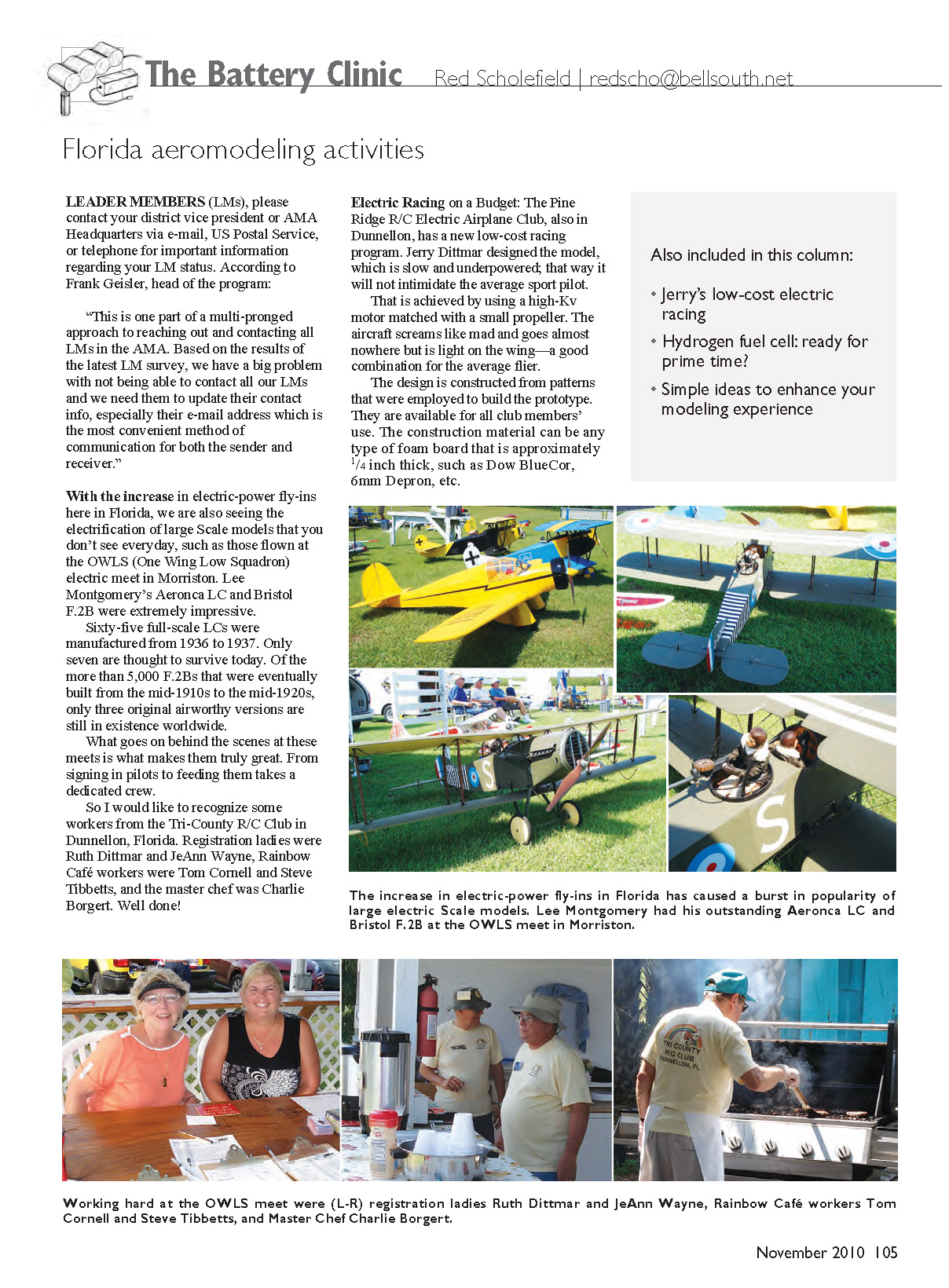
With the increase in electric‑power fly‑ins here in Florida, we are also seeing the electrification of large scale models that you don't see every day, such as those flown at the OWLS (One Wing Low Squadron) electric meet in Morriston. Lee Montgomery's Aeronca LC and Bristol F.2B were extremely impressive.
Sixty‑five full‑scale Aeronca LCs were manufactured from 1936 to 1937; only seven are thought to survive today. Of the more than 5,000 Bristol F.2Bs that were built from the mid‑1910s to the mid‑1920s, only three original airworthy examples are still in existence worldwide.
What goes on behind the scenes at these meets is what makes them truly great. From signing in pilots to feeding them, it takes a dedicated crew.
Tri‑County R/C Club recognition
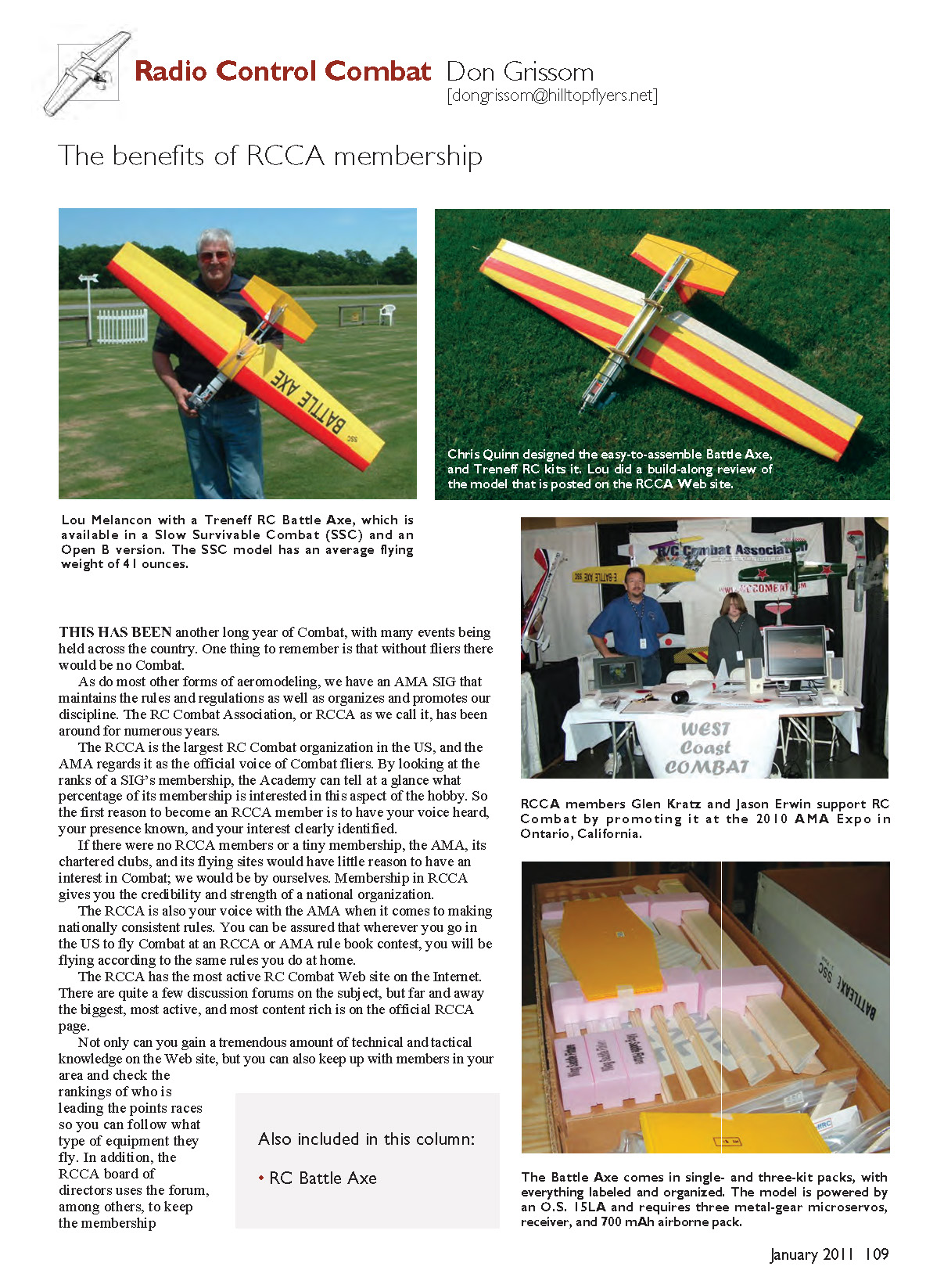
I would like to recognize some workers from the Tri‑County R/C Club in Dunnellon, Florida:
- Registration: Ruth Dittmar and JeAnn Wayne
- Rainbow Café: Tom Cornell and Steve Tibbetts
- Master chef: Charlie Borgert
Well done!
Electric Racing on a Budget
The Pine Ridge R/C Electric Airplane Club, also in Dunnellon, has a new low‑cost racing program. Jerry Dittmar designed the model to be slow and underpowered so it will not intimidate the average sport pilot.
Design features and construction
- The model uses a high‑Kv motor matched with a small propeller. The aircraft screams but goes almost nowhere; it is light on the wing—a good combination for the average flier.
- Construction is from patterns used to build the prototype. Patterns are available for all club members' use.
- Construction material can be any foam board approximately 1/4 inch thick, such as Dow BlueCor or 6 mm Depron.
- The model must have some form of landing gear suitable for unassisted takeoff at the start of a race. Landing is the pilot's responsibility.
Power system and performance
- Motor of choice: BP Hobbies 1450 Kv 2208/14 outrunner.
- ESC: pilot's choice.
- Typical draw: just under 12 amps on a 3S 1350 mAh Thunder Power battery, using a 7 x 4 APC Slow Flyer propeller.
- Caution: overpropping and running five laps at full throttle can overamp and burn up a motor.
Battery After much discussion, a three‑cell Li‑Poly battery (pilot's choice) may be used. The prototype used a 3S 1350 mAh Thunder Power battery.
Transcribed from original scans by AI. Minor OCR errors may remain.

