

The Battery Clinic — 2011/09
Predict your battery's performance
Red Scholefield | [email protected]
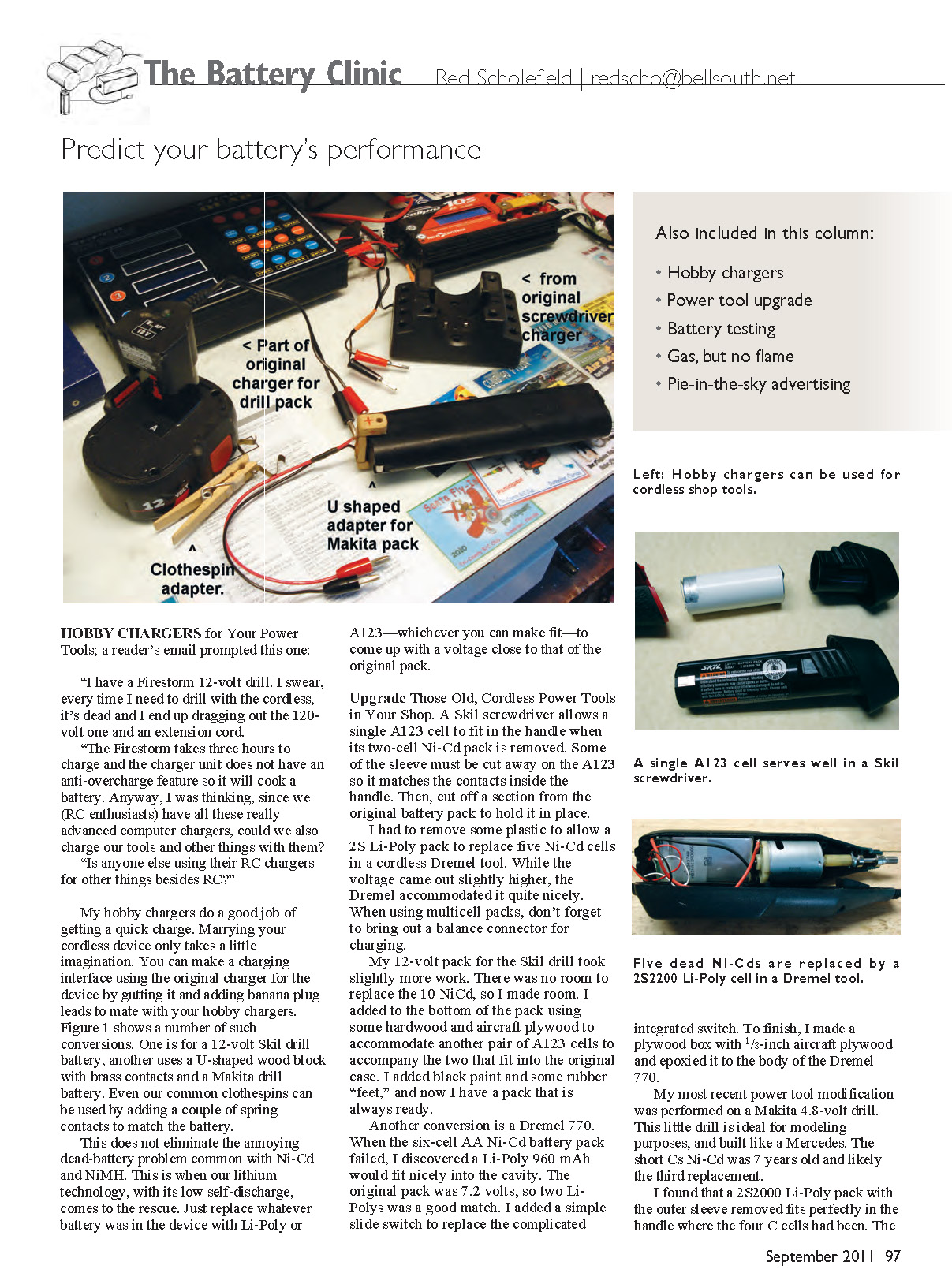
HOBBY CHARGERS for Your Power Tools; a reader's email prompted this one
"I have a Firestorm 12-volt drill. I swear, every time I need to drill with the cordless, it's dead and I end up dragging out the 120-volt one and an extension cord.
"The Firestorm takes three hours to charge and the charger unit does not have an anti-overcharge feature so it will cook a battery. Anyway, I was thinking, since we (RC enthusiasts) have all these really advanced computer chargers, could we also charge our tools and other things with them?
"Is anyone else using their RC chargers for other things besides RC?"
My hobby chargers do a good job of getting a quick charge. Marrying your cordless device only takes a little imagination. You can make a charging interface using the original charger for the device by gutting it and adding banana-plug leads to mate with your hobby chargers. Figure 1 shows a number of such conversions. One is for a 12-volt Skil drill battery; another uses a U-shaped wood block with brass contacts and a Makita drill battery. Even our common clothespins can be used by adding a couple of spring contacts to match the battery.
This does not eliminate the annoying dead-battery problem common with Ni-Cd and NiMH. This is when our lithium technology, with its low self-discharge, comes to the rescue. Just replace whatever battery was in the device with Li-Poly or A123—whichever you can make fit—to come up with a voltage close to that of the original pack.
Upgrade those old cordless power tools in your shop. A Skil screwdriver allows a single A123 cell to fit in the handle when its two-cell Ni-Cd pack is removed. Some of the sleeve must be cut away on the A123 so it matches the contacts inside the handle. Then cut off a section from the original battery pack to hold it in place.
I had to remove some plastic to allow a 2S Li-Poly pack to replace five Ni-Cd cells in a cordless Dremel tool. While the voltage came out slightly higher, the Dremel accommodated it quite nicely. When using multicell packs, don't forget to bring out a balance connector for charging.
My 12-volt pack for the Skil drill took slightly more work. There was no room to replace the 10 Ni-Cd, so I made room. I added to the bottom of the pack using some hardwood and aircraft plywood to accommodate another pair of A123 cells to accompany the two that fit into the original case. I added black paint and some rubber "feet," and now I have a pack that is always ready.
Another conversion is a Dremel 770. When the six-cell AA Ni-Cd battery pack failed, I discovered a Li-Poly 960 mAh would fit nicely into the cavity. The original pack was 7.2 volts, so two Li-Polys was a good match. I added a simple slide switch to replace the complicated integrated switch. To finish, I made a plywood box with 1/8-inch aircraft plywood and epoxied it to the body of the Dremel 770.
My most recent power tool modification was performed on a Makita 4.8-volt drill. This little drill is ideal for modeling purposes, and built like a Mercedes. The short C Ni-Cd pack was seven years old and likely the third replacement. I found that a 2S 2200 mAh Li-Poly pack with the outer sleeve removed fits perfectly in the handle where the four C cells had been. The label on the drill indicated it was a 4.8-volt unit and the voltage would be higher than original. However, I had a 7.2-volt Master Airscrew motor that, with some minor Dremel work on the rear support pad, fit nicely.
I removed the spur gear from the original motor and pressed it onto the Master Airscrew motor with the same shaft size. I searched the Internet for the Mabuchi RS-550SH motor and found that it was actually rated for 4.8 to 12 volts, so I could have used it.
When modifying any power tool you have to bring out the balance tap. I use Cellpro 4S chargers since I don't need the power leads for charging. If you use another charger, then connect the power leads to the original charge jack and create an adapter compatible with your charger. The tool can be used at any time since the self-discharge rate of lithium is very low.
The test of time
By testing batteries we gain insight into early performance by using equipment such as the Computerized Battery Analyzer III (CBA), which gives us a plot of the discharge.
Few of us have the resources to do life testing on packs, so we must rely on the experience of others who have used the battery. However, technology is constantly changing and patterns vary. What we begin tracking on battery performance can become invalid as the technology changes faster than our accumulation of data. Here is what I have found on the packs I have been "testing" by simply flying them and then collecting capacity data.
One interesting pack is the Sanyo eneloop NiMH. I obtained mine from Hangtime Hobbies in July 2009 and have used it in my Futaba 9C radio system, and later in my 7C when I converted to 2.4 GHz. I am fortunate that I can fly year-round in Florida, so batteries get a decent workout flying three days a week. I was surprised when I conducted a discharge test on the eneloop pack: there was no change in capacity in two years. I recommend buying this pack when you are ready to replace your existing one.
A PowerEdge Li-Poly 3S 2200 mAh I began using in July 2009 had an initial capacity of 2,194 mAh discharged at 450 mA. Discharged in April 2011 at 3 A, it gave a respectable 1,999 mAh. This pack has 22 cycles on it and some minor swelling.
An OKHobby Buffalo Li-Poly 3S 3200 mAh had an initial capacity of 3,140 mAh in August 2010. In April 2011, after 36 cycles, the capacity was 3,010 mAh. Both discharges were at 3.2 amps, and there was no swelling.
A TrueRC 3S 2500 mAh transmitter pack, used solely for backup, gave nearly the rated capacity when I first received it in February 2009. It was stored in my battery refrigerator. I noticed it was extremely swollen and decided to test it again. I gave it a full charge with a Cellpro 4S (I have several) and then discharged it at the 150 mA transmitter-simulated load on the CBA. It gave only 396 mAh. Charge and discharge were repeated on a different Cellpro 4S with the same results. This one was bad.
Note that none of these packs were driven to the low-voltage ESC cutoff; all were charged and balanced with the Cellpro chargers and none were discharged higher than 10C.
We can draw no definitive conclusions from tests only on one pack; only that these packs behaved as indicated under the use pattern and test regimes.
This swelling or puffing of Li-Polys is still somewhat of a mystery. No one has come up with a clear definition of what is happening or which gases are generated. The gases are believed to be flammable so I decided to check that out with the swollen TrueRC pack. Taking the proper safety precautions, I held a match next to the pack, made a small incision with a number 11 X-Acto blade, and squeezed the cell to force out any gases. I did this on each cell and nothing happened. Maybe different gases are generated by different kinds of pack abuse. Overcharge gives you one kind, deep-discharge another, and just normal use something else.
One would think as long as we have been using Li-Polys that someone would have come forward and shed some light on this mystery. Should you use a swollen or puffed pack? Some say to throw it away immediately (particularly those who are in the business of selling packs); others say to continue to use them as long as they continue to perform. I follow the latter, but I store swollen packs in a fireproof container.
Pie-in-the-Sky Department
It seems as though these are hitting us with increasing frequency. One recently touted the world's smallest petrol engine. One statement caught my eye: "At present, charging an ordinary battery to deliver one unit of energy involves putting 2,000 units into it." The article went on to state, "The engines got so hot they burned themselves out and could not be reused." I guess this one isn't ready for prime time.
Another startup company, Envia, may be a bit closer to reality with a new silicon-carbon nano-composite cathode design, which could result in batteries that can store twice the amount possible with current lithium-ion technology. This initiative is being funded by the United States Advanced Battery Consortium (a coalition between Chrysler, Ford, and General Motors). It might be one to watch.
Keep those cards and letters coming; I need all the motivation I can get. No email connection? Then drop me a note at the address listed below.
MA
Sources
- Red Scholefield
12219 NW 9th Ln. Newberry, FL 32669 www.hangtimes.com/redsbatteryclinic.html
- FMA Direct / Revolectrix (Cellpro chargers)
(800) 343-2934 www.fmadirect.com www.revolectrix.com
- West Mountain Radio (CBA III)
(262) 522-6503 www.westmountainradio.com
- Sanyo eneloop
- PowerEdge
(813) 765-0124 www.poweredgerc.com
- OKHobby
[email protected] www.okhobby.com
- TrueRC
(773) 203-8695 www.truerc.com
- Envia Systems Inc.
(510) 509-1367 www.enviasystems.com
Transcribed from original scans by AI. Minor OCR errors may remain.

