
What about C ratings on our LiPos?
Red Scholefield
I wrote about it approximately seven years ago, but with new pilots getting into electric-powered flight, it appears it is time to revisit the way LiPo vendors rate their packs.
It seems as though nearly all specify some continuous discharge rate, along with a burst rate. There is cause to suspect these ratings, particularly when they state that they are 20 C continuous or more.
One must look deeper. How hot does a pack get under these rates? You also need to consider how long it takes to dump all of the energy in a pack. At 20 C, you will get less than three minutes. At 40 C, expect less than 90 seconds.
If the pack temperature rises to much more than 140°, bad things happen internally to the pack, and capacity on subsequent discharges is significantly compromised. If the pack temperature is more than 160°, then you are in a danger zone.
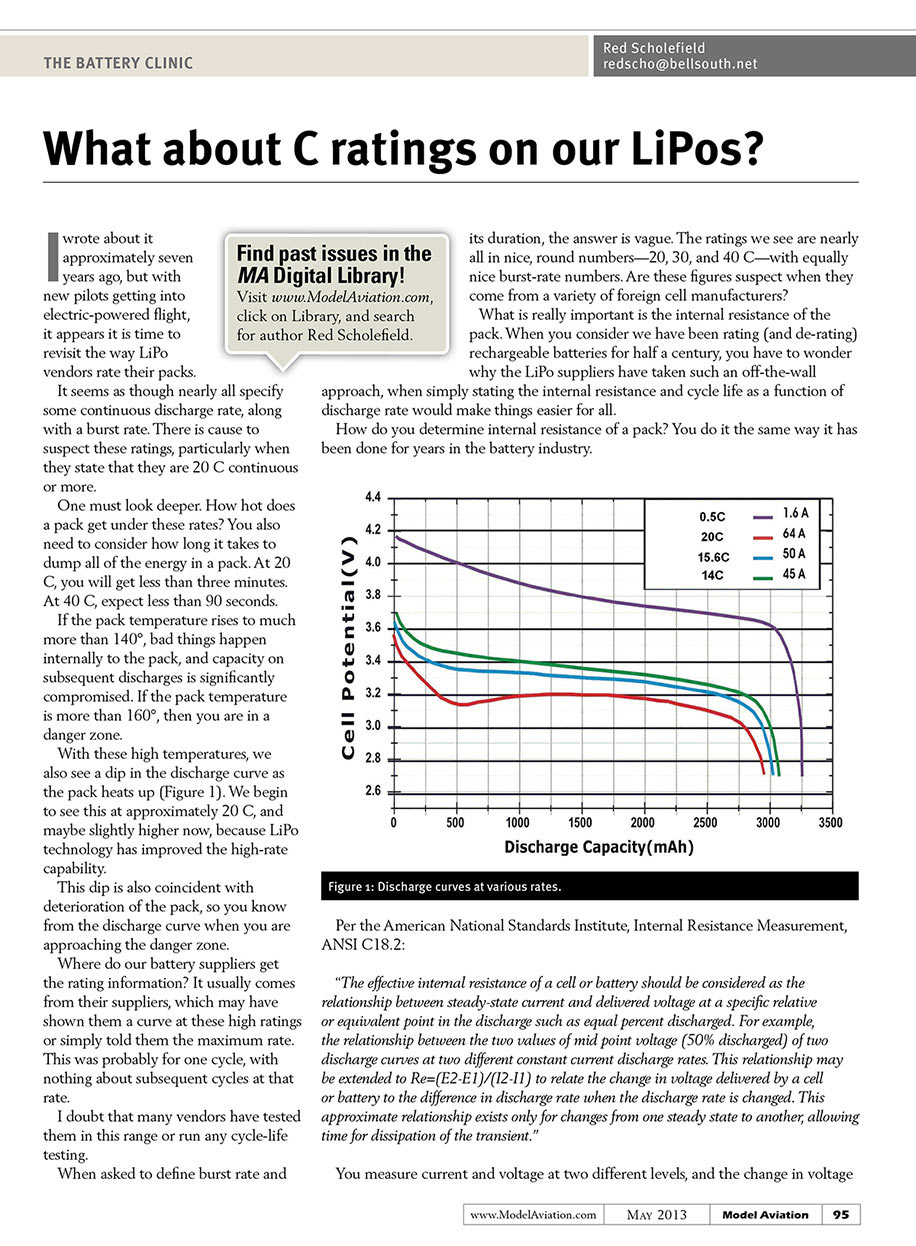
With these high temperatures, we also see a dip in the discharge curve as the pack heats up (Figure 1). We begin to see this at approximately 20 C, and maybe slightly higher now, because LiPo technology has improved the high-rate capability.
This dip is also coincident with deterioration of the pack, so you know from the discharge curve when you are approaching the danger zone.
Where do our battery suppliers get the rating information? It usually comes from their suppliers, which may have shown them a curve at these high ratings or simply told them the maximum rate. This was probably for one cycle, with nothing about subsequent cycles at that rate.
I doubt that many vendors have tested them in this range or run any cycle-life testing.
When asked to define burst rate and its duration, the answer is vague. The ratings we see are nearly all in nice, round numbers—20, 30, and 40 C—with equally nice burst-rate numbers. Are these figures suspect when they come from a variety of foreign cell manufacturers?
What is really important is the internal resistance of the pack. When you consider we have been rating (and de-rating) rechargeable batteries for half a century, you have to wonder why the LiPo suppliers have taken such an off-the-wall approach, when simply stating the internal resistance and cycle life as a function of discharge rate would make things easier for all.
How do you determine internal resistance of a pack? You do it the same way it has been done for years in the battery industry.
Per the American National Standards Institute, Internal Resistance Measurement, ANSI C18.2:
"The effective internal resistance of a cell or battery should be considered as the relationship between steady-state current and delivered voltage at a specific relative or equivalent point in the discharge such as equal percent discharged. For example, the relationship between the two values of mid point voltage (50% discharged) of two discharge curves at two different constant current discharge rates. This relationship may be extended to Re=(E2-E1)/(I2-I1) to relate the change in voltage delivered by a cell or battery to the difference in discharge rate when the discharge rate is changed. This approximate relationship exists only for changes from one steady state to another, allowing time for dissipation of the transient."
You measure current and voltage at two different levels, and the change in voltage divided by the corresponding change in current gives you the internal resistance.
You will need a wattmeter to do this. Use whatever model you have set up with the motor and ESC. Beginning with the pack between 40% and 60% discharged, record the voltage with a throttle setting that gives you a 1 C discharge, then advance the throttle to where you are drawing 10 C and measure the voltage again.
There are some battery chargers that will give you the internal resistance of the pack as part of the discharge function. Some of these also have a temperature probe that can be used to check pack temperatures.
From this you will have an idea of how your performance suffers as you push the packs at higher rates. The higher the discharge rate, the greater the voltage drop (E=I x R) you will see delivered to the power system because of the internal resistance. Heat generated in the battery is a function of the current squared, times the internal resistance: W=I^2 x R.
This brings me to the heating problem. A two-cell pack will dissipate heat better than three-, four-, or five-cell packs where one or more cells are nested inside the pack and there is no air flow. These packs still have the same 20, 30, and 40 C ratings, giving us even more reason to question.
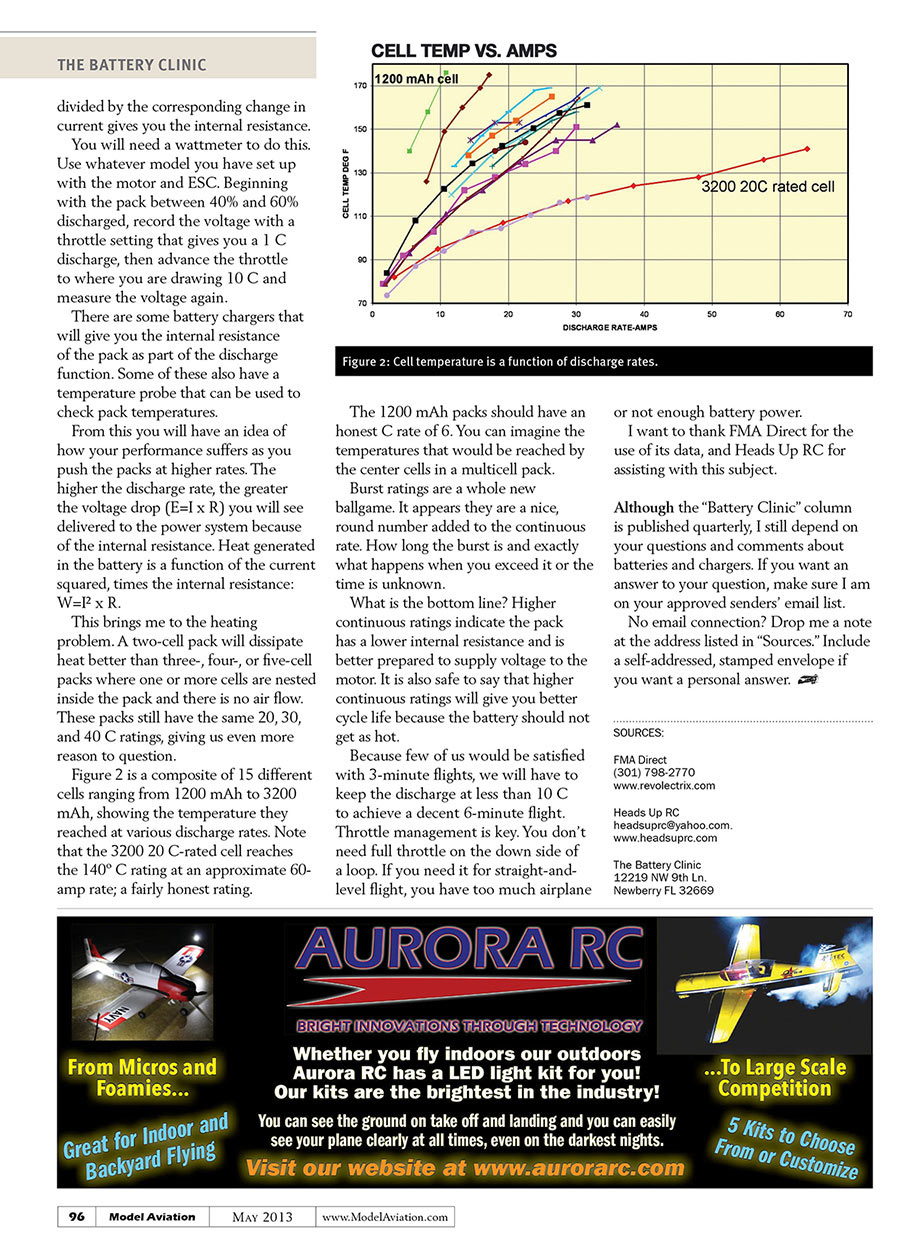
Figure 2 is a composite of 15 different cells ranging from 1200 mAh to 3200 mAh, showing the temperature they reached at various discharge rates. Note that the 3200 20 C-rated cell reaches the 140° C rating at an approximate 60-amp rate; a fairly honest rating.
The 1200 mAh packs should have an honest C rate of 6. You can imagine the temperatures that would be reached by the center cells in a multicell pack.
Burst ratings are a whole new ballgame. It appears they are a nice, round number added to the continuous rate. How long the burst is and exactly what happens when you exceed it or the time is unknown.
What is the bottom line? Higher continuous ratings indicate the pack has a lower internal resistance and is better prepared to supply voltage to the motor. It is also safe to say that higher continuous ratings will give you better cycle life because the battery should not get as hot.
Because few of us would be satisfied with 3-minute flights, we will have to keep the discharge at less than 10 C to achieve a decent 6-minute flight. Throttle management is key. You don't need full throttle on the down side of a loop. If you need it for straight-and-level flight, you have too much airplane or not enough battery power.
I want to thank FMA Direct for the use of its data, and Heads Up RC for assisting with this subject.
Although the "Battery Clinic" column is published quarterly, I still depend on your questions and comments about batteries and chargers. If you want an answer to your question, make sure I am on your approved senders' email list.
No email correction? Drop me a note at the address listed in "Sources." Include a self-addressed, stamped envelope if you want a personal answer.
SOURCES:
- FMA Direct
- (301) 798-2770
- www.revolectrix.com
- Heads Up RC
- [email protected]
- www.headsuprc.com
- The Battery Clinic
- 12219 NW 9th Ln.
- Newberry FL 32669
Transcribed from original scans by AI. Minor OCR errors may remain.

