
Where to store your models between flying sessions
Red Scholefield
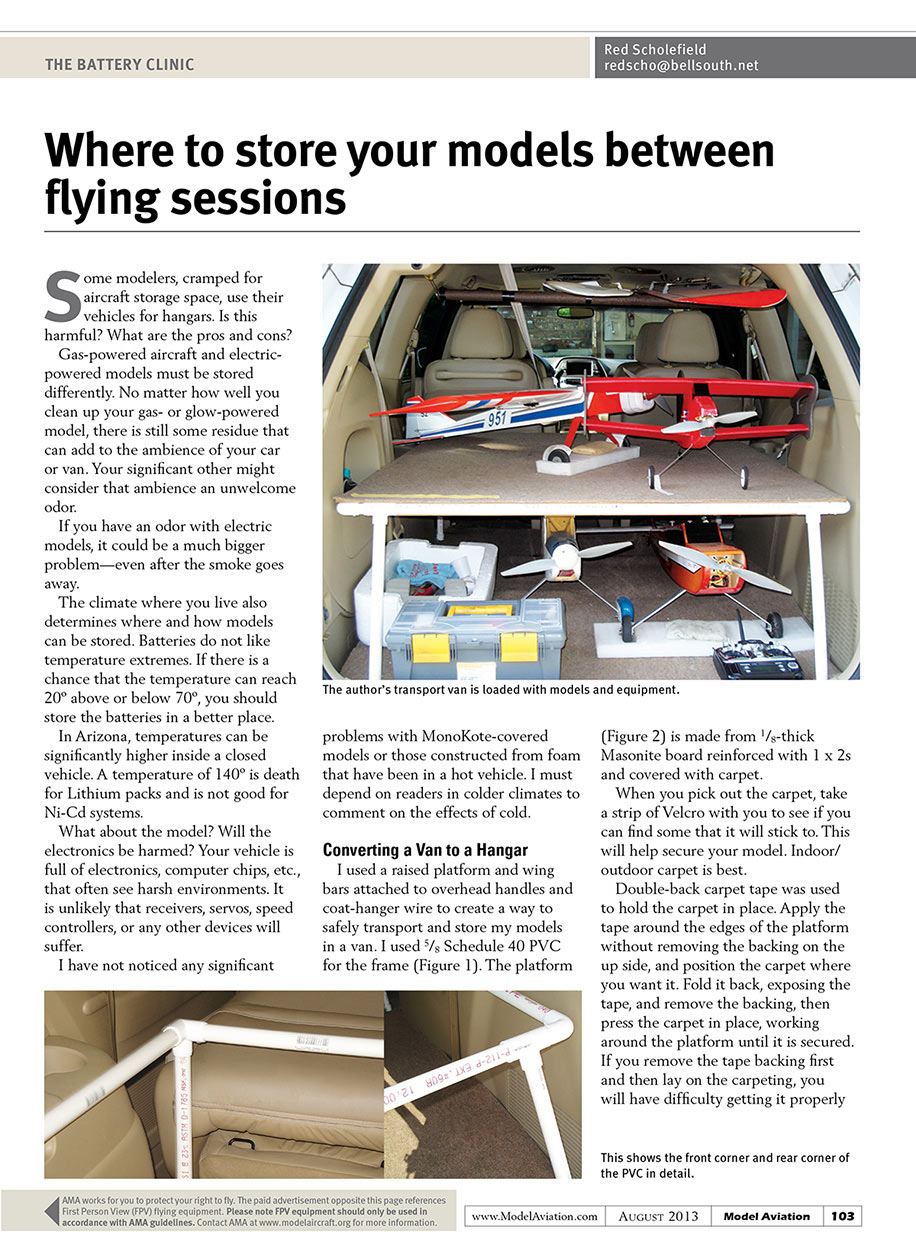
Some modelers, cramped for aircraft storage space, use their vehicles for hangars. Is this harmful? What are the pros and cons?
Gas-powered aircraft and electric-powered models must be stored differently. No matter how well you clean up your gas- or glow-powered model, there is still some residue that can add to the ambience of your car or van. Your significant other might consider that ambience an unwelcome odor.
If you have an odor with electric models, it could be a much bigger problem—even after the smoke goes away.
The climate where you live also determines where and how models can be stored. Batteries do not like temperature extremes. If there is a chance that the temperature can reach 20° above or below 70°, you should store the batteries in a better place.
In Arizona, temperatures can be significantly higher inside a closed vehicle. A temperature of 140° is death for Lithium packs and is not good for Ni-Cd systems.
What about the model? Will the electronics be harmed? Your vehicle is full of electronics, computer chips, etc., that often see harsh environments. It is unlikely that receivers, servos, speed controllers, or any other devices will suffer.
I have not noticed any significant problems with MonoKote-covered models or those constructed from foam that have been in a hot vehicle. I must depend on readers in colder climates to comment on the effects of cold.
Converting a Van to a Hangar
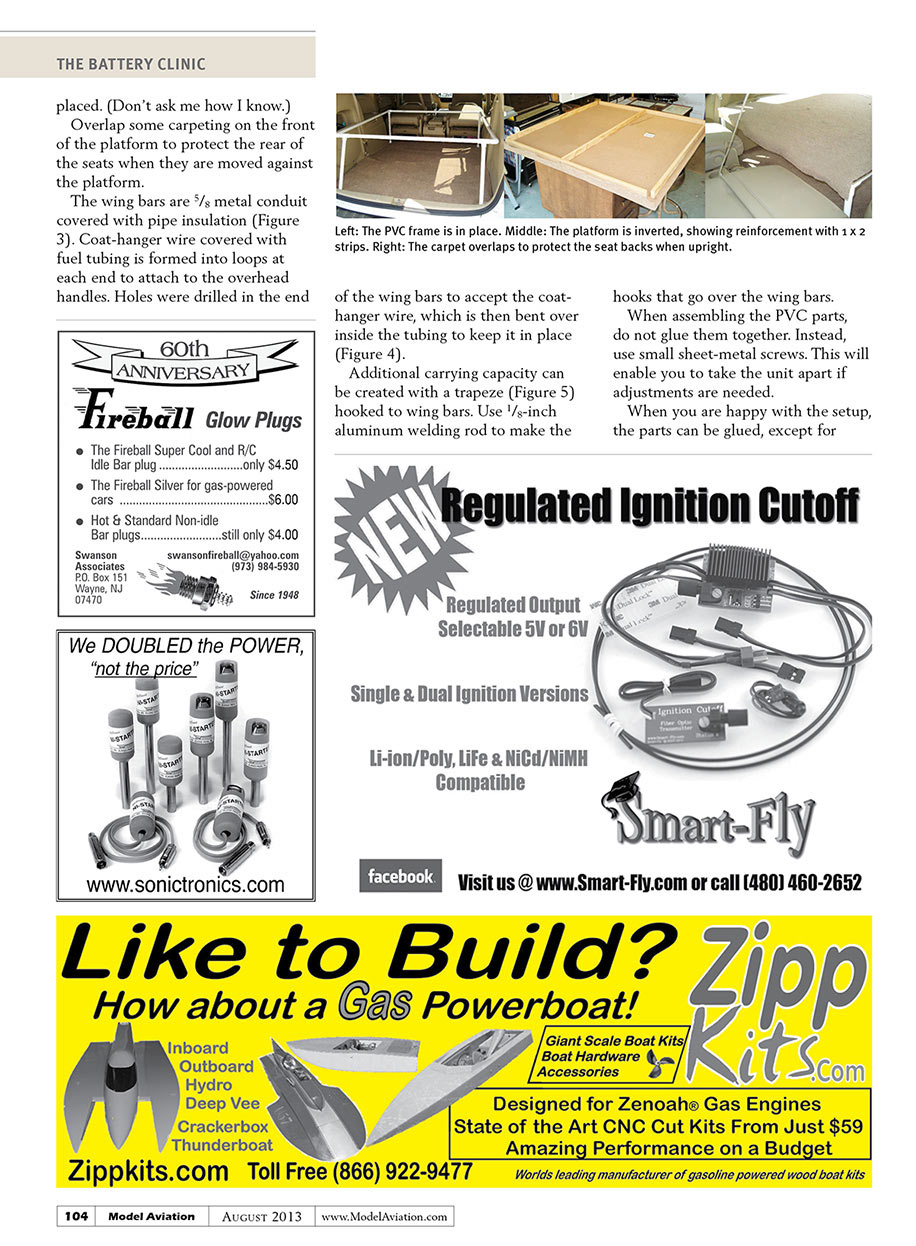
I used a raised platform and wing bars attached to overhead handles and coat-hanger wire to create a way to safely transport and store my models in a van. I used 5/8 Schedule 40 PVC for the frame (Figure 1). The platform (Figure 2) is made from 1/8-thick Masonite board reinforced with 1 x 2s and covered with carpet.
When you pick out the carpet, take a strip of Velcro with you to see if you can find some that it will stick to. This will help secure your model. Indoor/outdoor carpet is best.
Double-back carpet tape was used to hold the carpet in place. Apply the tape around the edges of the platform without removing the backing on the up side, and position the carpet where you want it. Fold it back, exposing the tape, and remove the backing, then press the carpet in place, working around the platform until it is secured. If you remove the tape backing first and then lay on the carpeting, you will have difficulty getting it properly positioned. (Don't ask me how I know.)
Overlap some carpeting on the front of the platform to protect the rear of the seats when they are moved against the platform.
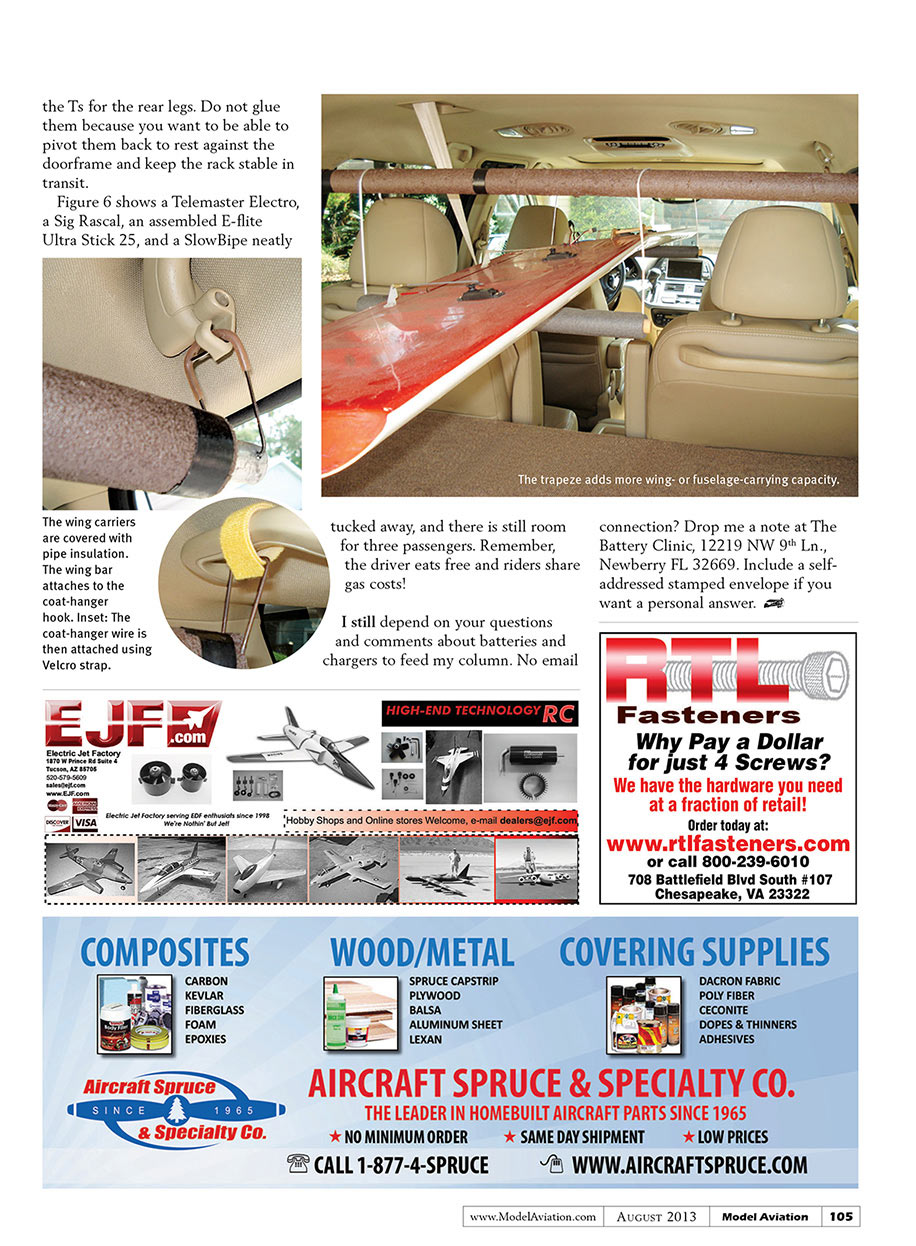
The wing bars are 5/8 metal conduit covered with pipe insulation (Figure 3). Coat-hanger wire covered with fuel tubing is formed into loops at each end to attach to the overhead handles. Holes were drilled in the end of the wing bars to accept the coat-hanger wire, which is then bent over inside the tubing to keep it in place (Figure 4).
Additional carrying capacity can be created with a trapeze (Figure 5) hooked to wing bars. Use 1/8-inch aluminum welding rod to make the hooks that go over the wing bars.
When assembling the PVC parts, do not glue them together. Instead, use small sheet-metal screws. This will enable you to take the unit apart if adjustments are needed. When you are happy with the setup, the parts can be glued, except for
Battery Clinic
Red Scholefield
tucked away, and there is still room for three passengers. Remember, the driver eats free and riders share gas costs!
I still depend on your questions and comments about batteries and chargers to feed my column. No email connection? Drop me a note at The Battery Clinic, 12219 NW 9th Ln., Newberry FL 32669. Include a self-addressed stamped envelope if you want a personal answer.
Transcribed from original scans by AI. Minor OCR errors may remain.

