

Battery selection for multirotor aircraft
Red Scholefield
“The time has come,” the Walrus said, “To talk of many things: Of shoes—and ships—and sealing-wax …” —Lewis Carroll Through the Looking-Glass
After more than eight years, “The Battery Clinic” column has come to an end. There has not been enough information about new batteries and systems for me to write about.
I am fortunate to have enlisted Craig Wainwright, a local modeler who has been working with multirotors for more than five years, to share his experience as a guest writer for my final column. Craig is a technical support engineer for General Electric and specializes in Linux.
Choosing the Best Battery for Your Multirotor
When choosing the best battery for your multirotor, there are a few things to consider, but you must first do some homework. My goal is to help you find the best batteries for your multirotor, based on the hardware requirements and application.
There are a couple of important things you should consider when doing any maintenance, testing, or troubleshooting with RC multirotor models. The first and most important is that you always remove the propellers when they are not necessary. I cannot stress enough the importance of this.
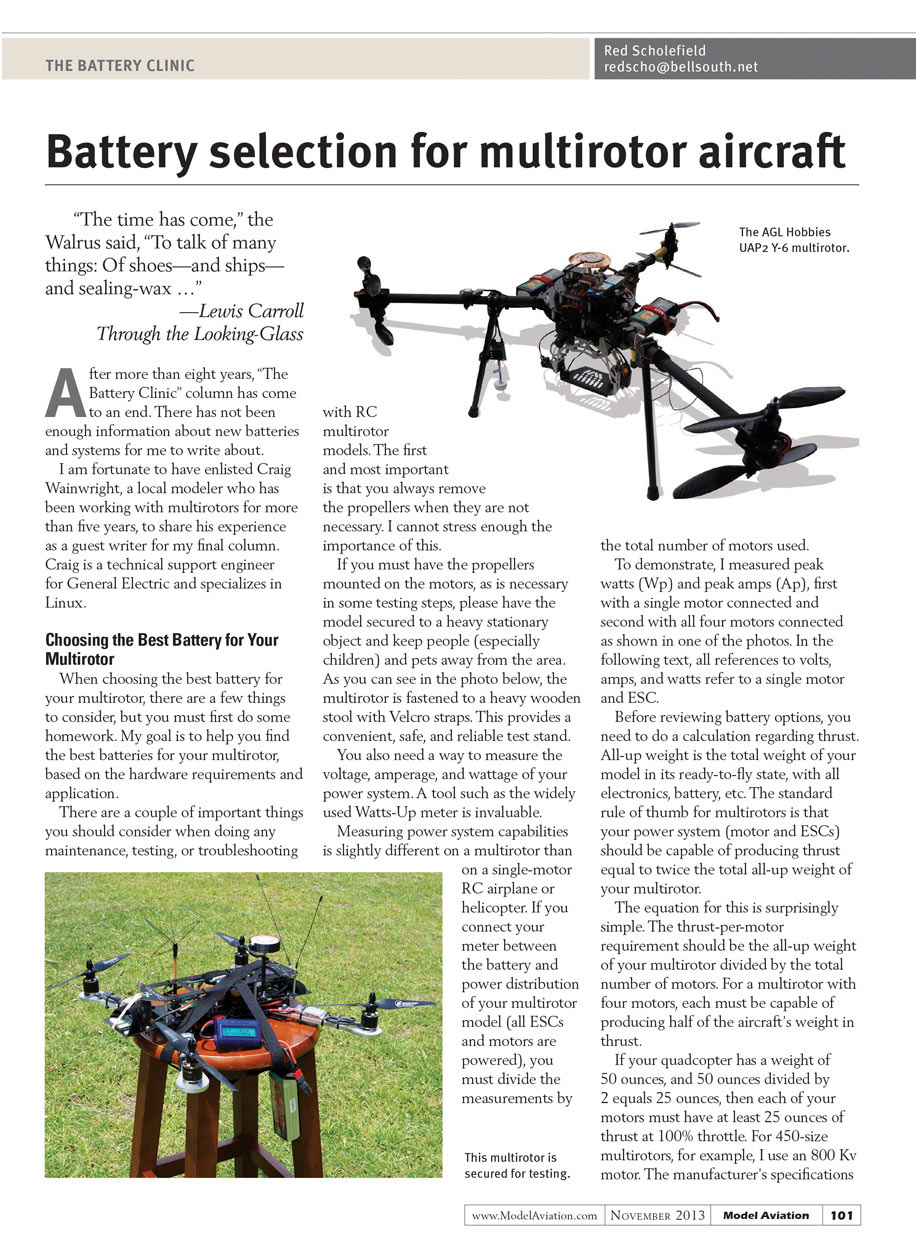
If you must have the propellers mounted on the motors, as is necessary in some testing steps, please have the model secured to a heavy stationary object and keep people (especially children) and pets away from the area. As you can see in the photo below, the multirotor is fastened to a heavy wooden stool with Velcro straps. This provides a convenient, safe, and reliable test stand.
You also need a way to measure the voltage, amperage, and wattage of your power system. A tool such as the widely used Watts-Up meter is invaluable.
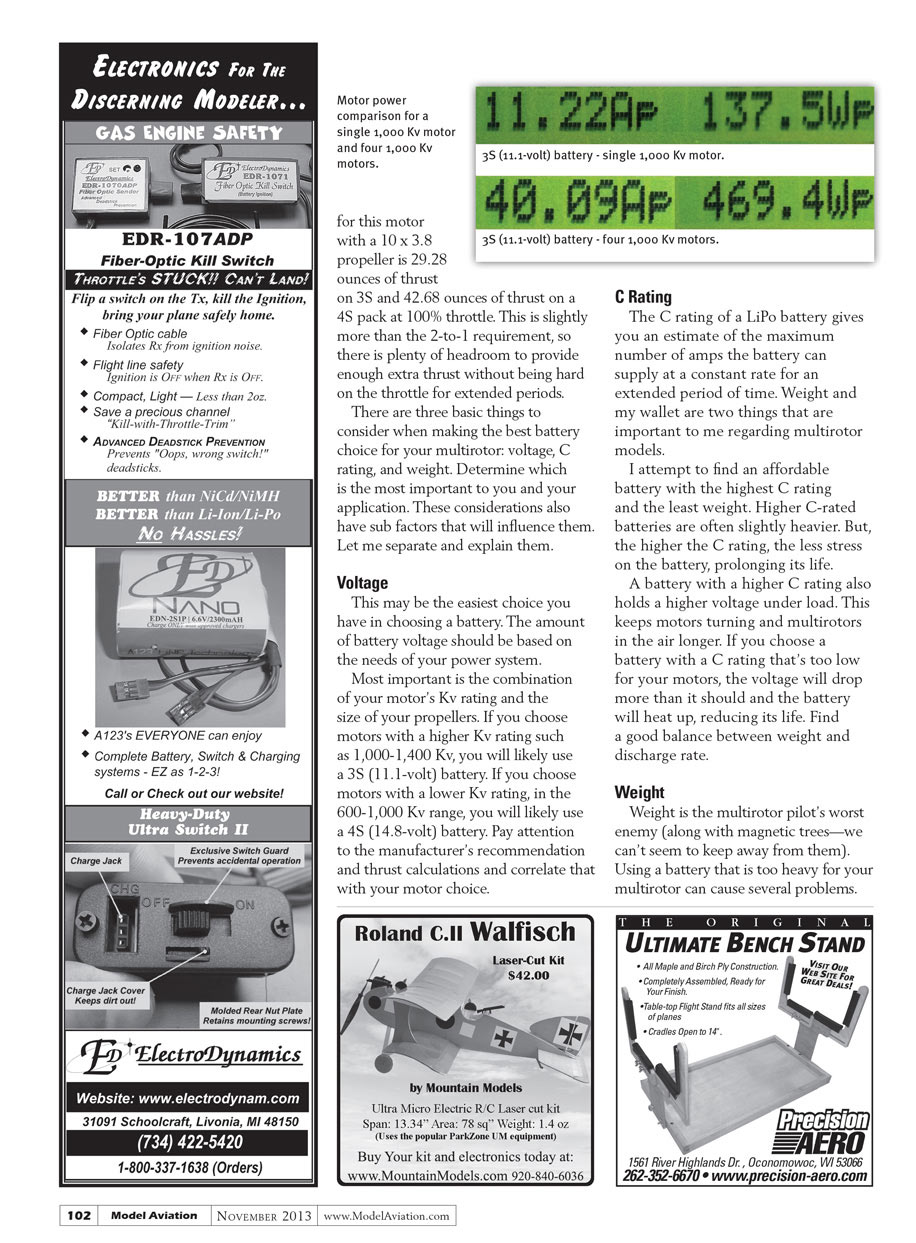
Measuring power system capabilities is slightly different on a multirotor than on a single-motor RC airplane or helicopter. If you connect your meter between the battery and power distribution of your multirotor model (all ESCs and motors are powered), you must divide the measurements by the total number of motors used.
To demonstrate, I measured peak watts (Wp) and peak amps (Ap), first with a single motor connected and second with all four motors connected as shown in one of the photos. In the following text, all references to volts, amps, and watts refer to a single motor and ESC.
Before reviewing battery options, you need to do a calculation regarding thrust. All-up weight is the total weight of your model in its ready-to-fly state, with all electronics, battery, etc. The standard rule of thumb for multirotors is that your power system (motor and ESCs) should be capable of producing thrust equal to twice the total all-up weight of your multirotor.
The equation for this is surprisingly simple. The thrust-per-motor requirement should be the all-up weight of your multirotor divided by the total number of motors. For a multirotor with four motors, each must be capable of producing half of the aircraft’s weight in thrust.
If your quadcopter has a weight of 50 ounces, and 50 ounces divided by 2 equals 25 ounces, then each of your motors must have at least 25 ounces of thrust at 100% throttle. For 450-size multirotors, for example, I use an 800 Kv motor.
Battery Clinic
The main drawback is unnecessary stress on your motors and ESCs. The heavier the load, the harder your motors and ESCs have to work to keep your multirotor in the air. The harder you push those parts, the shorter their life.
If you have a battery that is so heavy that it eats into the recommended thrust ratio, you will have shorter flight times and an undesirable performance.
Some manufacturers advertise batteries that are lighter and claim they retain the same power output as their heavier counterparts. Those tend to sag more than heavier ones.
You may consider choosing a battery that is slightly heavier, but has a higher C rating to prevent starving your multirotor of power. Some multirotor applications may require more than one, and possibly several, batteries.
My 1,000mm Y6 utilizes four batteries: two flight batteries in parallel for the flight system, ESC, and motors; one battery for the FPV pilot’s view; and one for the gimbal operation and camera operator view. In instances where multiple batteries are required, the weight factor becomes crucial. Lighter and more efficient parts may be needed to facilitate the additional battery weight.
Finding the perfect combination of electronics, hardware, and batteries for your multirotor is not complex. All it takes is some homework and making the right choice for the application.
Craig can be contacted at the email address listed in “Sources.”
I’m still available for consultation. Write me a letter if you can’t email. If something in the battery world worth writing about surfaces, I will try to do an article on it.
SOURCES:
Craig Wainwright [email protected]
The Battery Clinic 12219 NW 9th Ln. Newberry FL 32669
Transcribed from original scans by AI. Minor OCR errors may remain.

