
Blade mCP X
Mark Fadely
Every so often a new product is released that sets the example for others to follow. That is exactly what happened recently when Horizon Hobby put the Blade mCP X ultramicro RC helicopter on the market. MA was one of the first groups to get its hands on one of these sensational models.
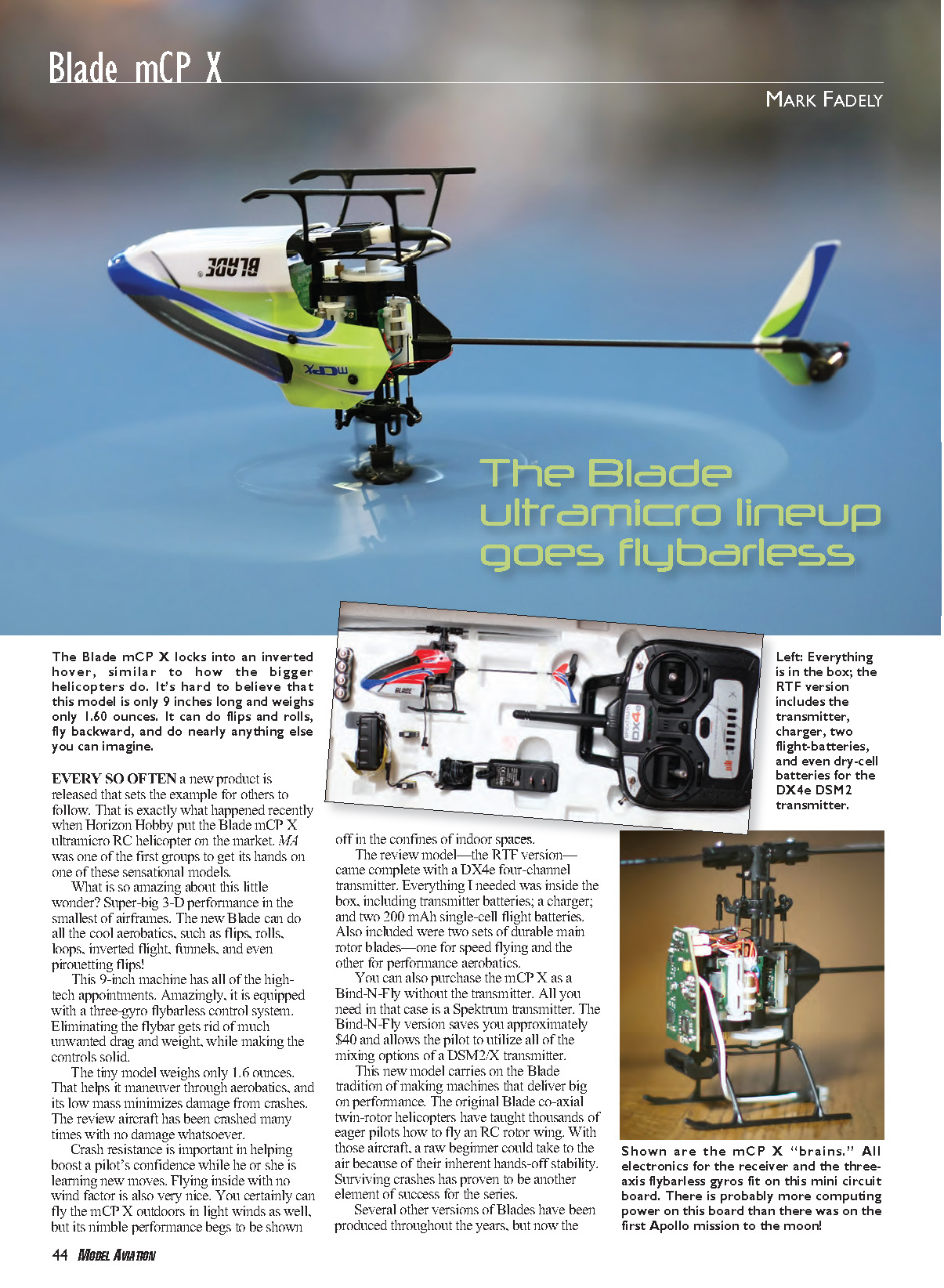
The Blade mCP X locks into an inverted hover, similar to how the bigger helicopters do. It's hard to believe that this model is only 9 inches long and weighs only 1.6 ounces. It can do flips and rolls, fly backward, and perform nearly anything else you can imagine.
What is so amazing about this little wonder? Super-big 3-D performance in the smallest of airframes. The new Blade can do all the cool aerobatics, such as flips, rolls, loops, inverted flight, funnels, and even pirouetting flips.
This 9-inch machine has all of the high-tech appointments. Amazingly, it is equipped with a three-gyro flybarless control system. Eliminating the flybar reduces unwanted drag and weight while making the controls solid.
The tiny model weighs only 1.6 ounces. That helps it maneuver through aerobatics, and its low mass minimizes damage from crashes. The review aircraft has been crashed many times with no damage whatsoever. Crash resistance is important in helping boost a pilot’s confidence while he or she is learning new moves. Flying inside with no wind factor is also very nice. You certainly can fly the mCP X outdoors in light winds as well, but its nimble performance begs to be shown off in the confines of indoor spaces.
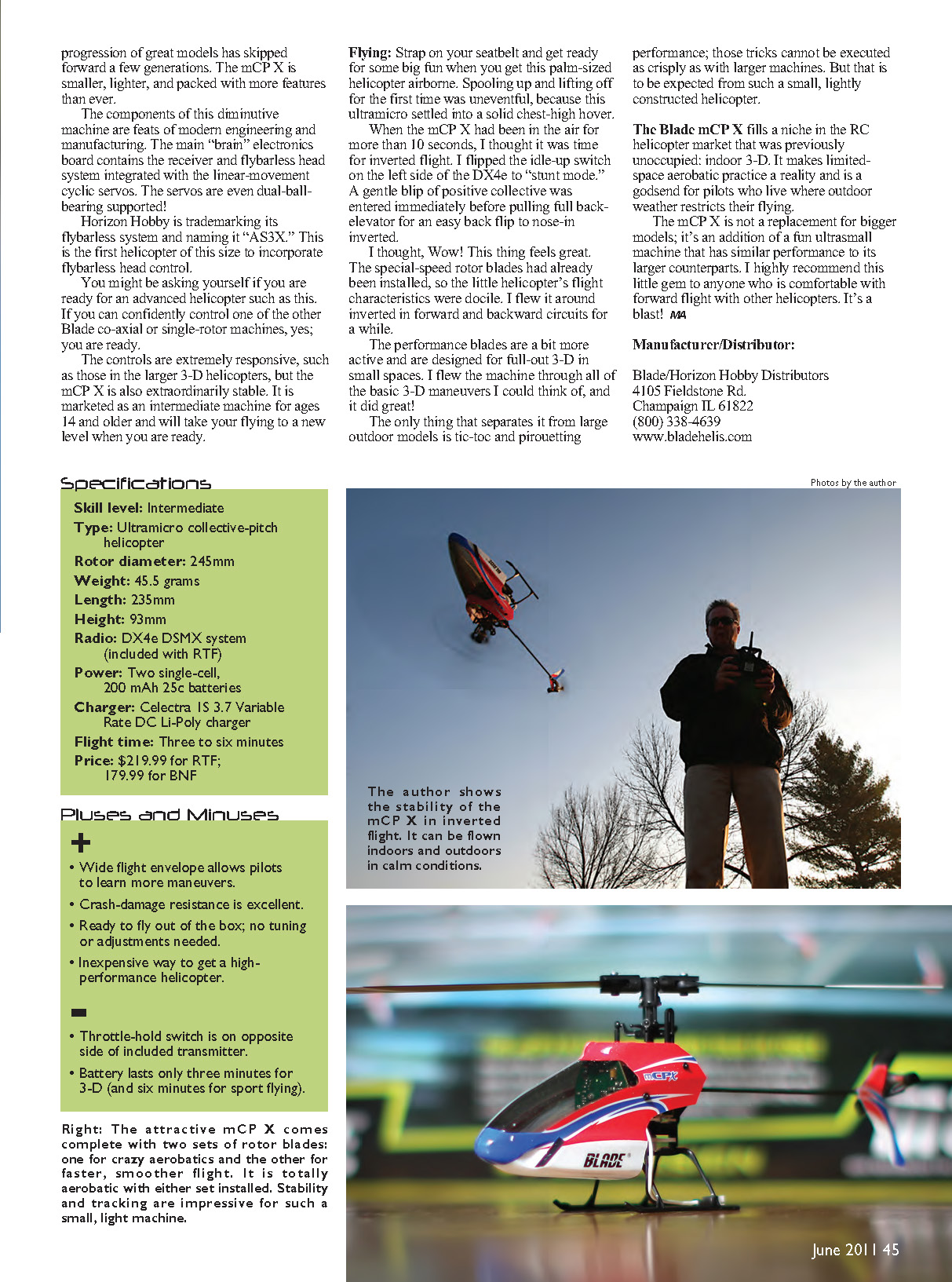
The review model — the RTF version — came complete with a DX4e four-channel transmitter. Everything I needed was inside the box, including transmitter batteries, a charger, and two 200 mAh single-cell flight batteries. Also included were two sets of durable main rotor blades — one for speed flying and the other for performance aerobatics.
You can also purchase the mCP X as a Bind-N-Fly (BNF) without the transmitter. All you need in that case is a Spektrum transmitter. The Bind-N-Fly version saves you approximately $40 and allows the pilot to utilize all of the mixing options of a DSM2/X transmitter.
This new model carries on the Blade tradition of making machines that deliver big on performance. The original Blade coaxial twin-rotor helicopters have taught thousands of eager pilots how to fly an RC rotor wing. With those aircraft, a raw beginner could take to the air because of their inherent hands-off stability. Surviving crashes has proven to be another element of success for the series.
Several other versions of Blade helicopters have been produced throughout the years, but now the progression of great models has skipped forward a few generations. The mCP X is small, smaller, lighter, and packed with more features than ever.
The components of this diminutive machine are feats of modern engineering and manufacturing. The main electronics "brain" board contains the receiver and flybarless head system integrated with the linear-movement cyclic servos. The servos are even dual-ball-bearing supported.
Horizon Hobby is trademarking its flybarless system and naming it "AS3X." This is the first helicopter of this size to incorporate flybarless head control.
You might be asking yourself if you are ready for an advanced helicopter such as this. If you can confidently control one of the other Blade coaxial or single-rotor machines, yes — you are ready. The controls are extremely responsive, similar to those in larger 3-D helicopters, but the mCP X is also extraordinarily stable. It is marketed as an intermediate machine for ages 14 and older and will take your flying to a new level when you are ready.
Flying
Strap on your seatbelt and get ready for some big fun when you get this palm-sized helicopter airborne. Spooling up and lifting off for the first time was uneventful, because this ultramicro settled into a solid chest-high hover.
When the mCP X had been in the air for more than 10 seconds, I thought it was time for inverted flight. I flipped the idle-up switch on the left side of the DX4e to "stunt mode." A gentle blip of positive collective was entered immediately before pulling full back-elevator for an easy back flip to nose-in inverted.
I thought, "Wow! This thing feels great." The special-speed rotor blades had already been installed, so the little helicopter’s flight characteristics were docile. I flew it around inverted in forward and backward circuits for a while.
The performance blades are a bit more active and are designed for full-out 3-D in small spaces. I flew the machine through all of the basic 3-D maneuvers I could think of, and it did great!
The only thing that separates it from large outdoor models is tic-toc and pirouetting performance; those tricks cannot be executed as crisply as with larger machines. But that is to be expected from such a small, lightly constructed helicopter.
The Blade mCP X fills a niche in the RC helicopter market that was previously unoccupied: indoor 3-D. It makes limited-space aerobatic practice a reality and is a godsend for pilots who live where outdoor weather restricts their flying.
The mCP X is not a replacement for bigger models; it's an addition — a fun ultrasmall machine that has similar performance to its larger counterparts. I highly recommend this little gem to anyone who is comfortable with forward flight with other helicopters. It’s a blast! MA
Manufacturer/Distributor
Blade/Horizon Hobby Distributors 4105 Fieldstone Rd. Champaign, IL 61822 (800) 338-4639 www.bladehelis.com
Specifications
- Skill level: Intermediate
- Type: Ultramicro collective-pitch helicopter
- Rotor diameter: 245 mm
- Weight: 45.5 grams (1.6 ounces)
- Length: 235 mm (approximately 9 in.)
- Height: 93 mm
- Radio: DX4e DSMX system (included with RTF)
- Power: Two single-cell, 200 mAh 25C batteries
- Charger: Celectra 1S 3.7 Variable Rate DC Li-Poly charger
- Flight time: Three to six minutes
- Price: $219.99 for RTF; $179.99 for BNF
Pluses and Minuses
- Wide flight envelope allows pilots to learn more maneuvers.
- Crash-damage resistance is excellent.
- Ready to fly out of the box; no tuning or adjustments needed.
- Inexpensive way to get a high-performance helicopter.
- Throttle-hold switch is on the opposite side of the included transmitter.
- Battery lasts only three minutes for 3-D (and six minutes for sport flying).
Transcribed from original scans by AI. Minor OCR errors may remain.

