
Born to Fly
Jim T. Graham | [email protected]
The Yuri Higuchi story
I'm going back in time to write about one of the early 3-D innovators. Most of us don't know who invented many of the 3-D maneuvers we do every day.
Flying 3-D is a fairly new concept to aeromodeling. No matter how long one has been in the hobby, a pilot exploiting and stretching the envelope at the flying field is a sight to behold. It makes most modelers want to try it—even those who may not otherwise be part of this interest. That is probably why 3-D flying is gaining so much popularity among modelers.
Many pilots have paved the way for this innovative form of flying. Modelers and manufacturers have spent countless hours developing aircraft and equipment to perform these 3-D maneuvers.
With John Sabini's help, I'm going to write about one such innovator—Yuri Higuchi—in the hopes of encouraging more modelers to tell their stories of the hobby they love.
Yuri is a master craftsman and a licensed A&P (airframe and powerplant) mechanic from Long Island, New York. He developed a passion for model airplanes at a young age. He would ride his bicycle to nearby hobby shops, fascinated by the airplanes he dreamed of someday building and flying.
At age eight Yuri began building balsa-and-tissue-covered airplanes. He spent hours on minute details that set his models apart from others. His building and flying abilities were evident.
When Yuri was 13 his mother and sisters bought him his first radio-control system, a Futaba unit. He started practicing and learning to fly on his own on the side streets of his neighborhood and at the local schoolyard.
Yuri learned about a club in the area, and on his second day at the local flying field he was immediately signed off as a pilot. He performed more than 20 landings that day.
Two years later he received a Carl Goldberg Skylark 56 kit for his birthday. Yuri had the airplane ready to fly in less than 24 hours. He constructed it and covered it in the three-color MonoKote scheme depicted on the kit box.
His superb craftsmanship and speedy work were so impressive that others took notice. RC modelers began lining up to have Yuri build and paint their airplanes. Eventually he was earning enough money to support his passion.
One of his customers and admirers picked him up every day after school and took him to the Port Washington Flight Club. There, at age 15, he practiced and taught others how to fly.
Yuri began designing model airplanes with Andrea Pasquarelli for the engineering department of Manhattan College to compete against designers and pilots from approximately 100 colleges for the SAE Heavy Lift Design competition in Dayton, Ohio, in 1996. Their model design, along with Yuri’s piloting, earned Manhattan College 11th place.
He and Andrea eventually started their own business. They designed 3-D models for Kangke such as the Extra 300, Laser 200, Texas Hurricane, and Rear-Wind Speedster. They introduced anodized aluminum control horns and pushrods to the market through their company, UCV Manufacturing.
Yuri stepped up to bigger models, purchasing his first 37% Almost Ready-to-Cover Precision Aviation Extra 300S and applying his own custom MonoKote scheme.
Yuri is one of the best MonoKote artists. His technique is stunning and flawless, and it has earned him many finishing awards. He added his unique top-half quick-pin-release cowl along with a quick-release canopy.
That Extra 300S won Best MonoKote and Best Aerobatic Aircraft in static competition at the 1996 WRAM Show in Westchester, New York, and the People’s Choice Award at the 8th Jumbo Jamboree in Mercer, New Jersey.
Yuri attended many Tournament of Champions (TOC) events in the mid- to late 1980s and 1990s. He remembers Hanno Prettner introducing music to a freestyle routine and seeing waterfalls and knife-edge spins there. Chip Hyde started torque rolling up high at one of the TOC events; later Quique Somenzini came back torque rolling lower to the ground. Yuri was hooked. This was the beginning of 3-D. Events such as the TOC pushed the hobby, pilots, and equipment to new heights and gave motivation to experiment and try new things.
At one TOC Yuri met Andreas of FiberClassics, and at the Toledo R/C Expo he ordered a FiberClassics 40% Giles 202. He also met Dave Johnson of Desert Aircraft and ordered a DA-150 engine. Since the beginning Yuri had flown Futaba equipment, so he upgraded to a 9Z radio system and finished the model in time for the next TOC.
Yuri drove out to Las Vegas and flew after-hours with the competing pilots. There he met Jason Shulman and let Jason fly the Giles 202. Jason loved the airplane so much that two days before the competition he asked Yuri if he could fly it in the TOC.
Dave Johnson assured Yuri that if anything happened to the model he would take responsibility. To sweeten the deal, Dave and Andreas gave Yuri a bargain on a new Giles 202 and a DA-150.
At that point Yuri had two airplanes with which to practice. He learned from those early TOC pilots to fly all the 3-D maneuvers using the 40% Giles 202. Many people don't do that; however, he perfected the maneuvers and practiced them constantly, burning about 15 gallons of fuel every week.
Then Yuri started competing in the International Miniature Aerobatic Club (IMAC). He sold all his smaller airplanes and helicopters so he could concentrate on flying large scale aerobatics models in competition. This paid off: Yuri became the 1999 and 2000 Northeast Unlimited Champion and finished in second place in 2001.
Jason Shulman and Yuri met up again that spring at the Joe Nall Fly-In. Both flew FiberClassics models. While flying, they decided to torque roll over the pond. It created roars and cheers. They started a trend, and everyone who dared joined in that evening over the pond.
At this time Yuri was working at Larry's Hobby Shop in Commack, New York. There he met many modelers who were interested in the new 3-D flight. Yuri helped many kids find a great hobby, and veteran modelers loved the technical knowledge he had of equipment, building techniques, and flying.
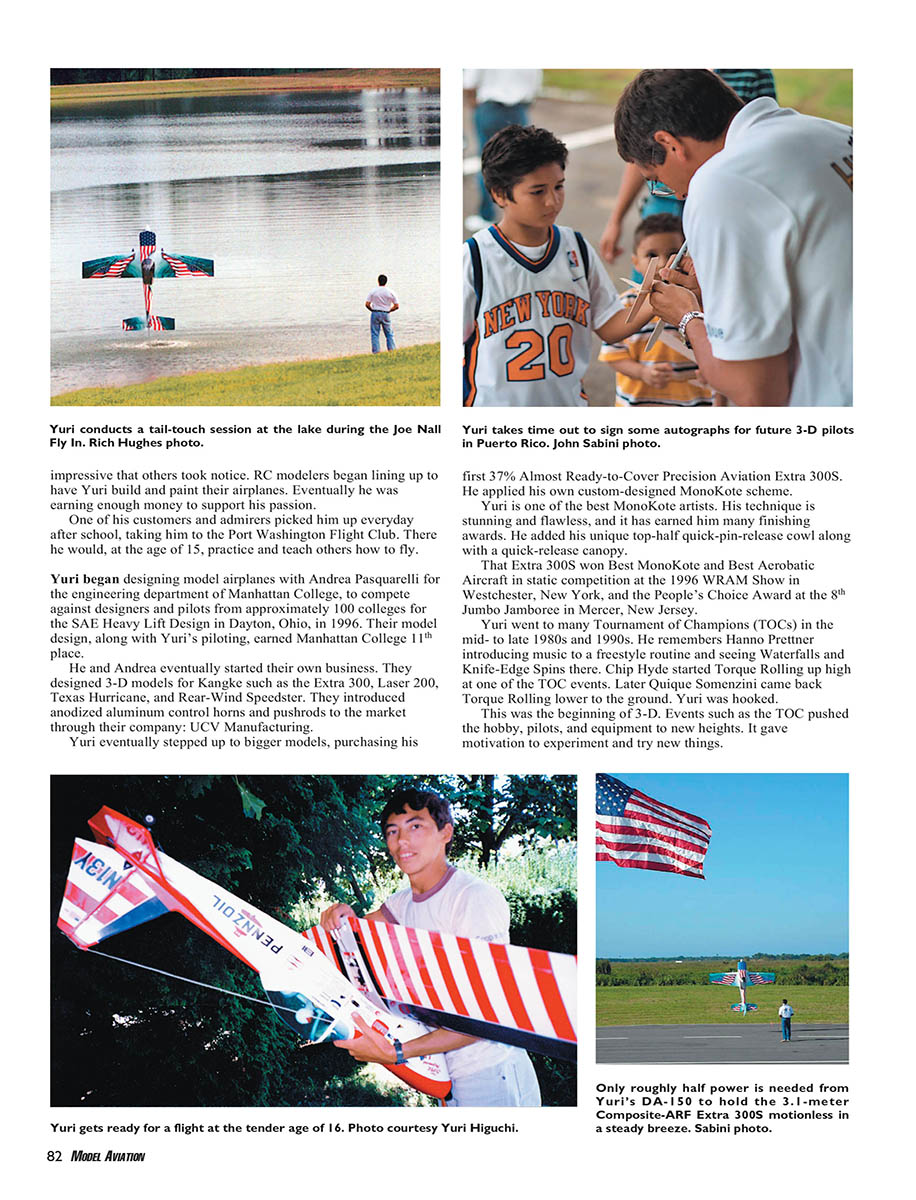
Yuri was known for his extraordinary abilities not only to fly, but to design and build models as well. His friends and business partners challenged him to build a 40%-plus-size aircraft from scratch and have it ready for the 2001 Westchester Radio Aero Modelers Show, which was nine and a half weeks away.
He put in 500 hours to unveil an all-balsa stick model of a 45% Extra 330SX. The aircraft was a masterpiece that was ahead of its time. Powered with a DA-150 engine, it was the largest 3-D scale aerobatics aircraft to date. At 42 pounds and spanning 135 inches, it was the lightest model of its size built.
The 330SX won Best Finish and Best Aerobatic Aircraft at the 2001 WRAM Show. The beautiful custom MonoKote color scheme is copied endlessly by many ARF manufacturers today.
Yuri pioneered many signature 3-D maneuvers, such as the climbing inverted flat spin, the high-alpha rollers, and the pogo stick. He had his award-winning Extra 330 at the Joe Nall, and it was a showstopper even sitting on the ground. He often waited until it quieted down that evening before flying.
When he flew his 45% Extra, no one imagined they would see new 3-D maneuvers performed so low to terra firma. It got everyone back out again and people crowded around him.
Back then no one did those 3-D maneuvers as low to the ground as Yuri did. He started a trend. People were amazed to see the 135-inch Extra high-alpha rolling straight down the runway with the wingtips inches off the ground, stopping at eye level, and then climbing out in an inverted flat spin.
Torque-rolling at will was Yuri's forte. He would pogo the torque roll almost as if the airplane would slam the tail into the ground. People went crazy.
A pilot next to Yuri at the Joe Nall who watched in amazement was Frank Noll. Yuri looked over and, without hesitation, said, "Here, you try it," and gave Frank the 9Z transmitter.
In an unexpected twist, Joe Nall event announcer Bob Sadler asked little Aaron Hayes — a boy who had suffered misfortune and had been given an airplane ride and a model airplane — if there was anything else those at Joe Nall could do for him. Aaron said he wanted to meet Yuri and get his autograph. The crowd went nuts.
Yuri came back to the Triple Tree Aerodrome in Woodruff, South Carolina, to win with his prized Extra at the 2001 Don Lowe Masters, taking first place in Freestyle, and he finished fourth at the 2002 Extreme Flight Championships (XFC).
Yuri relocated to Anthem, Arizona, so he could enjoy flying and riding his motorcycle year-round. His sponsor and friend Dave Johnson invited him to compete in the 2004 Tucson Shootout.
Yuri had an accident on his motorcycle the day before the competition, but it did not stop him from flying at the contest. Scarred and bruised, Yuri laughed at his second-to-last-place finish. As he always says, "Half of it is just showing up and talking to people."
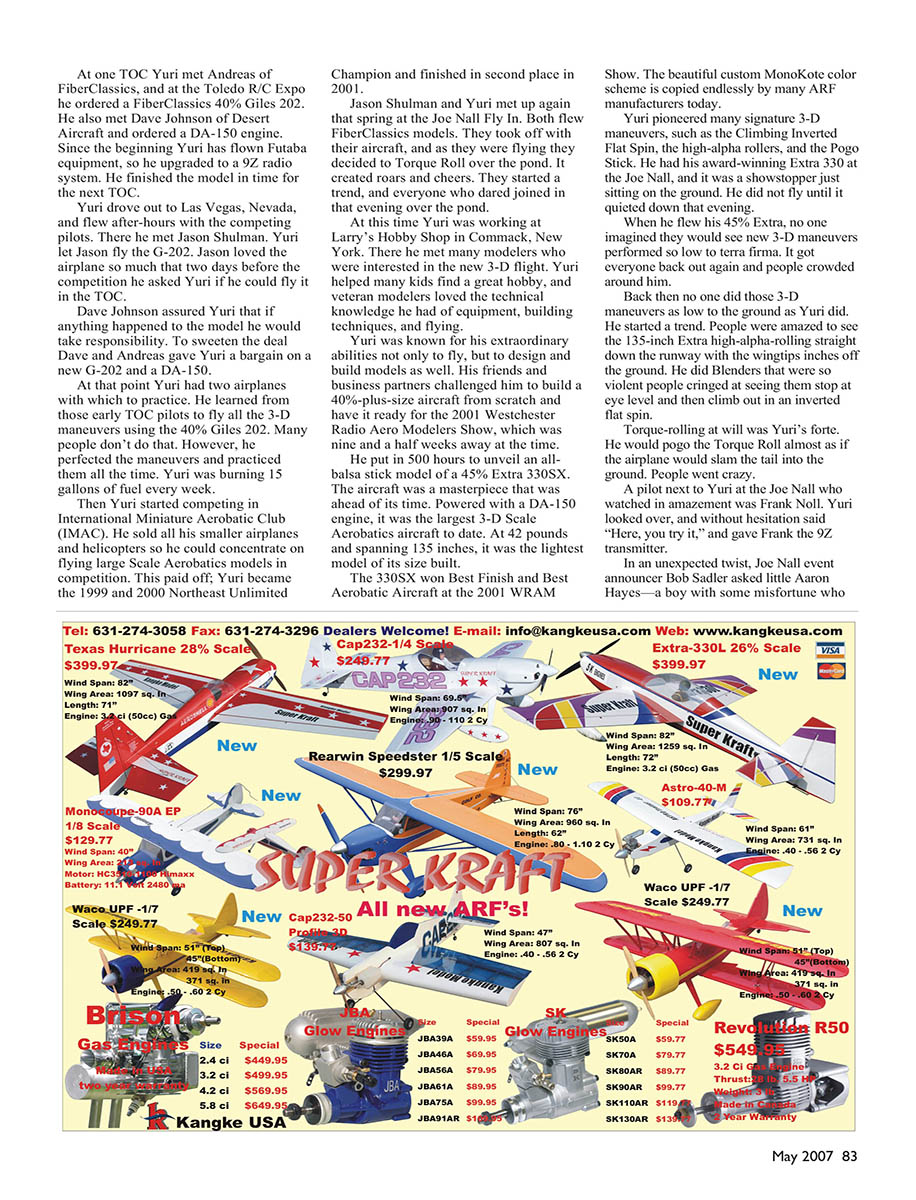
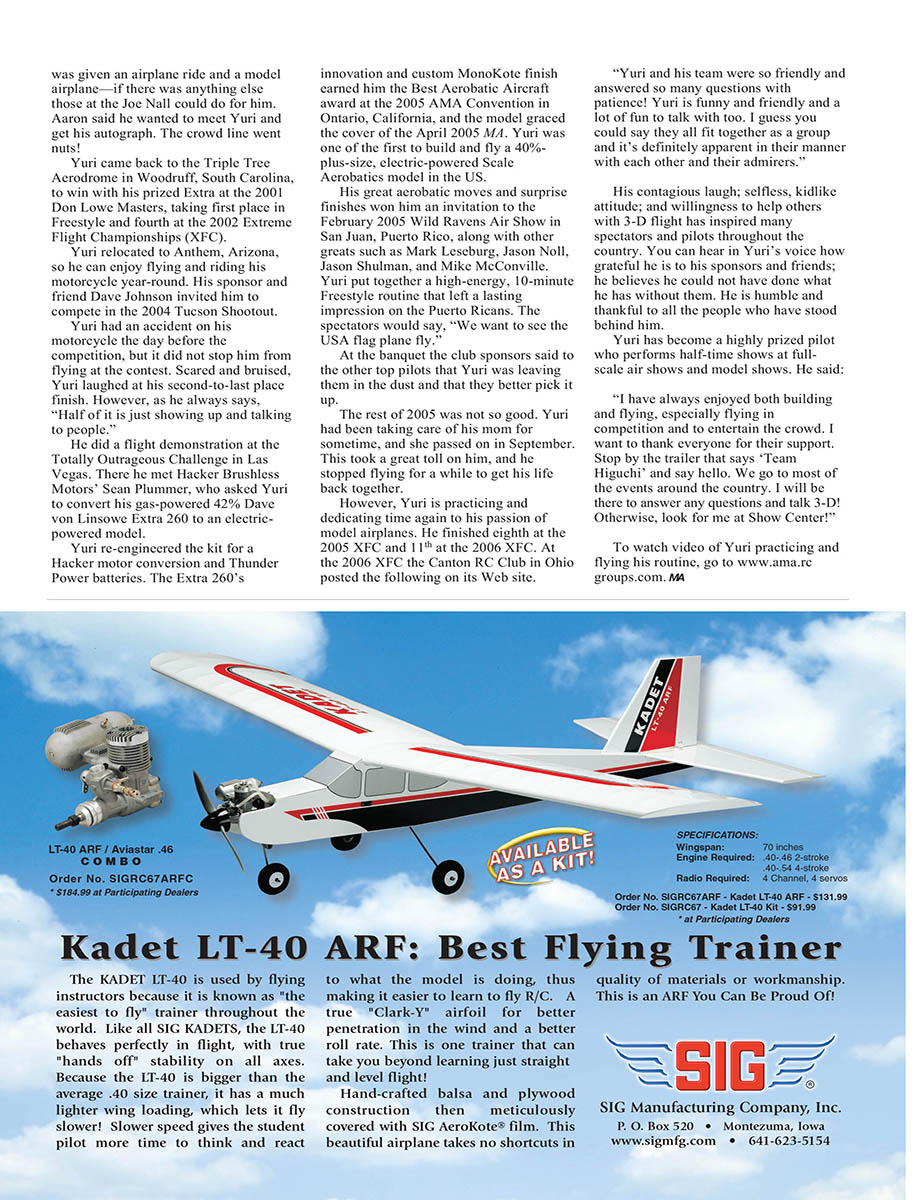
He did a flight demonstration at the Totally Outrageous Challenge in Las Vegas. There he met Hacker Brushless Motors' Sean Plummer, who asked Yuri to convert his gas-powered 42% Dave von Linsowe Extra 260 to an electric-powered model.
Yuri re-engineered the kit for a Hacker motor conversion and Thunder Power batteries. The Extra 260's innovation and custom MonoKote finish earned him the Best Aerobatic Aircraft award at the 2005 AMA Convention in Ontario, California, and the model graced the cover of the April 2005 issue of Model Aviation. Yuri was one of the first to build and fly a 40%-plus-size, electric-powered scale aerobatics model in the U.S.
His great aerobatic moves and surprise finishes won him an invitation to the February 2005 Wild Rascals Air Show in San Juan, Puerto Rico, along with other greats such as Mark Leseburg, Jason Noll, Jason Shulman, and Mike McConville. Yuri put together a high-energy, 10-minute freestyle routine that left a lasting impression on the Puerto Ricans. Spectators would say, "We want to see the USA flag plane fly."
At the banquet the club sponsors told the other top pilots that Yuri was leaving them in the dust and that they better pick it up.
The rest of 2005 was not so good. Yuri had been taking care of his mother for some time, and she passed away in September. This took a great toll on him, and he stopped flying for a while to get his life back together.
However, Yuri returned to practicing and dedicating time again to his passion for model airplanes. He finished eighth at the 2005 XFC and 11th at the 2006 XFC. At the 2006 XFC the Canton RC Club in Ohio posted the following on its website:
"Yuri and his team were so friendly and answered so many questions with patience! Yuri is funny and friendly and a lot of fun to talk with too. I guess you could say they all fit together as a group and it's definitely apparent in their manner with each other and their admirers."
His contagious laugh, selfless, kidlike attitude, and willingness to help others with 3-D flight have inspired many spectators and pilots throughout the country. You can hear in Yuri's voice how grateful he is to his sponsors and friends; he believes he could not have done what he has without them. He is humble and thankful to all the people who have stood behind him.
Yuri has become a highly prized pilot who performs half-time shows at full-scale air shows and model shows. He said:
"I have always enjoyed both building and flying, especially flying in competition and to entertain the crowd. I want to thank everyone for their support. Stop by the trailer that says 'Team Higuchi' and say hello. We go to most of the events around the country. I will be there to answer any questions and talk 3-D! Otherwise, look for me at Show Center!"
To watch video of Yuri practicing and flying his routine, go to www.ama.rcgroups.com.
Transcribed from original scans by AI. Minor OCR errors may remain.

