
Preparing for the E-TOC
Jim Graham | [email protected]
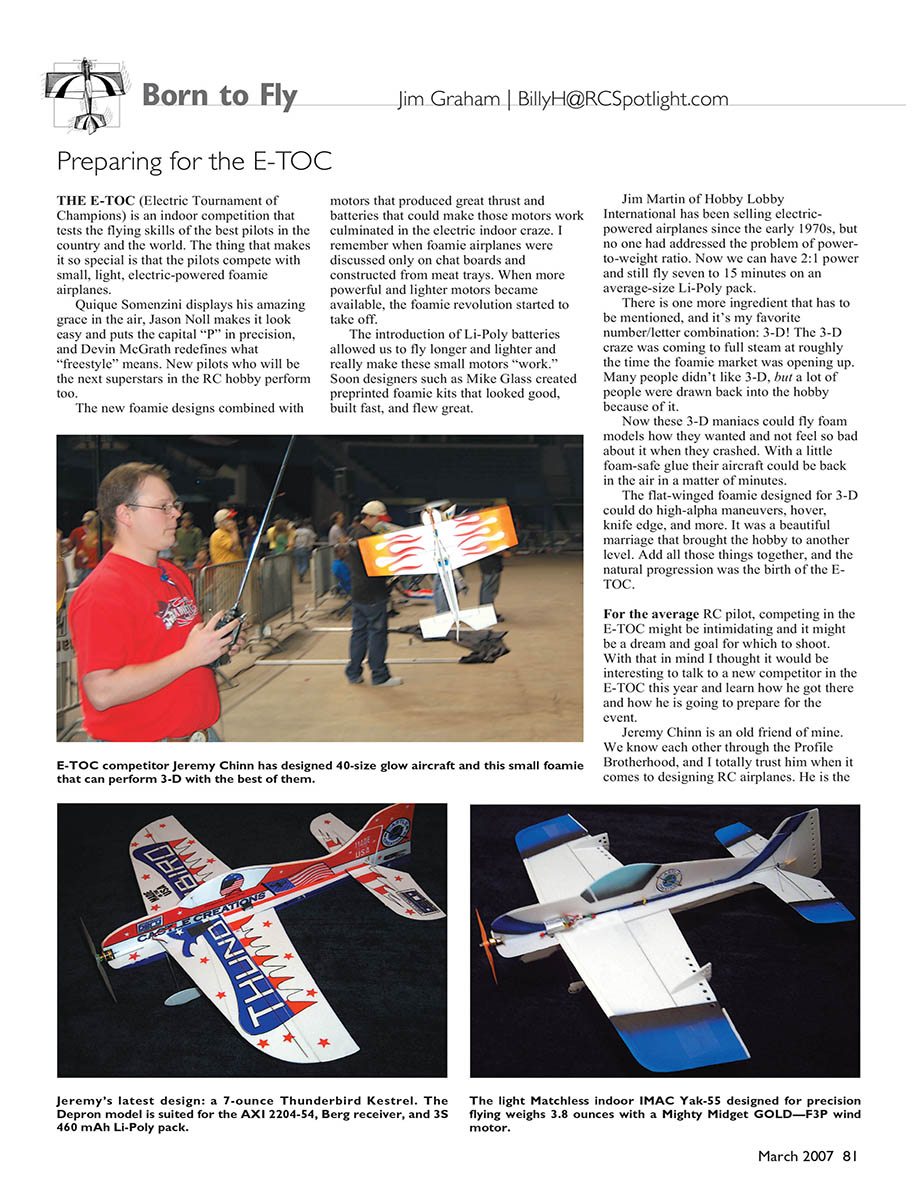
THE E-TOC (Electric Tournament of Champions) is an indoor competition that tests the flying skills of the best pilots in the country and the world. What makes it special is that pilots compete with small, light, electric-powered foamie airplanes.
Quique Somenzini displays amazing grace in the air, Jason Noll makes it look easy and puts the capital "P" in precision, and Devin McGrath redefines what "freestyle" means. New pilots who will be the next superstars in the RC hobby perform, too.
The new foamie designs combined with motors that produced great thrust and batteries that could make those motors work culminated in the electric indoor craze. I remember when foamie airplanes were discussed only on chat boards and constructed from meat trays. When more powerful and lighter motors became available, the foamie revolution started to take off.
The introduction of Li-Poly batteries allowed us to fly longer and lighter and really make these small motors "work." Soon designers such as Mike Glass created preprinted foamie kits that looked good, built fast, and flew great.
Jim Martin of Hobby Lobby International has been selling electric-powered airplanes since the early 1970s, but no one had addressed the problem of power-to-weight ratio. Now we can have a 2:1 power-to-weight ratio and still fly seven to 15 minutes on an average-size Li-Poly pack.
There is one more ingredient that has to be mentioned, and it's my favorite number/letter combination: 3-D! The 3-D craze was coming to full steam roughly when the foamie market was opening up. Many people didn't like 3-D, but a lot were drawn back into the hobby because of it. Now these 3-D maniacs could fly foam models how they wanted and not feel so bad about it when they crashed. With a little foam-safe glue their aircraft could be back in the air in a matter of minutes.
The flat-winged foamie designed for 3-D could do high-alpha maneuvers, hover, knife edge, and more. It was a beautiful marriage that brought the hobby to another level. Add all those things together, and the natural progression was the birth of the E-TOC.
For the average RC pilot, competing in the E-TOC might be intimidating and might be a dream and goal to shoot for. With that in mind I thought it would be interesting to talk to a new competitor in the E-TOC this year and learn how he got there and how he is preparing for the event.
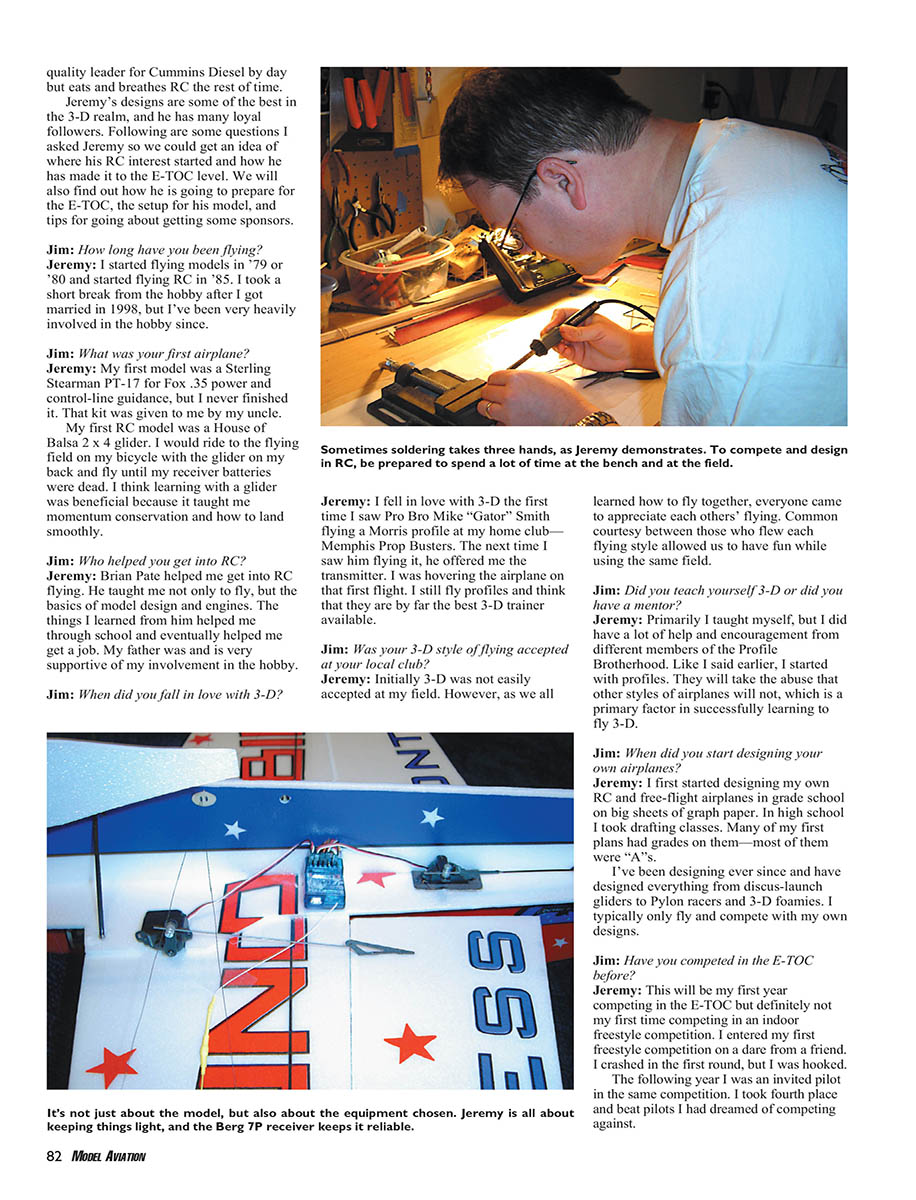
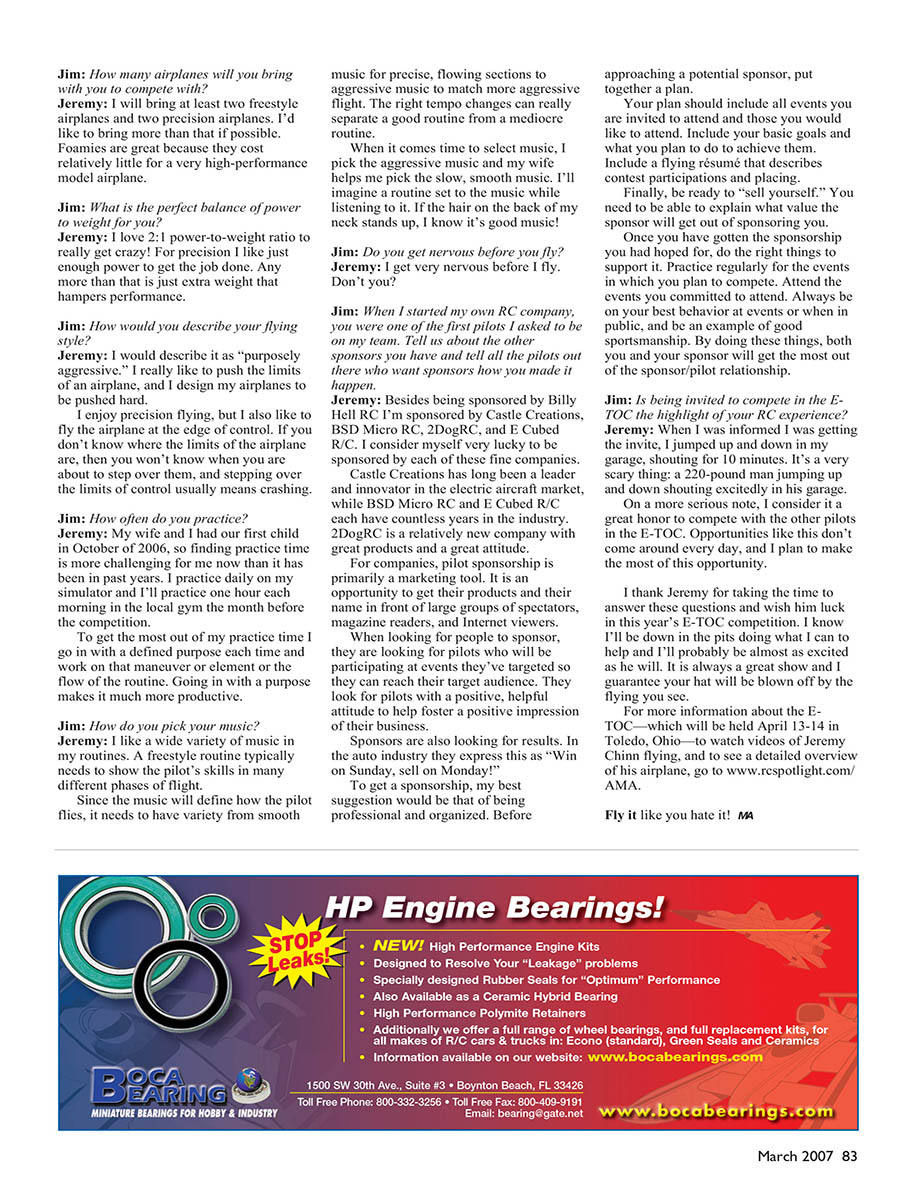
Jeremy Chinn is an old friend of mine. We know each other through the Profile Brotherhood, and I totally trust him when it comes to designing RC airplanes. He is the quality leader for Cummins Diesel by day but eats and breathes RC the rest of the time. Jeremy's designs are some of the best in the 3-D realm, and he has many loyal followers. Following are some questions I asked Jeremy so we could get an idea of where his RC interest started, how he has made it to the E-TOC level, how he is preparing for the E-TOC, his model setup, and tips for getting sponsors.
Interview with Jeremy Chinn
Jim: How long have you been flying? Jeremy: I started flying models in 1979 or 1980 and started flying RC in 1985. I took a short break from the hobby after I got married in 1998, but I've been very heavily involved in the hobby since.
Jim: What was your first airplane? Jeremy: My first model was a Sterling Stearman PT-17 for Fox .35 power and control-line guidance, but I never finished it. That kit was given to me by my uncle. My first RC model was a House of Balsa 2 x 4 glider. I would ride to the flying field on my bicycle with the glider on my back and fly until my receiver batteries were dead. I think learning with a glider was beneficial because it taught me momentum conservation and how to land smoothly.
Jim: Who helped you get into RC? Jeremy: Brian Pate helped me get into RC flying. He taught me not only to fly, but the basics of model design and engines. The things I learned from him helped me through school and eventually helped me get a job. My father was and is very supportive of my involvement in the hobby.
Jim: When did you fall in love with 3-D? Jeremy: I fell in love with 3-D the first time I saw Pro Bro Mike "Gator" Smith flying a Morris profile at my home club—Memphis Prop Busters. The next time I saw him flying, he offered me the transmitter. I was hovering the airplane on that first flight. I still fly profiles and think that they are by far the best 3-D trainer available.
Jim: Was your 3-D style of flying accepted at your local club? Jeremy: Initially 3-D was not easily accepted at my field. However, as we all learned how to fly together, everyone came to appreciate each other's flying. Common courtesy between those who flew each flying style allowed us to have fun while using the same field.
Jim: Did you teach yourself 3-D or did you have a mentor? Jeremy: Primarily I taught myself, but I did have a lot of help and encouragement from different members of the Profile Brotherhood. Like I said earlier, I started with profiles. They will take the abuse that other styles of airplanes will not, which is a primary factor in successfully learning to fly 3-D.
Jim: When did you start designing your own airplanes? Jeremy: I first started designing my own RC and free-flight airplanes in grade school on big sheets of graph paper. In high school I took drafting classes. Many of my first plans had grades on them—most of them were "A"s. I've been designing ever since and have designed everything from discus-launch gliders to pylon racers and 3-D foamies. I typically only fly and compete with my own designs.
Jim: Have you competed in the E-TOC before? Jeremy: This will be my first year competing in the E-TOC but definitely not my first time competing in an indoor freestyle competition. I entered my first freestyle competition on a dare from a friend. I crashed in the first round, but I was hooked. The following year I was an invited pilot in the same competition. I took fourth place and beat pilots I had dreamed of competing against.
Jim: How many airplanes will you bring with you to compete? Jeremy: I will bring at least two freestyle airplanes and two precision airplanes. I'd like to bring more than that if possible. Foamies are great because they cost relatively little for a very high-performance model airplane.
Jim: What is the perfect balance of power to weight for you? Jeremy: I love a 2:1 power-to-weight ratio to really get crazy! For precision I like just enough power to get the job done. Any more than that is just extra weight that hampers performance.
Jim: How would you describe your flying style? Jeremy: I would describe it as "purposely aggressive." I really like to push the limits of an airplane, and I design my airplanes to be pushed hard. I enjoy precision flying, but I also like to fly the airplane at the edge of control. If you don't know where the limits of the airplane are, then you won't know when you are about to step over them, and stepping over the limits of control usually means crashing.
Jim: How often do you practice? Jeremy: My wife and I had our first child in October 2006, so finding practice time is more challenging for me now than it has been in past years. I practice daily on my simulator and I'll practice once or twice on the weekend. The month before a competition I up the number of flights and try to get in a twice-a-week session. To get the most out of my practice time I go in with a defined purpose each time and work on that maneuver, element, or the flow of the routine. Going in with a purpose makes it much more productive.
Jim: How do you pick your music? Jeremy: I like a wide variety of music in my routines. A freestyle routine typically needs to show the pilot's skills in many different phases of flight. Since the music will define how the pilot flies, it needs to have variety—from smooth music for precise, flowing sections to aggressive music to match more aggressive flight. The right tempo changes can really separate a good routine from a mediocre routine. When it comes time to select music, I pick the aggressive music and my wife helps me pick the slow, smooth music. I'll imagine a routine set to the music while listening to it. If the hair on the back of my neck stands up, I know it's good music!
Jim: Do you get nervous before you fly? Jeremy: I get very nervous before I fly. Don't you?
Jim: When I started my own RC company, you were one of the first pilots I asked to be on my team. Tell us about the other sponsors you have and tell all the pilots out there who want sponsors how you made it happen. Jeremy: Besides being sponsored by Billy Hell RC I'm sponsored by:
- Castle Creations
- BSD Micro RC
- 2DogRC
- E Cubed R/C
I consider myself very lucky to be sponsored by each of these fine companies. Castle Creations has long been a leader and innovator in the electric aircraft market, while BSD Micro RC and E Cubed R/C each have countless years in the industry. 2DogRC is a relatively new company with great products and a great attitude.
For companies, pilot sponsorship is primarily a marketing tool. It is an opportunity to get their products and their names in front of large groups of spectators, magazine readers, and internet viewers. When looking for people to sponsor, they target pilots who will be participating at events they've targeted so they can reach their audience. They look for pilots with a positive, helpful attitude to help foster a positive impression of their business. Sponsors are also looking for results—"Win on Sunday, sell on Monday."
To get a sponsorship, my best suggestion is to be professional and organized. Before approaching a potential sponsor, put together a plan. Your plan should include:
- All events you are invited to attend and those you would like to attend.
- Your basic goals and what you plan to do to achieve them.
- A flying resume that describes contest participations and placings.
- A clear explanation of what value the sponsor will get from sponsoring you.
Once you have a sponsorship, support it. Practice regularly for the events in which you plan to compete. Attend the events you committed to attend. Always be on your best behavior at events or when in public, and be an example of good sportsmanship. By doing these things, both you and your sponsor will get the most out of the sponsor/pilot relationship.
Jim: Is being invited to compete in the E-TOC the highlight of your RC experience? Jeremy: When I was informed I was getting the invite, I jumped up and down in my garage, shouting for 10 minutes. It's a very scary thing: a 220-pound man jumping up and down and shouting excitedly in his garage. On a more serious note, I consider it a great honor to compete with the other pilots in the E-TOC. Opportunities like this don't come around every day, and I plan to make the most of this opportunity.
I thank Jeremy for taking the time to answer these questions and wish him luck in this year's E-TOC competition. I know he'll be down in the pits doing what he can to help and I'll probably be as excited as he will. It is always a great show and I guarantee your hat will be blown off by the flying you see.
For more information about the E-TOC—which will be held April 13–14 in Toledo, Ohio—to watch videos of Jeremy Chinn flying, and to see a detailed overview of his airplane, go to www.rcspotlight.com/AMA.
Fly it like you hate it! MA
Transcribed from original scans by AI. Minor OCR errors may remain.

