
Born to Fly
Jim T. Graham | [email protected]
Profiling and styling at the Nats
I've said it before, and I'll say it again: pushing the limits is what propels our hobby. In this month's column, I'll let a fellow RCer describe how he did just that.
You may have seen Jeremy Chinn's name in some of my other articles. We met through the Profile Brotherhood (Pro Bros) and have worked together at times to bring airplanes to market.
In the following, he recalls his quest to compete in the Nats RC Aerobatics (Pattern) competition. What makes this story unique is that he did so with a profile model, and he designed and built the airplane. And if all that wasn't enough, the airplane is electric instead of glow powered.
Read on to learn about Jeremy's experience, from start to finish, with his Kudzu.
The Seed
Last fall I was analyzing my flying, and I quickly realized that my biggest weakness was precision. Through preparation for the ETOC (Electric Tournament of Champions) and flying with some of my local buddies, I realized that I enjoy flying Pattern. I spent the whole winter flying indoor Pattern, as I have for the past three years, and decided I wanted to fly it during the summer too.
Al Glenn, who is Quique Somenzini's team manager, is one of the people who pushed me to design a profile Pattern airplane. Although the idea initially sounded crazy, it became more realistic as we fleshed out the details.
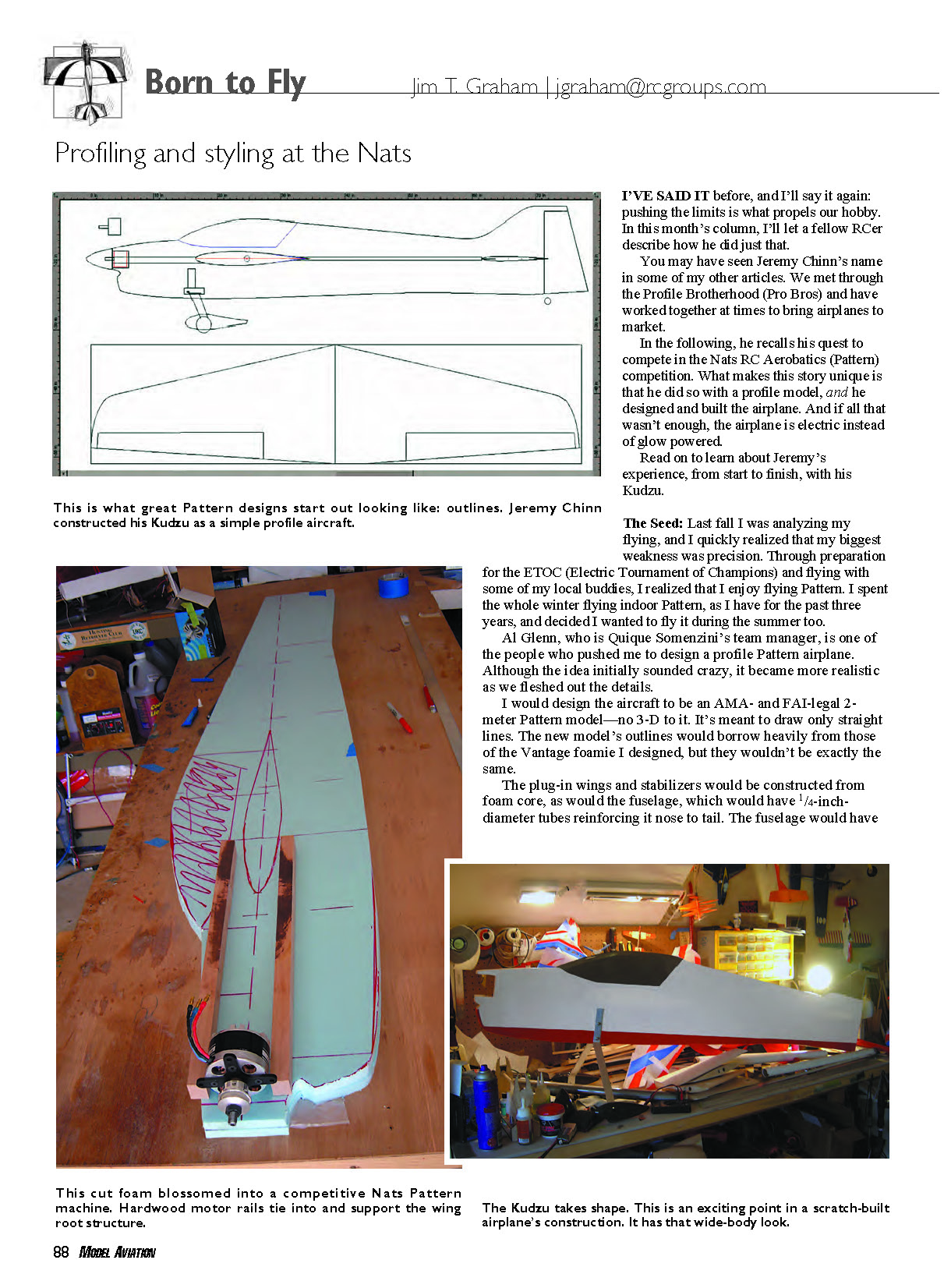
I would design the aircraft to be an AMA- and FAI-legal 2-meter Pattern model—no 3-D to it. It's meant to draw only straight lines. The new model's outlines would borrow heavily from those of the Vantage foamie I designed, but they wouldn't be exactly the same.
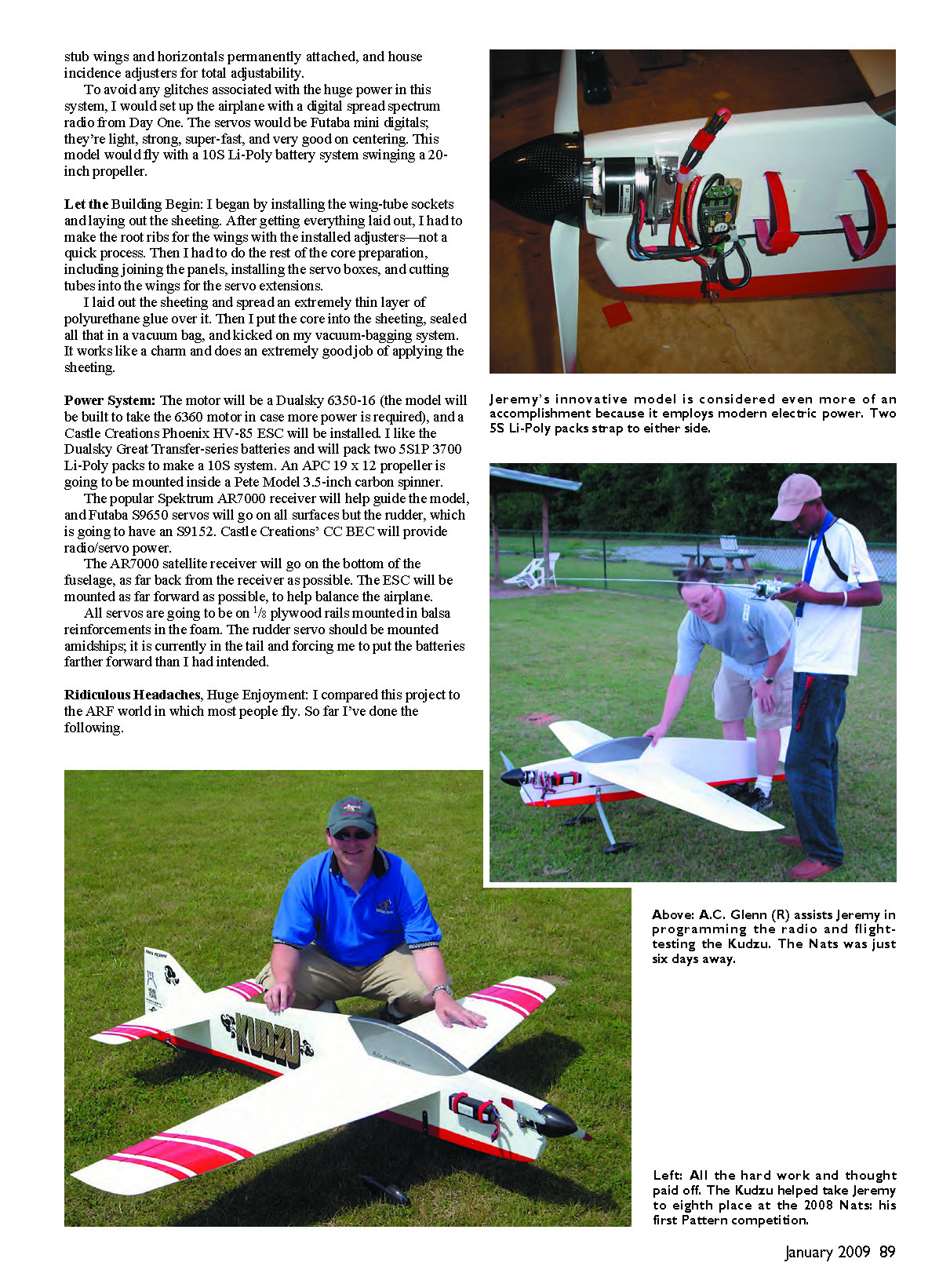
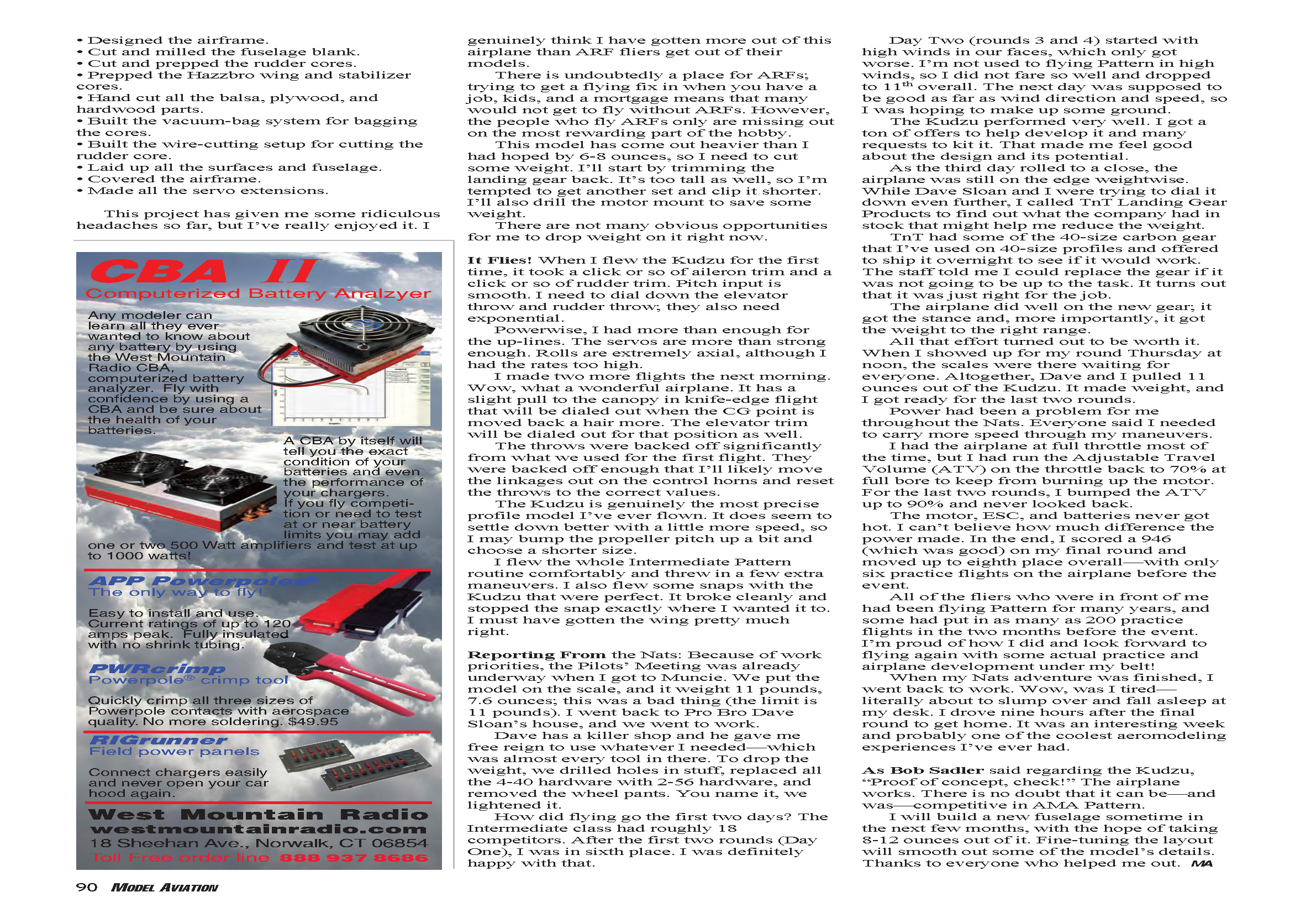
The plug-in wings and stabilizers would be constructed from foam core, as would the fuselage, which would have 1/4-inch-diameter tubes reinforcing it nose to tail. The fuselage would have stub wings and horizontals permanently attached, and house incidence adjusters for total adjustability.
To avoid any glitches associated with the huge power in this system, I would set up the airplane with a digital spread-spectrum radio from day one. The servos would be Futaba mini digitals; they're light, strong, super-fast, and very good on centering. This model would fly with a 10S Li-Poly battery system swinging a 20-inch propeller.
Let the Building Begin
I began by installing the wing-tube sockets and laying out the sheeting. After getting everything laid out, I had to make the root ribs for the wings with the installed adjusters—not a quick process. Then I had to do the rest of the core preparation, including joining the panels, installing the servo boxes, and cutting tubes into the wings for the servo extensions.
I laid out the sheeting and spread an extremely thin layer of polyurethane glue over it. Then I put the core into the sheeting, sealed all that in a vacuum bag, and kicked on my vacuum-bagging system. It works like a charm and does an extremely good job of applying the sheeting.
Power System
The motor will be a Dualsky 6350-16 (the model will be built to take the 6360 motor in case more power is required), and a Castle Creations Phoenix HV-85 ESC will be installed. I like the Dualsky Great Transfer-series batteries and will pack two 5S1P 3700 mAh Li-Poly packs to make a 10S system. An APC 19x12 propeller is going to be mounted inside a Pete Model 3.5-inch carbon spinner.
The popular Spektrum AR7000 receiver will help guide the model, and Futaba S9650 servos will go on all surfaces but the rudder, which will have an S9152. Castle Creations' CC BEC will provide radio/servo power.
The AR7000 satellite receiver will go on the bottom of the fuselage, as far back from the front as possible. The ESC will be mounted as far forward as possible, to help balance the airplane.
All servos will be on 1/8-inch plywood rails mounted in balsa reinforcements in the foam. The rudder servo should be mounted amidships; it is currently in the tail and forcing me to put the batteries farther forward than I had intended.
Ridiculous Headaches, Huge Enjoyment
I compared this project to the ARF world in which most people fly. So far I've done the following:
- Designed the airframe.
- Cut and milled the fuselage blank.
- Cut and prepped the rudder cores.
- Prepped the wing and stabilizer cores.
- Hand cut all the balsa, plywood, and hardwood parts.
- Built the vacuum-bag system for bagging the cores.
- Built the wire-cutting setup for cutting the rudder core.
- Laid up all the surfaces and fuselage.
- Covered the airframe.
- Made all the servo extensions.
This project has given me some ridiculous headaches so far, but I’ve really enjoyed it. I genuinely think I have gotten more out of this airplane than ARF fliers get out of their models.
There is undoubtedly a place for ARFs; trying to get a flying fix in when you have a job, kids, and a mortgage means that many would not get to fly without ARFs. However, the people who fly ARFs only are missing out on the most rewarding part of the hobby.
This model has come out heavier than I had hoped by 6–8 ounces, so I need to cut some weight. I’ll start by trimming the landing gear back. It’s too tall as well, so I’m tempted to get another set and clip it shorter. I’ll also drill the motor mount to save some weight.
There are not many obvious opportunities for me to drop weight on it right now.
It Flies!
When I flew the Kudzu for the first time, it took a click or so of aileron trim and a click or so of rudder trim. Pitch input is smooth. I need to dial down the elevator throw and rudder throw; they also need exponential.
Power-wise, I had more than enough for the up-lines. The servos are more than strong enough. Rolls are extremely axial, although I had the rates too high.
I made two more flights the next morning. Wow, what a wonderful airplane. It has a slight pull to the canopy in knife-edge flight that will be dialed out when the CG point is moved back a hair more. The elevator trim will be dialed out for that position as well.
The throws were backed off significantly from what we used for the first flight. They were backed off enough that I’ll likely move the linkages out on the control horns and reset the throws to the correct values.
The Kudzu is genuinely the most precise profile model I’ve ever flown. It does seem to settle down better with a little more speed, so I may bump the propeller pitch up a bit and choose a shorter size.
I flew the whole Intermediate Pattern routine comfortably and threw in a few extra maneuvers. I also flew some snaps with the Kudzu that were perfect. It broke cleanly and stopped the snap exactly where I wanted it to. I must have gotten the wing pretty much right.
Reporting From the Nats
Because of work priorities, the Pilots’ Meeting was already underway when I got to Muncie. We put the model on the scale, and it weighed 11 pounds, 7.6 ounces; this was a bad thing (the limit is 11 pounds). I went back to Pro Bro Dave Sloan’s house, and we went to work. Dave has a killer shop and has the free rein to use whatever I needed—which was almost every tool in there. To drop the weight, we drilled holes in stuff, replaced all the 4-40 hardware with 2-56 hardware, and removed the wheel pants. You name it, we did it.
How did flying go the first two days? The Intermediate class had roughly 18 competitors. After the first two rounds (Day One), I was in sixth place. I was definitely happy with that.
Day Two (rounds 3 and 4) started with high winds in our faces, which only got worse. I’m not used to flying Pattern in high winds, so I did not fare so well and dropped to 11th overall. The next day was supposed to be good as far as wind direction and speed, so I was hoping to make up some ground.
The Kudzu performed very well. I got a ton of offers to help develop it and many requests to kit it. That made me feel good about the design and its potential.
As the third day rolled to a close, the airplane was still on the edge weightwise. While Dave Sloan and I were trying to dial it down even further, I called TnT Landing Gear Products to find out what the company had in stock that might help me reduce the weight.
TnT had some of the 40-size carbon gear that I’ve used on 40-size profiles and offered to ship it overnight to see if it would work. The staff told me I could replace the gear if it was not going to be up to the task. It turns out that it was just right for the job.
The airplane did well on the new gear; it got the stance and, more importantly, it got the weight to the right range.
All that effort turned out to be worth it. When I showed up for my round Thursday at noon, the scales were there waiting for everyone. Altogether, Dave and I pulled 11 ounces out of the Kudzu. It made weight, and I got ready for the last two rounds.
Power had been a problem for me throughout the Nats. Everyone said I needed to carry more speed through my maneuvers.
I had the airplane at full throttle most of the time, but I had run the Adjustable Travel Volume (ATV) on the throttle back to 70% at full bore to keep from burning up the motor. For the last two rounds, I bumped the ATV up to 90% and never looked back.
The motor, ESC, and batteries never got hot. I can’t believe how much difference the power made. In the end, I scored a 946 (which was good) on my final round and moved up to eighth place overall—with only six practice flights on the airplane before the event.
All of the fliers who were in front of me had been flying Pattern for many years, and some had put in as many as 200 practice flights in the two months before the event. I’m proud of how I did and look forward to flying again with some actual practice and airplane development under my belt!
When my Nats adventure was finished, I went back to work. Wow, was I tired—literally about to slump over and fall asleep at my desk. I drove nine hours after the final round to get home. It was an interesting week and probably one of the coolest aeromodeling experiences I’ve ever had.
As Bob Sadler said regarding the Kudzu, “Proof of concept, check!” The airplane is a real success. I will build a new fuselage sometime in the next few months, and it will be a refined version—probably shaving off another 8–12 ounces. In the meantime, this plane is a great flying machine and gave me a chance to see how good a profile model can be. Thanks to everyone who helped me out.
-M
Transcribed from original scans by AI. Minor OCR errors may remain.

