
Born to Fly
Jim T. Graham | [email protected]
In the bones: An RC airplane designer's "How I did it" story
IF IT WEREN'T for RC airplane designers, we wouldn't have anything to fly. During my time working in the RC industry, I have been lucky to get to know some great RC aircraft designers. As RC pilots, we see countless ARFs in magazine ads as well as in print and online reviews. What we don't get to see are the people behind the designs we fly.
I thought it would be interesting to interview a fellow R/Cer whose love for RC has taken the models he has designed out of his basement and into the hands of modelers around the world. Quinn Coldiron and I met on the Pro Bro site. When I started Billy Hell RC, Quinn and I talked on the phone almost every day about designs, how to create better ARFs, and how we could bring airplanes to the market that would be great at 3-D maneuvers and tame enough for a new pilot.
I learned about the time it takes to design a great model, and we both learned a lot about what it takes to make an airplane a reality. In this edition of "Born to Fly," we learn the ins and outs of RC airplane design.
JG: What got you interested in designing models?
QC: I got started designing because I wanted a plane that had not been developed yet. This was the early stages of the current boom of electric 3-D planes. I wanted a plane around 36 inches in span that could 3-D on the current motors and batteries.
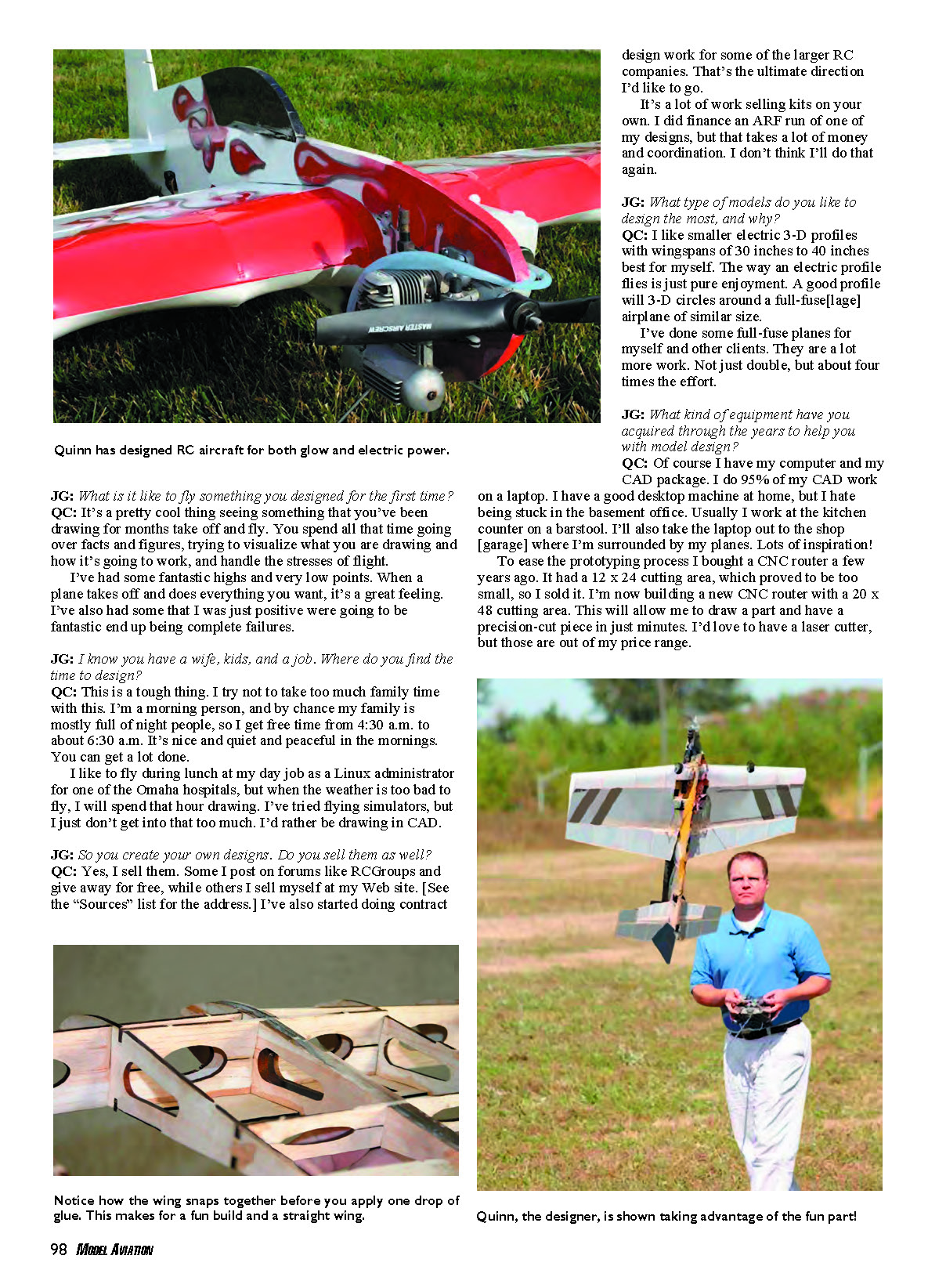
A few ARFs were on the market, but they were expensive and did not have the performance that I wanted. I wanted a profile 3-D monster, so I bought a copy of TurboCAD, and with the help of some local and online friends, I learned CAD and drew the Katana 35.
JG: When did you start designing airplanes?
QC: I started designing about six years ago.
JG: What is the hardest thing about designing models?
QC: Picking a subject and running with it. I have a head full of planes I want to do. Some scale and some totally unique and new.
JG: What do you get out of designing aircraft?
QC: It's a pretty cool feeling seeing something you drew flying around in the sky. Some fly better than others, but just seeing it take off and go is cool. The next best thing is seeing other people build your designs and seeing the fun they have with them.
JG: What is it like to fly something you designed for the first time?
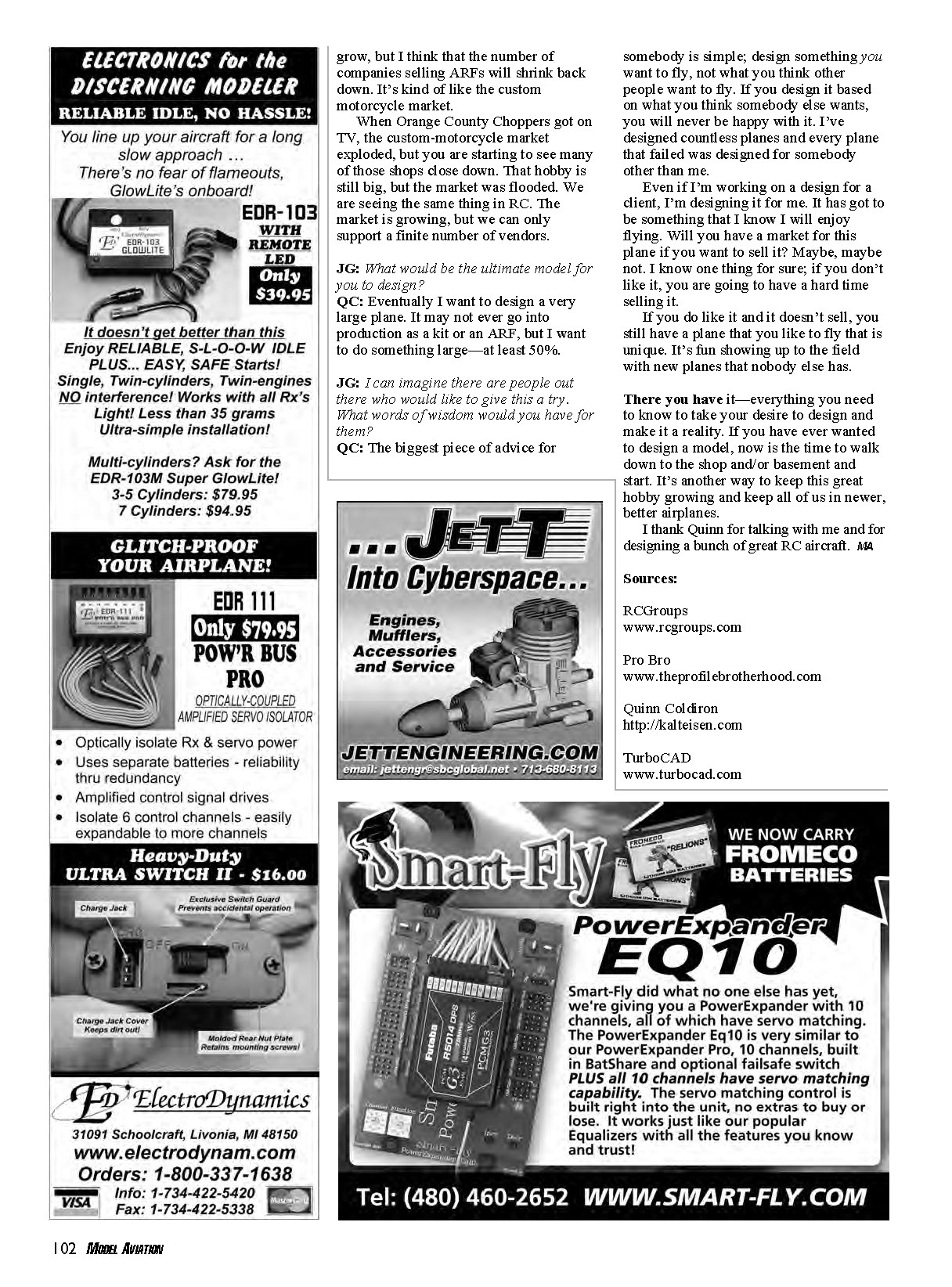
QC: It's a pretty cool thing seeing something that you've been drawing for months take off and fly. You spend all that time going over facts and figures, trying to visualize what you are drawing and how it's going to work, and handle the stresses of flight. I've had some fantastic highs and very low points. When a plane takes off and does everything you want, it's a great feeling. I've also had some that I was just positive were going to be fantastic end up being complete failures.
JG: I know you have a wife, kids, and a job. Where do you find the time to design?
QC: This is a tough thing. I try not to take too much family time with this. I'm a morning person, and by chance my family is mostly full of night people, so I get free time from 4:30 a.m. to about 6:30 a.m. It's nice and quiet and peaceful in the mornings. You can get a lot done. I like to fly during lunch at my day job as a Linux administrator for one of the Omaha hospitals, but when the weather is too bad to fly, I will spend that hour drawing. I've tried flying simulators, but I just don't get into that too much. I'd rather be drawing in CAD.
JG: So you create your own designs. Do you sell them as well?
QC: Yes, I sell them. Some I post on forums like RCGroups and give away for free, while others I sell myself at my Web site. [See the "Sources" list for the address.] I've also started doing contract design work for some of the larger RC companies. That's the ultimate direction I'd like to go. It's a lot of work selling kits on your own. I did finance an ARF run of one of my designs, but that takes a lot of money and coordination. I don't think I'll do that again.
JG: What type of models do you like to design the most, and why?
QC: I like smaller electric 3-D profiles with wingspans of 30 inches to 40 inches best for myself. The way an electric profile flies is just pure enjoyment. A good profile will 3-D circles around a full-fuselage airplane of similar size. I've done some full-fuselage planes for myself and other clients. They are a lot more work. Not just double, but about four times the effort.
JG: What kind of equipment have you acquired through the years to help you with model design?
QC: Of course I have my computer and my CAD package. I do 95% of my CAD work on a laptop. I have a good desktop machine at home, but I hate being stuck in the basement office. Usually I work at the kitchen counter on a barstool. I'll also take the laptop out to the shop [garage] where I'm surrounded by my planes. Lots of inspiration! To ease the prototyping process I bought a CNC router a few years ago. It had a 12 x 24 cutting area, which proved to be too small, so I sold it. I'm now building a new CNC router with a 20 x 48 cutting area. This will allow me to draw a part and have a precision-cut piece in just minutes. I'd love to have a laser cutter, but those are out of my price range. I also built a vacuum-forming table so that I can mold my own plastic parts, like cowls and canopies.
JG: What kind of computer skills do you need to do this?
QC: You don't need a lot of pure computer skills to start designing. The biggest hurdle is learning the CAD package. I tried AutoCAD, but I just could not get the hang of that system. I struggled and struggled with it. I got an old copy of TurboCAD really cheap and tried it out. It fit me very well, and I used it for the first few years of work, then I bought a more current version. The thing I like about TurboCAD is it's more like a traditional windows drawing program.
JG: Do you have a support group for your airplane-designing addiction?
QC: Yep, the Pro Bros. Actually, a small group inside the Pro Bros. Some great designers hang out on that site and we bounce things off each other. This is a group of people that I can trust to look over my CAD files and I know they won't steal anything.
JG: Has designing models taught you any life lessons?
QC: Plan everything out. Changing a part in CAD is a lot cheaper than changing it later. Changing it later means building the prototype again, and with laser-cutting, build time, covering, etc., that can get expensive. I guess I'm saying slow down and plan it out. Don't jump the gun.
JG: You and I worked together back in my Billy Hell RC days. Talk a little bit about how your kits are designed to be popped together first and glued later.
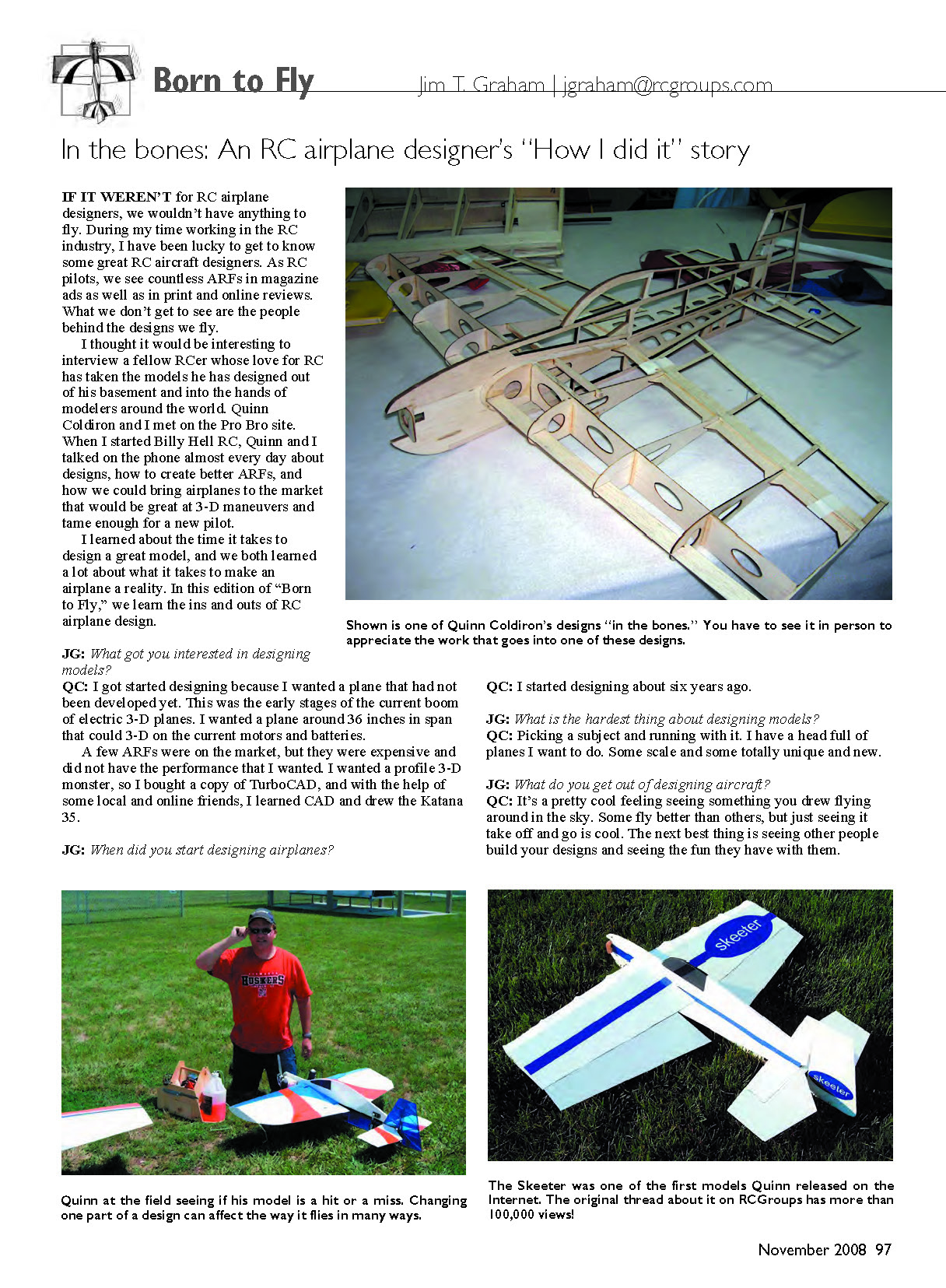
QC: My first drawings were very old school and traditional — typical stick-built structures. For scratch building this is okay, but the joints are weak. You have nothing but glue holding the stuff together. Over time I picked up on a lot of new things and have evolved my designs into mostly interlocking parts. The basic wing design that I have now will snap together without any glue at all. After you snap the wing together, you go back and drip thin cyanoacrylate into each joint to lock the wing together. The advantages here are a true, warp-free build and the added strength of wood interlocked with wood and not just glue.
JG: Does your wife like the fact that designing RC models is your hobby and side job?
QC: As long as it does not take too much time from the family, everything is A-OK. You must keep your priorities in line. Actually, coaching Little League baseball gets in the way of a lot more family things. With two boys playing, that's two-and-a-half to three months of baseball seven days a week.
The good thing about the design work is it makes the hobby self-supporting at a minimum. I've never had to dip into family funds to get anything new that I wanted or needed.
JG: How do you use the Internet to get your designs out there?
QC: Of course I have a Web site, but the biggest Internet tool is the various discussion forums. RCGroups has been very good to me. The types of planes that I design fit into the base of RCGroups very well. The other forum that has provided a fantastic vessel for getting my designs out is the Pro Bro site. These two sites comprise 99% of my customer base.
JG: Do the Web forums play a big part in getting the buzz going about new designs?
QC: Without forums like RCGroups and the Pro Bros, new products would be much more difficult to launch. The initial launch is online, with video, build threads, etc. After the initial quick buzz, getting the plane in solidifies the design. It's almost like a validation to see it in print.
JG: How does overseas production affect what you do?
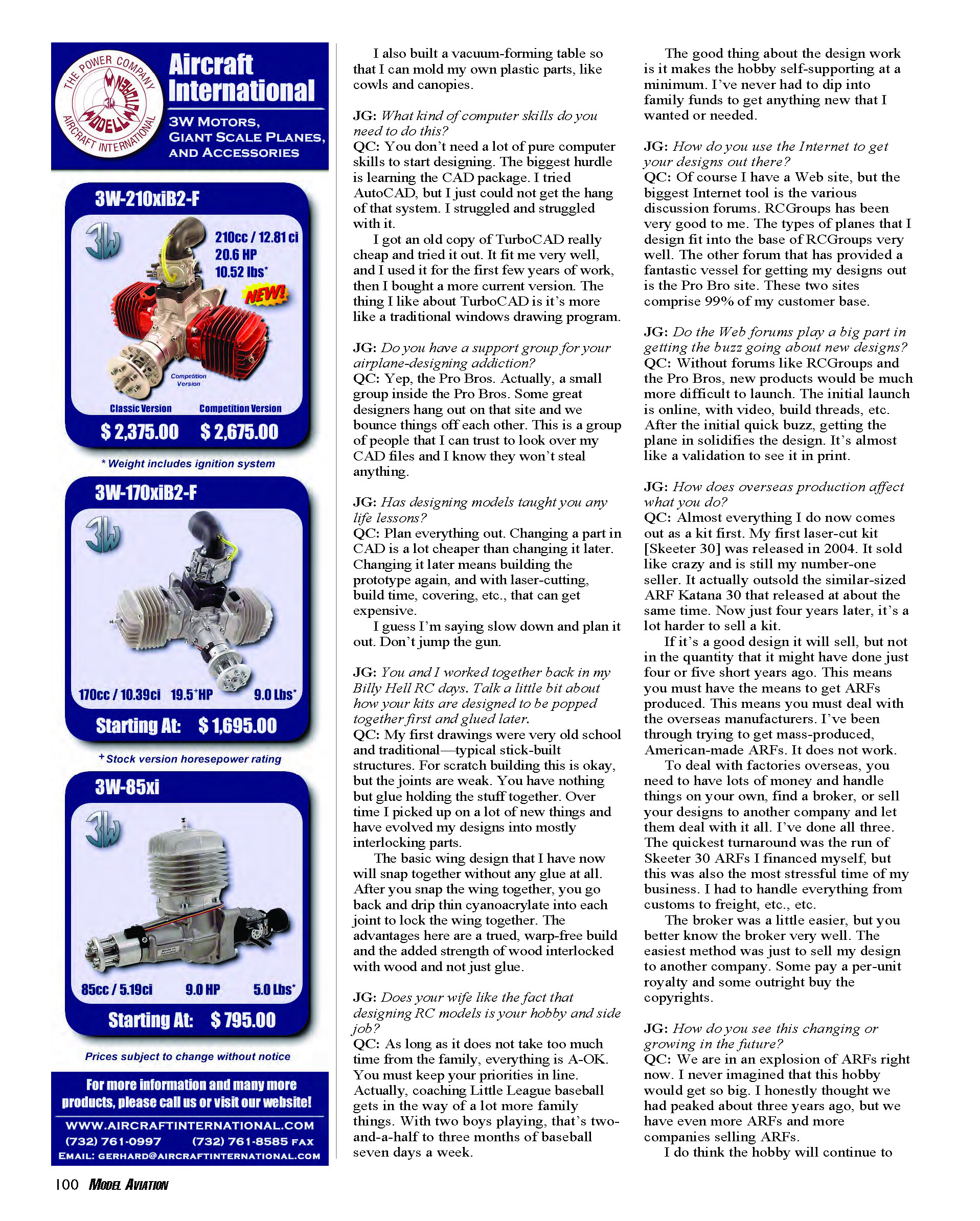
QC: Almost everything I do now comes out as a kit first. My first laser-cut kit (Skeeter 30) was released in 2004. It sold like crazy and is still my number-one seller. It actually outsold the similar-sized ARF Katana 30 that released at about the same time. Now just four years later, it's a lot harder to sell a kit. If it's a good design it will sell, but not in the quantity that it might have done just four or five short years ago. This means you must have the means to get ARFs produced. This means you must deal with the overseas manufacturers. I've been through trying to get mass-produced, American-made ARFs. It does not work. To deal with factories overseas, you need to have lots of money and handle things on your own, find a broker, or sell your designs to another company and let them deal with it all. I've done all three. The quickest turnaround was the run of Skeeter 30 ARFs I financed myself, but this was also the most stressful time of my business. I had to handle everything from customs to freight, etc., etc. The broker was a little easier, but you better know the broker very well. The easiest method was just to sell my design to another company. Some pay a per-unit royalty and some outright buy the copyrights.
JG: How do you see this changing or growing in the future?
QC: We are in an explosion of ARFs right now. I never imagined that this hobby would get so big. I honestly thought we had peaked about three years ago, but we have even more ARFs and more companies selling ARFs.
Born to Fly
Jim T. Graham
When Orange County Choppers got on TV, the custom-motorcycle market exploded, but you are starting to see many of those shops close down. That hobby is still big, but the market was flooded. We are seeing the same thing in RC. The market is growing, but we can only support a finite number of vendors.
JG: What would be the ultimate model for you to design?
QC: Eventually I want to design a very large plane. It may not ever go into production as a kit or an ARF, but I want to do something large—at least 50%.
JG: I can imagine there are people out there who would like to give this a try. What words of wisdom would you have for them?
QC: The biggest piece of advice for somebody is simple; design something you want to fly, not what you think other people want to fly. If you design it based on what you think somebody else wants, you will never be happy with it. I've designed countless planes and every plane that failed was designed for somebody other than me.
Even if I'm working on a design for a client, I'm designing it for me. It has got to be something that I know I will enjoy flying. Will you have a market for this plane if you want to sell it? Maybe, maybe not. I know one thing for sure; if you don't like it, you are going to have a hard time selling it.
If you do like it and it doesn't sell, you still have a plane that you like to fly that is unique. It's fun showing up to the field with new planes that nobody else has.
There you have it—everything you need to know to take your desire to design and make it a reality. If you have ever wanted to design a model, now is the time to walk down to the shop and/or basement and start. It's another way to keep this great hobby growing and keep all of us in newer, better airplanes.
I thank Quinn for talking with me and for designing a bunch of great RC aircraft. MA
Sources:
- RCGroups
- Pro Bro
- Quinn Coldiron
- TurboCAD
Transcribed from original scans by AI. Minor OCR errors may remain.

