
Multirotors for the beginner, part two
Jim T. Graham
In my last column, I discussed multirotors and quadcopters. They seem to have caught on throughout the RC community. Here is part two of my interview with Stephen Cinch:
JG: Tell me about your flying style. I know that you can go crazy with this thing, but if you wanted to do photos or video, the real trick is to fly smoothly and easily. Tell me how you make that happen.
SC: You set up how much correction happens from the gyros in the quadcopter and how much throw, or how much increased motor pitch you're going to get from that side of the quad. You could simply tune down the gains or the stick scaling, which is similar to adding exponential. You're basically telling it that you don't want your stick as sensitive as it could be.
On a popular board, such as the KK2, stick scaling up goes up to 150. Many of the aerobatic pilots are setting it at 115–130, which makes for a very sensitive quad. That's what you need to be able to do the flips, inverted flight, and death bombs toward the earth, flipping over at the last second.
I had a quad similarly set up, but I enjoy the settings in which the stick scaling is down at 30. I'm trying my best to fly as smoothly as possible and take out any vibrations so I can get good video with the smaller quad.
Whatever style you're going to do, RCGroups is exploding right now with activity about quads. I found myself frequently visiting the RCGroups forums, and there was information everywhere.
Nearly everything I've learned so far has been from RCGroups. Often, when I got stuck, I would type something into the search engine and there would be eight or 10 threads about it.
JG: How did your first flight go? SC: I was pretty amazed. I had a friend with me who had flown several in the past. He came up and flew it approximately a foot off the ground and double-checked that everything was correct. I couldn't believe how stable it was. We had it toned down, but still not as toned down as I have them for video flying now. It was pretty easy. If you have RC experience, it's not that hard.
If you are interested in aerial video or photography, there are a few controller boards that are called IO (Intelligent Orientation). When you power up the quad, it knows which way the front of the quad is by the position of the board.
When IO knows where the front of the quad is, you don't have to worry about your orientation. When you push your stick, it somehow figures out which way you want to go. No matter which direction the quad is pointing, if you need the quad to go left and you hit the stick left, it will move left.
JG: I want that! That sounds really cool. SC: You can turn that off with a switch on your radio. If you're flying like normal and you get confused, you hit that switch, it goes to IO, and you can drive it back.
JG: What do the boards cost? SC: The standard aerobatic board is approximately $400. But if you want to add GPS, that's roughly another $400. The GPS has a return-to-home function. If it loses signal for some reason or if you get freaked out and need it to come home, you can hit a switch, and it will return on its own.
The big brother to that is the NAZA M, which is basically a straight-up autopilot system. It's what many professional photographers use. It has settings that you can set up on the computer such as pan, tilt, etc.
You can even do a thing called "point of interest." If you wanted to film your house, for example, you'd go to the front of the house, hit a button, tell it that the front door is a point of interest, and program it from a laptop to do whatever maneuver automatically and land itself.
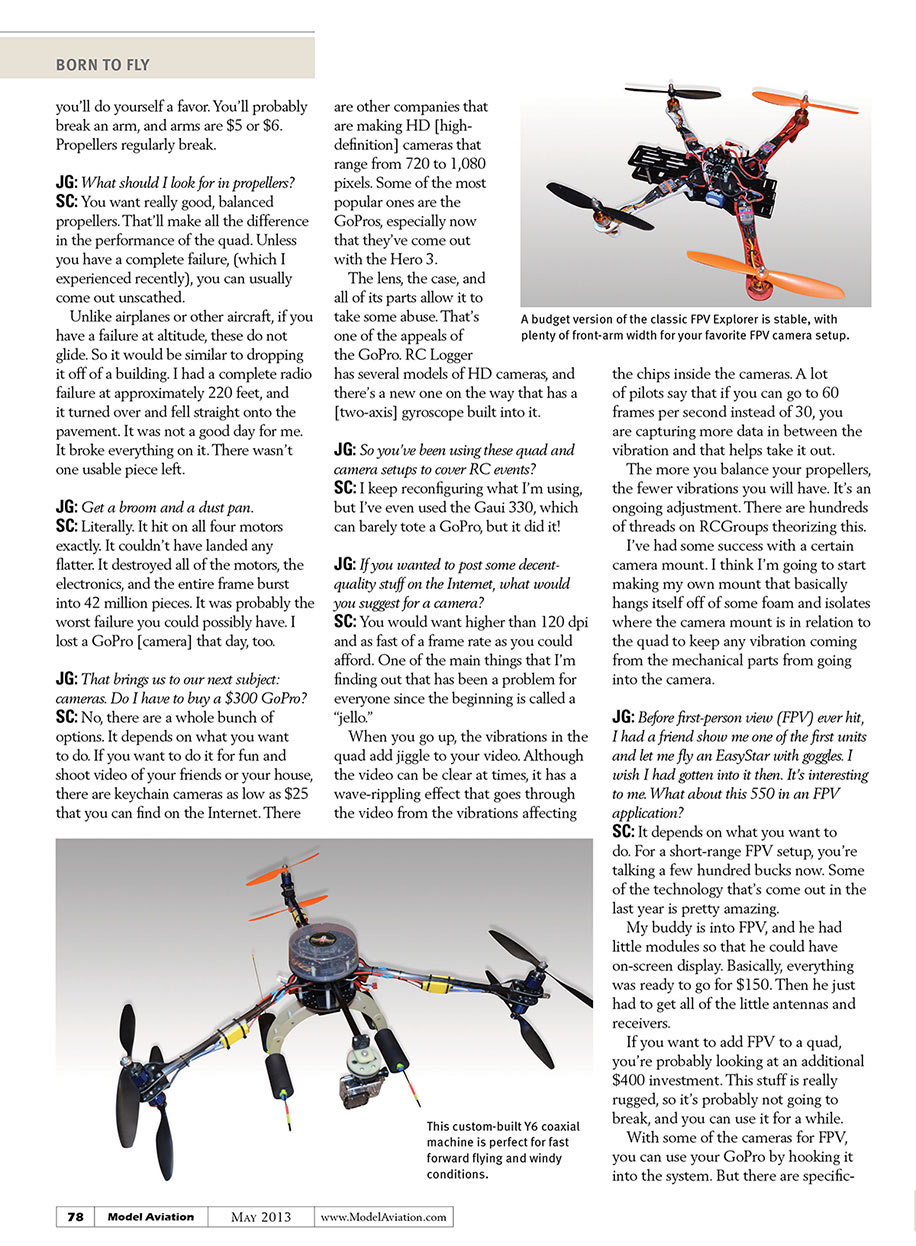
JG: I built a nice helicopter once, but I immediately sold it because I figured I'd crash it and cost myself $200 or $300. How much money do you lose if you crash one of these midsize quadcopters? SC: With some of the more aerobatic quads, or even a smaller one, you could make a mistake and plow it into the ground and maybe break a propeller or two. If you're getting into trouble and it gets out of hand and you cut the throttle, you'll do yourself a favor. You'll probably break an arm, and arms are $5 or $6. Propellers regularly break.
JG: What should I look for in propellers? SC: You want really good, balanced propellers. That'll make all the difference in the performance of the quad. Unless you have a complete failure, (which I experienced recently), you can usually come out unscathed.
Unlike airplanes or other aircraft, if you have a failure at altitude, these do not glide. So it would be similar to dropping it off of a building. I had a complete radio failure at approximately 220 feet, and it turned over and fell straight onto the pavement. It was not a good day for me. It broke everything on it. There wasn't one usable piece left.
JG: Get a broom and a dust pan. SC: Literally. It hit on all four motors exactly. It couldn't have landed any flatter. It destroyed all of the motors, the electronics, and the entire frame burst into 42 million pieces. It was probably the worst failure you could possibly have. I lost a GoPro [camera] that day, too.
JG: That brings us to our next subject: cameras. Do I have to buy a $300 GoPro? SC: No, there are a whole bunch of options. It depends on what you want to do. If you want to do it for fun and shoot video of your friends or your house, there are keychain cameras as low as $25 that you can find on the Internet. There are other companies that are making HD [high-definition] cameras that range from 720 to 1,080 pixels. Some of the most popular ones are the GoPros, especially now that they've come out with the Hero 3.
The lens, the case, and all of its parts allow it to take some abuse. That's one of the appeals of the GoPro. RC Logger has several models of HD cameras, and there's a new one on the way that has a [two-axis] gyroscope built into it.
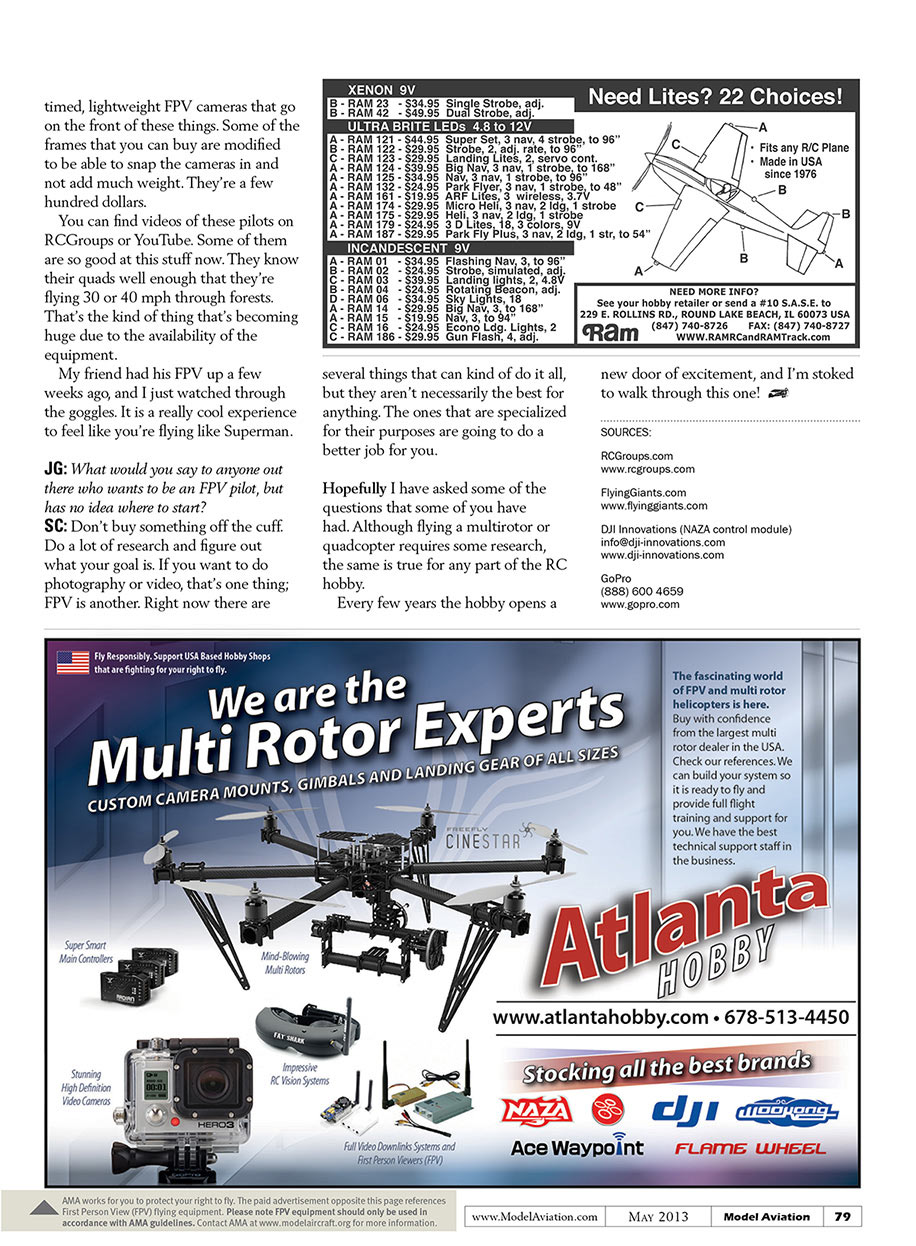
JG: So you've been using these quad and camera setups to cover RC events? SC: I keep reconfiguring what I'm using, but I've even used the Gaui 330, which can barely tote a GoPro, but it did it!
JG: If you wanted to post some decent-quality stuff on the Internet, what would you suggest for a camera? SC: You would want higher than 120 dpi and as fast of a frame rate as you could afford. One of the main things that I'm finding out that has been a problem for everyone since the beginning is called a "jello."
When you go up, the vibrations in the quad add jigglet to your video. Although the video can be clear at times, it has a wave-rippling effect that goes through the video from the vibrations affecting the chips inside the cameras. A lot of pilots say that if you can go to 60 frames per second instead of 30, you are capturing more data in between the vibration and that helps take it out.
The more you balance your propellers, the fewer vibrations you will have. It's an ongoing adjustment. There are hundreds of threads on RCGroups theorizing this.
I've had some success with a certain camera mount. I think I'm going to start making my own mount that basically hangs itself off of some foam and isolates where the camera mount is in relation to the quad to keep any vibration coming from the mechanical parts from going into the camera.
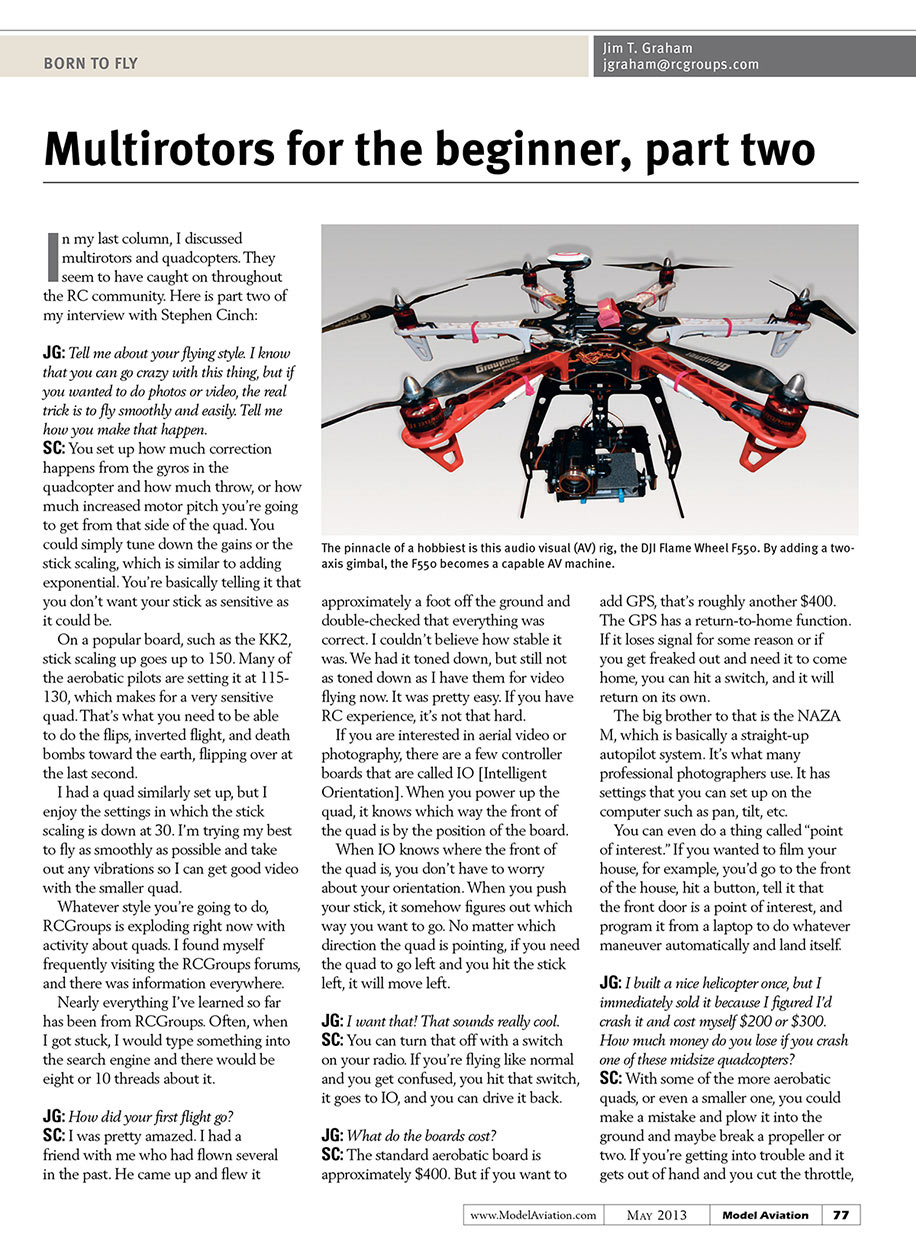
JG: Before first-person view (FPV) ever hit, I had a friend show me one of the first units and let me fly an EasyStar with goggles. I wish I had gotten into it then. It's interesting to me. What about this 550 in an FPV application? SC: It depends on what you want to do. For a short-range FPV setup, you're talking a few hundred bucks now. Some of the technology that's come out in the last year is pretty amazing.
My buddy is into FPV, and he had little modules so that he could have on-screen display. Basically, everything was ready to go for $150. Then he just had to get all of the little antennas and receivers.
If you want to add FPV to a quad, you're probably looking at an additional $400 investment. This stuff is really rugged, so it's probably not going to break, and you can use it for a while.
With some of the cameras for FPV, you can use your GoPro by hooking it into the system. But there are specific-timed, lightweight FPV cameras that go on the front of these things. Some of the frames that you can buy are modified to be able to snap the cameras in and not add much weight. They're a few hundred dollars.
You can find videos of these pilots on RCGroups or YouTube. Some of them are so good at this stuff now. They know their quads well enough that they're flying 30 or 40 mph through forests. That's the kind of thing that's becoming huge due to the availability of this equipment.
My friend had his FPV up a few weeks ago, and I just watched through the goggles. It is a really cool experience to feel like you're flying like Superman.
JG: What would you say to anyone out there who wants to be an FPV pilot, but has no idea where to start?
SC: Don't buy something off the cuff. Do a lot of research and figure out what your goal is. If you want to do photography or video, that's one thing; FPV is another. Right now there are several things that can kind of do it all, but they aren't necessarily the best for anything. The ones that are specialized for their purposes are going to do a better job for you.
Hopefully I have asked some of the questions that some of you have had. Although flying a multirotor or quadcopter requires some research, the same is true for any part of the RC hobby.
Every few years the hobby opens a new door of excitement, and I'm stoked to walk through this one!
Born to Fly
Jim T. Graham
SOURCES:
- RCGroups.com
- FlyingGiants.com
- DJI Innovations (NAZA control module)
[email protected] www.dji-innovations.com
- GoPro
(888) 600 4659 www.gopro.com
Transcribed from original scans by AI. Minor OCR errors may remain.

