
Bounty Hunter
by Richard Mathis
Set records with this "Fast Richard" design of the infamous record holder.
SNIDER SWAMP, Louisiana — June 2, 2006: Once upon a time in Snider Swamp I wrote many FF articles. Yes, I was paid a few dollars, but the real reason for doing them was that I loved free flight and thought plenty of FFers would build my designs and win contests with them. Ultimately I hoped to receive the kind of acclaim reserved for FF royalty such as the great Sal Taibi and the late Carl Goldberg.
Today, instead of acclaim there is suspicion and misinformation. There is even doubt about whether there ever was a Snider Swamp or a Fast Richard (that's me)! How sad.
During the three decades I have been retired from modeling, I have often reflected on the possible reasons I failed. As a result, I have figured out that the blame rests totally on my cynical and grouchy readers, who always seemed to be lacking in the skills needed to make my designs really go like they are supposed to.
Would you believe that I am still receiving hostile mail more than three decades after my last article? It can be very discouraging. As proof, check out the following letter from Midwestern reader Nimley Frip about his recent experiences with my signature design: the original 1961 Bounty Hunter. The whole thing is typical of the insane correspondence I get.
"Who do you think you're kidding? I just found out that everyone up here in Ohio (except me) already knew Snider Swamp is not real! I am totally embarrassed because I was always a fan of yours and believed everything you wrote. I even built one of your designs in 1967, the Bounty Hunter.
"Last Sunday when I took it out to my first contest in 37 years, everyone laughed at it and said it has been discovered that you never built any of your own designs, you just made up all the great contest records, and all of your designs automatically crash into open car trunks—especially any Hudsons—and disintegrate.
"To make matters even worse, I was not allowed to compete with it because once the sun came out and the tissue tightened up, the 'birdcage' wing and tail parts suddenly warped up like a potato chip and collapsed. The CD disqualified it for being a hazard. You should be ashamed.
"P.S. They also told me there really is no such person as Fast Richard. What sort of bogus explanation do you have for that?"
Isn't that sad? Reader Frip's experience shows how ridiculous myths can ruin a designer's credibility. Not any Snider Swamp? Not any Fast Richard? Absurd! Furthermore, Nimley, if you can't handle a warp or two and little setbacks such as disqualifications, you should not be flying my designs. Finally, although I admit that one sees very few Hudson automobiles at FF contests today, my designs should not be totally blamed.
The 2007 One Design Honor
Another angry FFer—Elrod Freep—e-mailed me about a subject that obviously needs clarification. It was addressed to "Fast Richard (or whoever you really are)."
"There is talk going around here in Southern California that your Bounty Hunter will be designated the National Free Flight Society [NFFS] One Design for 2007! Have they lost their minds? The Bounty Hunter 1/2A was ridiculously huge—bigger than some of today's C-Class models—and it won't go higher than 20 feet on today's short motor runs. The whole event will be ruined.
"It is bad enough that you have come out of retirement and will probably be writing more crazy articles, but this One Design thing is the last straw! They should not be encouraging you! The NFFS will be hearing from me about this travesty.
"P.S. You must have lobbied everyone—you should be ashamed."
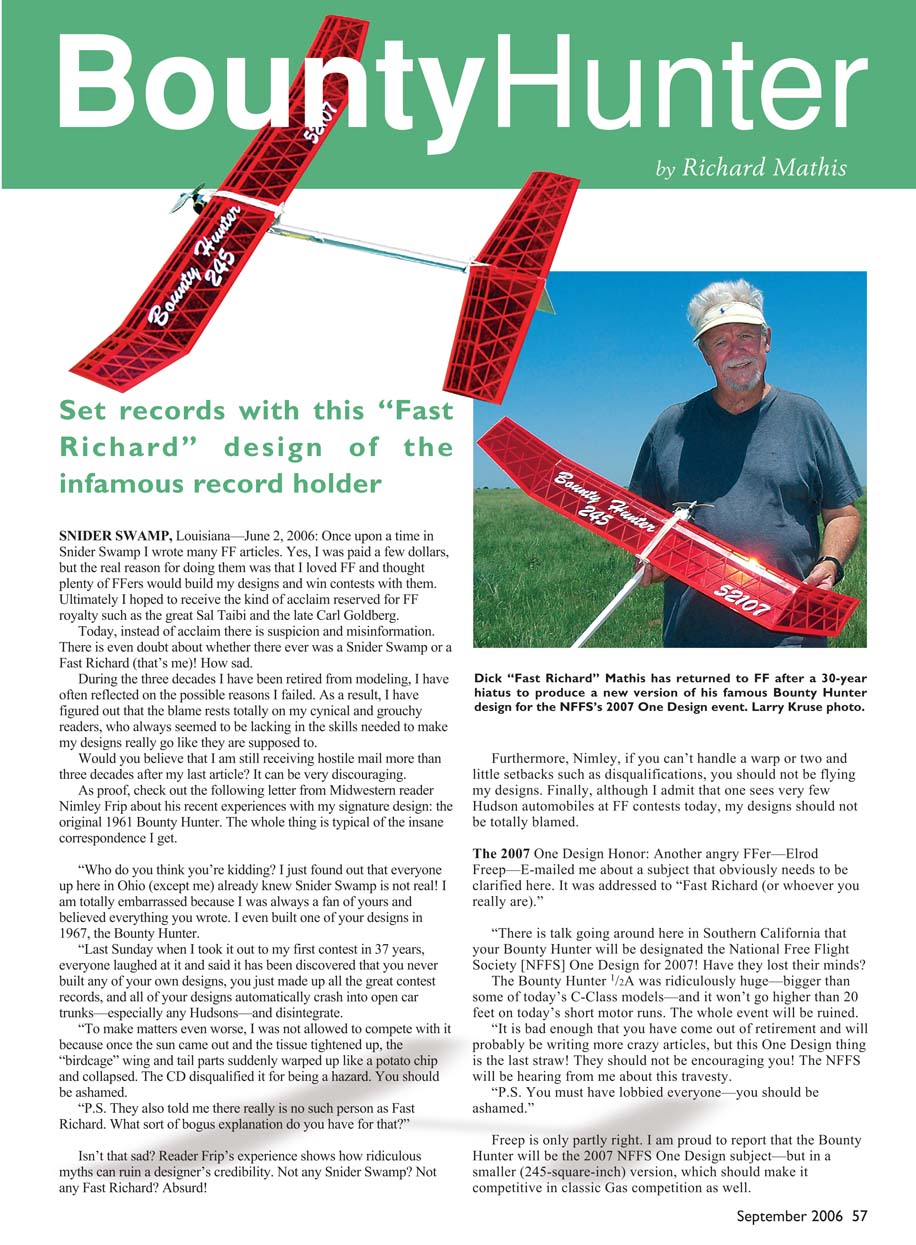
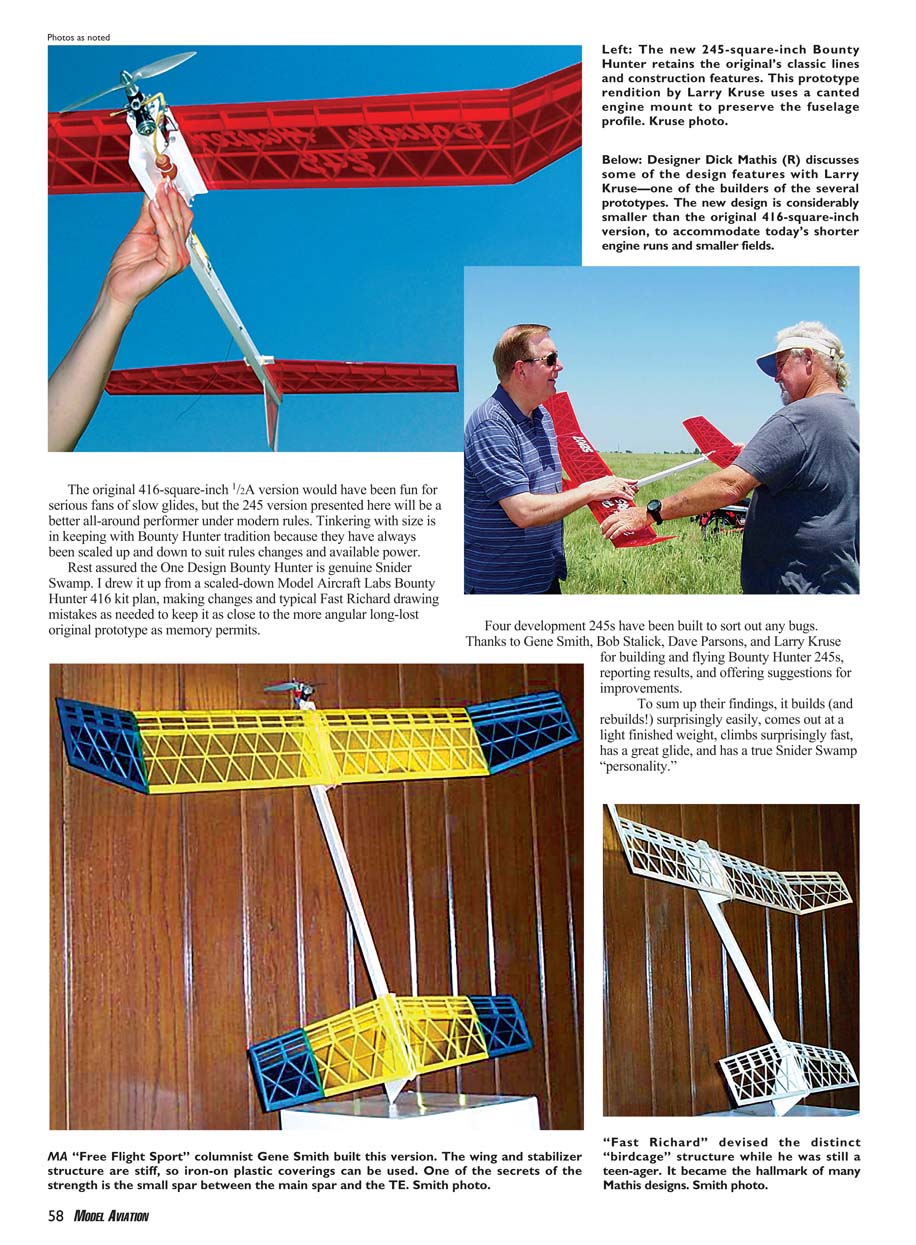
Freep is only partly right. I am proud to report that the Bounty Hunter will be the 2007 NFFS One Design subject—but in a smaller (245-square-inch) version, which should make it competitive in classic Gas competition as well. The original 416-square-inch 1/2A version would have been fun for serious fans of slow glides, but the 245 version presented here will be a better all-around performer under modern rules. Tinkering with size is in keeping with Bounty Hunter tradition because they have always been scaled up and down to suit rules changes and available power.
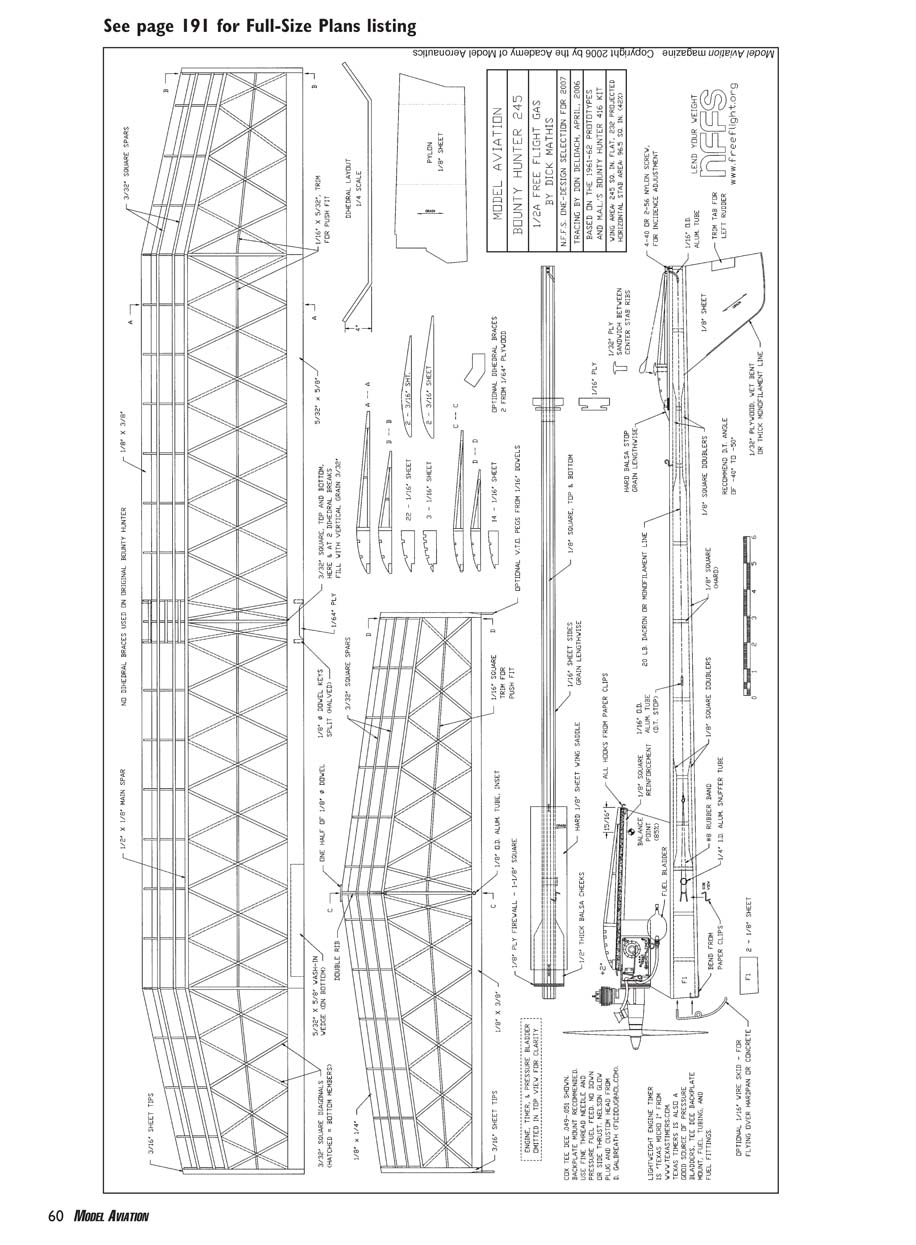
Rest assured the One Design Bounty Hunter is genuine Snider Swamp. I drew it up from a scaled-down Model Aircraft Labs Bounty Hunter 416 kit plan, making changes and typical Fast Richard drawing mistakes as needed to keep it as close to the more angular long-lost original prototype as memory permits.
Four development 245s have been built to sort out any bugs. Thanks to Gene Smith, Bob Stalick, Dave Parsons, and Larry Kruse for building and flying Bounty Hunter 245s, reporting results, and offering suggestions for improvements.
To sum up their findings: it builds (and rebuilds!) surprisingly easily, comes out at a light finished weight, climbs surprisingly fast, has a great glide, and has a true Snider Swamp "personality."
Specifications
- Type: 1/2A free flight, gas-powered model
- Wingspan: 40 inches
- Flying weight: 5.5–6.5 ounces (finished)
- Construction: balsa
- Covering/finish: iron-on covering or dope and tissue
Design Origins
It has always been interesting to me to read about how distinctive free flight designs come about. It is true that most designs are evolutionary rather than revolutionary. I recognize that my designs owe a lot to the true pioneers. However, the following letter from Reginald Foom in England about where the Bounty Hunter design came from was particularly irritating.
"I am writing a book about the evolution of FF Gas design. I have several questions I hope you can give a serious answer for. Please do not try to be funny, as my book is a scholarly work.
"My questions are: 1) What British model did you copy the Bounty Hunter design from? 2) Since no one here in Britain can figure out where you stole the idea for the crisscross 'birdcage' wing construction, do you claim it was original with you? If you do claim originality, you should be ashamed."
Well, Foom, when I was a kid growing up in the postwar, pre-RC "golden age" of aeromodelling, things were different. Major automotive companies and airlines and military services were spending sponsorship money on FF and CL competitions.
My dad and seemingly every man in the neighborhood built model airplanes, plus we lived roughly three blocks from the end of the main runway of Love Field in Dallas, Texas. Everywhere I looked I saw airplanes.
Worn-out Austin pneumatic FF timers and deceased Ohlsson .23 sideports served as Fast Richard the Toddler's main toys. My late dad Don flew FF and CL but was more accomplished at the latter, so he taught me to fly CL when I was 6 and put less emphasis on the FF part.
Nevertheless, I was always more interested in free flight gliders and wind-up Jim Walker Hornets because I could assemble, modify, and fly them by myself all day every day. Much of my early FF was self-taught and unguided until I discovered Zaic yearbooks, British magazines, and joined the Dallas Cloud Climbers FF club at approximately age 14.
The Bounty Hunter started coming together six years later, between 1960 and 1961, when I was 19, but it had many influences behind it. As a teenage Fast Richard in the period leading up to 1961 I had met Chicago's Russ Hansen and seen his high-thrust T-Birds go. I had watched Bob Latham dominate contests in the Dallas–Fort Worth area with his high-thrust, swept-wingtip designs, and I noted that many European A-2 gliders had flat center-panel wings with tip dihedral. I had also met and received guidance from Larry Conover, whose angular designs always inspired me.
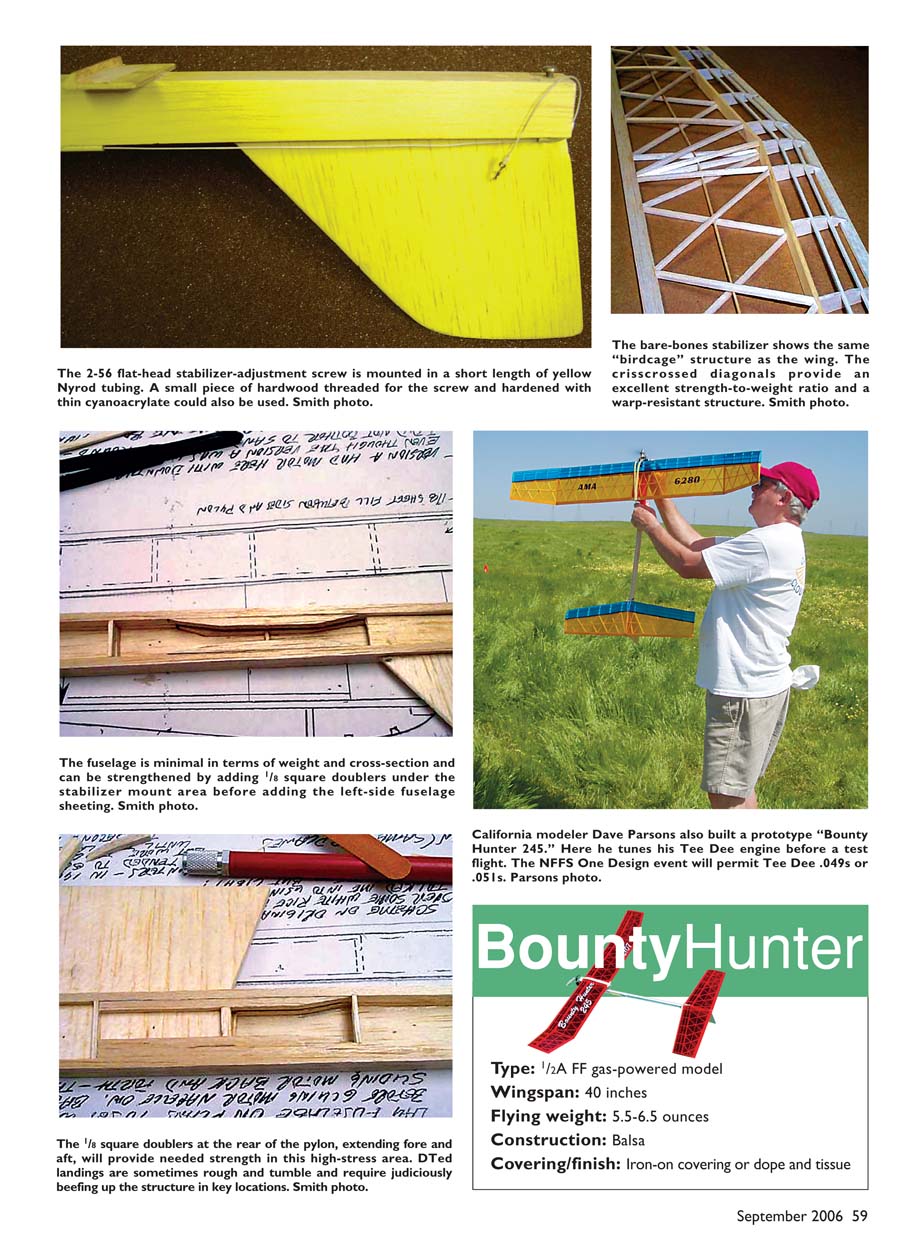
Finally, I had flown a great deal of indoor hand-launched glider (HLG), in which Curt Stevens' sharp high-point airfoils were extraordinarily popular. I also figured out that Warren truss wing ribs were less warp-prone than traditional 90° layouts. Somehow I translated Stevens's airfoil idea and Warren truss into the "birdcage" construction technique—an original idea.
Pre-Bounty Hunter I had successfully used the "birdcage" wing and tail construction on an FAI power model and the colossal Cage 1/2A—a Thermal Hopper–powered creation weighing roughly 8 ounces with 600 square inches of wing attached to an ultralight stick-and-tissue fuselage punctuated with a tiny stabilizer and no pylon (sort of like a modern F1C without carbon).
The Cage had an I-beam spar glued up from 1/16" sheet, and the diamond airfoil's thickness worked out to 4%–5%. It had crisscross stick ribs and was a fast climber, considering it was approximately three times bigger than a normal 1/2A. The glide was stunning.
The Cage lasted long enough for me to present it to a flabbergasted meeting of the Cloud Climbers, but it proved to be sensitive to careless launches, exploding full-bore in a puff of red tissue and 1/16" square sticks after narrowly missing my car: a battered black 1956 Volkswagen Karmann Ghia Coupe.
The next 1/2A following the Ghia's escape from the Cage was the original Bounty Hunter. For a short time, including during its first contest victory, it was low thrust. I did not like the shallow climb angle it had in low-thrust configuration, so I rewarped the wings over the kitchen stove, popped the firewall and nacelle cheeks off, and made it high thrust. After that it climbed vertically, as I wanted.
Thus a design signature emerged for me: high thrust; swept tips; pylon and inverted fin; flat center panel; angular lines; "birdcage" structure; and HLG airfoil. I recall there being only minor refinements to the design leading up to its being kitted by Model Aircraft Labs in the early 1960s and published in American Modeler magazine, although there were changes in the way we set up and trimmed it.
Several prominent designers and fliers including Bill Chenault, Jim Clem, and Jerry Murphy helped improve the design at the time of kitting by building and testing Bounty Hunters and providing feedback. It seems weird now to think of Jim (Witchdoctor) or Bill (Mini Pearl) ever flying Bounty Hunters, but it happened. Although we were rivals at contests, we were proud to promote worthy designs from the Southwest.
My own Bounty Hunter eventually went away OOS (out of sight) in an Oklahoma boomer. However, many others were built across the country, including various sizes ranging from 200 to 1,000 square inches. I made and distributed some rough drawings for the 1,000-square-inch version. In the hands of Jack Nix and others it became my favorite Bounty Hunter size, although I never had one of my own. The Bounty Hunter is a friendly but high-performance design in any size.
Construction
In the scaling-down process I shortened the nose from the original drawings, but the four 245 prototypes still came out nose-heavy.
You should wait to attach the motor nacelles and complete the front of the fuselage until the rest of the airplane is finished. Then slide the power pod to the right place to obtain the CG location specified and glue it all up. It may mean you have to inset the pod in the pylon. With heat-shrink covering the completed airplane should weigh 5.5–6.5 ounces.
I hate bent fuselages, so I build straight ones by pinning one sheet side to a flat board and gluing in the first layer of 1/8" square stringers and uprights. Then the pylon and fin go in, and the gaps between them receive the middle 1/8" square pieces. I glue the 1/8" stringers and uprights to the other side, remove the pins that were holding down the first side, and glue on the second side with books piled on top to hold everything flat.
Be extra careful to sink the front wing rubber-band hold-down hook low enough and even with, or slightly behind, the leading edge to secure the wing tight to the platform. Key the wing and rig the pop-up DT to at least 50'. Make sure your wing has at least some "net" washin on the left main panel (meaning all the warps combined should equal that much washin).
Trimming
Some readers, such as Seymour Throop, simply do not follow Fast Richard's recommendations—and they pay the price.
"I have built several of your FF Gas designs from magazine publications, and every one has been impossible to trim. I follow all your instructions except I do not believe in warping wings on purpose and I move all of the CGs ahead an extra inch just to be safe.
"They never crash, but all they do is loops and barrel rolls. Some guys in my club say they saw you fly in the 1960s and your mother had to trim all of your stuff for you—but they say she was really good at it. You should be ashamed for not giving her credit."
Okay, Seymour, I confess. My late mother Judy always adjusted my models and taught me Mama's Four Truths of Trimming, which would help you remember.
Mama's Four Truths of Trimming:
- Kitchen stoves are for warping your model airplanes.
- Put the CG where the designer has it.
- Most designs fly best when they are crooked, or cross-adjusted—like wing warps counteracted by rudder tab.
- To climb straight up you need more down—as in take the up out of your stabilizer to go more up.
If it were my new 245, my mama were observing, I had the CG in the right place, had matched all the angles on the plans, and was positive about the straight fuselage and fin, I would go out in calm weather and do numerous hand glides. There should be a teeny bit of left rudder tab (1/32") to start with, and I would add stabilizer tilt until it obviously had a slight left-circle tendency.
I would want a long floating glide with the wings flat—not banked. I might have to glide it 20–30 times to be sure. I would even purposely bank it slightly left and toss it into a mild stall to see if it recovered smoothly.
Sequence I recommend:
- Shim and trim stabilizer until glide is long and flat (no bank).
- Add a small left rudder tab and stabilizer tilt to introduce a slight left turn tendency.
- After a few full-power runs (3–4 seconds), correct stabilizer shims and rudder tab to adjust climb, and open or tighten stabilizer tilt to smooth the glide.
- If climb goes right and wants to crash, increase left rudder tab. If it still crashes right, check for other issues.
- If it wants to crash left, take out rudder tab; if it still crashes left, add more left washin. As a last resort, shim the trailing edge of the stabilizer up a bit.
If your Bounty Hunter is loopy, it will eventually end up climbing in a hot thermal, go to the right, and crash, so take the loop out with down-stabilizer. Make it glide to the left with stabilizer or wing tilt, which affects only glide. A hot (and safe) Bounty Hunter 245 might make a quarter of a left turn on a full engine run and go nearly vertical.
Because it is obvious that some FF types will never heed Fast Richard's instructions, maybe they will at least listen to his mama.
Competing With the Bounty Hunter
Admittedly, Fast Richard is a bit rusty from not flying for several decades, and there may occasionally be a slipup in the heat of competition. When that happens we should just move on. It does not help any when so-called fans constantly remind us of it, as in the following snide e-mail message I received today from Vince Third.
"We are all glad you are back, especially because your flights give us something entertaining to talk about between contests. I hear your F1C FF performed several parts of the CL stunt pattern (including a high-speed inverted pass over the flightline) last week at the Texas Cloud Climbers meet before it stuck in the ground like a spear. At least you did not injure anyone—and you have not been disqualified yet.
"Keep up the good work."
About all there is to say to Vince is: wait until next year when I arrive in my vintage Hudson Terraplane with my Bounty Hunter 245 going good for the one-design competitions. You will notice that it is adjusted perfectly, just as my mama would do it. May we all (with the exception of Elrod Freep) max out in 2007 with our 245s.
Richard Mathis
Transcribed from original scans by AI. Minor OCR errors may remain.

