


Broadband Over Power Lines
By Dan Williams
John just finished his pride and joy: a Stand-Off Scale P-51D Mustang. When he arrived at the field, he picked up the frequency pin and his transmitter. Once the preflight checks were completed, including a range check, John figured he was “good to go.”
He was the only one on the flightline; all other transmitters were in the impound. Everyone seemed captivated while watching the maiden flight. After a bit of trimming during the first few passes, the model was flying well. John let the dogs out and ripped a few rolls. All was fine with the world.
With its gasoline engine sounding sweet, John decided to take the P-51 up high and way out to set up for a big ol’ victory roll. He rolled the model inverted and began a Split S. Suddenly there was a twitch of the tail. Then another. In desperation, John yelled, “I ain’t got it!”
There was a sickening crunch as “Six Shooter” buried itself in the ground way off the edge of the runway. “Somebody shot me down!” John moaned. But as he looked around, he saw that everyone was standing around the pits, nowhere near the impound. All of the transmitters were there and were off. No one knew what to say, but everyone headed out to the crash site to help with the pickup.
“Something happened; I had no control at all,” John related.
“Ah, it must have been BPL,” said one of John’s buddies as they walked. “I heard those systems are going in everywhere and they’re causing crashes all over the country. That must’ve been what happened.”
“Huh? I’ve heard of pagers and stuff, but not BPL,” said John. “Maybe that was it.”
A couple more crashes during the long weekend served to reinforce John’s friend’s proclamation. Little did John know that he caused the crash by not range-checking with that big gasoline engine running. He got the airplane far enough out, and the signal loss was caused by interference from metal-to-metal noise in the linkage. The other crashes that weekend were caused by “dumb-thumb” maneuvers. However, the damage was done. That field was labeled as having a problem with BPL when BPL was nowhere nearby.
Loss of control is usually followed by placing blame on someone or something beyond your influence. It’s human nature to say, “I sure didn’t cause the crash; it must have been something else.” BPL is the latest buzzword, and it is causing quite a stir. What is BPL? Can it cause you problems? Please take some time to read this. I know technobabble can glaze people’s eyes over faster than warm milk, but try to read on; I’ll keep it to a minimum. It is important that everyone understand the basics of what BPL is, what it is not, and what it can and cannot do to us as modelers.
What is BPL?
Broadband Over Power Lines (BPL), Access BPL, or just plain BPL, is part of what is generally known as power-line communications. Utility companies have used power-line communications for years to communicate telemetry between sites.
In BPL, Internet communication signals are transmitted through the power lines and are fed into the home. It is a high-speed form of Internet service, much like cable Internet service or Digital Subscriber Line (DSL) phone-line Internet service.
How BPL works
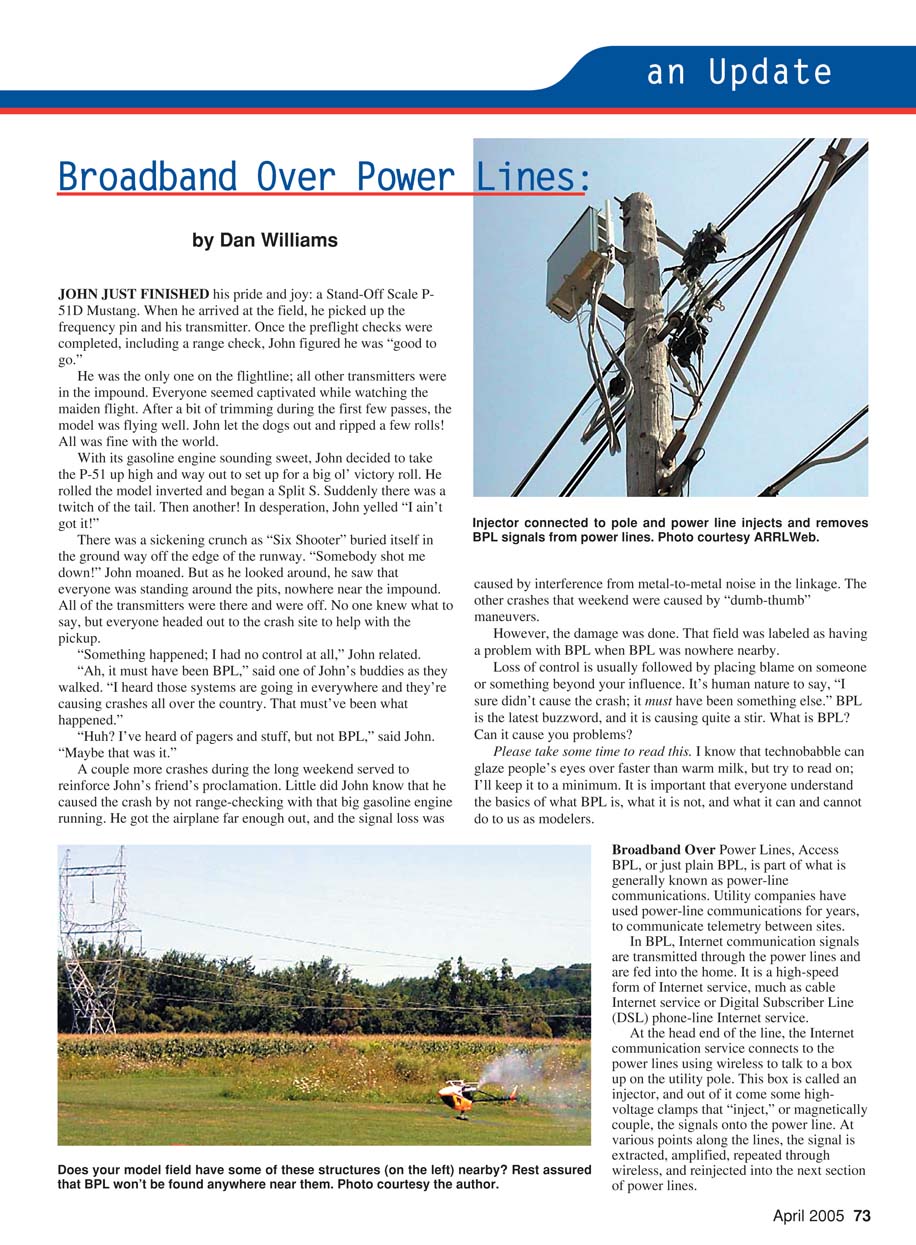
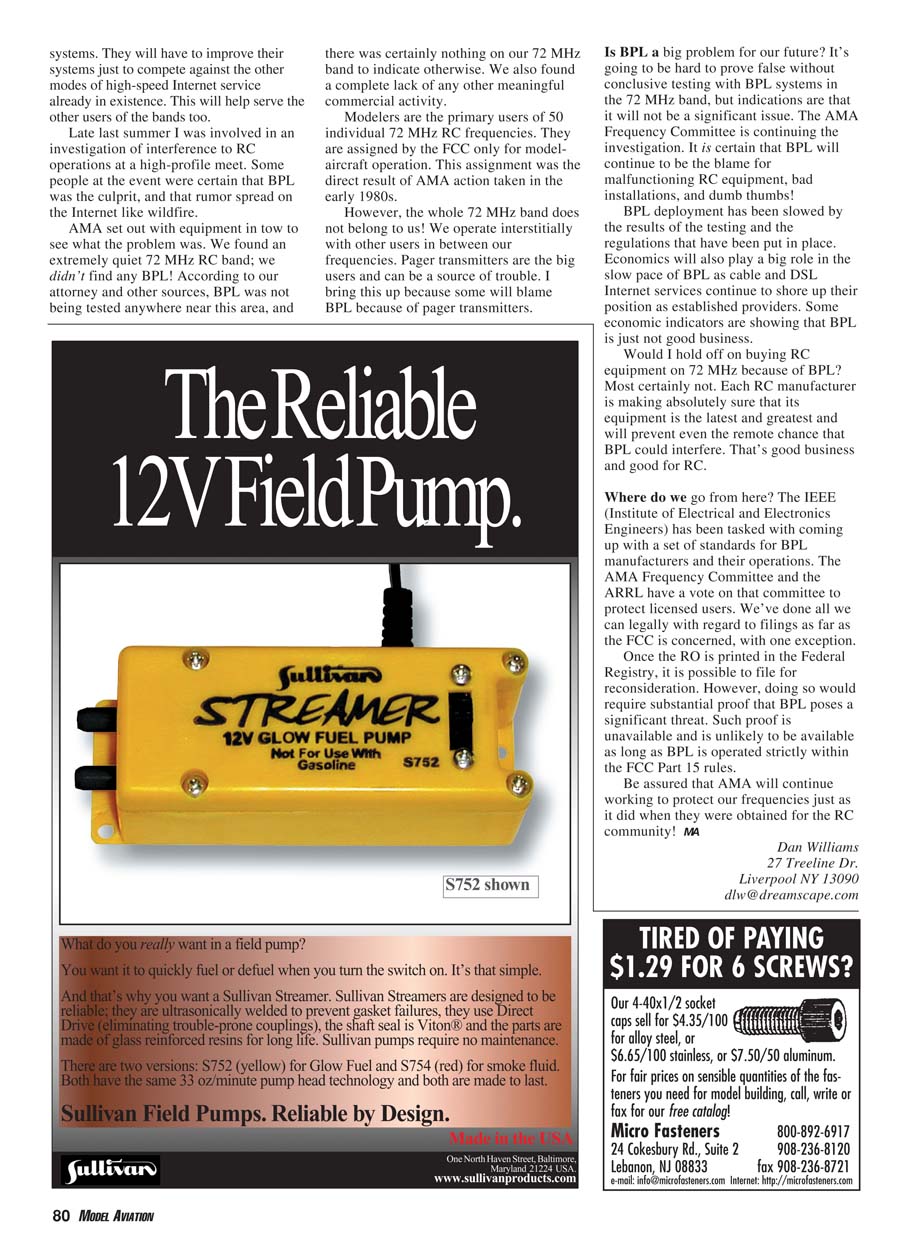
At the head end of the line, the Internet communication service connects to the power lines using wireless to talk to a box up on the utility pole. This box is called an injector, and out of it come some high-voltage clamps that “inject,” or magnetically couple, the signals onto the power line. At various points along the lines, the signal is extracted, amplified, repeated through wireless, and reinjected into the next section of power lines.
This continues along the path in a huge network that becomes the distribution means for Internet service. At the home, a special modem extracts the signals from the power line and connects to your computer.
BPL is authorized to operate on frequencies between 1.8 MHz and 80.0 MHz. This is above the AM (Amplitude Modulation) broadcast band and below the FM (Frequency Modulation) broadcast band.
Why BPL can be different from cable and DSL
The Federal Communications Commission (FCC) authorized the testing of these BPL systems in a series of trials during the past few years. The FCC and BPL manufacturers intentionally kept it quiet; they did not want to arouse the suspicions of other users of the frequencies they were utilizing.
Not until late in 2003—when the FCC put out a Notice of Inquiry (NOI)—did it become evident that some changes were coming. The NOI indicated that the FCC was going to incorporate the specifics of BPL under FCC Part 15 rules. Part 15 regulates the output signal power of unlicensed intentional and unintentional signal radiators, such as computers and power supplies; somehow the FCC was going to pigeonhole BPL into this rule.
AMA immediately took action through its attorney and responded with a letter of objection, as did most others who used the radio bands that could be affected.
FCC Part 15 was originally intended to regulate emissions from sources that are considered "point source radiators." The oscillators in your dual-conversion RC receivers, microwave ovens, television sets, and garage-door openers are governed by this rule. All of these devices have essentially one point where the emission occurs.
On the other hand, BPL is a distributed source of radio-frequency (RF) energy because the BPL signals are transmitted along unshielded power lines. DSL is shielded with twisted telephone wires. Cable service is protected with a braided shield. BPL is transmitted along bare wires that were meant to transmit 60-hertz AC power—not the many MHz of broadband RF signals.
Although BPL was technically already allowable under FCC Part 15, there were no specific rules and requirements. The BPL manufacturers needed the specifics added to proceed with deployment.
The potential problem with BPL is that the signals don't stay within the power line, as they do in cable broadband technology. The power line radiates the signal like a big antenna. How far away from the power line the signal is going to affect other services is a source of contention and much debate among users and the FCC.
FCC action: NOI, NPRM, and the Rule and Order
Early in 2004 the FCC put out a Notice of Proposed Rulemaking (NPRM), which meant it intended to move ahead with incorporating BPL into FCC Part 15. AMA, along with its attorney, drafted an extensive letter outlining our objections to the rulemaking.
The Amateur Radio Relay League (ARRL) has done exhaustive impact studies on its operations and included serious technical details in the report. We have been in continual contact with the ARRL and its engineering staff, and we have basically aligned AMA with the ARRL to pool our memberships on this issue. The ARRL has provided us with much valuable information about the tests underway and the studies done. This has been incredibly helpful in the effort to evaluate BPL and supports our licensed HAM operators who use the Six Meter band for RC modeling.
In the NPRM, the FCC outlined a series of tests that would be used to govern emissions from BPL systems. At a given distance and height away from the power lines, the signal level would have to be below the limit for FCC Part 15 emissions from unlicensed equipment.
The dilemma is that, at the time, the BPL equipment wasn't using the whole allotment of frequencies. Testing our equipment for compatibility with these systems has been difficult. We've attempted to do some tests on the 27 MHz band (CB) with equipment on the few CB frequencies we have, but the results have been inconclusive. Some BPL systems have been "notching out," or trying to limit the amount of power used in the CB frequencies. It has been difficult for AMA to determine the effects.
On October 28, 2004, the FCC released a Rule and Order (RO). It made BPL official. The order essentially outlined what was in the NPRM, with several crucial exceptions and protections:
- BPL equipment must be certified to meet FCC standards. Manufacturers must prove compliance rather than simply verify it.
- The installer must verify the equipment at the installation site and ensure it meets Part 15 requirements. Providers must have test equipment available to do the checking, preventing arbitrary increases in power to overcome installation issues.
- A public database must be kept of all BPL installations so anyone can determine where a BPL system has been deployed.
Those three points were advanced by the Academy in its filings to exercise some control over BPL operations. In addition, BPL is authorized to exist through "license by rule," the same condition that exists for our operations. Therefore, BPL is required to cease operations if it interferes with licensed operations.
These conditions serve to protect everyone to a greater degree and make BPL a harder sell when trying to compete with cable or DSL.
Potential impact on RC modeling
Our airborne RC operations are in the 72 MHz band, near the upper end of the allowable spectrum for BPL. The few frequencies available on 27 MHz in the Citizens' Band (CB), some inexpensive systems on 49 MHz, and licensed handheld amateur radio (HAM) operators who can use the 50 MHz and 53 MHz frequencies for RC are also affected.
Most RC modelers use our exclusive 50 frequencies in the 72 MHz band. Currently the state-of-the-art BPL systems being deployed in the test sites were operating between 1.8 MHz and roughly 30.0 MHz—well below our normally used RC band.
The AMA Frequency Committee reviewed the small list of test sites in operation and found there had been no widespread deployment of BPL to date. There were only roughly a dozen systems being tested, and they were limited in size and scope. These sites were within suburbs or small city areas, not where the average modeler would be flying airplanes.
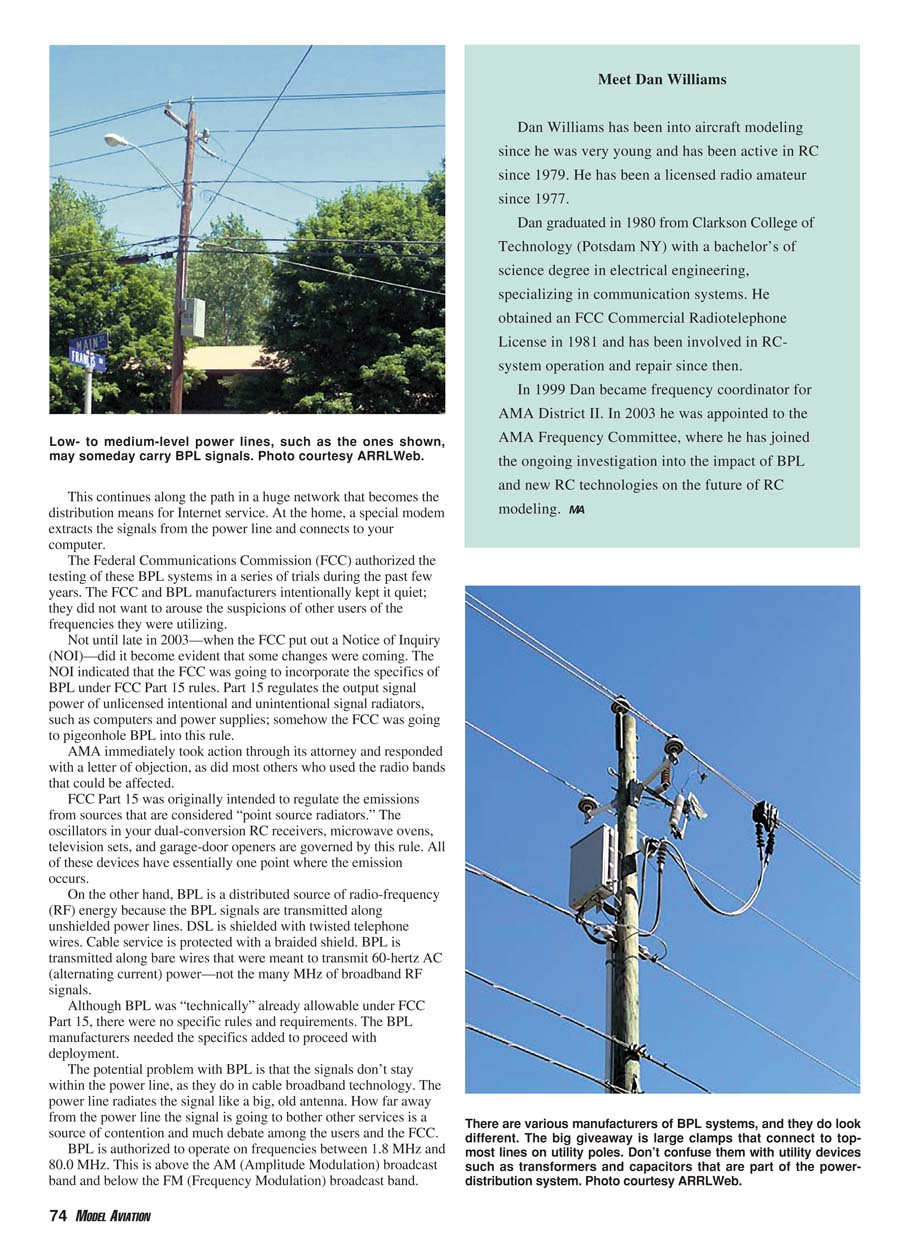
BPL is only to be used in medium-voltage lines—the typical power lines that run down the road in neighborhoods. It is not being used in high-voltage transmission lines. Many model sites are within sight of towering high-voltage lines; BPL will not be found on those lines.
As of this writing, several of the dozen or so systems used for testing have been shut down for various reasons. Some companies have found the return is not worth the investment. Many studies show BPL is not the cash cow providers and utilities thought it would be.
In some places BPL just doesn't work well. Every several hundred feet a new repeater injector has to be installed on the power lines to keep the signal going. This is a cost issue. In many places, simple power-line noise is causing grief for installers. They cannot turn up the power to make things work, so there are places that can't receive BPL signals at all.
HAM radio communicators have been pressing BPL providers in their areas. HAM communications are weak by nature, and operators are having a tough time coping with BPL signal levels. These communication signal levels are much lower than the levels used for RC operations.
Signal-level comparisons and modeling
Members of the AMA Frequency Committee have been working with mathematics and system modeling studies to see if FCC Part 15 levels would be a problem for us. The jury is still out, but initial indications are that signals from our transmitters are much stronger at some distance from receivers than BPL signals. Therefore, BPL may not be a concern for RC.
Theoretical examples indicate the following:
- An RC receiver a half-mile away from its transmitter and 30 feet from power lines will have roughly twice as much RC signal as a BPL signal would produce. For potential interference, a model would have to be a half-mile away and 60 feet or lower in altitude directly above power lines containing BPL signals.
- At half that distance (a quarter-mile), the RC signal would be four times stronger. Flying a model a quarter-mile away at 60 feet altitude is an extreme case for most sport flying.
It is doubtful many would fly a model that far away and that close to the ground because of visual constraints near power lines. Park flyers may be flown within 60 feet of a power line, but the transmitter is usually much closer to the receiver as well, providing ample signal strength.
This does not account for all path losses. Modeling a BPL system radiation pattern is not trivial, and there are numerous arguments about assumptions and results. Some studies indicate that after approximately 100 feet from the power line the BPL signal level will be below the background noise level, while HAM operators who have experienced BPL interference firsthand disagree. Comparisons must be made carefully between HAM communications and RC operation.
Tests, incidents, and practical experience
Late last summer I was involved in an investigation of interference to RC operations at a high-profile meet. Some people at the event were certain BPL was the culprit, and that rumor spread on the Internet like wildfire.
AMA set out with equipment in tow to see what the problem was. We found an extremely quiet 72 MHz RC band; we didn't find any BPL. According to our attorney and other sources, BPL was not being tested anywhere near this area, and there was certainly nothing on our 72 MHz band to indicate otherwise. We also found a complete lack of any other meaningful commercial activity.
Modelers are the primary users of 50 individual 72 MHz RC frequencies. They are assigned by the FCC only for model-aircraft operation. This assignment was the direct result of AMA action taken in the early 1980s. However, the whole 72 MHz band does not belong to us. We operate interstitially with other users in between our frequencies. Pager transmitters are the big users and can be a source of trouble. Some will blame BPL when pager transmitters are the real cause.
Is BPL a big problem for our future? It's going to be hard to prove false without conclusive testing with BPL systems in the 72 MHz band, but indications are that it will not be a significant issue. The AMA Frequency Committee is continuing the investigation. It is certain that BPL will continue to be blamed for malfunctioning RC equipment, bad installations, and dumb thumbs.
BPL deployment has been slowed by test results and the regulations that have been put in place. Economics will also play a big role in the slow pace of BPL as cable and DSL Internet services continue to shore up their position as established providers. Some economic indicators show BPL is just not good business.
Would I hold off on buying RC equipment on 72 MHz because of BPL? Most certainly not. Each RC manufacturer is making sure its equipment is the latest and greatest and will prevent even the remote chance that BPL could interfere. That's good business and good for RC.
Where we go from here
The IEEE (Institute of Electrical and Electronics Engineers) has been tasked with developing a set of standards for BPL manufacturers and their operations. The AMA Frequency Committee and the ARRL have votes on that committee to protect licensed users. We've done all we can legally with regard to filings at the FCC, with one exception.
Once the RO is printed in the Federal Register, it is possible to file for reconsideration. However, doing so would require substantial proof that BPL poses a significant threat. Such proof is unavailable and is unlikely to be available as long as BPL is operated strictly within FCC Part 15 rules.
Be assured that AMA will continue working to protect our frequencies just as it did when they were obtained for the RC community.
Dan Williams 27 Treeline Dr. Liverpool, NY 13090 [email protected]
Meet Dan Williams
Dan Williams has been into aircraft modeling since he was very young and has been active in RC since 1979. He has been a licensed radio amateur since 1977.
Dan graduated in 1980 from Clarkson College of Technology (Potsdam, NY) with a Bachelor of Science degree in electrical engineering, specializing in communication systems. He obtained an FCC Commercial Radiotelephone License in 1981 and has been involved in RC-system operation and repair since then.
In 1999 Dan became frequency coordinator for AMA District II. In 2003 he was appointed to the AMA Frequency Committee, where he has joined the ongoing investigation into the impact of BPL and new RC technologies on the future of RC modeling. The AMA Frequency Committee continues to examine BPL and related issues to protect modelers' interests.
Transcribed from original scans by AI. Minor OCR errors may remain.

