
Cape Coral R/Sea Hawks
John Agnew
Cape Coral, Florida is a new city across a river from an older city, Fort Myers, which is less well known than nearby Sanibel Island. Cape Coral had a population of 5,000 in 1965, then became one of the fastest-growing communities in the country. It is a retirement haven, but is also a center for young families and new businesses.
Three model fliers found each other and formed a club in Cape Coral in 1977. They became the R/Sea Hawks—chartered and incorporated in 1980—and have been in continuous operation since, although not always without problems.
The developers of Cape Coral built far more roads and dug far more canals than would be utilized in half a century, so our initial flying site was a road with no houses nearby. Organization was informal and frequency control was primitive, but we flew.
Nonmembers flew from other roads, which seemed to be a limitless resource until the telephone poles went up. Glider pilots found a full block of undeveloped lots and flew on Saturday mornings. Then the houses began to spring up, complaints were directed at City Hall, and we were asked to move.
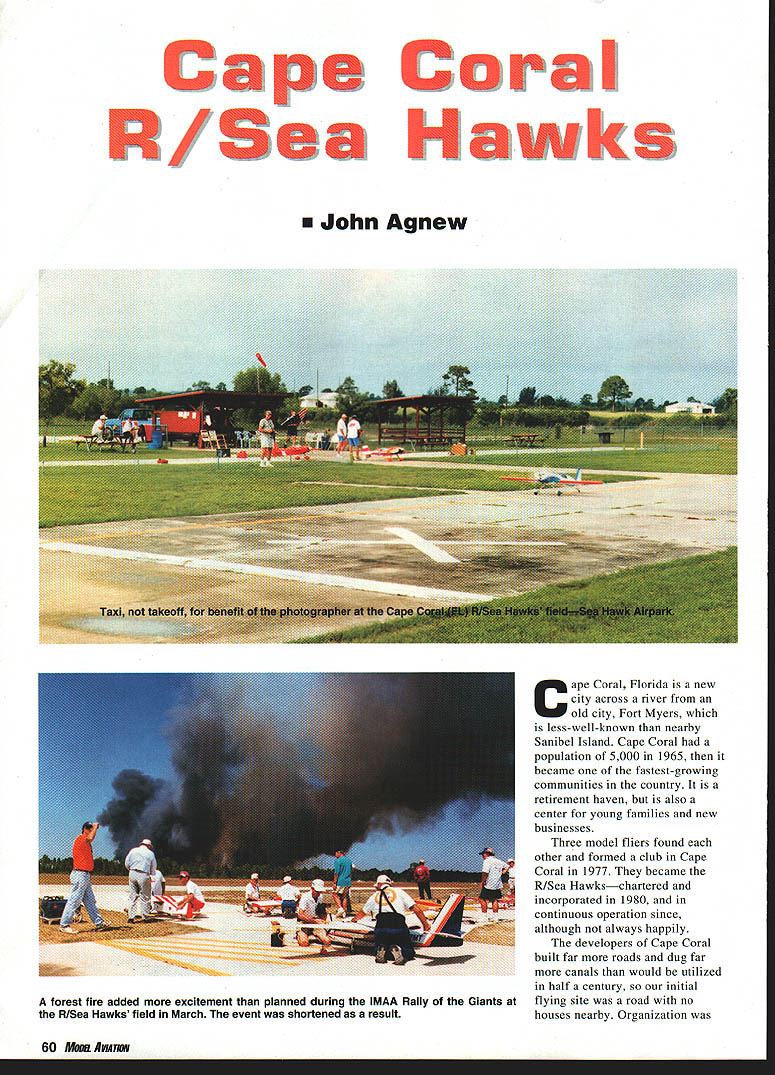
Club members looked at a map and found a city-owned parcel far from development. We requested use of the area, and it was granted. The location became a city park—a park with no facilities, but one designated for model flying. Our club has developed this site for 12 years, and improvements have come in fits and starts—almost all of them with club money and “sweat equity.”
Facilities and Field Layout
- A 330 x 30-foot cement runway; surrounding grass increases the potential landing area to about 500 x 80 feet.
- A large grass field contiguous to the runway adequate for winch-launched glider flying.
- Cement pit area about two-thirds the length of the runway, with holes drilled at each station for a padded aluminum-bungee tail restraint.
- Large airplanes are started only at the central entrance to the runway; models must be under physical control in the pits at all times.
- A knee-high safety fence immediately in front of the pilot stations and a chest-high fence behind the pits to protect spectators and remind them to stay behind it.
- Two shelters (one for spectators), picnic tables, a designated parking lot, and a Portosan™ facility.
The site continues to be a city park, and the city government has designated the club responsible for management, maintenance, and flying safety. We use the park free of charge, which allows us to keep annual dues at $45. There is no initiation fee, although we have occasionally had assessments for field improvements.
Membership and Activity
Club membership has grown from three to 220—about one third of whom go north in the summer. We have two three-generation groups and several two-generation groups. The club newsletter keeps everyone in touch.
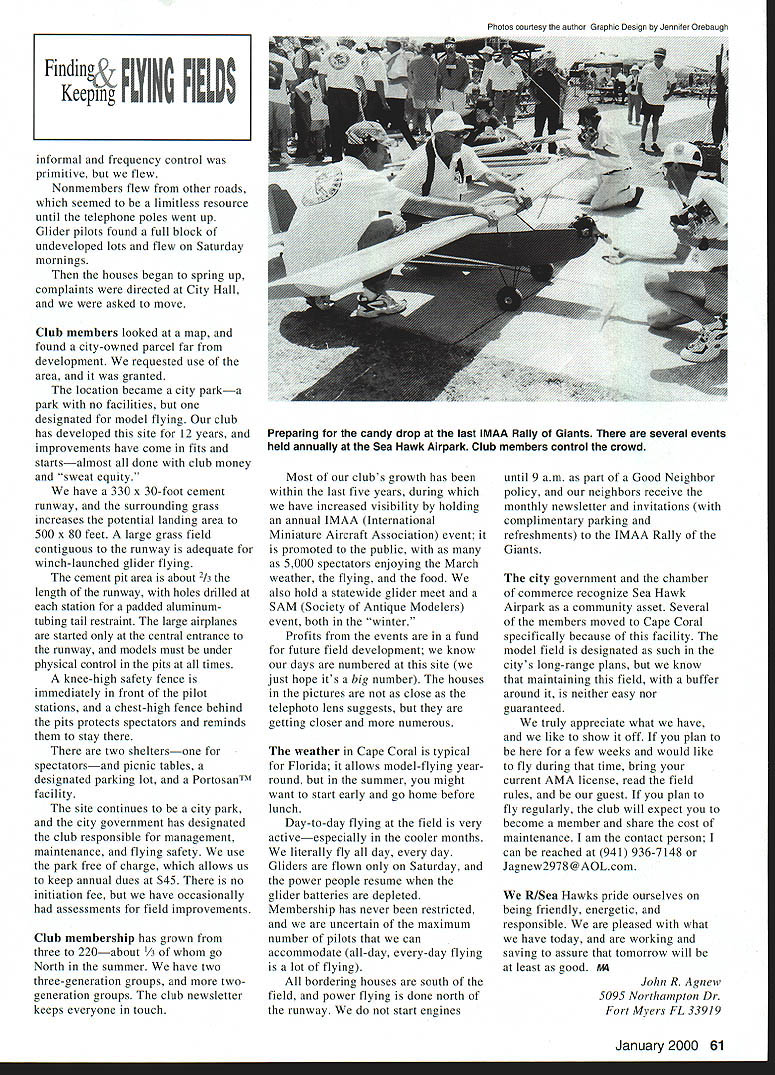
Most of our club’s growth has been within the last five years, during which we increased visibility by holding an annual IMAA (International Miniature Aircraft Association) event. It is promoted to the public, with as many as 5,000 spectators enjoying the March weather, the flying, and the food. We also hold a statewide glider meet and a SAM (Society of Antique Modelers) event, both in the “winter.”
Profits from the events are placed in a fund for future field development; we know our days are numbered at this site (we just hope it’s a big number). The houses in photographs are not as close as a telephoto lens might suggest, but they are getting closer and more numerous.
The weather in Cape Coral is typical for Florida; it allows model flying year-round, but in the summer you might want to start early and go home before lunchtime.
Day-to-day flying at the field is very active—especially in the cooler months. We literally fly all day, every day. Gliders are flown only on Saturdays, and the power fliers resume when the glider batteries are depleted. Membership has never been restricted, and we are uncertain of the maximum number of pilots that we can accommodate (all-day, every-day flying is a lot of flying).
All bordering houses are south of the field, and power flying is done north of the runway. We do not start engines until 9 a.m. as part of a Good Neighbor policy, and our neighbors receive the monthly newsletter and invitations (with complimentary parking and refreshments) to the IMAA Rally of the Giants.
The city government and the chamber of commerce recognize Sea Hawk Airpark as a community asset. Several members moved to Cape Coral specifically because of this facility. The model field is designated as such in the city’s long-range plans, but maintaining this field, with a buffer around it, is neither easy nor guaranteed.
Visiting and Membership Notes
We truly appreciate what we have, and we like to show it off. If you plan to be here for a few weeks and would like to fly during that time, bring your current AMA license, read the field rules, and be our guest. If you plan to fly regularly, the club will expect you to become a member and share the cost of maintenance.
We R/Sea Hawks pride ourselves on being friendly, energetic, and responsible. We are pleased with what we have today and are working and saving to assure that tomorrow will be at least as good.
John R. Agnew <REDACTED>
Transcribed from original scans by AI. Minor OCR errors may remain.

