
The Case for Building Model Aircraft
by Bob Aberle
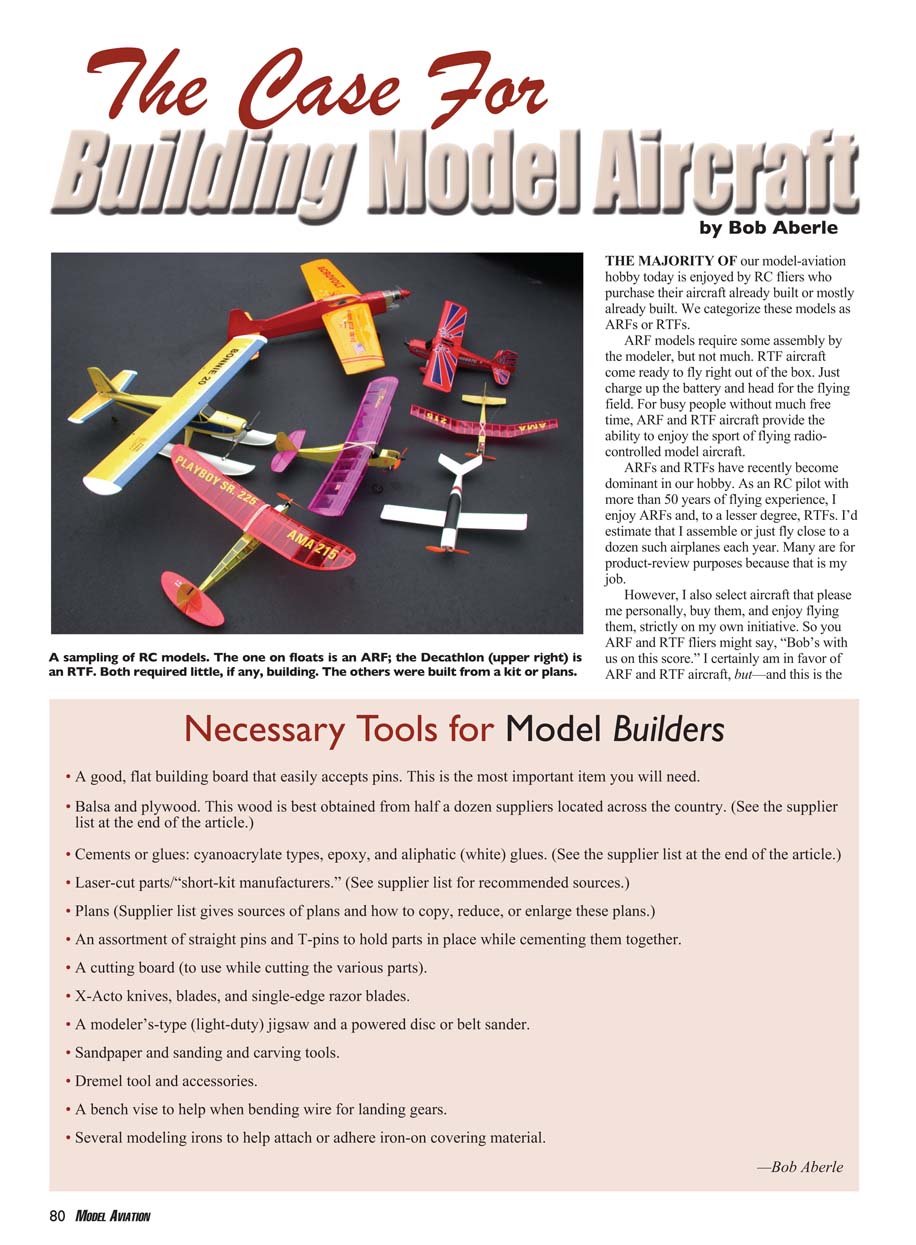
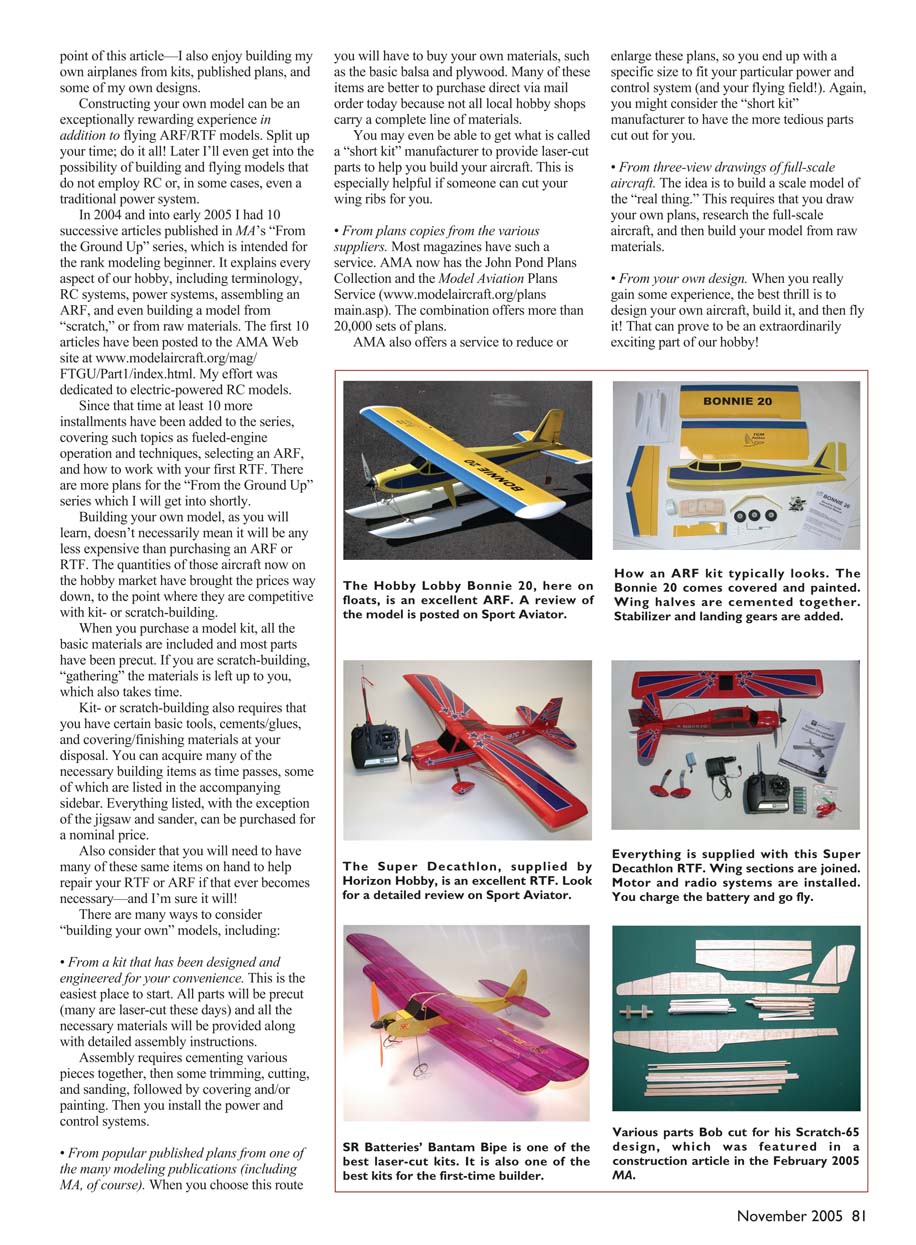
The majority of our model-aviation hobby today is enjoyed by RC fliers who purchase their aircraft already built or mostly built. We categorize these models as ARFs (Almost-Ready-to-Fly) or RTFs (Ready-to-Fly).
ARF models require some assembly by the modeler, but not much. RTF aircraft come ready to fly right out of the box—just charge the battery and head for the flying field. For busy people without much free time, ARF and RTF aircraft provide the ability to enjoy the sport of flying radio-controlled model aircraft.
ARFs and RTFs have recently become dominant in our hobby. As an RC pilot with more than 50 years of flying experience, I enjoy ARFs and, to a lesser degree, RTFs. I assemble or fly close to a dozen such airplanes each year; many are for product-review purposes because that is my job. I also select aircraft that please me personally, buy them, and enjoy flying them strictly on my own initiative. So you ARF and RTF fliers might say, "Bob's with us on this score." I certainly am in favor of ARF and RTF aircraft, but I also enjoy building my own airplanes from kits, published plans, and some of my own designs.
Constructing your own model can be an exceptionally rewarding experience in addition to flying ARF/RTF models. Split up your time; do it all. Later in this article I'll even get into the possibility of building and flying models that do not employ RC or, in some cases, even a traditional power system.
In 2004 and into early 2005 I had 10 successive articles published in MA's "From the Ground Up" series, which is intended for the rank modeling beginner. It explains every aspect of our hobby, including terminology, RC systems, power systems, assembling an ARF, and even building a model from "scratch" or from raw materials. The first 10 articles have been posted to the AMA Web site at www.modelaircraft.org/mag/FTGU/Part1/index.html. My effort was dedicated to electric-powered RC models.
Since that time at least 10 more installments have been added to the series, covering such topics as fueled-engine operation and techniques, selecting an ARF, and how to work with your first RTF. There are more plans for the "From the Ground Up" series which I will get into shortly.
Building your own model doesn't necessarily mean it will be less expensive than purchasing an ARF or RTF. The quantities of those aircraft now on the hobby market have brought prices down to the point where they are competitive with kit- or scratch-building.
When you purchase a model kit, all the basic materials are included and most parts have been precut. If you are scratch-building, gathering the materials is left up to you, which also takes time. Kit- or scratch-building also requires that you have certain basic tools, cements/glues, and covering/finishing materials at your disposal. You can acquire many of the necessary building items as time passes; some of these are listed below. Everything listed, with the exception of a jigsaw and a sander, can be purchased for a nominal price.
Also consider that you will need many of these same items on hand to repair your RTF or ARF if that ever becomes necessary—and I'm sure it will!
Necessary Tools for Model Builders
- A good, flat building board that easily accepts pins. This is the most important item you will need.
- Balsa and plywood. This wood is best obtained from a half dozen suppliers located across the country. (See the supplier list at the end of the article.)
- Cements or glues: cyanoacrylate types, epoxy, and aliphatic (white) glues. (See the supplier list at the end of the article.)
- Laser-cut parts / "short-kit" manufacturers. (See supplier list for recommended sources.)
- Plans (supplier list gives sources of plans and how to copy, reduce, or enlarge these plans).
- An assortment of straight pins and T-pins to hold parts in place while cementing them together.
- A cutting board to use while cutting the various parts.
- X-Acto knives, blades, and single-edge razor blades.
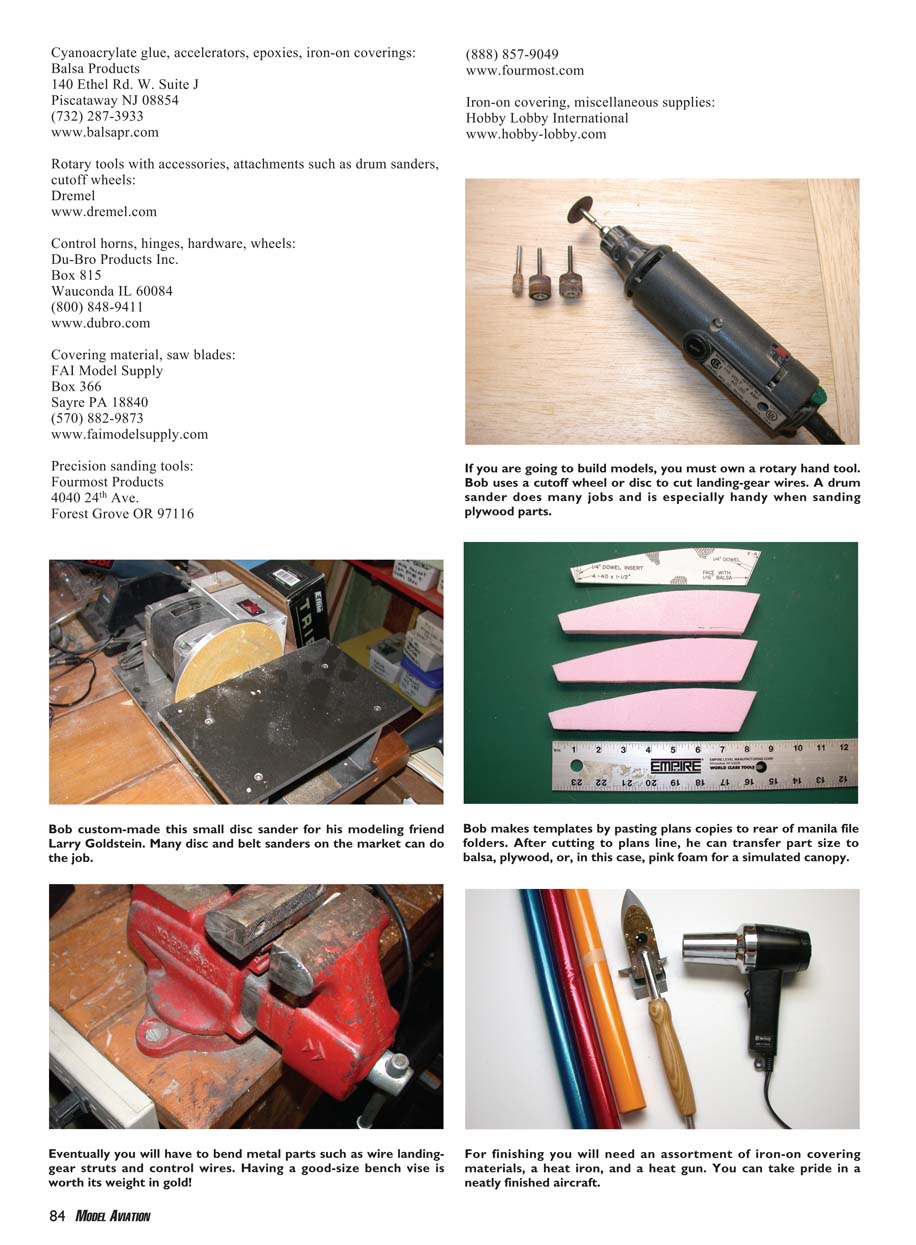
- A modeler's-type (light-duty) jigsaw and a powered disc or belt sander.
- Sandpaper and sanding and carving tools.
- Dremel tool and accessories.
- A bench vise to help when bending wire for landing gear.
- Several modeling irons to help attach or adhere iron-on covering material.
Constructing your own aircraft is as much a part of the hobby as the flying. If you haven't built before, this is a great way to put the hobby back into the hobby.
Ways to Build Your Own Models
There are many ways to consider "building your own" models, including:
- From a kit designed and engineered for your convenience. This is the easiest place to start. All parts will be precut (many are laser-cut these days) and all the necessary materials are provided along with detailed assembly instructions. Assembly requires cementing various pieces together, then some trimming, cutting, and sanding, followed by covering and/or painting. Then you install the power and control systems.
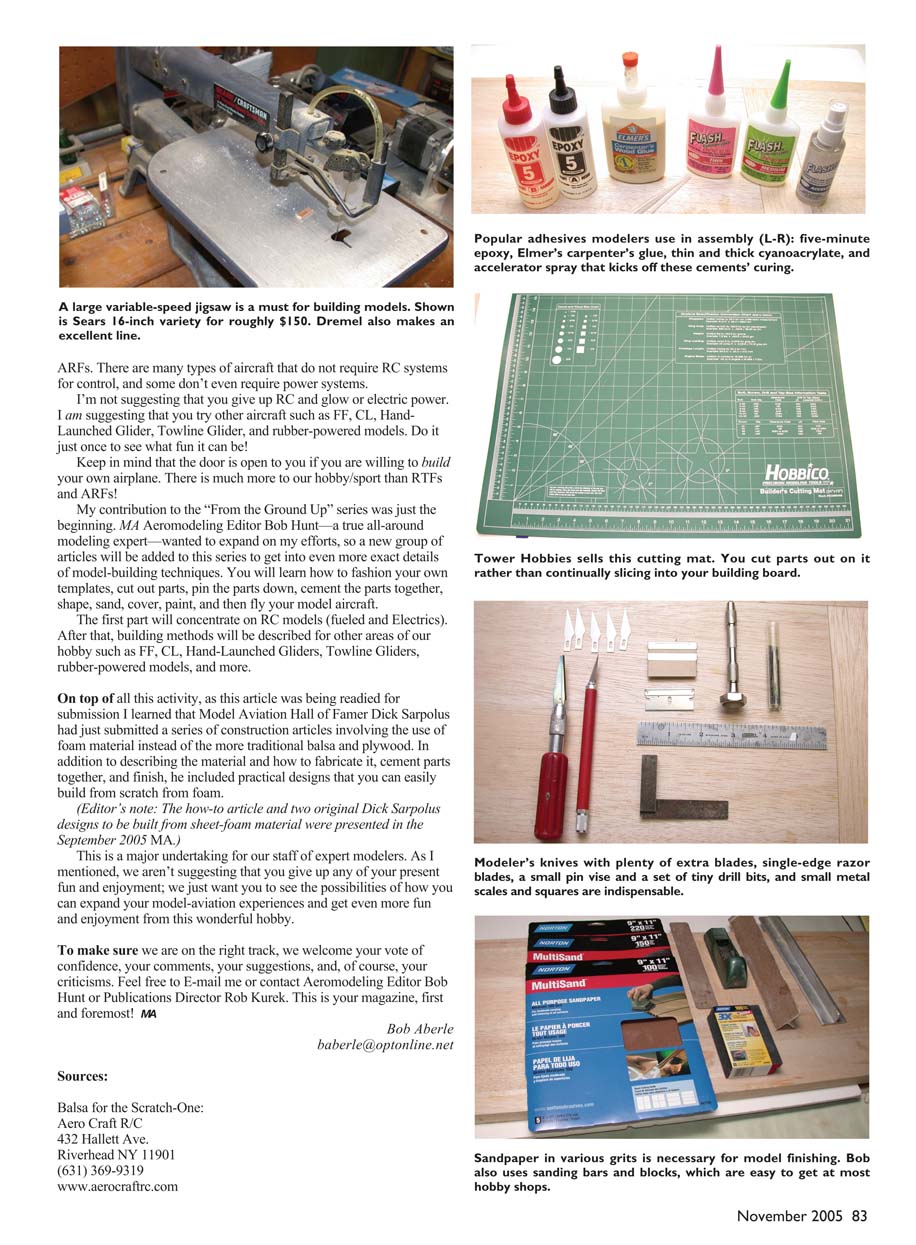
- From popular published plans from one of the many modeling publications (including MA). When you choose this route you will have to buy your own materials, such as balsa and plywood. Many of these items are better purchased via mail order because not all local hobby shops carry a complete line of materials. You may even be able to have a "short kit" manufacturer provide laser-cut parts to help you build your aircraft—especially helpful if someone can cut your wing ribs for you.
- From plans copies provided by various suppliers. Most magazines offer such a service. AMA has the John Pond Plans Collection and the Model Aviation Plans Service (www.modelaircraft.org/plans/main.asp). The combination offers more than 20,000 sets of plans. AMA also offers a service to reduce or enlarge these plans so you end up with a specific size to fit your particular power and control system (and your flying field). Again, consider a "short kit" manufacturer to have tedious parts cut for you.
- From three-view drawings of full-scale aircraft. The idea is to build a scale model of the real thing. This requires that you draw your own plans, research the full-scale aircraft, and then build your model from raw materials.
- From your own design. When you gain experience, the best thrill is to design your own aircraft, build it, and then fly it. That can be extraordinarily exciting!
Where to Start
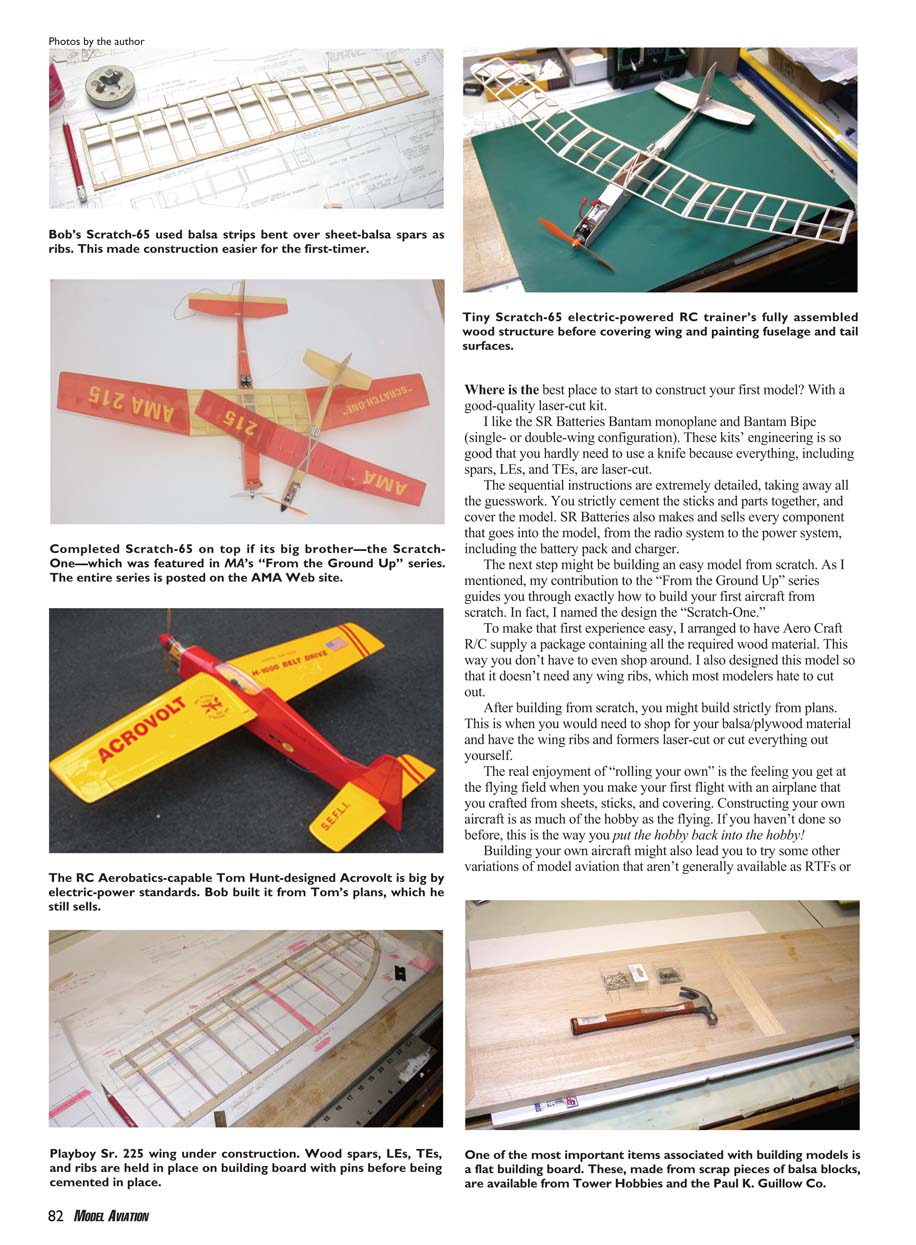
The best place to start constructing your first model is with a good-quality laser-cut kit. I like the SR Batteries Bantam monoplane and Bantam Bipe (single- or double-wing configuration). These kits' engineering is so good that you hardly need to use a knife because everything, including spars, leading edges, and trailing edges, are laser-cut. The sequential instructions are extremely detailed, taking away all the guesswork. You strictly cement the sticks and parts together and cover the model. SR Batteries also makes and sells every component that goes into the model, from the radio system to the power system, including the battery pack and charger.
The next step might be building an easy model from scratch. My contribution to the "From the Ground Up" series guides you through exactly how to build your first aircraft from scratch; I named the design the "Scratch-One." To make that first experience easy, I arranged to have Aero Craft R/C supply a package containing all the required wood material so you don't have to shop around. I also designed this model so it doesn't need any wing ribs, which most modelers hate to cut out.
After building from scratch, you might build strictly from plans. This is when you would need to shop for balsa/plywood material and have the wing ribs and formers laser-cut—or cut everything out yourself.
The real enjoyment of "rolling your own" is the feeling you get at the flying field when you make your first flight with an airplane that you crafted from sheets, sticks, and covering.
Try Other Types of Models
Building your own aircraft might lead you to try variations of model aviation that aren't generally available as RTFs or ARFs. There are many types of aircraft that do not require RC systems for control, and some don't even require power systems. I'm not suggesting you give up RC and glow or electric power; I am suggesting you try other aircraft just once to see what fun they can be:
- FF (free flight)
- CL (control line)
- Hand-launched glider
- Towline glider
- Rubber-powered models
Keep in mind the door is open to you if you are willing to build your own airplane. There is much more to our hobby/sport than RTFs and ARFs.
Ongoing "From the Ground Up" Efforts and Foam Construction
My contribution to the "From the Ground Up" series was just the beginning. MA Aeromodeling Editor Bob Hunt wanted to expand on my efforts, so new articles will be added to the series to get into even more exact details of model-building techniques. You will learn how to fashion your own templates, cut out parts, pin parts down, cement parts together, shape, sand, cover, paint, and then fly your model aircraft.
The first part will concentrate on RC models (fueled and electrics). After that, building methods will be described for other areas of our hobby such as FF, CL, hand-launched gliders, towline gliders, rubber-powered models, and more.
As this article was being readied for submission I learned that Model Aviation Hall of Famer Dick Sarpoulas had just submitted a series of construction articles involving the use of foam material instead of the more traditional balsa and plywood. In addition to describing the material and how to fabricate it, cement parts together, and finish, he included practical designs that you can easily build from scratch from foam.
(Editor's note: The how-to article and two original Dick Sarpoulas designs to be built from sheet-foam material were presented in the September 2005 issue of Model Aviation.)
This is a major undertaking for our staff of expert modelers. We aren't suggesting you give up any of your present fun and enjoyment; we just want you to see the possibilities of how you can expand your model-aviation experiences and get even more enjoyment from this wonderful hobby.
To make sure we are on the right track, we welcome your vote of confidence, comments, suggestions, and, of course, criticisms. Feel free to E-mail me or contact Aeromodeling Editor Bob Hunt or Publications Director Rob Kurek. This is your magazine, first and foremost.
Bob Aberle [email protected]
Sources
Balsa for the Scratch-One:
- Aero Craft R/C
432 Hallett Ave. Riverhead, NY 11901 (631) 369-9319 www.aerocraftrc.com
Cyanoacrylate glue, accelerators, epoxies, iron-on coverings:
- Balsa Products
140 Ethel Rd. W., Suite J Piscataway, NJ 08854 (732) 287-3933 www.balsapr.com
Rotary tools with accessories, attachments such as drum sanders and cutoff wheels:
- Dremel
Control horns, hinges, hardware, wheels:
- Du-Bro Products Inc.
Box 815 Wauconda, IL 60084 (800) 848-9411 www.dubro.com
Covering material, saw blades:
- FAI Model Supply
Box 366 Sayre, PA 18840 (570) 882-9873 www.faimodelsupply.com
Precision sanding tools:
- Fourmost Products
4040 24th Ave. Forest Grove, OR 97116 (888) 857-9049 www.fourmost.com
Iron-on covering, miscellaneous supplies:
- Hobby Lobby International
Transcribed from original scans by AI. Minor OCR errors may remain.

