
CL Aerobatics
AS I WAS fighting to find the working combination of adjustments on my Classic Venus, I remembered a concept that I'd long forgotten: the baseline.
If you've been at this flying as long as I have, the baseline—where you are going in your trimming—is so ingrained that you don't even think about it. Baseline is a difficult concept to explain, because of many interrelated factors.
From experience, there is a definite "feel" that I'm looking for, and I try to make all my airplanes fly to that feel. The reasons are ease in transitioning and the standard for good performance.
You need to establish some kind of baseline for evaluating the performance of your model. How do you know you really have something special without a good comparison?
How many times do you hear or read the words, "this is the best I've ever had!" Each time I hear this my immediate rejoinder is, "compared to what?"
That is okay for an old graybeard like me to say; I know what I'm looking for. But there are some real difficulties in defining what's good, because of the differences in everyone's philosophies.
I get varying opinions each time I let other fliers try one of my airplanes. One leading flier usually comments on the lack of corner, yet the design shows an outstanding corner for me. This puzzled me until I discussed this with a friend who had flown the leading flier's model.
The mystery was solved by the control setup. He has limited wrist movement, so he set his airplane with very quick controls. I have a lot of wrist, so I compensate with slower controls. Which is best is a matter of personal preference and maximizing the best combination.
In searching for your personal best, your requirements may well be different from what your local expert says is the best. The ideal situation would be to try a few airplanes with different control configurations, to see what is best for you.
Before I get into some of the things to look for in evaluating your needs, a word of caution: as you look at successes and failures, ask yourself how a situation was executed.
Numbers tell a big story. If many pilots fly a certain design or equipment suite, you have a fair degree of confidence in them.
One controversy was about which kind of leadouts to use—solid or cable. Rumors abounded that cable would fray through at the bellcrank, or that solids would fatigue at bend points—both were true!
But the execution of the instruction had a major effect on the effectiveness and longevity of each type of leadout. Properly done, both work fine.
The same holds true for many trends; consider the source and design to make your evaluation. For those of you who are moving up on the skills ladder, the time-proven technologies are probably the best choice.
Tuned Pipe and Finding Your Baseline
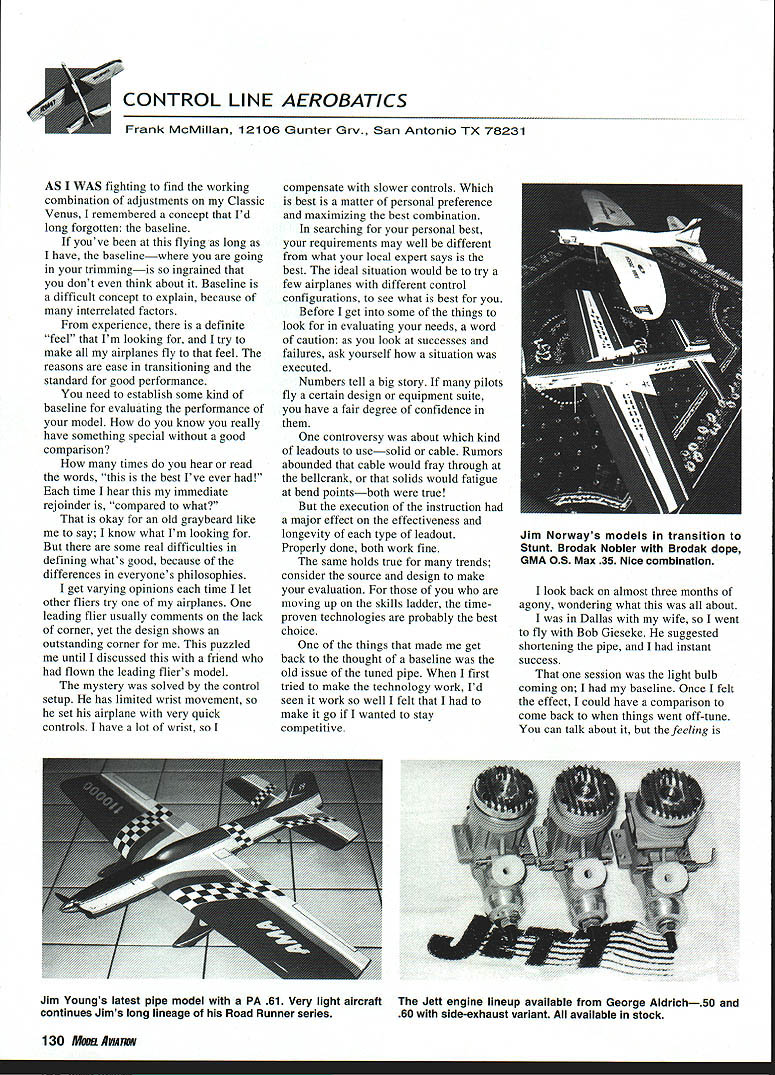
One of the things that made me get back to the thought of a baseline was the old issue of the tuned pipe. When I first tried to make the technology work, I'd seen it work so well I felt that I had to make it go if I wanted to stay competitive.
I look back on almost three months of agony, wondering what this was all about. I was in Dallas with my wife, so I went to fly with Bob Gieseke. He suggested shortening the pipe, and I had instant success.
That one session was the light bulb coming on; I had my baseline. Once I felt the effect, I could have a comparison to come back to when things went off-tune. You can talk about it, but the feeling is what gives you the indication of where you need to go.
The baseline changes and evolves, and you need to constantly strive to find and improve yours. Up-and-coming fliers continually ask where to set their — or that; that's good, but the idea is to explore various parameters to find out what makes you comfortable.
Never be satisfied with the status quo—that is the fun of our event.
I've deferred looking at specifics, because there are so many ways to approach various problems.
I plan to devote various columns to topics that pop up. If discussion of certain areas would be helpful to you, please let me know and I'll be happy to share some thoughts on them.
Videos and Tapes
There's an old saying that a picture is worth a thousand words. The videos in our area of interest are absolutely wonderful.
Some time ago, I mentioned that Bob Hunt was going to produce a video on Al Rabe's semicircle models. More important projects came along, so the video was delayed.
Then with the huge interest in all semicircle Stunters and the confidence of Al being elected to the PAMPA (Precision Aerobatics Model Pilots Association) Hall of Fame, the time was right.
The tape is now available; it is a wealth of information on all the technology and the history of the Rabe Air Force.
Fortunately for the Stunt world, Al documented the construction of all his major models.
In the video, Bob Hunt intersperses still shots with Al's discussion of various technologies, such as molded shells, mold development, movable rudder, etc. There are more than 150 photos—many seen for the first time in this video.
As I watched the tape, I was struck by the amount of work Al did in a very short time. The still photos show the complexity and innovation demanded by these unusual models. The work required on one of these semicircles is 2½–3 times that of the usual Nationals-quality Stunter, but the rewards of flying one of these superb models more than justifies the effort.
This is a wonderful tale of effort by a very talented and dedicated individual, well-produced and edited by Bob Hunt.
Bob has also released his Vintage Stunt Championships II tape, which captures the atmosphere of the annual Tucson spring bash. This tape features fast-moving action of the models and the banquet festivities.
Products, Kits, and Contacts
- Contact Bob Hunt:
- Robin's View Productions
- Box 68, Stockton PA 18083
- Tel.: (610) 746-0106
- The Classic-legal Mustang and Bearcat airplanes are available through PAMPA Products:
- PAMPA Products, 100 Park Ave., Carmichaels PA 15320
- Tel.: (724) 966-2726
- Fax orders: (724) 966-5670
If you have the urge to tackle one of the latest designs, contact Al Rabe for plans. Several fliers already have the enlarged P-51 under construction.
Windy Urtnowski is still going strong on his multifaceted Miss Ashley project. Contained on a single tape, this is a good tutorial on building competitive tail surfaces.
The last major component Windy completed was the horizontal stabilizer and elevator. He uses a molded leading edge and flat sheet surfaces to develop a lightweight structure.
- Contact Windy:
- Pro Stunt Products, 93 Elliott Pl., Rutherford NJ 07070
- Tel.: (201) 896-8740
Those of us who frequent the contest trail might have watched Tom Morris build his Lincoln Log™ wings. Tom's goal is to produce designs fabricated to the point that only final assembly of major components and finish are required to complete the model.
Tom and John Simpson—designer of the Cavalier—have produced two versions: a full-bodied classic-legal Stunter and a profile Stunter.
Tom showed examples at the Vintage Stunt Championships. The models had their own shipping crates, which were like fine cabinetry.
I looked at the kits (if you can call them that; they are much more) in detail. The craftsmanship is excellent, requiring only finish-sanding and detailing.
The full-fuselage model is assembled in two crutches—fore and aft. The full-length top and bottom are molded shells with formers installed. The wing and tail surfaces are light and straight, with controls installed.
The basic assemblies require only a finish-sanding, checks on the controls, and final assembly. Some more sanding, and you're ready to finish.
The design that Tom picked is an excellent-flying classic model. His offerings will produce a light model, which will fly well. I was impressed with the approach to details in the engineering—particularly the protection in the shipping unit.
With the construction provided along with all the hardware, the kits are an excellent value at $325 for the Profile and $395 for the full-bodied version.
- Contact Tom Morris:
- 327 Pueblo Pass, Anniston AL 36206
- Tel.: (256) 820-1983
Transcribed from original scans by AI. Minor OCR errors may remain.

