
Electric power in competition
by Bob Hunt [email protected]
I'm going to kick off this month's column with a big nod to Doug Moon who won his first Nats Open CL Aerobatics (Stunt) crown in 2012. I first met Doug and his brother, Steve, at a Nats back in the early 1990s. Doug showed promise even then, and he's been steadily improving ever since. He's had some bad equipment luck throughout the years, but everything worked perfectly for him last summer and he's our new National Champion. It couldn't happen to a nicer or more dedicated guy!
Kudos also go out to the new 2012 F2B World Champion, Igor Burger. Igor notched this win on his belt at the World Championships held in Bulgaria last August. Igor also won the F2B World Cup meet that was held before the World Championships and also the 2011 European F2B Championships. He is on a roll!
I want to congratulate our US F2B team of Paul Walker, David Fitzgerald, and Orestes Hernandez, for capturing the team gold medal in F2B in Bulgaria. Paul finished in fourth place, David in fifth, and Orestes in ninth. Great show!
In case you haven't heard, Igor was the first person to win the F2B World Championships flying an electric-powered model. In fact, the first four places were captured by electric-powered models. Alexander Schrek took the second-place silver medal, Jiri Vejmola captured the bronze, and as noted, Paul Walker took fourth with an electric-powered version of his famous Impact design.
In a conversation I had with Paul after he returned from the World Championships, I asked him if he thought there would be more competitors flying electric-powered aircraft at the next World Championships. His answer was an emphatic, "Yes!" He said there was great interest in the electric-powered models that were there and that many others had already stated that they were going to make the changeover from glow to electric power.
From what I've been seeing from US Stunt contest results and gleaning from conversations with many fliers, the same holds true here. There seems to be a move toward electric power, or at least a keen interest in trying it.
Interestingly, many of those who have called me and asked about electric power and how to get started in it are fliers from the Beginner, Intermediate, and Advanced ranks. They seem to sense that electric power, with its reliability and repeatability, holds the key to quicker advancement in flying.
I agree, but there are a number of other benefits to electric power. I mentioned some of these in a past column, but I want to list them again.
In no particular order of importance, those benefits are as follows:
- Extremely quiet operation, allowing use of fields that were previously unusable because of glow-engine noise output. Generally those fields can be used at a much earlier time of the day because of the lack of noise output.
- Clean operation. There is no oil residue left on the airplane, on your hands, on your clothes, or in your vehicle.
- No CG shift during the flight as there is no fuel consumption; you can quickly reset the timer for a normal-length flight.
- The ability to use a "pusher" (reverse-pitch) propeller. This provides better vertical and overhead line tension. From my perspective, it is one of the major advantages.
- Extremely low vibration ensures longer model and control-system life.
- Your coach can easily communicate with you while you are flying!
These attributes (and possibly more) produce an ideal power system for those who want to learn quickly.
The advantages for journeyman Stunt fliers were brought into focus when I watched my good friend and flying buddy, Tom Hampshire, fly his electric-powered Gieseke Nobler. Tom originally planned to install a Webra .32 in that aircraft, but after beginning construction he decided to convert the model to electric power.
Tom, Buddy Wieder, and I have gained permission to use a large asphalt parking lot adjacent to a local volunteer firehouse in Tom's town. It is less than a mile from Tom's house and is situated in the downtown area.
Flying glow power there would be impossible at any time, but especially early in the morning when we meet there to fly our electric-powered models.
The ability to meet early and often, and fly many useful practice flights—with coaching—has made each of us better.
Tom has always flown well, but his skills have greatly improved since he's been flying the electric-powered Gieseke Nobler. The combination that he is using seems to work perfectly, and I think he's hit on a size/power formula that can yield success for others as well.
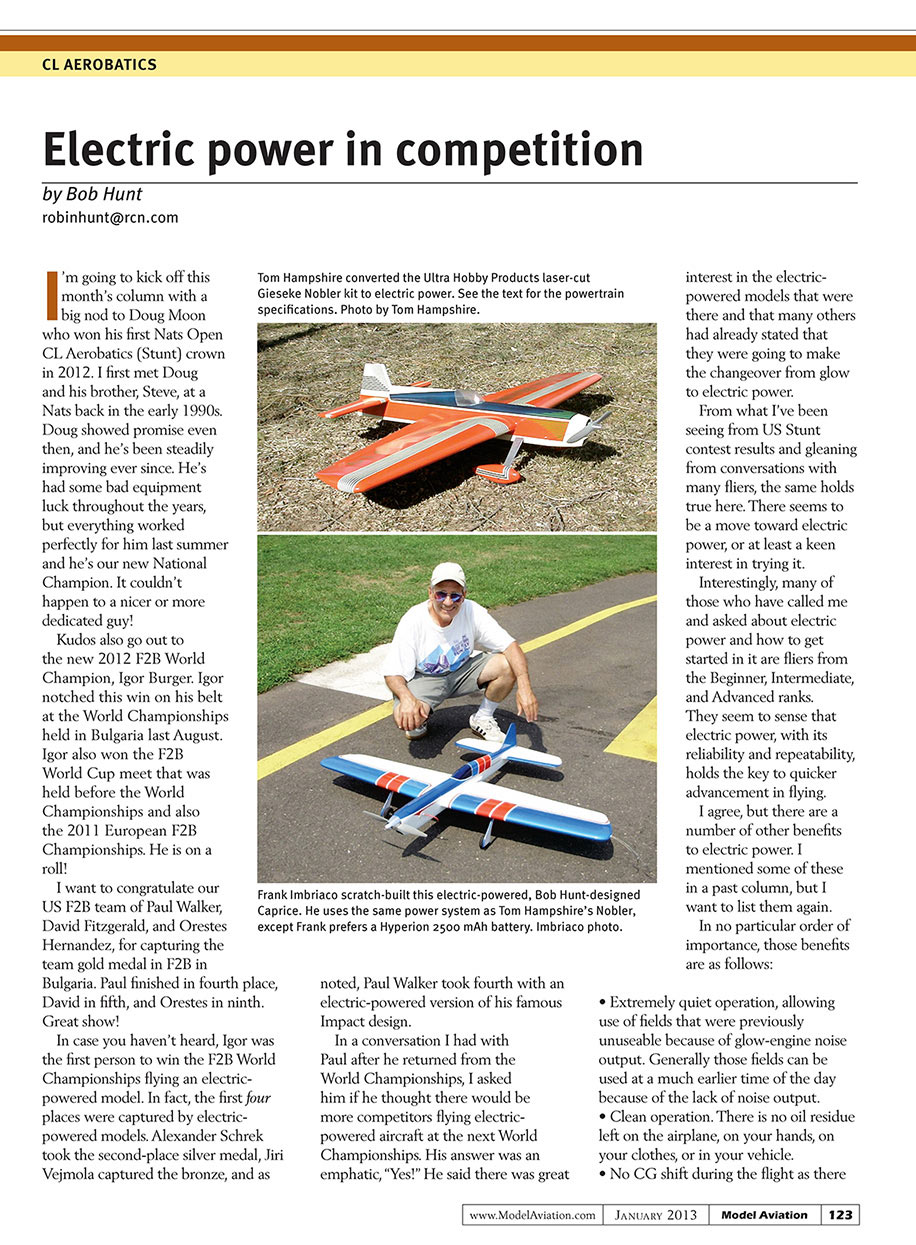
Tom's Gieseke Nobler was built from an Ultra Hobby Products laser-cut kit. The power train consists of an E-flite Power 15 motor, an APC 11 x 5.5 EP propeller, a Castle Creations Ice Lite 50 ESC, a Will Hubin timer, and Gens Ace 25C 5S1P 2500 mAh LiPo battery. It flies roughly a 5.2 lap time on 59.5 foot .015, 18-strand, braided steel lines.
Unfortunately, that Gieseke Nobler kit is no longer available, but I called Steve Moon from Ultra Hobby Products and hope that he may again begin producing it.
CL Aerobatics
Bob Hunt
Models that have wing areas ranging from 490 to 550 square inches are ideal for the type of setup that Tom is running. I'm so convinced that this size of model has great potential to help up-and-coming fliers improve that I'm going to design a few airplanes of this size that will be specifically intended for electric power.
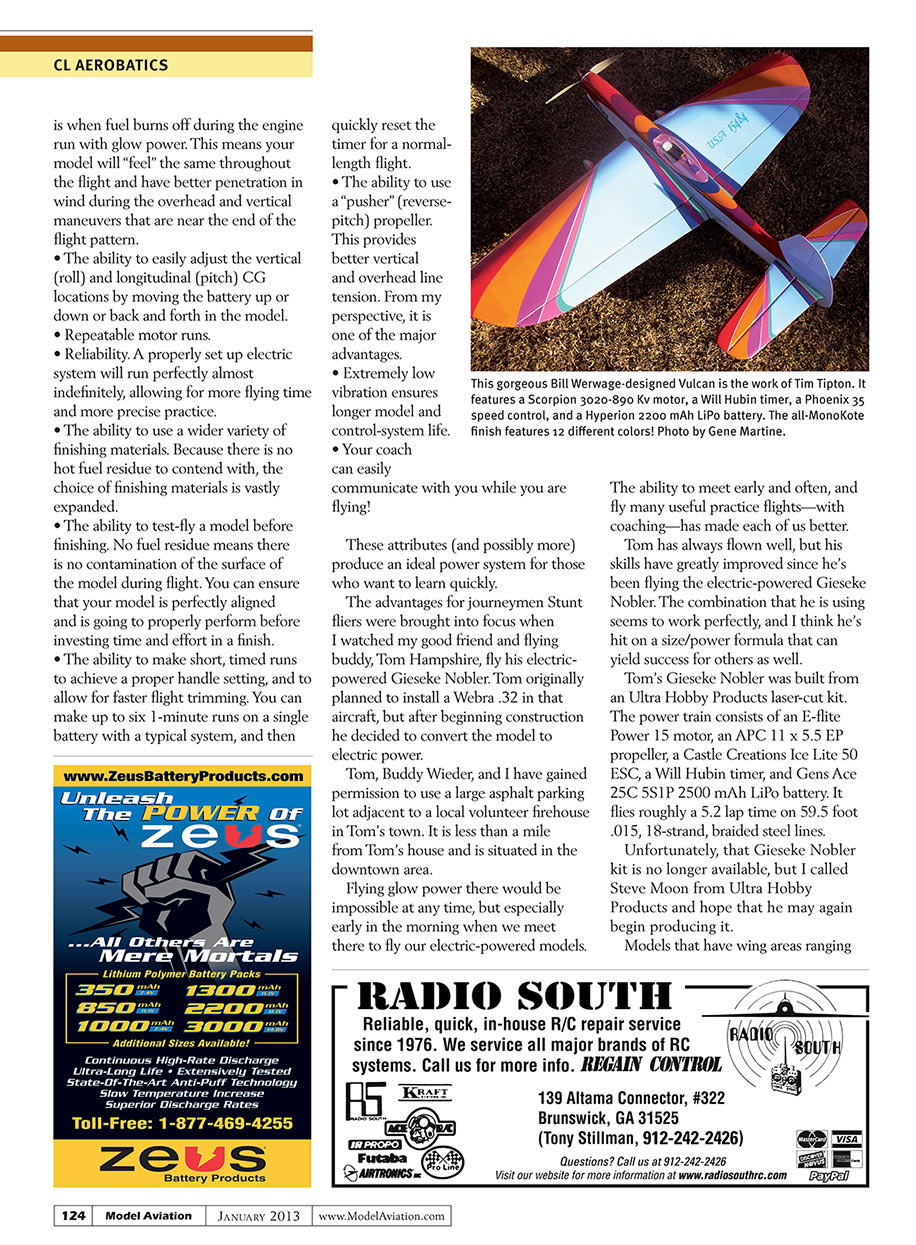
Frank Imbriaco, another local CL Stunt flier, recently retrofitted my Classic-legal Caprice design to electric power and he used the same setup that Tom used in the Gieseke Nobler. Frank's Caprice model is slightly larger than Tom's, is stunning in appearance, and it flies well at 48 ounces all-up.
I have included photos of Tom's Gieseke Nobler and Frank's Caprice to help whet your appetite for a similar model!
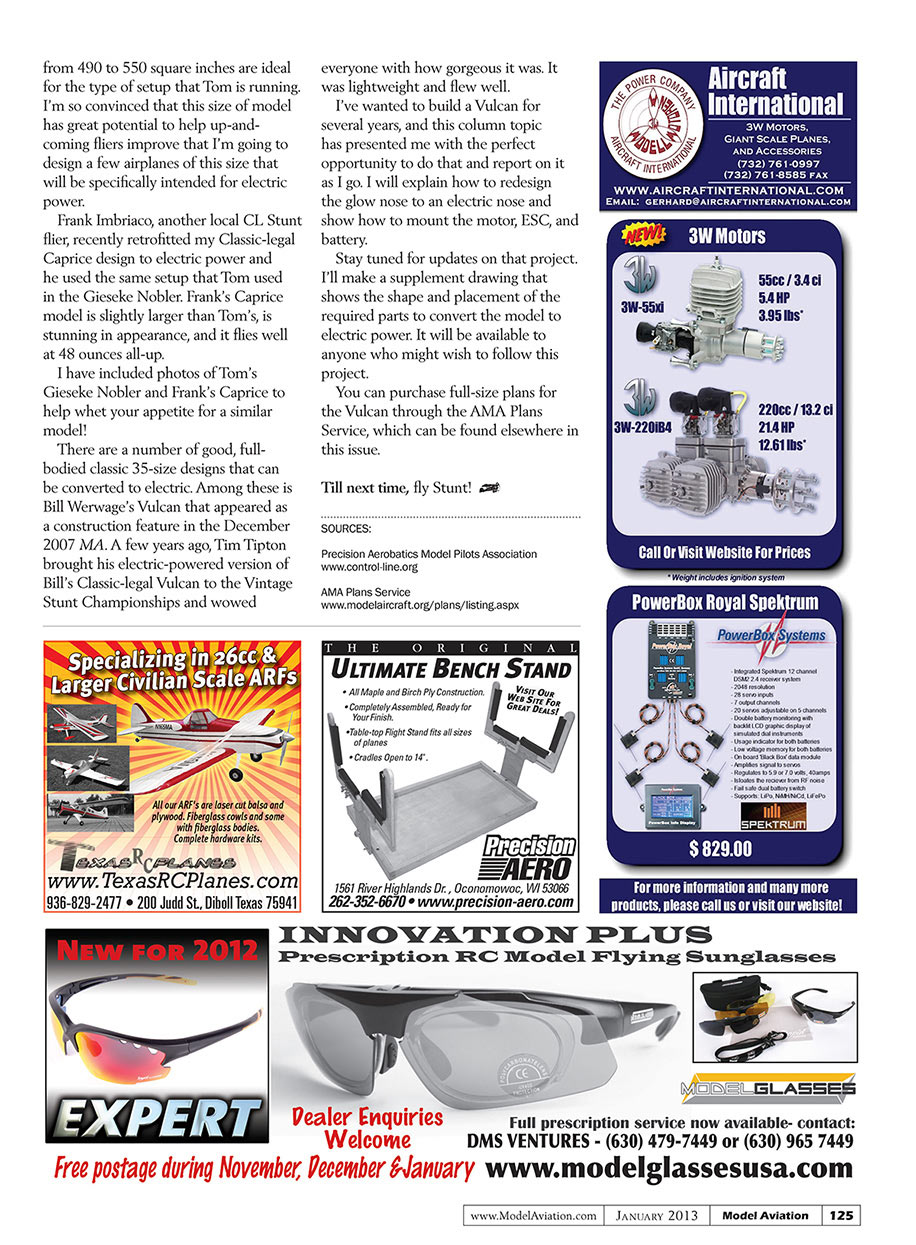
There are a number of good, full-bodied classic 35-size designs that can be converted to electric. Among these is Bill Werwage's Vulcan that appeared as a construction feature in the December 2007 MA. A few years ago, Tim Tipton brought his electric-powered version of Bill's Classic-legal Vulcan to the Vintage Stunt Championships and wowed everyone with how gorgeous it was. It was lightweight and flew well.
I've wanted to build a Vulcan for several years, and this column topic has presented me with the perfect opportunity to do that and report on it as I go. I will explain how to redesign the glow nose to an electric nose and show how to mount the motor, ESC, and battery.
Stay tuned for updates on that project. I'll make a supplement drawing that shows the shape and placement of the required parts to convert the model to electric power. It will be available to anyone who might wish to follow this project.
You can purchase full-size plans for the Vulcan through the AMA Plans Service, which can be found elsewhere in this issue.
Till next time, fly Stunt!
SOURCES:
Precision Aerobatics Model Pilots Association www.control-line.org
AMA Plans Service www.modelaircraft.org/plans/listing.aspx
Transcribed from original scans by AI. Minor OCR errors may remain.

